Avoid common CCRN exam mistakes to boost your success
Passing the CCRN exam takes more than mastering hemodynamic monitoring or knowing your ventilator modes cold. Many dedicated critical care nurses fall short on exam day not because of a gap in clinical knowledge but because of entirely preventable test-taking errors. A misread question stem here, a skipped practice test there, and suddenly a passing score slips out of reach. This article breaks down the most common CCRN exam mistakes, shows you how to identify them in your own prep, and gives you a clear path to walking into that testing center with real confidence.
Table of Contents
- Top 10 mistakes candidates make on the CCRN exam
- Comparison: minor slips vs. high-impact errors
- How to spot and correct your own exam errors
- What the highest-scoring candidates do differently
- Why mastering mistake correction beats traditional studying
- Take the next step toward CCRN exam mastery
- Frequently asked questions
Key Takeaways
| Point | Details |
|---|---|
| Prioritize error prevention | Correcting and preventing common CCRN exam mistakes boosts your pass rate more than extra hours of study. |
| Major mistakes matter most | Focus on eliminating high-impact errors like pattern misreading and poor time management. |
| Practice with feedback | Use practice questions with answer rationales to spot and correct personal error trends. |
| Simulate real exam pressure | Take full-length timed practice exams to identify your mistakes in a realistic test environment. |
| Adopt high-scorer habits | Emulate top performers by reviewing rationales, logging errors, and focusing on critical thinking in your prep. |
Top 10 mistakes candidates make on the CCRN exam
With the stakes clear, let’s review the mistakes that can derail even the most prepared candidates. As any experienced CCRN educator will tell you, many test-takers fail due to misreading questions, poor time management, or not practicing with the correct formats. Here are the ten most impactful offenders.
-
Misreading question stems. The CCRN is full of carefully worded questions where a single word like “most appropriate” or “first priority” changes the correct answer entirely. Rushing through a stem causes you to answer a question that was never actually asked. Slow down and read every word before scanning the options.
-
Time mismanagement. Spending four or five minutes on one difficult question in the first third of the exam is a trap. You lose time you need for later questions, and that pressure causes focus to collapse. A solid rule: allow roughly 75 to 90 seconds per question and flag anything you’re unsure about, then return if time allows.
-
Relying on memorization instead of critical thinking. The CCRN is not a recall test. It tests clinical judgment. You may know every parameter of cardiogenic shock, but if you cannot apply those values to a scenario with a deteriorating patient, you will choose the wrong answer. Study for application, not just recognition. Your CCRN exam guide should reinforce this distinction throughout your prep.
-
Falling for distractors. The AACN (American Association of Critical-Care Nurses) designs wrong answer choices to look appealing. They often represent appropriate actions in a slightly different clinical scenario. Learn to identify what makes an option a distractor, not just what makes the correct answer correct.
-
Ignoring the test blueprint. The CCRN blueprint tells you exactly how questions are weighted across body systems. Cardiovascular content accounts for the largest share of the exam. If you spend equal time on every system, you leave points on the table in the highest-yield areas. Review the blueprint early and let it guide your time investment.
-
Not practicing with realistic question formats. Reading a textbook is not the same as working through clinical vignettes under timed conditions. If you have never seen a multi-select or complex scenario question before exam day, format shock costs you valuable seconds. Work through a quality practice question set that mirrors the actual exam experience.
-
Skipping full-length practice tests. Short quizzes build knowledge. Full-length exams build stamina and strategy. The CCRN contains 150 questions over three hours. If you have never sat through that duration under simulated pressure, your ability to sustain focus in the final hour is untested and likely weaker than you expect.
-
Changing correct answers at the last minute. Second-guessing is the enemy of a good score. Research consistently shows that first instincts are more often correct, especially when built on solid preparation. Change an answer only when you have a specific, rational reason to do so, not because doubt crept in.
-
Fatigue and focus loss in the latter half. Cognitive fatigue is real and measurable. Your accuracy naturally drops if you have not trained for sustained concentration. Build exam-length study blocks into your schedule weeks before the test to condition your brain for the full duration.
-
Ignoring practice question rationales. Getting a question right or wrong means nothing without understanding why. Skipping rationales is the single most common way nurses repeat the same mistakes. Every explanation is a learning opportunity, and those opportunities compound across hundreds of practice questions. Use exam confidence strategies to build this habit into every study session.
Pro Tip: After each study block, spend at least 15 minutes reviewing rationales for every question you answered, whether you got it right or wrong. Correct answers chosen for the wrong reason are just as important to analyze as outright mistakes.
Comparison: minor slips vs. high-impact errors
Not every mistake carries the same weight. Let’s see which errors to prioritize preventing.
Some mistakes are recoverable. You miss one question because you misread “least likely” as “most likely,” catch yourself, and move on. That’s a minor slip. But major errors, such as consistently misreading complex questions, can cost more points than occasional slips and compound across the entire exam.

| Mistake type | Category | Impact on score | Recoverable? |
|---|---|---|---|
| Single misread word in one question | Minor slip | Minimal (1 question) | Yes |
| Changing a correct answer once | Minor slip | Minimal (1 question) | Yes |
| Skipping rationale review occasionally | Minor slip | Low to moderate | Yes, if corrected early |
| Consistently misreading question stems | High-impact | Significant (many questions) | Difficult without intervention |
| Not using timed practice | High-impact | Moderate to high | Requires structured fix |
| Ignoring blueprint weighting | High-impact | High (entire content areas) | Requires full reprioritization |
| Relying on memorization alone | High-impact | Very high | Requires strategy shift |
| Skipping full-length practice tests | High-impact | High (stamina and strategy) | Requires immediate correction |
The pattern is clear. Isolated errors are part of any exam and rarely sink a score. Systemic errors, patterns you repeat across the whole exam, are the ones that put a passing score at risk.
Here are the high-impact errors every CCRN candidate should watch for:
- Misreading the question stem on more than 10% of practice questions
- Consistently picking the action-oriented option before fully assessing the patient situation
- Spending more than two minutes on any single question without flagging and moving on
- Ignoring question format mastery when scenarios use unfamiliar structures
- Not adjusting your study plan after identifying weak content areas
If you recognize any of these patterns in your practice sessions, address them now. On exam day, there is no time to diagnose and correct a systemic problem.
How to spot and correct your own exam errors
Identifying which mistakes affect you most is only the beginning. Next, let’s turn to how to catch and fix them.
The most effective self-correction strategy starts during practice, not after the exam. Reviewing rationale for every practice question and using targeted feedback accelerates improvement faster than any other single strategy. Here is a step-by-step process to make error analysis part of your daily prep.
-
Complete a timed practice session. Do not interrupt yourself mid-question or look up answers as you go. Simulate exam conditions as closely as possible to get accurate data on your behavior.
-
Score the session before reviewing. Know your raw score first. This gives you a performance baseline and motivates honest analysis without cherry-picking the questions you revisit.
-
Categorize every wrong answer. Did you miss the question because of a content gap, a misread stem, a distractor, or time pressure? Each category requires a different fix. Content gaps send you back to your study guides. Misread stems require slowing down your reading. Distractors require more clinical scenario practice.
-
Build an error log. A simple document or spreadsheet where you track mistake type, subject area, and frequency is one of the highest-value tools in your prep. Over time, patterns emerge. Maybe you consistently miss pulmonary questions when the stem involves ventilator settings. That is specific, actionable data.
-
Review the rationale for every question, right or wrong. This cannot be overstated. Getting a question right for the wrong reason means you will get a similar question wrong later. Rationale review is where real learning happens.
-
Revisit flagged content within 24 hours. Memory research is clear that reviewing material within a day of encountering it significantly increases retention. Do not let a hard concept sit for a week before you return to it.
“The error log is not about beating yourself up. It is about building a map. Every mistake you catch in practice is a mistake you will not repeat on exam day.”
Pro Tip: Use your error log at the start of each weekly review session. Identify your top three recurring mistake types and build at least one practice block each week specifically targeting those areas. This approach, described in depth through using feedback methods, consistently produces faster score improvement than general review alone.
Pair this with targeted practice questions organized by body system, so you can isolate weakness areas and track improvement over time. Building this kind of structured self-review loop is what separates candidates who plateau from those who improve steadily toward a passing score. You can reinforce this cycle further by studying how retention and confidence build through consistent, reflective practice.
What the highest-scoring candidates do differently
Now that you know how to correct errors, see what sets repeat passers and high scorers apart.
High scorers are not just smarter or more experienced. They are more strategic. They treat their prep like a clinical quality improvement project, tracking what is not working and fixing it systematically. Top scorers consistently use full-length practice tests and review detailed rationales to learn from their errors, building both knowledge and exam-day stamina.
Here is what the highest performers do consistently:
- Use exam-like resources exclusively. They do not rely on textbook reading as their primary mode of studying. They drill with realistic clinical scenarios that mirror the actual CCRN format. Their question breakdown methods are specific, repeatable, and practiced until they become automatic.
- Allocate dedicated time for rationale review. For every hour of practice questions, they spend at least 30 minutes reviewing explanations, even for questions they answered correctly.
- Simulate real exam conditions. They sit in a quiet room, set a timer for three hours, take a full 150-question exam, and do not stop. This trains focus, stamina, and the mental discipline to stay sharp in the final 30 questions.
- Manage focus and energy intentionally. They sleep well before exam day, avoid cramming in the final 48 hours, and use brief mental resets during the exam if focus starts to drift. They know fatigue is a test variable, not just a feeling.
- Complete at least five full-length practice exams before their test date. This is not a casual recommendation. The volume of realistic practice directly correlates with exam-day performance. Each full exam surfaces new gaps and builds the consistency that high scores require.
Stat callout: The majority of first-attempt CCRN passers report completing five or more full-length practice exams before their test date. Volume and realism in practice are the two variables most within your control.
These are not secrets. They are habits. The difference between knowing them and doing them is consistency, and that starts in your very next study session.
Why mastering mistake correction beats traditional studying
With the best practices established, here is a perspective you may not hear at every review course.
Most CCRN study plans are built around content. Study cardio. Review respiratory. Memorize sedation scales. That structure is not wrong, but it is incomplete. In our experience, the candidates who struggle after putting in serious study hours are almost always those who studied more without studying differently.
Clinical nurses understand error analysis intuitively. In the ICU, you run a post-event debrief after a near-miss. You review the chart. You identify what was missed and when. You build a system to catch it next time. That same mindset, applied to CCRN prep, is genuinely your most powerful tool.
The problem is that most review courses reward attendance and content exposure. They do not reward mistake identification and correction. So nurses walk in having covered every body system and walk out having never built the reflex to analyze why they get certain question types wrong.
Focusing on proven confidence building through error correction closes the gap between knowing the material and performing on the exam. Small mistakes, uncorrected, compound. A candidate who misreads question stems even 15% of the time loses enough questions to fail a test they would otherwise pass. Catching and fixing that one pattern could be the difference between passing and retaking.
The most effective path to certification is not more content review. It is smarter review, anchored in understanding exactly where and why your answers go wrong.
Take the next step toward CCRN exam mastery
Ready to put mistake-busting into your own prep? Here is how you can bring all these strategies together.
Zero Deficit™ CCRN Exam Prep is built around exactly the approach this article describes. Our platform gives you the tools to identify, track, and correct the specific errors standing between you and your certification.
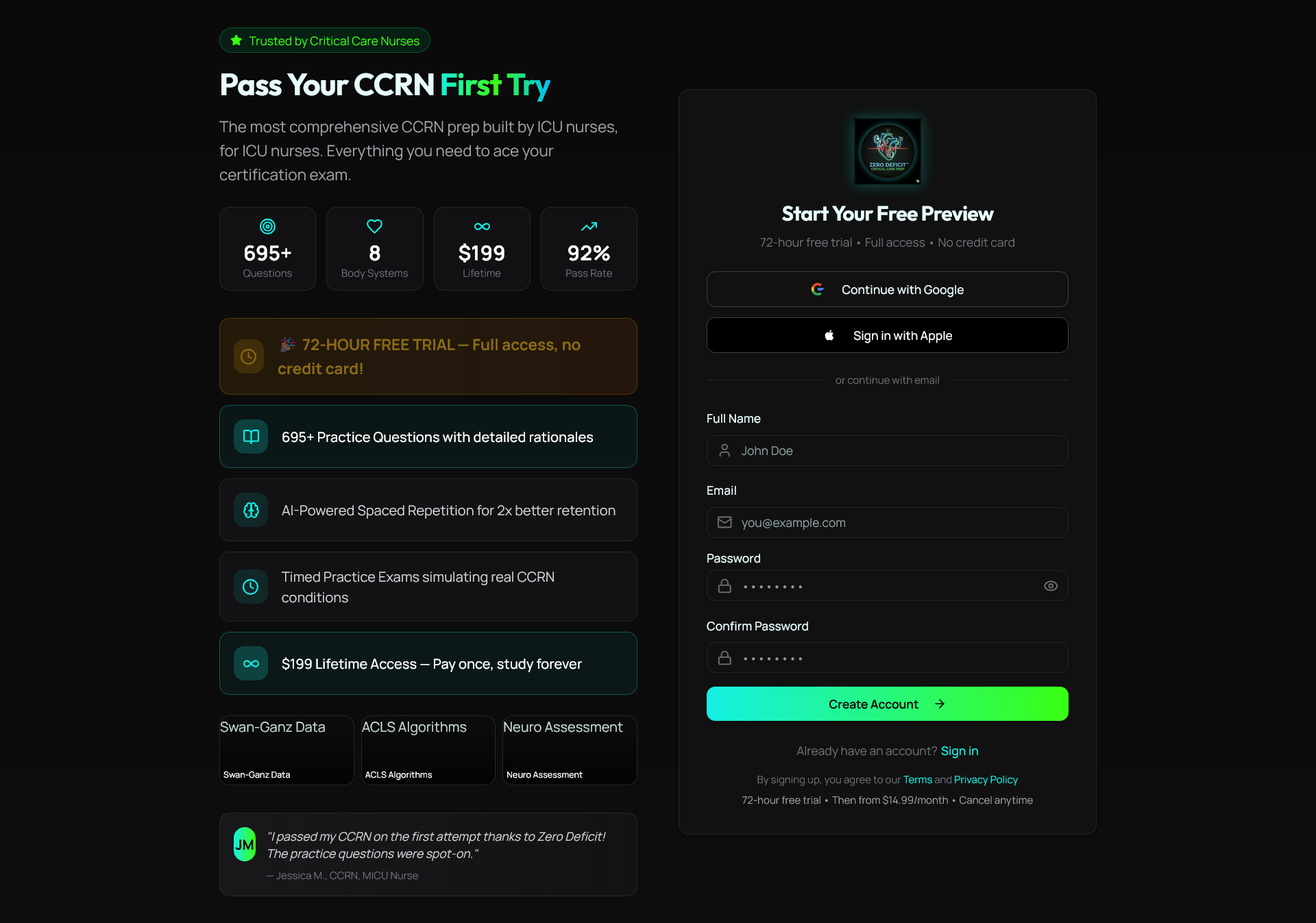
Start with our question breakdown guides to learn how to approach every question format the CCRN uses. Then build your knowledge base using our comprehensive CCRN study guides organized by body system with built-in analytics to track your progress. When you are ready to simulate exam conditions, our extensive practice question bank includes over 695 questions with detailed rationales for every single one. No credit card required to start. Just sign up and begin building the exam-day readiness you deserve.
Frequently asked questions
What is the most common mistake on the CCRN exam?
The top mistake is misreading or overanalyzing question stems, which causes candidates to answer the wrong question entirely. Many test-takers fail due to misreading questions even when they know the underlying clinical content.
How can I avoid wasting time on the CCRN exam?
Practice timed exams regularly and train yourself to flag difficult questions and move on, returning to them only if time allows. Time mismanagement in the early portion of the exam is one of the most preventable causes of poor outcomes.
Is memorization enough to pass the CCRN?
No. The CCRN requires you to apply clinical judgment to complex patient scenarios, not simply recall facts. Not applying critical thinking versus memorization is classified as a high-impact error that costs significant points.
What is the best way to identify my weak areas on the CCRN?
Use timed practice tests and review rationales after every question to track which content areas and question types you miss repeatedly. Reviewing rationale for every practice question and using targeted feedback accelerates improvement faster than any other strategy.
Recommended
Take a Neurological practice quiz
Test your knowledge of stroke, ICP, seizures, and neuro assessment.
Get Your Free 20-Question CCRN Diagnostic
20 high-yield CCRN-style questions across every body system, with detailed rationales — emailed to you instantly.
No spam. One email + a couple of helpful follow-ups. Unsubscribe anytime.
Ready to pass your CCRN?
Join 12,000+ nurses using Zero Deficit — 695+ practice questions with rationales, AI-powered weak-area drilling, and spaced-repetition flashcards.
Start Free Trial →