Best Renal CCRN Review: 5 Options Compared for 2026

The best renal CCRN review is the one that pairs a focused renal content review with practice questions that explain every answer, and that matches the current exam. For most ICU nurses, that means a question bank with rationales plus a renal study guide, not a single book or a single deck of flashcards. Below we compare five real options by format, cost, and who each one suits, so you can pick one and get back to studying.
TL;DR
- Renal is a smaller slice of the Adult CCRN, so you want a review that is efficient, not exhaustive. Our renal study guide covers it as 6% of the exam.
- The strongest renal prep combines a content review (AKI, CKD, dialysis, electrolytes) with rationale-based practice questions.
- AACN’s own review course and practice exams are priced from $35 to $199, depending on the product and membership.
- Zero Deficit™ costs $14.99 per month or $84.99 per year, with a free trial, and includes 695+ practice questions, AI-powered review tools, and spaced repetition.
- Whatever you choose, confirm it matches the exam launched on November 12, 2025.
Table of Contents
- What the renal section of the CCRN actually asks
- The five renal CCRN review options compared
- How to choose a renal review that fits you
- A renal study plan that uses your time well
- Our perspective
- Start with the free trial
- FAQ
- Sources
What the renal section of the CCRN actually asks
Before you compare tools, know what you are buying prep for. AACN’s Adult CCRN review syllabus places renal and genitourinary content alongside endocrine, hematology, gastrointestinal, and integumentary under Clinical Judgment, which together account for 21% of the exam. Within renal and genitourinary, the syllabus points candidates to acute kidney injury (AKI), acute tubular necrosis (ATN), chronic kidney disease (CKD), and genitourinary infections such as urosepsis.
That tells you where to spend your hours. A good renal review should let you do the following:
- Stage AKI and separate prerenal, intrarenal, and postrenal causes at the bedside.
- Interpret the labs that drive decisions: creatinine trends, BUN, urine output, potassium, sodium, bicarbonate, and phosphate.
- Choose and troubleshoot renal replacement therapy: intermittent hemodialysis, CRRT, and peritoneal dialysis.
- Recognize and treat electrolyte emergencies, especially hyperkalemia.
- Connect kidney problems to sepsis, shock, and nephrotoxic drugs, because the exam rarely tests renal in isolation.
The exam also changed recently. AACN states that current CCRN study materials remain relevant for exams taken on and after November 12, 2025. Even so, check the publication date on anything you buy. A book titled for the 2022 to 2023 outline deserves a closer look before you trust it.
The five renal CCRN review options compared
| Option | Format | Cost (US) | Best for |
|---|---|---|---|
| Zero Deficit™ CCRN Prep | Renal study guide, 695+ practice questions with rationales, AI-powered review, flashcards, spaced repetition | $14.99 per month or $84.99 per year; lifetime option listed on the subscription page | Nurses who want content and questions in one place |
| AACN Adult CCRN Certification Review | 16-module online course, 15.5 CE contact hours | $159 members, $199 nonmembers | Nurses who want a structured, lecture-style course |
| AACN Certification Practice Exams | Question bank with rationales and content-area scores | Basic $35 members, $45 nonmembers (30 days); Premium $75 members, $90 nonmembers (180 days) | Diagnostic testing of renal strengths and gaps |
| Nicole Kupchik renal flashcards | Digital flashcards on renal topics | Varies by platform | Quick recall drills between shifts |
| Printed Adult CCRN prep books | Content outline plus practice exams | Varies by retailer | Nurses who learn best on paper |
Prices for AACN products come from the course store listing and the certification practice exams page, and AACN can change them, so confirm at checkout.
Zero Deficit™ CCRN Prep
Our renal material is built around the way the exam asks questions. The renal study guide is written by ICU nurses and walks through renal anatomy and physiology, AKI, CKD, KDIGO AKI staging criteria, dialysis (HD, CRRT, PD), electrolyte imbalances, and an AKI lab comparison. A dedicated AKI topic page goes deeper on causes, staging, and dialysis.
Then you test yourself. The renal practice questions come with detailed rationales, and the full bank has more than 695 questions across body systems. The platform adds AI-powered review tools, flashcards, progress tracking, spaced repetition, exam simulations, and personalized question generation. Read the rationale for every question, right or wrong. That is where renal reasoning gets built.
Who it suits: nurses who want one subscription for renal and every other system, and who like questions that adapt to what they miss.
AACN Adult CCRN Certification Review
AACN’s online course is a 16-module program organized by body system, with clinical scenarios, practice questions with detailed rationales, and 15.5 CE contact hours. It is aligned to the current test plan. AACN lists the price at $159 for members and $199 for nonmembers, and it offers a 50% discount when you buy the course at the time you apply for the exam.
Who it suits: nurses who want structure, a set sequence, and CE credit, and who are less concerned about volume of practice questions. Renal is one module among many, so you will likely still want extra renal questions.

AACN Certification Practice Exams
AACN offers a free one-time seven-day trial with 30 questions and rationales. After that, the Basic option gives 150 questions and rationales for 30 days, at $35 for members or $45 for nonmembers. Premium gives hundreds of questions, content-area exams, scores, and regularly added questions for 180 days, at $75 for members or $90 for nonmembers. AACN presents these as a diagnostic service, with randomized questions and scores by content area that show where you need more study.

Who it suits: anyone who wants to measure renal readiness against the certifying body’s own style of question. It tests you more than it teaches you, so pair it with a content review.
Nicole Kupchik renal flashcards
Nicole Kupchik’s CCRN renal review appears as a flashcard set, with cards that cover topics such as the main function of the renal system and CCRN-style study questions. Flashcards are efficient for definitions, thresholds, and drug or lab associations. They are weaker at teaching you to reason through a multi-system patient.
Who it suits: nurses who already understand renal physiology and want fast recall practice in short sessions.
Printed Adult CCRN prep books
Several publishers sell Adult CCRN review books with practice exams, including Prep Books’ Adult CCRN review and Joshua Rueda’s practice exam book. Books give you a portable outline and a fixed set of questions. The drawback to watch for is the edition: one widely listed title is labeled for the 2022 to 2023 outline, so verify the edition against the current test plan before you spend money.
Who it suits: paper learners who want to annotate and who will supplement with an online question bank.
How to choose a renal review that fits you
Match the tool to your gap, not to a generic ranking. Use these questions:
- Do you understand the physiology, or just remember facts? If the pathophysiology is shaky, start with a study guide or course. If you know it but forget it, start with flashcards and spaced repetition.
- Do the rationales teach? A rationale that only names the right answer is not enough. You want an explanation of why each wrong option fails.
- Can you see your weak spots? Progress tracking by topic tells you whether your renal misses are AKI staging, dialysis modality, or electrolyte management.
- Is it current? Check for alignment with the test plan in effect for exams after November 12, 2025.
- What is the total cost? Add up the course, the question bank, and any extras. A single subscription can replace two or three purchases.
The AACN review course is built for candidates on the Direct Care, Tele-critical Care, or Knowledge Professional pathway, so confirm you fit your eligibility track before you decide on any prep. Our CCRN exam cost breakdown helps you plan the exam fee alongside your prep budget.
A renal study plan that uses your time well
Renal is a smaller share of the exam than cardiovascular or pulmonary, so give it a defined block rather than a month. A sensible pattern over two weeks:
- Days 1 to 3, build the frame. Read the renal study guide. Focus on AKI causes (prerenal, intrarenal, postrenal), KDIGO staging, and how ATN differs from a prerenal state.
- Days 4 to 6, dialysis and drugs. Compare HD, CRRT, and PD: when each is chosen, what the hemodynamic tradeoffs are, and what you monitor. Review which drugs are nephrotoxic and which need dose adjustment.
- Days 7 to 9, electrolytes. Work through hyperkalemia, hyponatremia, hypocalcemia, and acid-base shifts, including the ECG changes and the treatment order.
- Days 10 to 14, questions. Take timed sets of renal questions, then mixed sets. Review every rationale, and flag misses for spaced repetition.
When you miss a renal question, ask what the question was really testing. Often it is a priority decision, such as treating hyperkalemia before addressing the cause. Our question breakdown methods show a step-by-step way to read the stem, find the clinical judgment being tested, and eliminate distractors.
Remember that renal rarely stands alone. Septic patients develop AKI, and shock states change kidney perfusion. If you want the bigger picture, our guide on how to pass the CCRN exam shows how to fit renal into a full study schedule.
Our perspective
We built Zero Deficit™ because critical care nurses told us the same thing: they did not need more pages, they needed to know why an answer is right and why the other three are wrong.
That is why every practice question carries a detailed rationale, and why our content is written by ICU nurses who have managed CRRT circuits, titrated insulin for hyperkalemia, and watched creatinine climb overnight. Renal questions on the CCRN reward clinical reasoning, and reasoning is learned by repetition with feedback.
Our approach combines the study guide, the question bank, AI-powered review tools, and spaced repetition so that what you miss on Tuesday comes back before you forget it. We designed the platform for faster retention and a first-attempt pass, and many of our users report exactly that.
If you are choosing one renal review, choose the one that makes you practice, explains your mistakes, and shows your progress.
Zero
Start with the free trial
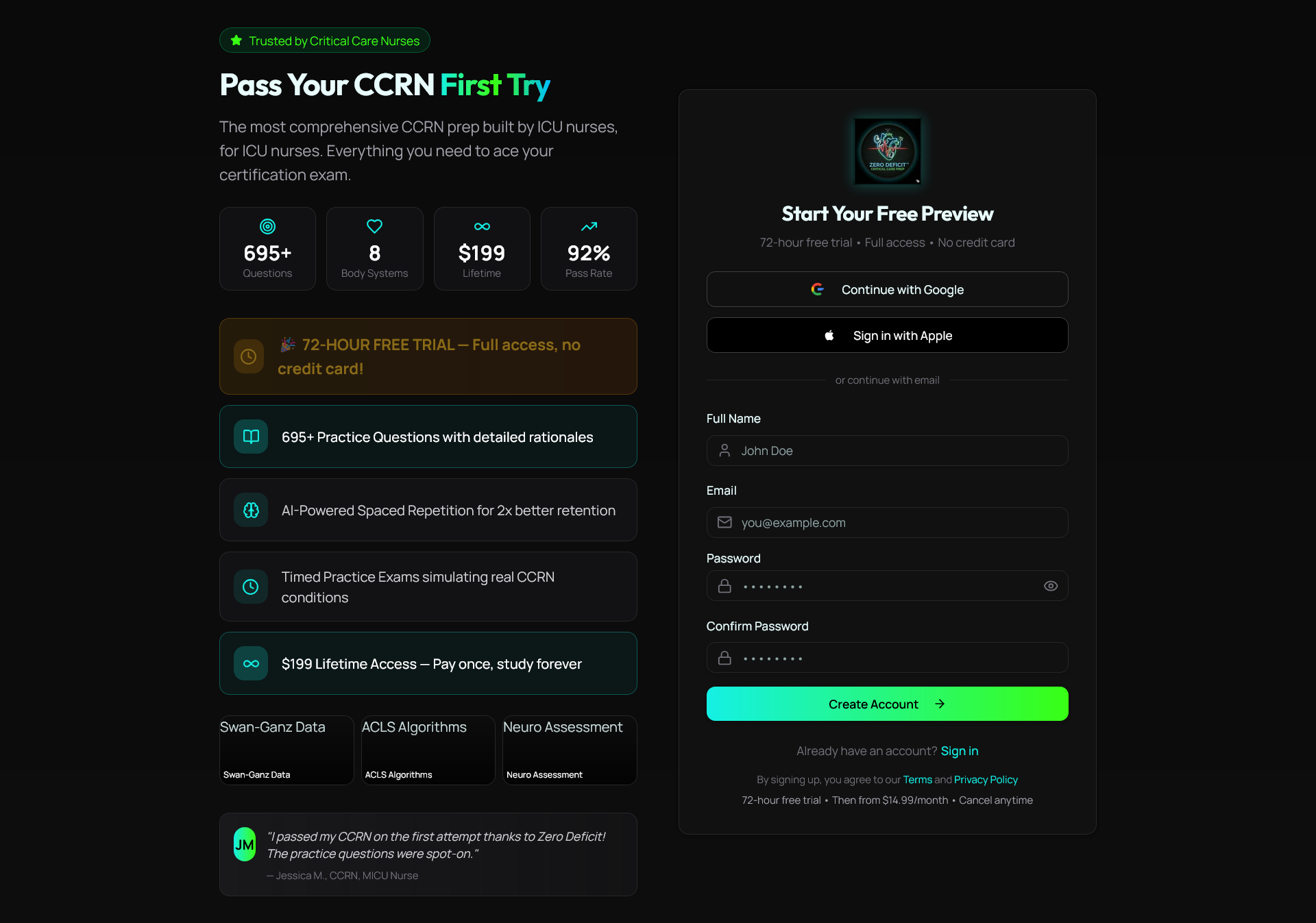
If you want to try this approach for renal, start with a free trial and run a set of renal questions. Read the rationales, and see whether the explanations change how you think about AKI staging or dialysis choices. When you are ready for full access, Premium Monthly is $14.99 per month and Yearly Access is $84.99 per year. A Lifetime Mastery option is also listed, so see the subscription page for details.
If you are comparing other platforms first, our breakdowns of Passetra study alternatives and Critical Care Health Services alternatives show how the options stack up.
FAQ
How much of the CCRN is renal?
Our renal study guide treats renal as about 6% of the exam. AACN’s syllabus groups renal and genitourinary with endocrine, hematology, GI, and integumentary content, which together make up 21% of the exam. Renal is smaller than cardiovascular or pulmonary, but it overlaps with sepsis, shock, and electrolytes, so it shows up across other questions.
Is the AACN review course enough for renal?
The course covers renal as one of its body-system modules, with scenarios and practice questions with rationales. Most candidates add a larger bank of questions so they can repeat renal content many times. Use AACN’s practice exams or a platform like ours to check how well the material has stuck.
Are flashcards or practice questions better for renal?
Use both for different jobs. Flashcards lock in facts such as staging criteria and electrolyte treatments, while practice questions train you to apply them to a patient. If you only have time for one, choose questions with strong rationales.
Are older CCRN prep books still useful?
They can help with core physiology, which does not change quickly. Check the edition against the current test plan, because AACN revised the exams on November 12, 2025. Pair an older book with a current question bank.
Sources
- AACN Adult CCRN review course syllabus
- AACN: Revised CCRN exams launch Nov. 12, 2025
- AACN Adult CCRN Certification Review
- AACN Adult CCRN Certification Review Course, individual purchase
- AACN Certification Practice Exams
Ready to master renal? Work through our CCRN renal practice questions with full rationales at Zero Deficit CCRN Prep.
Recommended
Take a Renal practice quiz
Master AKI, dialysis, electrolytes, and fluid balance for the CCRN.
Get Your Free 20-Question CCRN Diagnostic
20 high-yield CCRN-style questions across every body system, with detailed rationales — emailed to you instantly.
No spam. One email + a couple of helpful follow-ups. Unsubscribe anytime.
Ready to pass your CCRN?
Join 12,000+ nurses using Zero Deficit — 695+ practice questions with rationales, AI-powered weak-area drilling, and spaced-repetition flashcards.
Start Free Trial →