CCRN Pharmacology: Critical Care Drug Guide for ICU Nurses
TL;DR:
- Critical care pharmacology focuses on managing medications like vasopressors, sedatives, and antibiotics, aligning drug timing with clinical protocols such as sepsis bundles and titration targets. Norepinephrine is the preferred first-line vasopressor in septic shock, with careful monitoring of MAP, urine output, and skin perfusion to prevent complications. Mastering drug effects, adverse reactions, and patient-specific considerations through clinical reasoning is essential for CCRN success.
CCRN pharmacology is defined as the focused study of critical care medications, including their mechanisms, dosing, titration, and safety profiles, required for safe patient management and CCRN exam success. The AACN Adult CCRN exam tests your ability to apply pharmacology at the bedside, not just recall drug names. You need to know why norepinephrine is first-line in septic shock, how context-sensitive half-time affects fentanyl infusions, and when to pull back on a vasopressor before end-organ damage sets in. This guide covers the high-yield drug classes you will see on the exam and manage every shift: vasopressors, sedatives, analgesics, and antibiotics in sepsis.
What are the key vasopressors used in critical care?
Norepinephrine is the first-line vasopressor for adults in septic shock, per SCCM guidance, with dosing titrated to maintain a mean arterial pressure (MAP) of at least 65 mmHg. That target matters because MAP below 65 mmHg is directly associated with acute kidney injury and worsening lactate. You titrate up or down based on the patient’s response, not a fixed dose.

The table below summarizes the vasopressors you need to know for the CCRN exam pharmacology section.
| Vasopressor | Primary Mechanism | Typical Dose Range | Key Side Effect |
|---|---|---|---|
| Norepinephrine | Alpha-1, Beta-1 agonist | 0.01–3 mcg/kg/min | Peripheral vasoconstriction |
| Vasopressin | V1 receptor agonist | Up to 0.03 U/min | Hyponatremia, skin necrosis |
| Epinephrine | Alpha and Beta agonist | 0.01–1 mcg/kg/min | Tachycardia, lactic acidosis |
| Dopamine | Dose-dependent DA, Beta, Alpha | 2–20 mcg/kg/min | Arrhythmias (higher risk) |
| Phenylephrine | Pure Alpha-1 agonist | 0.5–6 mcg/kg/min | Reflex bradycardia |
Dopamine carries a higher arrhythmia risk compared to norepinephrine, which is why SCCM guidelines limit its routine use in septic shock. Epinephrine is reserved for refractory cases or anaphylaxis because it raises lactate through beta-2 stimulation, which can confuse your resuscitation picture. Vasopressin is added as a second agent, not a replacement, when norepinephrine doses climb and you need to spare the catecholamine load.
Phenylephrine is useful in distributive shock when tachycardia is the primary concern, since it raises SVR without increasing heart rate. However, it reduces cardiac output in patients with already compromised ventricular function, so patient selection matters.
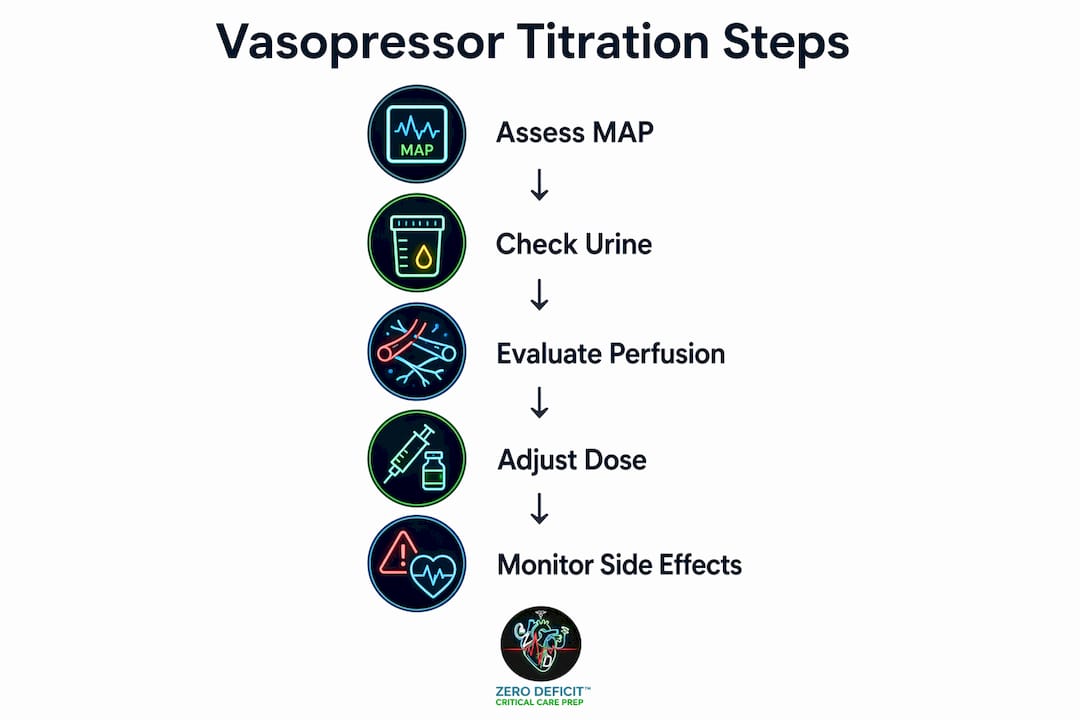
Pro Tip: When titrating vasopressors, always reassess MAP, urine output, and skin perfusion together. A MAP of 65 mmHg with cold, mottled extremities and oliguria tells a different story than the number alone.
How is sedation and analgesia managed pharmacologically in the ICU?
The analgesia-first approach is the standard of care for mechanically ventilated ICU patients. You treat pain before layering on sedation, because uncontrolled pain drives agitation and increases sedative requirements. The Richmond Agitation-Sedation Scale (RASS) is the validated tool for titrating sedation depth, with a target range of RASS −2 to +1 for most ventilated patients.
Only 53.4% of patients achieve at least 60% of RASS scores within target during the first 72 hours of mechanical ventilation. That gap between guideline and reality is exactly what the CCRN exam tests: your ability to recognize when sedation is off target and correct it.
Common ICU opioids and sedatives you need to know:
- Fentanyl: Short-acting, lipophilic, preferred in hemodynamically unstable patients; context-sensitive half-time increases significantly with prolonged infusions
- Morphine: Histamine release risk; active metabolite (morphine-6-glucuronide) accumulates in renal failure
- Hydromorphone: More potent than morphine, fewer histamine effects, still renally cleared
- Remifentanil: Ester hydrolysis metabolism makes it less affected by organ dysfunction; predictable offset supports faster extubation
- Propofol: Rapid onset and offset; watch for propofol infusion syndrome with doses above 5 mg/kg/hr beyond 48 hours
- Dexmedetomidine: Alpha-2 agonist; provides sedation without respiratory depression; useful for agitation and alcohol withdrawal
The context-sensitive half-time concept is high-yield for the exam. Fentanyl’s half-time extends dramatically after prolonged infusions because it accumulates in fat and muscle. Remifentanil does not accumulate because plasma esterases break it down regardless of infusion duration. That difference directly affects when you can safely attempt a spontaneous breathing trial.
Pro Tip: A multimodal analgesia approach using scheduled acetaminophen, low-dose ketamine, or regional techniques reduces total opioid exposure and supports earlier extubation. The CCRN exam rewards nurses who think beyond the opioid drip.
What are the sepsis pharmacology steps every CCRN candidate must know?
Pharmacologic management in sepsis follows a protocolized timeline where timing is the intervention. Empiric broad-spectrum antibiotics must be administered within 1 hour of sepsis recognition, after blood cultures are drawn. Delaying antibiotics beyond that window is directly associated with increased mortality.
The standard sepsis pharmacology bundle follows this sequence:
- Draw blood cultures (at least 2 sets) before starting antibiotics
- Administer empiric antibiotics within 1 hour: vancomycin plus a broad-spectrum beta-lactam such as piperacillin/tazobactam or a carbapenem for high-risk patients
- Start IV crystalloid resuscitation at 30 mL/kg for hypotension or lactate at or above 4 mmol/L
- Reassess lactate within 2–4 hours if the initial value was elevated; a falling lactate confirms adequate resuscitation
- Initiate vasopressors targeting MAP at or above 65 mmHg if the patient remains hypotensive after fluid resuscitation
The table below maps the pharmacologic steps to their timing targets.
| Pharmacologic Action | Timing Target | Goal |
|---|---|---|
| Blood cultures drawn | Before antibiotics | Preserve culture yield |
| Empiric antibiotics | Within 1 hour of recognition | Reduce mortality |
| IV crystalloid 30 mL/kg | Within 3 hours | Restore perfusion |
| Lactate remeasurement | Within 2–4 hours | Confirm resuscitation |
| Vasopressor initiation | If MAP below 65 mmHg post-fluids | Maintain organ perfusion |
Pharmacologic interventions in sepsis are integrated into a protocolized timeline that links drug timing to outcomes. The exam will present scenarios where you must identify the correct next pharmacologic step based on the patient’s current status. Connecting medication choices to time-sensitive bundles is one of the strongest predictors of CCRN exam success.
For a deeper review of infection control workflows that connect to antibiotic selection, the CCRN infection control review at Zerodeficitccrnprep covers medication administration in sepsis care in detail.
What pharmacologic pitfalls show up on the CCRN exam?
CCRN exam pharmacology questions focus on adverse effect recognition and titration decisions, not just drug mechanisms. Knowing the pitfall is often the difference between a correct and incorrect answer.
The most testable safety considerations include:
- Sedation during neuromuscular blockade: Standard RASS assessment fails when a patient is paralyzed because movement cues are absent. Sedation assessment during paralysis requires prioritizing analgesia first and using additional monitoring such as BIS (bispectral index) when available.
- Dopamine and arrhythmias: Dopamine’s dose-dependent receptor activity increases arrhythmia risk at higher doses. The exam expects you to recognize this and select norepinephrine as the safer alternative.
- Opioid accumulation in organ dysfunction: Morphine’s active metabolite accumulates in renal failure, causing prolonged sedation and respiratory depression. Altered pharmacokinetics in critical illness affect every opioid differently, and the exam tests whether you can match the drug to the patient’s organ function.
- Excessive vasopressor dosing: High-dose vasopressors cause peripheral vasoconstriction severe enough to produce digital ischemia and worsen lactic acidosis. Titrating down when MAP exceeds target is as important as titrating up when it falls short.
- Propofol infusion syndrome: Doses above 5 mg/kg/hr for more than 48 hours risk metabolic acidosis, rhabdomyolysis, and cardiac failure. Monitor triglycerides and creatine kinase in patients on high-dose propofol.
Pro Tip: When you see a CCRN question involving a paralyzed patient and worsening hemodynamics, always consider undertreated pain before increasing sedation. The exam tests this clinical reasoning pattern repeatedly.
Key takeaways
Mastering critical care pharmacology requires connecting drug selection, titration targets, and adverse effect recognition to specific patient conditions and time-sensitive clinical protocols.
| Point | Details |
|---|---|
| Norepinephrine is first-line | Titrate to MAP at or above 65 mmHg; add vasopressin as a second agent before escalating to epinephrine. |
| Analgesia before sedation | Treat pain first using the RASS scale; target light sedation (RASS −2 to +1) for most ventilated patients. |
| Opioid selection matters | Match the opioid to organ function; remifentanil is preferred when rapid offset and extubation timing are priorities. |
| Sepsis pharmacology is timed | Antibiotics within 1 hour, 30 mL/kg crystalloid, and vasopressors if MAP stays below 65 mmHg after fluids. |
| Know the pitfalls | Dopamine arrhythmias, morphine accumulation in renal failure, and propofol infusion syndrome are high-yield exam traps. |
Why titration beats memorization every time
I have reviewed hundreds of CCRN exam questions, and the pattern is consistent. The nurses who struggle are the ones who memorized drug names and mechanisms but never connected them to a clinical decision. The nurses who pass are the ones who can look at a MAP of 58 mmHg, a rising lactate, and a patient on 0.15 mcg/kg/min of norepinephrine and know exactly what to do next.
The exam is built around that clinical reasoning loop. You see a hemodynamic picture, you identify the pharmacologic gap, and you select the correct intervention. Rote memorization gets you halfway there. Understanding titration targets, adverse effect thresholds, and the timing logic behind sepsis bundles gets you the rest of the way.
One thing I tell every nurse prepping for the CCRN: map your pharmacology to your monitoring parameters. Norepinephrine maps to MAP and urine output. Fentanyl maps to CPOT or NRS scores and respiratory rate. Vancomycin maps to trough levels and renal function. When you study that way, the exam questions become recognizable patterns rather than isolated facts.
The CCRN study guides at Zerodeficitccrnprep are organized exactly this way, connecting drug classes to the hemodynamic and clinical targets that drive titration decisions. That structure mirrors how you actually think at the bedside, and it mirrors how the exam is written.
— Zero
Build your pharmacology confidence with Zerodeficitccrnprep
Pharmacology questions on the CCRN exam reward nurses who can apply drug knowledge under pressure, not just recall it. Zerodeficitccrnprep gives you the tools to practice that skill before exam day.
The platform’s pharmacology practice questions cover vasopressors, sedation management, sepsis drug timing, and adverse effect recognition across more than 695 high-yield items. Each question includes a detailed rationale that explains the clinical reasoning, not just the correct answer. You can also use the question breakdown methods to learn how to dissect complex pharmacology scenarios step by step. Start studying free at Zero Deficit CCRN Prep today, no credit card required.
FAQ
What vasopressor does the CCRN exam favor for septic shock?
Norepinephrine is the correct first-line vasopressor for septic shock on the CCRN exam, per SCCM guidelines, titrated to maintain a MAP of at least 65 mmHg.
Why is dopamine less preferred in critical care pharmacology?
Dopamine carries a higher arrhythmia risk compared to norepinephrine, particularly at higher doses, making it a second-line choice in most septic shock scenarios.
How does organ dysfunction affect opioid selection in the ICU?
Renal failure causes morphine’s active metabolite to accumulate, prolonging sedation and respiratory depression. Remifentanil is preferred when organ dysfunction is present because plasma esterases metabolize it independently of hepatic or renal function.
What is the analgesia-first approach and why does it matter for the CCRN?
The analgesia-first approach means treating pain before adding sedation in mechanically ventilated patients. The CCRN exam tests this principle because undertreated pain is a primary driver of agitation and excessive sedative use.
When should vasopressors start in sepsis management?
Vasopressors should be initiated when MAP remains below 65 mmHg after the initial 30 mL/kg IV crystalloid bolus, with norepinephrine as the first agent and vasopressin added if higher doses are needed.
Recommended
- Nursing Mnemonics for CCRN: Top Picks That Actually Work | Zero Deficit CCRN Prep
- Neurology CCRN Study Guide: Exam Prep Resources | Zero Deficit™
- Types of Critical Care Certifications: Your 2026 Guide | Zero Deficit CCRN Prep
- CCRN Infection Control Review Topics: ICU Nurse Guide | Zero Deficit CCRN Prep
Take a Multisystem practice quiz
Master sepsis, shock, MODS, and multi-organ failure scenarios.
Get Your Free 20-Question CCRN Diagnostic
20 high-yield CCRN-style questions across every body system, with detailed rationales — emailed to you instantly.
No spam. One email + a couple of helpful follow-ups. Unsubscribe anytime.
Ready to pass your CCRN?
Join 12,000+ nurses using Zero Deficit — 695+ practice questions with rationales, AI-powered weak-area drilling, and spaced-repetition flashcards.
Start Free Trial →