Checklist for Exam Day: CCRN and NCLEX Nurse Guide
TL;DR:
- A comprehensive exam day checklist helps prevent avoidable errors from document issues to logistics mishaps.
- Arriving early, verifying ID matches registration, and packing minimal essentials reduce stress and enhance focus.
A checklist for exam day is the single most effective tool for eliminating preventable errors on test day, from arriving without your Authorization to Test to wearing a smartwatch that triggers disqualification. For nursing students and critical care professionals sitting for the CCRN or NCLEX, the stakes are too high to rely on memory alone. This guide covers every item, document, and mental strategy you need, organized in the order you will actually use them. Follow it once, and exam day becomes a controlled clinical procedure rather than a source of dread.
1. Mandatory documents and ID requirements
Pearson VUE and NCLEX exams require your Authorization to Test (ATT), a primary government-issued photo ID, and often a secondary ID. The ATT is your permission slip to sit. Without it, you do not enter the testing room, regardless of how prepared you are.

Your name on every ID must exactly match your exam registration. A single discrepancy, such as a middle name on your license that was omitted during registration, is grounds for being turned away. Mismatched or forgotten ID means you must reschedule and pay fees again. That is a costly and avoidable outcome.
Here is what to prepare and verify at least 48 hours before your exam:
- Primary ID: Unexpired, government-issued photo ID (driver’s license, passport, or state ID)
- Secondary ID: Credit card, debit card, or any ID with your name and signature
- ATT: Printed copy and digital backup on your phone (stored in your locker during the exam)
- Name verification: Cross-check your ID name against your Pearson VUE or AACN registration profile exactly
- International NCLEX candidates: Passport is required as primary ID; additional documentation from CGFNS or your state board may be needed
Pro Tip: Print your ATT and place it in a dedicated folder with your primary ID the night before. Do not rely solely on your phone for the ATT. Testing center Wi-Fi is not guaranteed, and a dead battery is not an acceptable excuse.
2. What you can and cannot bring into the testing center
Prohibited items include mobile phones, smartwatches, fitness trackers, food, and unauthorized notes. This is non-negotiable at Pearson VUE centers, which administer both the NCLEX and the CCRN through AACN’s testing program. Violating these rules can void your exam results entirely.
Testing centers store personal belongings in secure lockers, so you are not walking into the exam room with your bag. Plan accordingly. Only what is explicitly permitted crosses that threshold.
| Item | Status at most testing centers |
|---|---|
| Government-issued photo ID | Required |
| ATT (printed or digital) | Required |
| Clear water bottle | Permitted (stored in locker, accessible on breaks) |
| Snacks | Permitted in locker only, not in exam room |
| Mobile phone | Prohibited in exam room |
| Smartwatch or fitness tracker | Prohibited |
| Bulky coats or hooded sweatshirts | Prohibited in exam room at most centers |
| Scratch paper or whiteboard | Provided by testing center |
Dress in layers. Exam room temperatures vary significantly, and you cannot bring a bulky coat inside. A fitted zip-up or cardigan that passes security inspection is your best option. Avoid any clothing with large pockets or hoods that could trigger additional screening.
Pro Tip: Pack a dedicated exam day kit the night before: your ID folder, a clear water bottle, a protein-based snack for your locker, and your car keys. Nothing else. This eliminates the last-minute bag search that spikes cortisol right before you sit down.
3. How to plan your arrival and check-in process
Arrive at the testing center 30 minutes before your scheduled start time. This buffer accounts for parking, building navigation, and the multi-step check-in process. Arriving late does not pause your exam clock at most centers.
The Pearson VUE check-in process follows a specific sequence:
- Sign in at the front desk and present your ATT and primary ID
- Photo capture is taken for identity verification
- Biometric screening (palm vein scan or fingerprint) is completed
- Signature capture is recorded
- Personal belongings are stored in your assigned locker
- Secondary screening may include a wand scan or pocket check before entering the exam room
- Workstation setup allows you to adjust your chair and monitor before the test begins
- Tutorial review is offered before the live exam starts. Use it to confirm your screen and audio settings
Allow 15 to 20 minutes for this full check-in process. Rushing through biometric verification or skipping the tutorial increases your error rate before you answer a single question. Treat check-in as part of the exam itself.
For nurses using OnVUE remote proctoring, the process differs. You complete identity verification via webcam, scan your testing space, and confirm your system meets technical requirements. Run a system check 24 hours in advance using Pearson VUE’s official tool, and test your internet connection speed.
4. Physical and mental strategies for exam day focus
Eating a balanced breakfast with protein and complex carbohydrates sustains your cognitive energy through a 3 to 5 hour exam. Skipping breakfast or eating a high-sugar meal creates energy crashes that impair clinical reasoning, exactly the skill set the CCRN tests most heavily.
Avoid heavy new studying the morning of your exam. A brief retrieval review of must-know points, such as hemodynamic parameters, ARDS criteria, or vasopressor thresholds, is appropriate. Attempting to learn new content the morning of the exam increases cognitive load and anxiety without improving performance.
Here are the strategies that work on exam day:
- Breathing exercises: Box breathing (4 counts in, hold 4, out 4, hold 4) before entering the exam room lowers heart rate and cortisol
- Positive self-talk: Replace “I might fail” with “I have prepared for this specific content.” This is not motivational fluff. It is a clinically supported cognitive reframe
- Pacing: Flag difficult questions and move forward. Do not spend 4 minutes on a single hemodynamics question when 134 others are waiting
- Break strategy: During scheduled breaks, drink water, eat your locker snack, and avoid discussing exam content with other candidates in the waiting area
- Visual rest: Every 30 to 40 questions, look away from the screen for 20 seconds. This reduces eye fatigue during long exams
Deep breathing, positive self-talk, and pacing breaks are the three most consistently cited strategies for maintaining calm and optimal performance during high-stakes exams. For CCRN candidates, these are not soft skills. They are performance tools.
Pro Tip: Use the “cover and commit” method just before entering the exam room. Review your top 10 retrieval cues on a notecard, then put it away and commit to what you know. Stopping active studying at that point prevents cognitive overload and lets your preparation surface naturally during the exam.
Key takeaways
A structured checklist for exam day removes the variables that derail well-prepared nurses, from ID mismatches to prohibited items to pre-exam anxiety that compounds under time pressure.
| Point | Details |
|---|---|
| Documents are non-negotiable | Bring your ATT and matching government-issued ID or you will not be admitted. |
| Pack a minimalist exam kit | Prepare your ID folder, water, and snack the night before to eliminate morning stress. |
| Arrive 30 minutes early | The Pearson VUE check-in process takes 15 to 20 minutes before you sit down. |
| Prohibited items are strictly enforced | Leave your phone, smartwatch, and bulky outerwear in your locker or car. |
| Mental prep is clinical prep | Balanced nutrition, brief retrieval review, and breathing exercises directly support exam performance. |
What I have learned about exam day after working with hundreds of CCRN candidates
The nurses who struggle most on exam day are not the ones who studied the least. They are the ones who treated exam day logistics as an afterthought. I have seen candidates turned away from Pearson VUE centers because their driver’s license showed a middle name that their AACN registration omitted. That is not a knowledge failure. That is a logistics failure, and it is entirely preventable.
My strongest advice: adopt a logistics-first mindset the night before. Lay out your documents, confirm your name match, charge your phone for the ATT backup, and pack your locker snack. Then stop. The exam room is not the place to fix anything. Everything fixable must be fixed before you walk through that door.
On the clinical reasoning side, trust your ICU experience. The CCRN is not testing whether you memorized a textbook. It is testing whether you think like a critical care nurse. When you hit a question about a patient in cardiogenic shock with a wedge pressure of 22 mmHg and a cardiac index of 1.6, your bedside instincts are an asset. Use them. The step-by-step exam review approach we use at Zerodeficitccrnprep is built around that exact principle: systematic thinking, not rote recall.
One more thing. The candidates who perform best arrive calm, not because they are less anxious, but because they have nothing left to worry about logistically. When your documents are confirmed, your kit is packed, and your arrival is planned, your brain is free to focus on the 150 questions in front of you. That is the real value of a solid day of exam checklist.
— Zero
Prepare for the CCRN with resources built for critical care nurses
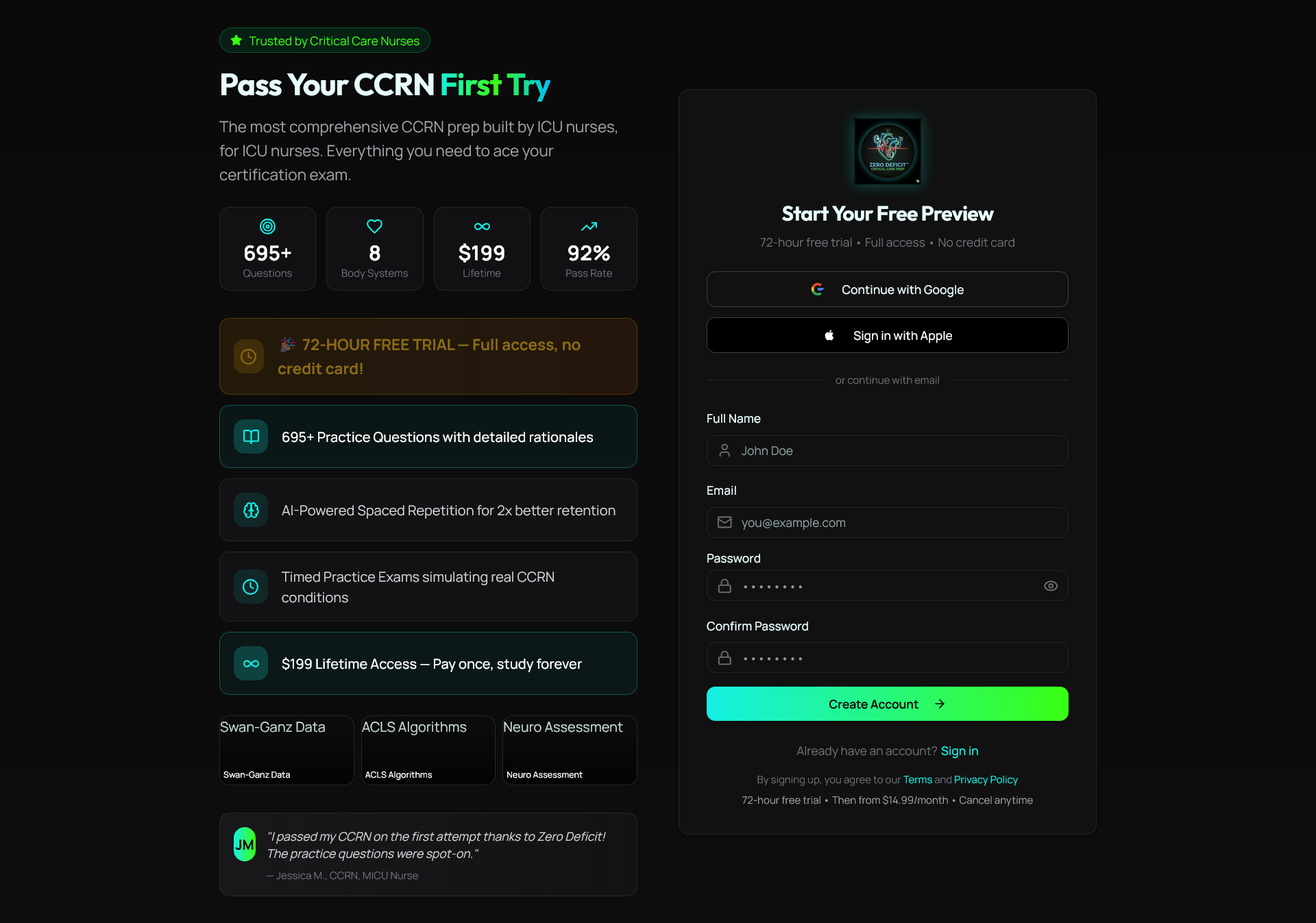
Exam day readiness starts weeks before you walk into Pearson VUE. Zerodeficitccrnprep is built specifically for ICU nurses who want to pass the CCRN on their first attempt. The platform covers all 8 critical care body systems through targeted CCRN study guides that align directly with the AACN exam blueprint. Over 695 practice questions with detailed rationales simulate real exam conditions, so you arrive on test day having already practiced the pacing and clinical reasoning the CCRN demands. Progress tracking and AI-powered review tools show you exactly where to focus your remaining prep time. Start your free version at Zerodeficitccrnprep.com, no credit card required.
FAQ
What ID do I need for the NCLEX or CCRN exam?
You need a primary unexpired government-issued photo ID (driver’s license or passport) with a name that exactly matches your exam registration. Most testing centers also require a secondary ID such as a credit card or signed debit card.
What happens if my name does not match my ID?
You will not be admitted and must reschedule your exam, paying all associated fees again. Verify your name match between your ID and your Pearson VUE or AACN registration at least 48 hours before your exam date.
Can I bring food or water into the exam room?
Water in a clear bottle and snacks are permitted at most testing centers but must be stored in your locker. Eating and drinking inside the exam room is prohibited. Access your snack and water only during scheduled breaks.
How early should I arrive at the testing center?
Arrive 30 minutes before your scheduled exam time. The Pearson VUE check-in process includes ID verification, photo capture, biometric screening, and locker assignment, which takes 15 to 20 minutes before you sit down.
Should I study the morning of my exam?
A brief retrieval review of high-yield content is appropriate. Avoid learning new material the morning of your exam, as it increases cognitive load without improving performance. Use the cover and commit method: review your top cues on a notecard, then put it away before you enter the testing center.
Recommended
- Pass the CCRN Exam: Proven Guide for Critical Care Nurses | Zero Deficit CCRN Prep
- Top CCRN study topics to master for exam success | Zero Deficit CCRN Prep
- How educators boost CCRN certification success for nurses | Zero Deficit CCRN Prep
- Step by Step Exam Review for the CCRN: 2026 Guide | Zero Deficit CCRN Prep
Take a Cardiovascular practice quiz
Test your mastery of hemodynamics, ACLS, MI, arrhythmias, and heart failure.
Ready to pass your CCRN?
Join 12,000+ nurses using Zero Deficit — 695+ practice questions with rationales, AI-powered weak-area drilling, and spaced-repetition flashcards.
Start Free Trial →