How to Create Nursing Study Plans That Get Results

TL;DR:
- Creating a personalized nursing study plan based on diagnostic data and structured around spaced repetition significantly improves exam success.
- Focusing on high-yield topics, simulating test conditions, and practicing clinical judgment questions early develops skills necessary for the CCRN or NCLEX.
An effective nursing study plan is a personalized roadmap that organizes your study time using strategic timelines, targeted practice questions, and continuous review cycles to maximize exam readiness. For nurses preparing for the NCLEX or the AACN Adult CCRN exam, knowing how to create nursing study plans that actually work means building a system around your baseline performance data, not your gut feeling about what you already know. The difference between passing on your first attempt and retaking the exam almost always comes down to structure. Tools like spaced repetition apps, Google Calendar time-blocking, and a quality CCRN practice question bank are not optional add-ons. They are the foundation of a plan that holds up under the pressure of a 12-hour shift schedule and a test date that keeps getting closer.
How to create nursing study plans: choosing your timeline
The standard study window for NCLEX and CCRN preparation runs 6 to 8 weeks, with flexibility to extend to 10 to 12 weeks or compress to 4 weeks depending on your diagnostic results. The key move is to work backward from your exam date and assign every week a specific content focus before you study a single page.
Your timeline should not be based on how confident you feel. It should be based on data. Take a full-length diagnostic practice exam before you build your schedule. The results tell you exactly where to invest your time.
Use these benchmarks to set your window:
- Extend to 10 to 12 weeks if three or more categories score below 50% on your diagnostic exam. This signals foundational gaps that need more than surface review.
- Use the standard 8-week plan if your scores are mixed, with some categories above 65% and others in the 50 to 65% range.
- Compress to 6 weeks if most categories score above 65% and you have recent clinical experience in critical care.
Working nurses and nurses with family commitments need to factor in realistic daily study hours, not ideal ones. A nurse working three 12-hour shifts per week has roughly four study days available. Planning for two hours on workdays and three to four hours on days off is more sustainable than planning for five hours every day and burning out by week three.
Pro Tip: Set your exam date before you build your study plan. Nurses who register for the CCRN or NCLEX first and then plan backward are significantly more likely to follow through than those who study indefinitely without a deadline.
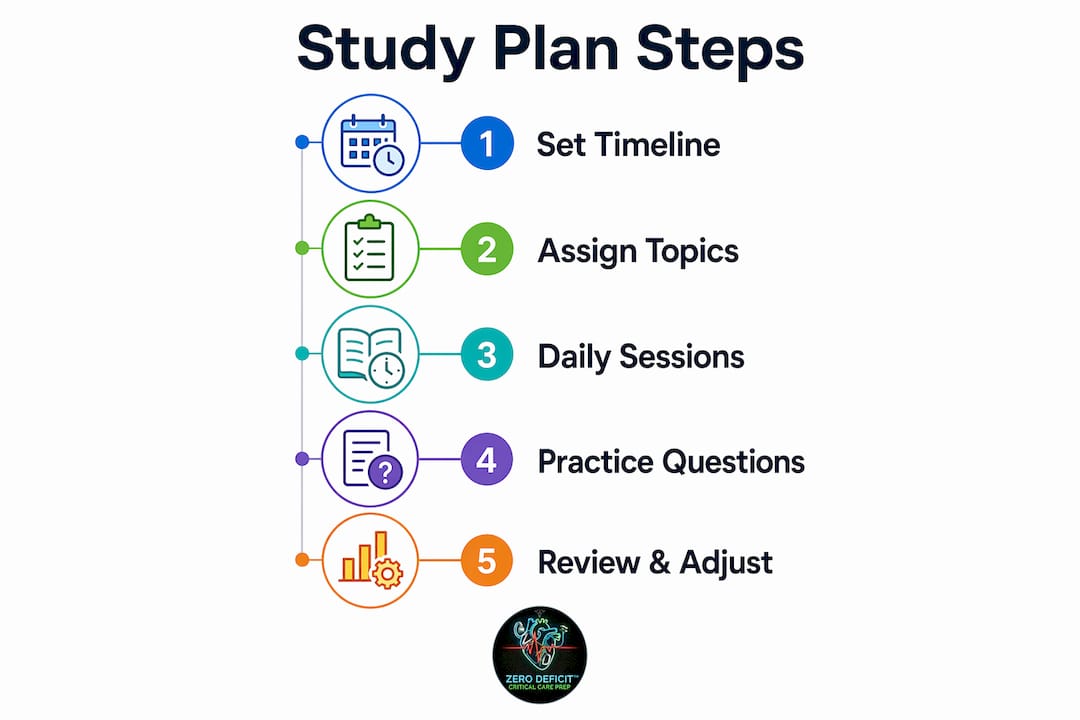
How to structure your daily and weekly study sessions
Daily study sessions for nursing exam prep work best when they follow a consistent format rather than a random mix of reading and questions. Time-blocking with scheduled breaks using the Pomodoro technique, 25 minutes of focused study followed by a 5-minute break, reduces cognitive fatigue and keeps retention higher across a full session.
A reliable daily structure looks like this:
- Open with 25 to 50 NCLEX-style or CCRN-style questions in timed mode. Do not look anything up. Simulate real exam conditions.
- Review every wrong answer with its full rationale. This is where the actual learning happens. Skipping rationale review is the single most common reason study plans fail.
- Spend 30 to 45 minutes on targeted content review in the category where you missed the most questions that day.
- Close with a 10-minute spaced repetition flashcard session on previously flagged content from earlier in the week.
For working nurses, micro-study sessions built into commutes and breaks are not a compromise. They are a legitimate strategy. Reviewing 10 flashcards on vasopressor dosing during a lunch break reinforces content that a single long session cannot replicate. Reserve your deep work blocks, meaning two or more uninterrupted hours, for days off when you can complete full question sets and content review without interruption.
Weekly structure matters as much as daily habits. Assign each week a primary content domain: cardiovascular in week one, pulmonary in week two, and so on. Keep one day per week as a full review day where you revisit flagged questions from the entire week. Build in one complete rest day. Consistent rest is not wasted time. It is when memory consolidation actually occurs.

Pro Tip: Use Google Calendar to block your study sessions as recurring appointments. Treat them with the same commitment as a scheduled shift. Nurses who schedule study time in advance are far more likely to protect it.
How to use performance data and spaced repetition to focus your plan
Exam readiness depends on category-driven studying, not equal time allocation across all topics. Your study plan should weight content based on your ongoing diagnostic results combined with your baseline scores, not on how difficult a topic feels emotionally.
Spaced repetition is the most evidence-supported method for long-term retention in nursing exam prep. Distributed review beats marathon cramming for recall on test day. The review schedule follows increasing intervals: review new content on Day 1, then again on Day 2, Day 4, Day 7, and Day 14. By Day 14, the material is encoded in long-term memory rather than short-term recall.
Here is how spaced repetition compares to traditional review in practice:
| Approach | Method | Retention at 2 weeks | Best for |
|---|---|---|---|
| Spaced repetition | Review at Day 1, 2, 4, 7, 14 | High | High-yield facts, drug dosing, lab values |
| Massed practice (cramming) | Review once in a long session | Low | Short-term recall only |
| Passive re-reading | Re-read notes without testing | Very low | Familiarity, not recall |
Digital tools like Anki allow you to build adaptive flashcard decks organized by body system. Tag each card with its CCRN content domain, cardiovascular, pulmonary, neuro, sepsis, endocrine, or renal, so you can filter reviews by your weakest categories. Pair this with progress tracking to see which categories are improving and which need more time.
Adjust your content focus every two weeks based on your question bank performance, not your initial diagnostic alone. A category that scored 70% in week one may drop to 60% in week three when question difficulty increases. Your plan needs to respond to that shift.
Which critical care topics to prioritize in your study plan
The AACN Adult CCRN exam blueprint concentrates heavily on cardiovascular, pulmonary, and multisystem content. Your study plan for critical care certification should reflect that weight, not distribute time evenly across all body systems.
Prioritize these domains in your CCRN study topics:
- Cardiovascular: Hemodynamic monitoring, shock states (distributive, cardiogenic, obstructive), ACS management, vasopressor and inotrope drips including norepinephrine, dopamine, and dobutamine dosing ranges.
- Pulmonary: ARDS (Berlin Definition criteria, P/F ratio below 300), mechanical ventilation modes, ABG interpretation with normal ranges (pH 7.35 to 7.45, PaCO2 35 to 45 mmHg, HCO3 22 to 26 mEq/L).
- Neuro: ICP management (target below 20 mmHg, CPP 60 to 80 mmHg), stroke recognition and tPA eligibility windows, sedation and agitation scales.
- Sepsis and MODS: Surviving Sepsis Campaign 2021 bundle compliance, lactate clearance targets, and organ failure sequencing.
- Endocrine: DKA and HHS management, thyroid storm, adrenal crisis recognition.
- Renal and CRRT: Indications for continuous renal replacement therapy, fluid balance management, electrolyte correction protocols.
Pharmacology deserves 20 to 30% of your total study time because drug calculations, life-threatening reactions, and safety monitoring appear throughout every content domain on the exam. Do not treat pharmacology as a separate category. Integrate it into every body system you review.
Clinical judgment questions on the CCRN require you to prioritize actions, not just recall facts. Practice questions that ask “what do you do first” or “which finding requires immediate intervention” build the decision-making pattern recognition that the exam tests directly.
Start practicing clinical judgment questions from week one. Nurses who wait until the final two weeks to practice prioritization questions consistently underperform on that question type because the skill requires repetition, not last-minute review.
How to incorporate full-length practice exams and final review
Full-length practice exams are not just a confidence check. They are a diagnostic tool that reveals stamina gaps, timing problems, and content weaknesses that shorter question sets miss entirely. Schedule at least three full-length practice exams in CAT mode before your test date.
Follow this sequence for your final exam phase:
- Schedule your first full-length exam at the end of week four. Use the results to reallocate study time for weeks five and six.
- Complete your second full-length exam at the end of week six. Focus the following week on any category scoring below 60%.
- Take your third full-length exam one week before test day. This is your final calibration. Do not start new content after this point.
- Reduce study intensity 24 to 48 hours before the exam. Light review of high-yield flashcards is appropriate. Heavy question sets are not.
- Confirm all exam logistics the day before: testing center location, required identification, arrival time, and any AACN-specific check-in requirements.
Building exam stamina matters as much as content mastery. The CCRN is 150 questions. Nurses who have never sat through a full timed session before test day often experience decision fatigue in the final third of the exam. Full-length practice tests train your brain to sustain focus and clinical reasoning at question 130 the same way it does at question 10.
Key takeaways
A nursing study plan built on diagnostic data, spaced repetition, and weekly content rotation produces better exam results than any fixed schedule that ignores your actual performance.
| Point | Details |
|---|---|
| Set your timeline from data | Use diagnostic scores to choose 6 to 12 weeks; extend if three or more categories fall below 50%. |
| Structure every study day | Open with timed questions, review every rationale, then do targeted content review in your weakest area. |
| Use spaced repetition | Review content at Day 1, 2, 4, 7, and 14 intervals to move facts into long-term memory. |
| Prioritize high-yield domains | Cardiovascular, pulmonary, sepsis, and pharmacology (20 to 30% of study time) carry the most exam weight. |
| Complete three full-length exams | Schedule at least three timed practice exams before test day and taper intensity in the final 48 hours. |
What I’ve learned about study plans that actually hold up
I have worked with enough critical care nurses in exam prep to say this clearly: the nurses who struggle most are not the ones who lack knowledge. They are the ones who treat their study plan as a fixed calendar rather than a feedback system that adjusts based on what the data shows.
The most common mistake I see is waiting until week five or six to start timed practice questions. Nurses tell me they want to “learn the content first.” The problem is that the CCRN does not test content recall in isolation. It tests clinical judgment under time pressure. You cannot build that skill by reading. You build it by practicing from week one and reviewing every wrong answer with the same rigor you would apply to a patient deteriorating in front of you.
Self-care is not a soft concept in exam prep. Sleep deprivation impairs the same clinical reasoning the CCRN tests. Nurses who cut sleep to add study hours in the final week consistently perform worse than those who protect seven to eight hours and study less. That is not opinion. That is what the performance data shows.
If you fall behind your plan, do not abandon it. Compress the next week, drop one content domain to the following week, and keep going. A plan with gaps is still better than no plan. Consistency over perfection is what gets you to test day ready.
— Zero
Build your CCRN study plan with Zero Deficit™
Zerodeficitccrnprep is built specifically for critical care nurses who need more than a generic question bank. The platform organizes all study content across all eight body systems, with over 695 CCRN practice questions that mirror the AACN exam format and include detailed rationales for every answer.
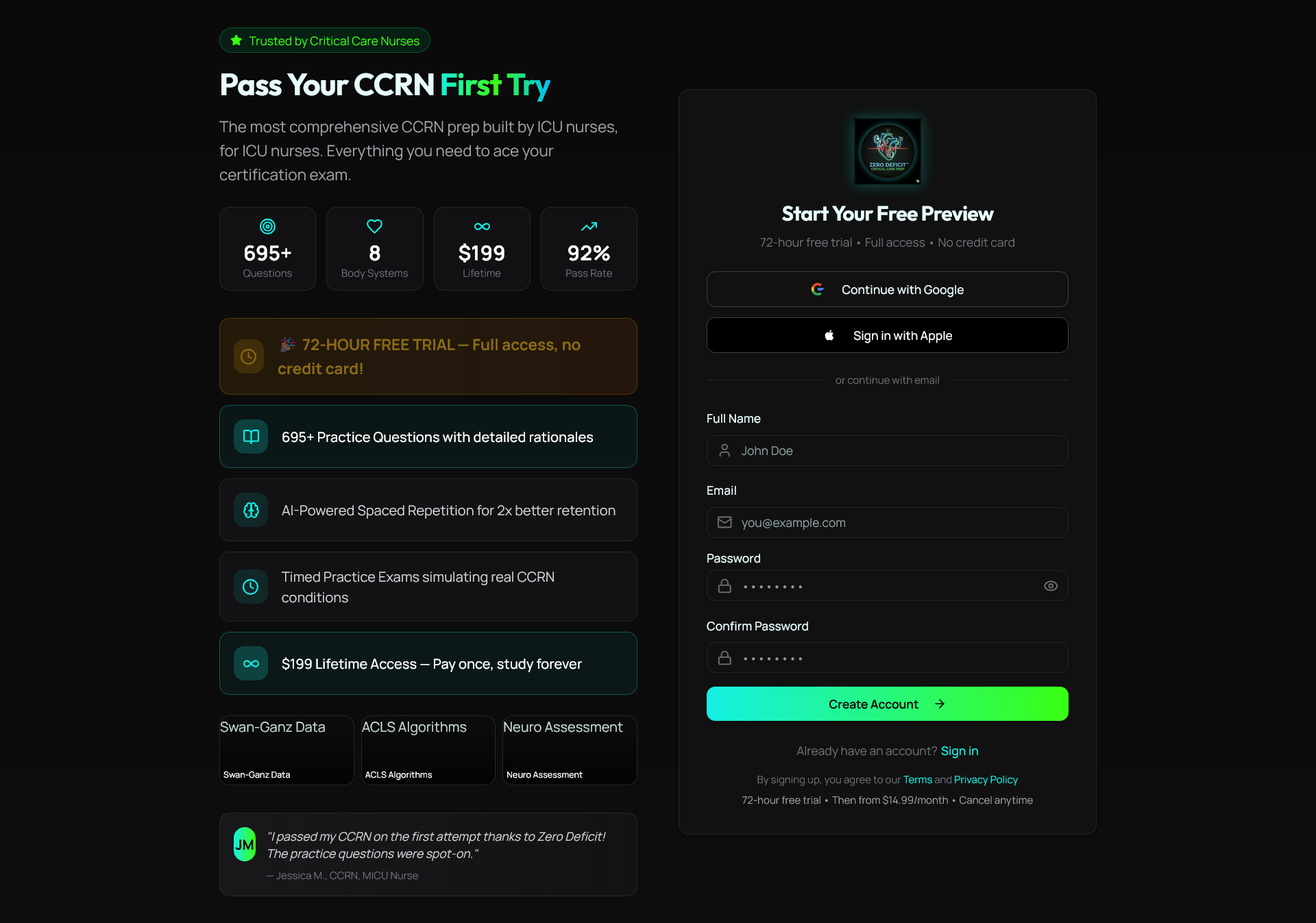
The CCRN study guides and question breakdown methods at Zerodeficitccrnprep give you the structure to build a study plan grounded in real exam content, not guesswork. Progress tracking and study analytics show you exactly where to focus each week. Start studying free at Zero Deficit CCRN Prep today, no credit card required, and see why critical care nurses trust Zero Deficit™ to pass on the first attempt.
FAQ
How long should a nursing study plan be for the CCRN?
Most candidates need 6 to 8 weeks for CCRN preparation, though nurses with multiple weak content categories should extend to 10 to 12 weeks based on diagnostic exam results.
When should I start practicing CCRN-style questions?
Start timed practice questions in week one of your study plan. Early question practice builds clinical judgment and pacing skills that cannot be developed through content review alone.
How do I know which topics to focus on in my study plan?
Take a full-length diagnostic exam before building your schedule, then allocate more time to any category scoring below 60%. Update your focus every two weeks based on ongoing question bank performance.
What is spaced repetition and why does it matter for nursing exams?
Spaced repetition schedules content review at increasing intervals, Day 1, 2, 4, 7, and 14, to move information into long-term memory. It outperforms cramming for retention of high-yield facts like drug dosing and lab values.
How many practice exams should I complete before test day?
Complete at least three full-length practice exams in CAT mode before your exam date, with the final one scheduled one week out. Taper study intensity in the 24 to 48 hours before the exam.
Recommended
Take a Multisystem practice quiz
Master sepsis, shock, MODS, and multi-organ failure scenarios.
Ready to pass your CCRN?
Join 12,000+ nurses using Zero Deficit — 695+ practice questions with rationales, AI-powered weak-area drilling, and spaced-repetition flashcards.
Start Free Trial →