Step by Step Exam Review for the CCRN: 2026 Guide
TL;DR:
- Effective CCRN preparation requires a structured study system aligned with the AACN blueprint and focused on active recall through practice questions. Building and executing a deliberate study plan, including timed mock exams and error analysis, enhances reasoning skills and exam confidence. Consistently reviewing mistake patterns and prioritizing high-yield content areas ensure thorough readiness for test day.
The CCRN exam does not reward effort alone. It rewards organized effort. Many critical care nurses spend hundreds of hours studying but walk into test day feeling underprepared because their prep lacked a clear architecture. A structured step by step exam review changes that. It transforms scattered studying into a system where every session builds on the last, your weaknesses shrink on schedule, and you show up confident in what you know. This guide gives you that system, built specifically for the Adult CCRN exam, aligned with the 2026 AACN blueprint.
Table of Contents
- Key takeaways
- Your step by step exam review: foundation first
- Building and executing your CCRN review plan
- Common mistakes that sabotage your review
- How to verify your readiness before exam day
- CCRN-specific review considerations for 2026
- My take on what actually works
- Build your CCRN prep on a system that works
- FAQ
Key takeaways
| Point | Details |
|---|---|
| Start with the AACN blueprint | Align every study session to the official content weights before you open a single review book. |
| Use active recall, not passive reading | Structured study guides improve test scores by 13 to 34 percent compared to passive review methods. |
| Practice timed from day one | Timed practice from the first week builds the time management instincts you need on exam day. |
| Analyze errors, not just scores | A mistake log that categorizes error types directs your late-stage review far better than overall percentages. |
| Simulate before you test | At least two full-length mock exams taken at the exact time of your real test build the mental endurance CCRN demands. |
Your step by step exam review: foundation first
Before you write a single flashcard or answer your first practice question, you need the right materials in place. Skipping this setup phase is one of the most common reasons nurses reach week six of their prep and feel like they are starting over.
Required materials
Here is what you need before your first study session:
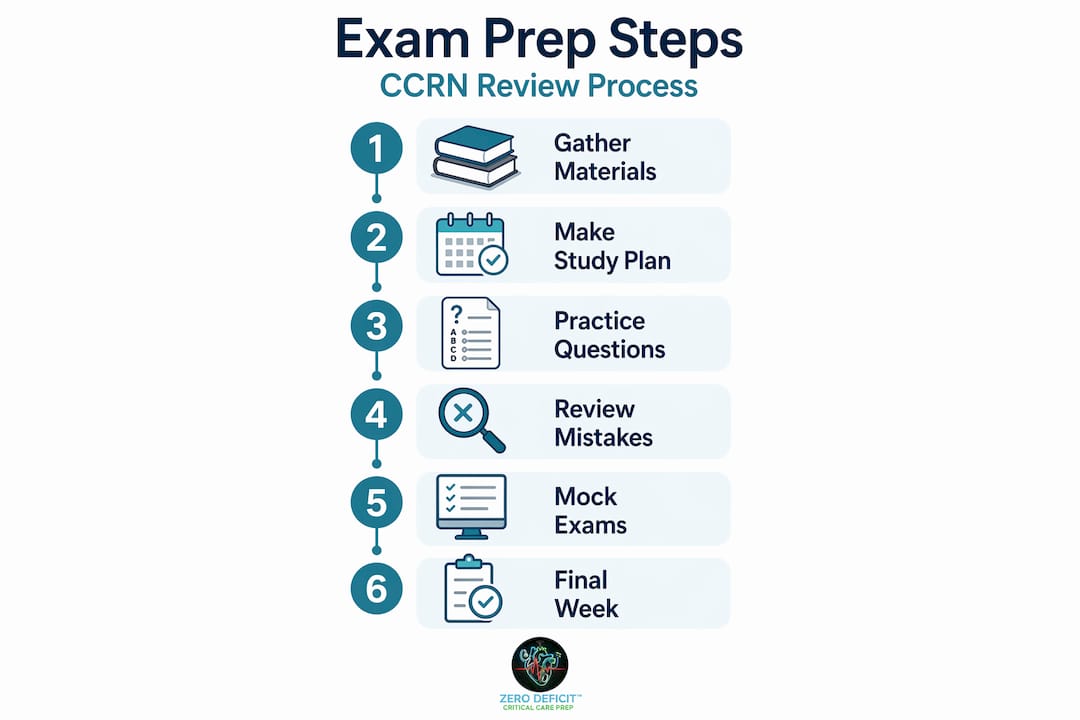
- AACN CCRN Exam Handbook: Download the current version at AACN.org. This is your blueprint. Every topic you study should map back to a category listed here.
- System-based study guide: Choose one that covers all eight body systems tested on the Adult CCRN. Avoid guides that are simply lists of facts. You want one with rationales and clinical context.
- Practice question bank: At minimum, 500 questions with detailed answer explanations. The explanations matter as much as the questions themselves.
- Mistake log: A simple spreadsheet or notebook page where you record every wrong answer, the reason you missed it, and the correct concept. You will revisit this repeatedly.
- A dedicated study space: Minimize auditory and visual distractions during every session. Your brain needs consistent environmental cues to shift into focused recall mode.
The two-column study guide technique
Once your materials are gathered, apply this format to your notes. Draw a line down the center of the page. On the left side, write the key concept or clinical scenario, such as “Cardiogenic shock hemodynamics.” On the right side, write your self-test question, such as “What does a PCWP greater than 18 mmHg with a CI below 2.2 L/min/m² tell you?” Cover the right side and test yourself. This two-column format promotes active recall rather than recognition, which is what the CCRN actually tests.
| Material | Purpose |
|---|---|
| AACN CCRN Exam Handbook | Sets content priorities and category weights |
| System-based study guide | Provides organized clinical content with rationale |
| Practice question bank (500+) | Builds reasoning skills and identifies knowledge gaps |
| Mistake log | Tracks error patterns to direct late-stage review |
| Two-column notes | Promotes active recall over passive rereading |

Building and executing your CCRN review plan
This is where most nurses either lock in their pass or drift into unproductive studying. The order of operations matters. Follow these steps from week one through your final review.
-
Download and mark up the AACN blueprint. Highlight the content categories by weight. Cardiovascular carries the largest proportion of questions on the Adult CCRN, followed by pulmonary and neurology. Your study time should reflect those weights directly.
-
Attack your hardest topics first. This is counterintuitive. Most people start with what they know because it feels good. But your cognitive capacity is sharpest early in your prep, and that is when difficult content, like CRRT mechanics, vasopressor titration, or ARDS ventilator management, deserves your full attention.
-
Study one body system at a time to completion. Spend three to five days per major system. Review content, then immediately practice 30 to 40 questions specific to that system. Review every rationale, including the ones you got right, because understanding why correct answers work builds pattern recognition.
-
Begin timed practice from week one. Timed practice from day one is not about speed. It is about building the internal pacing instinct that keeps you from burning 4 minutes on a single question during the real exam. Set a timer for every practice set.
-
Log every missed question immediately after each session. Do not wait until the weekend to review your errors. Categorize each miss as a knowledge gap, a misread question, or a reasoning error. Each category needs a different correction strategy.
-
Run full-length mock exams in your final two weeks. Schedule at least two complete mock tests at the exact time of day your real exam is booked. This is not optional. Full-length timed mocks are the single best tool for building exam temperament.
-
Adjust your plan based on performance data, not intuition. If your mock scores show persistent weakness in endocrine emergencies, your final week gets more DKA, SIADH, and thyroid storm, not more cardiovascular content you already know.
Pro Tip: Schedule study sessions in 45 to 60 minute focused blocks with 10 minute breaks. The research on cognitive load is clear: sustained high-focus study beyond 90 minutes without rest produces sharply diminishing returns. Your brain consolidates learning during rest, not during cramming.
Common mistakes that sabotage your review
Understanding where exam prep goes wrong is as valuable as knowing what to do right. These are the patterns that consistently cost nurses their first attempt.
- Passive rereading: Highlighting text and re-reading notes feels productive, but active recall and mistake logs outperform passive methods every time. Reading without testing yourself is practice for reading, not for answering CCRN questions.
- Score-chasing instead of error analysis: A 75% practice score tells you almost nothing without knowing why you missed the other 25%. Analyzing your error patterns by category is what drives actual improvement.
- Learning new content in the final 48 hours: Your brain needs time to consolidate. Introducing unfamiliar material the night before your exam increases cognitive load and anxiety. Late-stage review should focus entirely on recall and targeted error correction.
- Multitasking during study sessions: Reviewing content while monitoring your phone or the TV splits attentional resources. Every interruption during a practice question set resets the cognitive focus you built. Protect your study blocks like a critical procedure.
- Skipping rationale explanations: Practice questions are most valuable when you read the full rationale for every answer, not just the ones you missed. Understanding why a distractor is wrong teaches you the reasoning the exam is testing.
“The nurses who pass the CCRN on their first attempt are not the ones who studied the most hours. They are the ones who studied the most intentionally.”
Pro Tip: Build a weekly mistake log review into your schedule every Sunday. Look for recurring error types. If you are consistently missing hemodynamic interpretation questions because of misreading the scenario, that is a reading strategy problem, not a knowledge gap. Fix the right thing.
How to verify your readiness before exam day
Feeling ready and being ready are two different things. Here is how to measure actual preparedness instead of relying on gut feel.
The most reliable indicator is consistency across multiple mock exams, not a single peak score. If you score in the 70 to 75 percent range across three consecutive full-length practice tests covering the full CCRN blueprint, you have a strong performance floor. One great score after a week of intense review is not the same signal.
Use your mock exam data to check two things: your accuracy by content category and your time per question. If you are averaging more than 75 seconds per question on practice tests, your pacing needs work before exam day. The CCRN gives you 150 minutes for 150 questions, which is exactly one minute per question including reading time.
Simulating exam-day conditions repeatedly is non-negotiable. Effective exam prep includes timing, environment, and mental endurance. Take your mocks in a quiet space, at the same time of day, without your phone, and without pausing. Sleep matters too. Prioritize seven to eight hours in the final week.
| Readiness indicator | Target benchmark |
|---|---|
| Mock exam scores (3 consecutive tests) | 70 to 75 percent or higher |
| Average time per question | 60 seconds or less |
| Mistake log errors in major categories | Declining trend week over week |
| Comfort level with AACN top content areas | No category below 65 percent accuracy |
| Final week study focus | Review and recall only, no new content |
Pro Tip: Treat your final week as consolidation, not acceleration. Organize your mistake log, run your last full-length mock, review your highest-yield topic summaries, and prepare your exam-day logistics. Confidence builds from preparation, not from adding more material.
CCRN-specific review considerations for 2026
The 2026 AACN Adult CCRN exam blueprint reflects clinical realities in ICU practice. Your exam review guide needs to account for how the exam is actually structured, not just what content exists.
The CCRN tests eight content areas, with cardiovascular carrying approximately 17 to 18 percent of the total exam weight. Pulmonary follows at around 15 percent, and neurological and musculoskeletal content accounts for roughly 12 percent. Proportional study time aligned with those weights is more efficient than equal time across all categories.
The CCRN also emphasizes clinical judgment over pure memorization. The exam expects you to reason through patient scenarios, recognize hemodynamic deterioration, prioritize interventions, and apply the AACN Synergy Model to nursing care decisions. Understanding that the exam tests reasoning rather than recall changes how you should study.
Key content areas to prioritize in 2026 based on blueprint weighting and clinical emphasis:
- Cardiovascular: Hemodynamic monitoring (PA catheter values, MAP targets), shock states, ACS management, vasopressor and inotrope pharmacology
- Pulmonary: ARDS (Berlin definition, lung-protective ventilation with TV 6 mL/kg IBW, PEEP titration), ABG interpretation, ventilator alarms
- Sepsis/MODS: Surviving Sepsis Campaign 2021 bundle, early antibiotic administration, fluid resuscitation targets, vasopressor thresholds
- Neurological: ICP management (CPP = MAP minus ICP, target CPP 60 to 70 mmHg), stroke protocols, sedation and delirium (RASS, CAM-ICU)
- Renal: CRRT indications and modes, electrolyte management in AKI
- Synergy Model: Matching nurse competencies to patient needs across all clinical scenarios
Read every rationale in your CCRN practice questions fully, including the explanations for correct answers. The reasoning embedded in those rationales teaches you to think like the CCRN expects you to think.
My take on what actually works
I have worked with a lot of CCRN candidates. And the pattern I see most often is this: nurses who struggle are not struggling because they lack clinical knowledge. They are struggling because their study plan is not strategic.
I have seen nurses with six years of MICU experience fail their first attempt because they studied by feel, reviewing whatever they were curious about that day. I have also seen nurses with 18 months of ICU experience pass on their first attempt because they followed a disciplined stepwise exam study method and used data to drive every decision about where to focus next.
The uncomfortable truth is that studying harder is rarely the answer. Studying smarter, with a deliberate plan, a mistake log, timed practice, and full-length mock exams, is what separates first-attempt passes from retakes. The CCRN is a reasoning test dressed up in clinical content. Once you internalize that, your entire approach to prep shifts.
My other strong opinion: stop worrying about the “hardest” questions. Focus on mastering the reasoning pattern behind the mid-difficulty questions that make up the bulk of the exam. Those are the ones you can own with disciplined prep. The outliers will take care of themselves when your foundational reasoning is solid.
Trust the process. Build the structure. Stay consistent.
— Zero
Build your CCRN prep on a system that works
If this step by step approach resonates with you, Zerodeficitccrnprep has the infrastructure to execute it. The platform is built specifically for the Adult CCRN exam, with no filler content and no generic test prep material.
Start with the 12-week CCRN study plan to structure your entire prep from day one through exam week. Layer in the system-based study guides covering all eight body systems, each organized around the AACN blueprint categories. Then drill with the 695+ CCRN practice questions, which include full rationale explanations for every answer. Use the built-in progress tracking and question breakdown methods to analyze your error patterns and adjust your focus. You can start without a credit card. Just show up and start building your plan.
FAQ
What is the best study plan for the CCRN exam?
Start with the AACN blueprint to identify content weights, then build a week-by-week schedule that prioritizes cardiovascular, pulmonary, and sepsis content first. Use a 12-week plan with timed practice integrated from week one.
How many practice questions should I do before the CCRN?
Most first-attempt passers complete at least 500 to 700 practice questions with full rationale review. Volume matters, but the quality of your rationale review matters more than raw question count.
When should I start full-length mock exams?
Schedule your first full-length mock exam two to three weeks before your test date, and complete at least two total mocks timed at the same hour as your real exam to build pacing and mental endurance.
What are the most common mistakes in CCRN exam prep?
Passive rereading, skipping rationale explanations, and studying new content in the final 48 hours are the most common errors. Replace them with active recall, error pattern analysis, and consolidation-focused final review.
How do I know if I am ready for the CCRN exam?
Scoring 70 to 75 percent consistently across three full-length practice tests, with declining error trends in your mistake log and no content category below 65 percent accuracy, signals solid readiness for exam day.
Recommended
- Complete Guide to the CCRN Certification Exam 2026 | Zero Deficit
- Pass the CCRN Exam: Proven Guide for Critical Care Nurses | Zero Deficit CCRN Prep
- Top CCRN study topics to master for exam success | Zero Deficit CCRN Prep
- How educators boost CCRN certification success for nurses | Zero Deficit CCRN Prep
Take a Respiratory practice quiz
Master ARDS, ventilation, ABGs, oxygenation, and pulmonary emergencies.
Ready to pass your CCRN?
Join 12,000+ nurses using Zero Deficit — 695+ practice questions with rationales, AI-powered weak-area drilling, and spaced-repetition flashcards.
Start Free Trial →