The Role of Feedback in Nurse Study and CCRN Prep
TL;DR:
- Effective feedback in nursing education is formative, guiding learners to improve clinical reasoning and confidence before exams and practice. Instructor-led debriefings outperform peer or AI feedback by offering structured, high-quality insights that foster growth. Incorporating diverse feedback sources, timely reflection, and managing feedback’s tone are crucial for developing competent, confident nurses and passing certification exams like the CCRN.
Most nurses think of feedback as something that happens to them, not for them. That framing costs you. The role of feedback in nurse study goes far beyond receiving a grade or hearing what you got wrong. In nursing education research, the formal term is formative assessment feedback: structured information that helps you adjust your learning in real time. Whether you are an ICU nurse preparing for the CCRN or a nursing student building clinical judgment from scratch, understanding how to seek, interpret, and apply feedback is one of the highest-leverage study skills you can develop.
Table of Contents
- Key takeaways
- The role of feedback in nurse study: types and sources
- How feedback shapes confidence and clinical judgment
- Applying feedback to your CCRN prep and study routine
- Navigating the challenges of feedback in nursing education
- My honest take on feedback and passing the CCRN
- Build your feedback loop with Zerodeficitccrnprep
- FAQ
Key takeaways
| Point | Details |
|---|---|
| Feedback is formative, not just corrective | Structured feedback during study builds clinical judgment, not just test scores. |
| Instructor-led feedback outperforms peer or self-review | Research shows significantly higher clinical judgment scores when instructor feedback guides debriefing. |
| Feedback-seeking profiles vary widely | Roughly 21% of nursing interns actively avoid feedback, which directly limits their learning potential. |
| AI feedback supports but cannot replace expert input | Automated tools identify knowledge gaps fast, but human clinical reasoning validation remains critical. |
| Distinguishing growth feedback from bullying protects learning | Feedback that targets behavior and offers guidance builds confidence; repeated personal criticism without direction does not. |
The role of feedback in nurse study: types and sources
Feedback in nursing education arrives through several distinct channels, and each one carries different strengths. Understanding the spectrum helps you build a study routine that draws on all of them strategically.
Informal feedback is the most common and the least utilized. This includes offhand comments from preceptors, quick corrections during a simulation, or a classmate pointing out a missed assessment step. It is immediate, but it is rarely documented or reflected upon.
Structured instructor-led debriefing is where the research gets compelling. Studies comparing different debriefing formats consistently show that instructor-led debriefing produces significantly higher clinical judgment scores (F=96.21, p<.001), confidence, and satisfaction than peer-led or self-directed debriefing. The difference is not small. It is the difference between reviewing what happened and understanding why it happened at a clinical reasoning level.
Peer feedback still holds value. It develops communication skills, builds psychological safety, and surfaces blind spots that instructors might not catch. But it works best as a complement, not a substitute, for expert guidance.
Automated and AI-based feedback has grown sharply since 2020. A scoping review of nursing education technology found that AI feedback delivery now dominates many formal study environments, offering immediate, scalable responses to practice questions and simulations. The speed is a real advantage. The limitation is that AI cannot yet validate clinical reasoning the way a seasoned critical care educator can.
Here is a quick comparison of feedback sources by key attributes:
| Feedback source | Timing | Specificity | Clinical reasoning depth |
|---|---|---|---|
| Instructor-led debriefing | Delayed but structured | High | High |
| Peer feedback | Immediate | Moderate | Low to moderate |
| AI/automated tools | Immediate | High (knowledge gaps) | Low without human follow-up |
| Informal preceptor feedback | Immediate | Variable | Moderate |
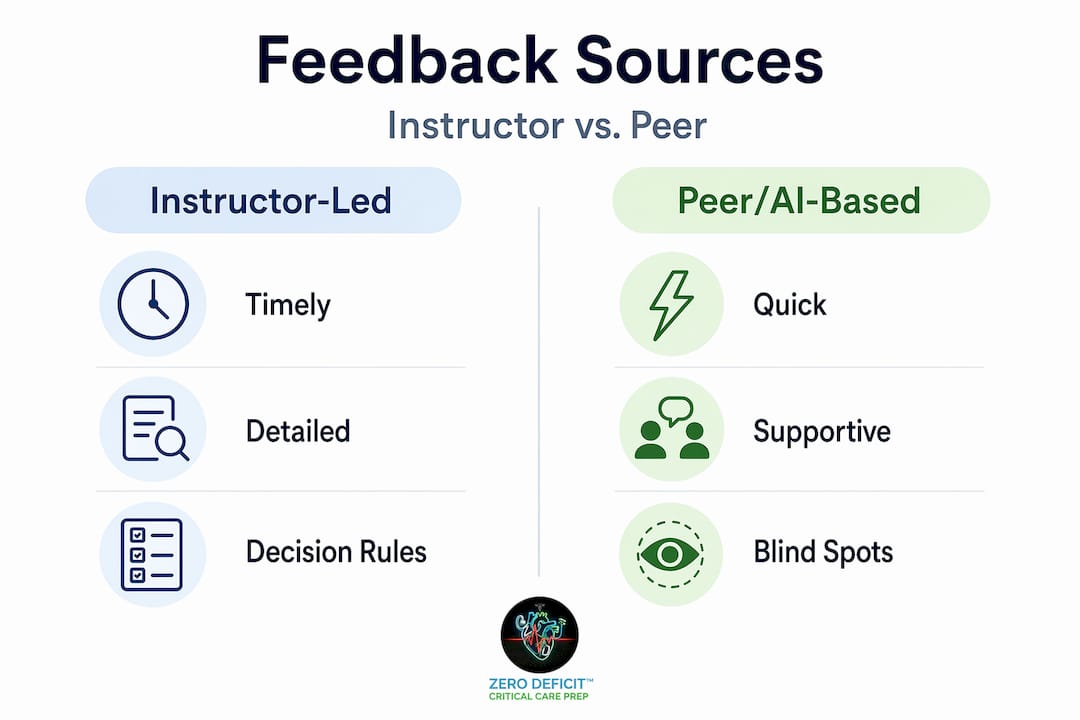
The source matters because it shapes what you do with the information. Instructor debriefing gives you decision rules. AI tools give you data points. Peer feedback gives you perspective. Build your study routine to include all three in the right proportions.
How feedback shapes confidence and clinical judgment
The link between feedback and clinical judgment is not theoretical. It is measurable and reproducible across nursing education settings.
When nursing students receive timely, structured debriefing feedback, their ability to recognize clinical cues and prioritize interventions improves significantly. This matters for CCRN prep because the exam tests exactly that: your ability to process a hemodynamic picture, recognize a deteriorating ARDS patient, or prioritize a septic patient’s fluid resuscitation before the vasopressors run dry.

Confidence follows a similar pattern. Virtual patient simulations that include integrated feedback showed a statistically significant confidence improvement of +1.26 (95% CI 0.40 to 2.15; p=0.010) compared to control groups who practiced without structured feedback. That is not just a test score improvement. Confidence in clinical conversation and decision-making is what carries you through high-stakes exam scenarios and real patient events alike.
Feedback also supports a specific skill set that the CCRN exam demands: self-regulation. When you receive feedback and act on it, you develop the habit of monitoring your own reasoning process. Students who actively seek and process feedback are better at recognizing when their clinical logic is incomplete, which is exactly the metacognitive skill that separates passing CCRN candidates from those who fall short.
“Students often interpret feedback as a judgment of competence rather than a prompt for growth. The research is clear: low feedback seekers are more likely to use defensive avoidance strategies that slow professional development. Reframing feedback as evidence about your learning process, not your worth as a clinician, changes everything.”
Feedback also plays a critical role during the transition from student to practicing nurse. This period is where clinical identity forms. Nurses who receive structured, behavior-focused feedback during this transition build a more stable professional identity, report higher career adaptability, and show stronger engagement with evidence-based practice learning, as seen in flipped classroom research where students moved from fear to genuine integration of EBP through feedback-supported engagement.
Pro Tip: After every practice question session, do not just check the answer. Ask yourself: “What clinical cue did I miss, and what feedback does this rationale give me about my reasoning process?” That single habit accelerates learning faster than volume alone.
Applying feedback to your CCRN prep and study routine
Knowing that feedback matters is only useful if you know how to build it into your actual study practice. Here is a structured approach that works for CCRN candidates preparing in critical care nursing.
-
Seek instructor or mentor feedback proactively. Do not wait for a formal review. Bring a specific clinical scenario or a practice question you missed to a preceptor, educator, or colleague with CCRN experience. Ask them to walk through the reasoning, not just confirm the answer. Proactive feedback seeking requires what researchers call permission structures: clear, taught norms that make asking for feedback feel safe rather than risky.
-
Use AI-powered study tools as a first pass, then validate. Automated feedback from platforms like Zerodeficitccrnprep is fast and precise for identifying knowledge gaps across cardiovascular, pulmonary, neuro, and sepsis content. Treat that output as your starting point. Then bring your weakest areas to a human expert for clinical context. AI identifies what. Experienced nurses help you understand why, which is what the CCRN exam question breakdown is built to address.
-
Build a reflection log. After debriefing sessions, simulation labs, or complex patient events, write down three things: what feedback you received, what it told you about your clinical reasoning, and one specific change you will make. This practice connects feedback directly to evidence-based learning and accelerates retention.
-
Seek peer mentoring with structure. Pair with a colleague who is further along in their CCRN prep or critical care experience. Structured peer review with a defined focus (say, hemodynamic interpretation or vent management) yields more specific feedback than an open-ended “What did you think?”
-
Recognize feedback from exam simulators as performance data. Your score on a timed CCRN practice set is feedback on pacing, topic mastery, and clinical reasoning under pressure. Look at pattern, not just percentage. Which system keeps tripping you up? That is your feedback signal.
Pro Tip: Educators and certification success research both point to the same thing: nurses who ask for feedback consistently outperform those who wait to receive it. Make asking a habit, not an event.
Navigating the challenges of feedback in nursing education
Not all feedback is created equal, and recognizing the difference between growth-oriented feedback and harmful criticism is a skill worth developing explicitly.
Research on feedback-seeking profiles among nursing interns shows three distinct groups: approximately 40.83% are high seekers, 38.3% are moderate, and 20.87% are low seekers. Education level and career adaptability predict which group a learner falls into. Low seekers are not disengaged by accident. They have often learned through experience that seeking feedback feels dangerous to their sense of competence.
The table below outlines key differences between feedback that builds learning and feedback that crosses into bullying or counterproductive criticism:
| Characteristic | Constructive feedback | Counterproductive feedback |
|---|---|---|
| Focus | Specific behavior or clinical action | Personal character or worth |
| Tone | Respectful and goal-oriented | Demeaning or intimidating |
| Guidance offered | Clear path for improvement | Criticism without direction |
| Frequency | Consistent and proportionate | Repeated, disproportionate |
| Effect on learning | Builds confidence and self-regulation | Increases anxiety and avoidance |
As the ANMF research documents clearly, bullying behaviors in clinical settings include repeated criticism without guidance, singling out students publicly, and withholding crucial information. These experiences are not just unpleasant. They directly suppress feedback-seeking behavior and slow professional development.
For educators reading this: tailoring feedback approaches to the learner’s profile is not a soft skill. It is a pedagogical strategy with measurable outcomes. High seekers can handle more challenging feedback earlier. Low seekers need structured safety and explicit permission to ask before they can engage productively with corrective input.
My honest take on feedback and passing the CCRN
I have watched nurses approach exam prep two ways. The first way: study hard, take practice questions, check the answers, move on. The second way: treat every wrong answer as a data point that reveals a specific gap in clinical reasoning, then seek an explanation, validate it against guidelines, and adjust the study plan accordingly.
The second approach is feedback-driven learning. In my experience, it is the approach that gets nurses across the finish line on the first attempt.
What I have seen underestimated most often is timing. Feedback received immediately after a practice scenario or question set is processed differently than feedback reviewed days later. The clinical context is fresh, the reasoning error is visible, and the correction sticks. Do not save your review sessions for the weekend.
I also think the field overestimates what AI feedback alone can accomplish. The analytics are genuinely useful. But the CCRN is not a knowledge recall exam. It is a clinical judgment exam. At some point, you need a human who has managed a patient on a balloon pump or titrated a propofol drip to tell you whether your reasoning reflects real bedside practice.
My honest advice: use every feedback channel available to you, be deliberate about what each one tells you, and do not let ego get in the way of asking. The nurses who pass on their first attempt are not the smartest ones in the room. They are the ones who found out what they did not know and fixed it before exam day.
— Zero
Build your feedback loop with Zerodeficitccrnprep
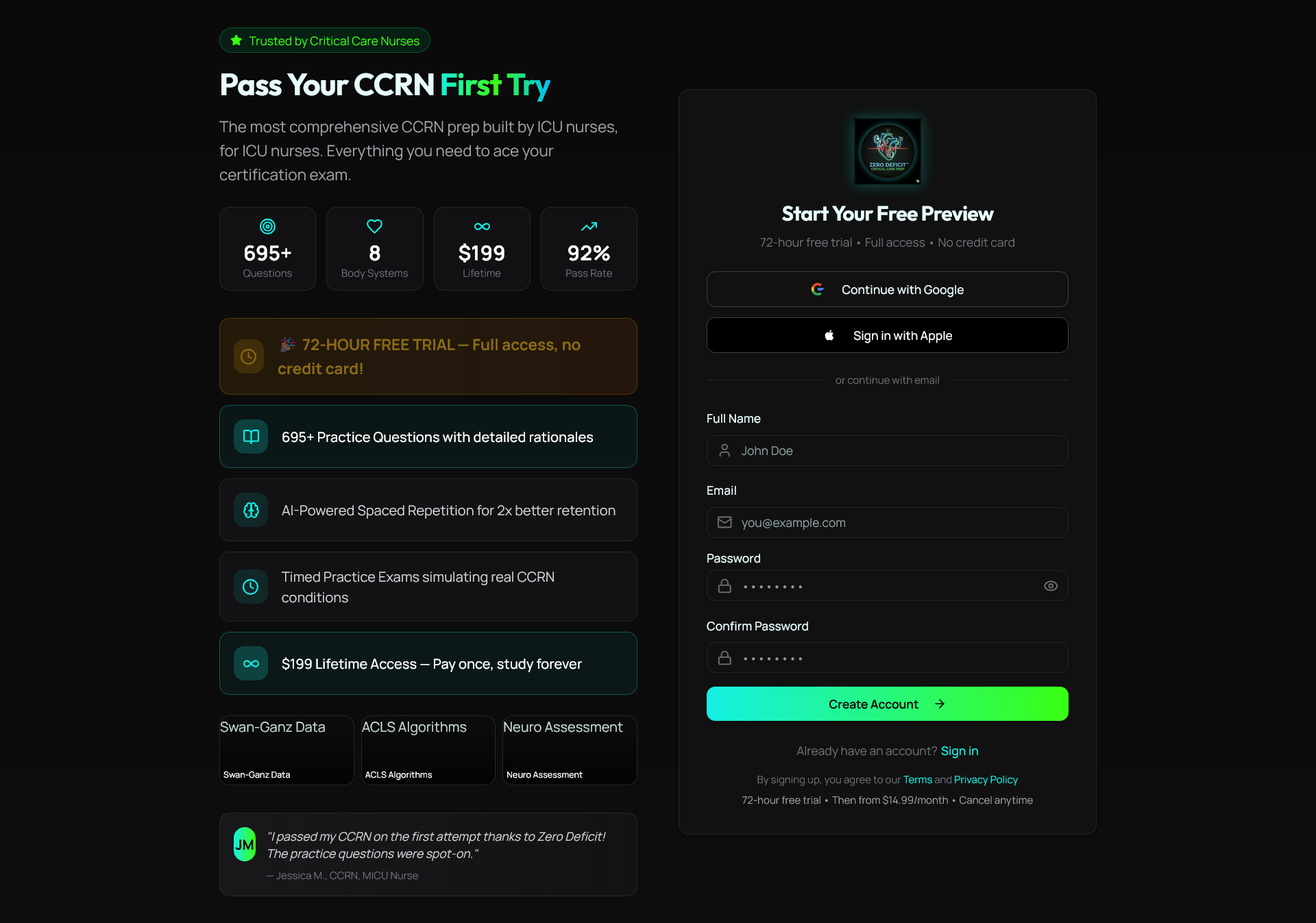
Zerodeficitccrnprep is built around the exact principle this article covers: feedback should be specific, immediate, and tied to clinical reasoning, not just answer keys. The platform’s 695+ CCRN practice questions come with detailed rationales for every answer, correct and incorrect. That means every question you attempt gives you actionable feedback on your clinical reasoning process, mapped directly to CCRN exam blueprint content areas.
The study guides across all 8 body systems are organized to support the kind of structured, feedback-integrated review the research points to. You can identify your weak systems, study them with depth, and then test your understanding through practice questions that reflect real exam complexity.
Start studying free at Zero Deficit CCRN Prep today. No credit card required. Just clear, feedback-driven prep designed to get you to passing on your first attempt.
FAQ
What is the role of feedback in nurse study?
Feedback in nurse study, formally called formative assessment feedback, gives learners specific information about gaps in clinical reasoning and knowledge so they can adjust their approach before exams or patient care situations.
Why is instructor-led feedback better than peer feedback?
Research shows instructor-led debriefing produces significantly higher clinical judgment and confidence scores than peer or self-debriefing, because instructors can translate feedback into actionable clinical decision rules.
How can feedback improve CCRN exam readiness?
Structured feedback from practice questions, debriefing, and AI-powered tools helps you identify specific knowledge gaps and reasoning errors, then correct them before exam day, which is directly linked to first-attempt pass rates.
What percentage of nursing students actively avoid seeking feedback?
Approximately 20.87% of nursing interns fall into the low feedback-seeking profile, often due to fear that asking for help signals incompetence rather than growth.
When does feedback become harmful in nursing education?
Feedback crosses into harmful territory when it targets personal character rather than specific clinical behavior, lacks guidance for improvement, or is delivered publicly in a way that intimidates rather than teaches.
Recommended
- Why assessment matters: Boost CCRN exam success | Zero Deficit CCRN Prep
- How educators boost CCRN certification success for nurses | Zero Deficit CCRN Prep
- How to track CCRN progress: a critical care nurse’s guide | Zero Deficit CCRN Prep
- Pass the CCRN Exam: Proven Guide for Critical Care Nurses | Zero Deficit CCRN Prep
Take a Neurological practice quiz
Test your knowledge of stroke, ICP, seizures, and neuro assessment.
Ready to pass your CCRN?
Join 12,000+ nurses using Zero Deficit — 695+ practice questions with rationales, AI-powered weak-area drilling, and spaced-repetition flashcards.
Start Free Trial →