Types of Critical Care Certifications: Your 2026 Guide
TL;DR:
- Critical care certifications validate specialized nursing skills for various patient populations and care settings.
- Choosing the right credential depends on your clinical focus, patient demographics, and career goals, ensuring targeted expertise.
Types of critical care certifications are professional credentials that validate specialized knowledge and clinical skills for nurses and advanced practice clinicians who care for critically ill patients. The three major certification bodies governing these credentials are the American Association of Critical-Care Nurses (AACN), the Board of Certification for Emergency Nursing (BCEN), and the American College of Chest Physicians (CHEST). Choosing the right credential from the critical care specialty certifications list depends on your patient population, care setting, and career goals. This guide breaks down every major option so you can make a confident, informed decision.
1. Types of critical care certifications: the full landscape
Critical care certifications fall into three broad categories: bedside nursing credentials, emergency and transport nursing credentials, and advanced practice provider credentials. Each category is governed by a distinct certifying body with its own eligibility rules, exam blueprints, and recertification cycles. AACN issues CCRN, PCCN, CMC, CSC, and other credentials for both direct care and non-direct care providers, making it the most expansive source of critical care nursing certifications in the United States. Understanding the full landscape before you commit to a study plan saves you months of misdirected effort.

2. AACN CCRN: the gold standard for ICU nurses
The CCRN credential from AACN is the most recognized critical care nursing certification for bedside ICU nurses caring for adult, pediatric, or neonatal patients. AACN offers three separate CCRN tracks: Adult, Pediatric, and Neonatal. Each track targets a distinct patient population, so your unit determines which exam you sit for.
Eligibility for the Adult CCRN requires 1,750 hours of direct care within the two years preceding application, with at least 875 of those hours completed in the most recent year. That recency rule catches many candidates off guard. You cannot bank hours from three years ago and expect them to count.
Key CCRN eligibility facts:
- CCRN Adult: 1,750 total direct care hours, 875 in the past year, acute or critical care setting
- CCRN Pediatric: Same hour requirements, applied to pediatric critical care patients
- CCRN Neonatal: Same structure, focused on neonatal intensive care
- Current RN license: Required across all three tracks
- Direct patient contact: Tele-ICU and remote monitoring hours have specific rules; verify with AACN before applying
Pro Tip: If you are approaching your two-year window, apply before your oldest hours age out. Losing eligible hours to a paperwork delay is one of the most avoidable setbacks in the certification process.
The CCRN exam blueprint covers cardiovascular, pulmonary, neurological, renal, endocrine, gastrointestinal, hematology, and multisystem content, weighted heavily toward hemodynamics, shock, and mechanical ventilation. This is the credential that signals ICU-level mastery to employers and colleagues alike.
3. AACN PCCN: the credential for progressive care nurses
The PCCN (Progressive Care Certified Nurse) credential targets nurses working in step-down, telemetry, and intermediate care units rather than the full ICU. The patient acuity is lower than ICU, but the clinical complexity remains significant. PCCN eligibility mirrors CCRN in structure: 1,750 hours of direct care with 875 in the most recent year, applied to progressive care patients.
The PCCN exam blueprint overlaps with CCRN in cardiovascular and pulmonary content but places less emphasis on invasive hemodynamic monitoring and more on rhythm interpretation and medication management. If you work in a cardiac step-down unit or a medical progressive care unit, PCCN is the credential that directly reflects your scope of practice.
4. AACN specialty credentials: CMC and CSC
AACN offers two advanced specialty credentials that layer on top of the base CCRN: the Cardiac Medicine Certification (CMC) and the Cardiac Surgery Certification (CSC). These credentials are designed for nurses who specialize in cardiac medical or cardiac surgical patients and want to demonstrate subspecialty expertise beyond the general CCRN.
Both CMC and CSC require a current CCRN or PCCN credential as a prerequisite, plus additional direct care hours in the relevant specialty. The CMC focuses on heart failure, acute coronary syndromes, and arrhythmia management. The CSC addresses post-operative cardiac surgical care, including ventricular assist devices and post-bypass hemodynamics. For nurses in cardiac ICUs or cardiovascular surgical units, these credentials are the clearest signal of subspecialty depth.
5. BCEN emergency nursing certifications
The Board of Certification for Emergency Nursing offers six nationally accredited certifications accepted by ANCC Magnet-recognized facilities: CEN (Certified Emergency Nurse), CPEN (Certified Pediatric Emergency Nurse), CFRN (Certified Flight Registered Nurse), CTRN (Certified Transport Registered Nurse), TCRN (Trauma Certified Registered Nurse), and CBRN (Certified Burn Registered Nurse). These credentials are not ICU-specific, but they are directly relevant to critical care nurses who work in trauma bays, flight transport, or burn units.
The CEN is the most widely held BCEN credential and covers the full spectrum of emergency nursing practice. The CEN exam content outline updates effective July 6, 2026 reorganize clinical areas and professional issues to better reflect current role delineations in emergency nursing. If you are preparing for the CEN in 2026, study from the updated blueprint, not the prior version.
BCEN certifications complement AACN credentials in two specific scenarios:
- ICU nurses who float to the ED or trauma bay benefit from CEN or TCRN to formalize their cross-setting competency
- Flight and transport nurses need CFRN or CTRN because those credentials are often required by air medical programs as a condition of employment
The overlap between BCEN and AACN content is real. Cardiovascular emergencies, respiratory failure, and shock management appear on both the CEN and CCRN blueprints. That shared content means your CCRN prep gives you a head start on BCEN exams, and vice versa.
6. CHEST CCAPP: the advanced practice provider credential
The Critical Care Advanced Practice Provider (CCAPP) certification from CHEST is the primary credential for nurse practitioners and physician assistants practicing in critical care. CCAPP is offered twice yearly in 2026 with application deadlines in spring and fall. The 2025 exam reported a 90% pass rate, which reflects both the quality of candidates and the focused, clinically grounded exam design.
APPs require a distinct certification because their scope of practice, prescriptive authority, and clinical decision-making responsibilities differ fundamentally from bedside RN roles. The CCAPP exam covers:
- Respiratory failure and mechanical ventilation management
- Hemodynamic monitoring and shock resuscitation
- Sepsis and multiorgan dysfunction
- Neurological emergencies in the ICU
- Procedural competency and evidence-based critical care protocols
CCAPP certification reflects modern critical care practice beyond generic ICU knowledge, and candidates consistently describe it as professional validation rather than just a credential check. Advanced practice clinicians should align certification timing with the biannual exam window to avoid a six-month delay in their credentialing timeline.
7. How to choose the best critical care certification for your role
Certifications vary by setting: ICU versus progressive care, adult versus pediatric, bedside versus tele-ICU. The right credential is the one that matches where you practice and where you want to go. Use this comparison to orient your decision:
| Certification | Best for | Certifying body | Prerequisite |
|---|---|---|---|
| CCRN Adult | ICU RNs caring for adult patients | AACN | 1,750 direct care hours |
| PCCN | Step-down and progressive care RNs | AACN | 1,750 progressive care hours |
| CMC / CSC | Cardiac ICU or cardiac surgical RNs | AACN | Active CCRN or PCCN |
| CEN | Emergency department RNs | BCEN | Current RN license |
| CFRN / CTRN | Flight and transport nurses | BCEN | Current RN license, experience |
| CCAPP | NPs and PAs in critical care | CHEST | APP license, ICU practice |
Recertification matters as much as initial certification. CCRN recertification requires ongoing clinical hours and continuing education, reinforcing that the credential reflects sustained expertise rather than a one-time achievement. Plan your recertification cycle from day one so you are never scrambling at the three-year mark.
Pro Tip: If you are a new ICU nurse with under two years of experience, start logging your direct care hours now with a simple spreadsheet. Tracking hours in real time eliminates the guesswork when you apply and protects you from the most common eligibility mistake.
Exam blueprints update periodically to reflect evolving clinical practice, so always download the current content outline from the certifying body before you build your study plan. A study plan built on an outdated blueprint is a plan built on the wrong foundation.
Key takeaways
The most effective approach to critical care certification is matching your credential to your patient population, care setting, and career trajectory before you begin studying.
| Point | Details |
|---|---|
| AACN leads critical care credentials | CCRN, PCCN, CMC, and CSC cover ICU, progressive care, and cardiac subspecialties. |
| Hour requirements are strict | CCRN requires 1,750 direct care hours with 875 completed in the most recent year. |
| BCEN covers emergency and transport | CEN, CFRN, TCRN, and CBRN are Magnet-accepted and complement ICU credentials. |
| CCAPP serves APPs specifically | CHEST’s CCAPP exam runs twice yearly with a 90% pass rate from the 2025 cohort. |
| Recertification is ongoing | All major credentials require continued clinical hours and education every three years. |
What I have learned after years of watching nurses prep for these exams
The single biggest mistake I see is nurses treating all critical care certifications as interchangeable. They pick the CCRN because it sounds the most prestigious, without confirming they meet the hour requirements or that it actually matches their unit. A step-down nurse who sits for the CCRN Adult exam is studying content that goes well beyond their daily practice, which makes the exam harder than it needs to be. PCCN exists for a reason.
The second mistake is ignoring specialty add-ons like CMC and CSC. If you work in a cardiac surgical ICU and you hold a CCRN, you are leaving a significant professional differentiator on the table. Those credentials are not harder to earn than the base CCRN. They just require you to already have one.
The third thing worth saying plainly: certification is more than a credential. Every nurse I have seen go through the CCRN process comes out with sharper clinical reasoning, not just a certificate. The study process forces you to systematize knowledge you use intuitively every shift. That is the real return on investment. Check the 2026 certification trends to stay ahead of blueprint changes before you commit to a study timeline.
— Zero
Start your CCRN prep with the right resources
If the AACN Adult CCRN is your target credential, the study resources you use need to match the actual exam blueprint. Zerodeficitccrnprep.com is built specifically for that purpose.
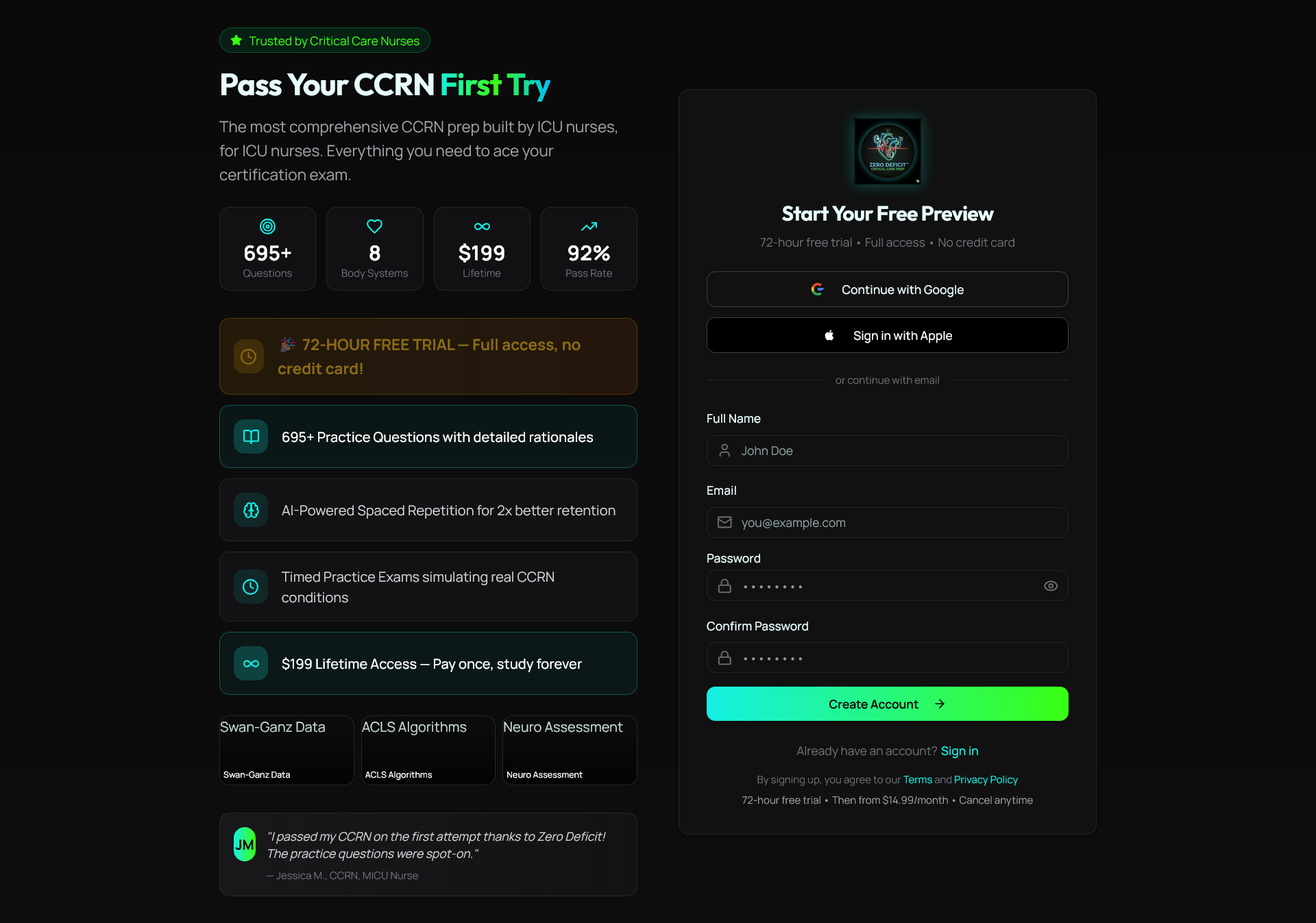
The platform gives you access to 695+ CCRN practice questions with detailed rationales, organized by body system so you can target your weakest areas first. The CCRN study guides cover all eight body systems tested on the exam, from cardiovascular hemodynamics and shock to neurological emergencies and sepsis management. You can start with a free version with no credit card required, and evaluate the quality of the materials before committing. If you are ready to pass on your first attempt, this is where you start.
FAQ
What are the main types of critical care certifications?
The main types are AACN credentials (CCRN, PCCN, CMC, CSC), BCEN emergency nursing certifications (CEN, CPEN, CFRN, TCRN, CBRN), and the CHEST CCAPP for advanced practice providers. Each targets a specific care setting and patient population.
How many hours do you need to qualify for the CCRN?
CCRN eligibility requires 1,750 hours of direct acute or critical care nursing within the past two years, with at least 875 of those hours completed in the most recent year.
What is the difference between CCRN and PCCN?
The CCRN is designed for nurses caring for acutely or critically ill patients in an ICU setting, while the PCCN targets nurses in progressive care, step-down, or intermediate care units with lower-acuity patients.
Is BCEN certification relevant for ICU nurses?
Yes. BCEN credentials like the CEN and TCRN are directly relevant for ICU nurses who cross-train in emergency or trauma settings, and CFRN or CTRN are often required for flight and transport nursing positions.
How often do critical care certification exams change?
Exam content outlines update periodically to reflect current clinical practice. The CEN blueprint updates effective July 6, 2026, and AACN reviews its blueprints on a regular cycle. Always download the current outline from the certifying body before building your study plan.
Recommended
- 2026 Trends in Critical Care Certification You Must Know | Zero Deficit CCRN Prep
- Nursing Certification Terminology Explained for ICU Nurses | Zero Deficit CCRN Prep
- Pass the CCRN Exam: Proven Guide for Critical Care Nurses | Zero Deficit CCRN Prep
- Why Certification Retention Matters for Critical Care Nurses | Zero Deficit CCRN Prep
Take a Cardiovascular practice quiz
Test your mastery of hemodynamics, ACLS, MI, arrhythmias, and heart failure.
Ready to pass your CCRN?
Join 12,000+ nurses using Zero Deficit — 695+ practice questions with rationales, AI-powered weak-area drilling, and spaced-repetition flashcards.
Start Free Trial →