What Does First Attempt Exam Pass Mean for CCRN?
TL;DR:
- Passing the CCRN on your first attempt signifies meeting the required score without retakes, ensuring certification begins promptly. It reflects effective study strategies, clinical judgment, and maintains study momentum, positively impacting your career trajectory. Using structured preparation, targeted practice, and understanding exam standards increases your likelihood of first try success.
If you’ve been studying for your CCRN and wondering what does first attempt exam pass mean, you’re not alone. Many ICU nurses assume it’s simply about “passing,” but the term carries real weight. A first attempt pass signals more than clearing a cut score. It shapes your certification timeline, your study momentum, and how you show up in your clinical practice. This article breaks down the exact meaning, the official AACN standards behind it, and why passing the CCRN on your first try is worth building your entire study strategy around.
Table of Contents
- Key Takeaways
- What does first attempt exam pass mean on the CCRN
- Why passing on your first try matters more than you think
- Common misconceptions about first attempt pass status
- Strategies to pass the CCRN on your first attempt
- First attempt vs. multiple attempts: what to expect
- My honest take on first attempt success
- Start your first attempt preparation with Zero Deficit™
- FAQ
Key Takeaways
| Point | Details |
|---|---|
| Official passing score | You need 83 out of 125 scored questions to pass the Adult CCRN exam. |
| First attempt exam meaning | Passing on your first sitting avoids 45-day waiting periods, extra fees, and lost study momentum. |
| Significance of first attempt pass | First-time success reflects strong clinical judgment and reinforces confidence for your career. |
| Retakes are permitted but costly | AACN allows up to four discounted retakes within 12 months before requiring a new application. |
| Strategy over luck | Structured study plans with quality practice questions drive first attempt success more than any other factor. |
What does first attempt exam pass mean on the CCRN
A first attempt exam pass means you achieved the required passing score on your very first sitting of the CCRN exam, without any retakes. For the Adult CCRN, that means meeting the cut score benchmark of 83 out of 125 scored questions. The exam actually delivers 150 questions total, but 25 of those are unscored pretest items embedded throughout. Only the 125 scored questions count toward your result.
Your score is reported as a scaled score rather than a raw percentage. AACN builds this scaling into the process to account for slight variation in difficulty across different exam forms. What this means practically: meeting the 83-question threshold on your first sitting earns you the designation of passing on the first attempt. Your certification begins that day.
What counts as an “attempt” under AACN policy is specific. Each time you schedule and sit for the exam, that counts as one attempt, regardless of how many questions you answer before any technical issue or personal circumstance. Logging in and beginning the exam is the threshold. There is no provisional or “soft” first attempt.
Here is what you need to understand about the official criteria:
- The Adult CCRN exam contains 150 total questions, with 125 scored and 25 unscored pretest items
- The passing standard is 83 correct answers out of those 125 scored questions
- Scores are delivered as scaled scores, typically on a range up to 150
- AACN retake policy requires a 45-day waiting period before your first retake attempt
- You can schedule up to four discounted retakes within 12 months of your original application before needing to reapply entirely
Understanding these specifics matters before you sit. Knowing exactly what the target looks like makes your preparation concrete rather than abstract.
Why passing on your first try matters more than you think
The significance of first attempt pass goes well beyond saving money on a retake fee. It touches your psychology, your timeline, and the trajectory of your career in critical care.
Start with the numbers. First-time NCLEX pass rates for US-educated nurses sit around 87%, while second-attempt pass rates drop to roughly 45 to 53%. The CCRN is not the NCLEX, but the trend holds: nurses who do not change their approach between attempts rarely improve their outcomes. The difficulty of repeat attempts is not just mechanical. It is psychological.
“Passing on the first attempt is more than a number. It reflects effective clinical judgment under pressure, a key nursing skill tested by the CCRN.” — Insight from nursing exam strategy research
The financial cost of retaking is real. A failed first attempt triggers fees for rescheduling, plus a mandatory wait before you can retest. That waiting period disrupts your study momentum and extends the window between your peak preparation state and your next attempt. Many nurses report that the hardest part of retaking is reigniting motivation after a setback.
From a career perspective, first attempt success tends to accelerate everything. Certification often opens doors to charge nurse roles, clinical ladder advancement, and pay increases. Every extra month spent in retake cycles is a month those opportunities are delayed.
Pro Tip: Track your practice question scores by body system starting at least eight weeks before your exam date. If cardiovascular or pulmonary content is pulling your average below 70%, shift your weekly study hours toward those areas immediately. Don’t wait for a full mock exam to reveal the gap.
There is also an often-overlooked confidence factor. Nurses who pass on the first try report feeling more anchored in their clinical decisions after certification. The act of demonstrating competency under exam conditions reinforces the same judgment skills used at the bedside every shift.

Common misconceptions about first attempt pass status
A lot of anxiety around the CCRN comes from misunderstanding what first attempt exam meaning actually implies. Here are the most common myths worth correcting directly.
-
“First attempt pass means you’re naturally gifted.” It doesn’t. It means your preparation strategy was sound and consistent. Nurses who pass first try are not smarter. They studied with a plan and executed it.
-
“If I don’t pass on the first attempt, I’ve failed as a nurse.” This one is harmful and false. Certification exams are high-stakes standardized tests that measure specific exam competencies, not your worth as a clinician. Many excellent critical care nurses have needed two attempts.
-
“A preliminary pass is the same as a confirmed pass.” Not exactly. Some testing systems use terminology like preliminary pass to indicate a conditional result pending final score validation. For the CCRN, your immediate result is considered reliable, but understanding this terminology prevents confusion if you encounter it in other certification contexts.
-
“Retaking with the same materials will produce a different result.” It won’t. Unchanged study strategies consistently lead to similar outcomes. If you need to retake, a full reset of your approach is non-negotiable.
-
“Passing on the first try means you’re done learning.” Certification is a floor, not a ceiling. Your CCRN credential requires renewal every three years, and the clinical knowledge that carries you through the exam is the same knowledge that protects your patients.
Clarifying these misconceptions matters because the anxiety they create can actually undermine your performance. Walking into the exam with accurate expectations frees cognitive space for the clinical reasoning the CCRN is actually testing.
Strategies to pass the CCRN on your first attempt
Passing exams on the first try is not about grinding through content for 100 hours. It’s about studying the right material with the right methods. Here is what works for CCRN candidates who pass on the first sitting:
- Use practice questions with detailed rationales. Candidates who follow structured plans and focus on reasoning consistently outperform those who only review content passively. Reading the rationale for every question, right or wrong, builds the clinical judgment framework the exam tests.
- Map your study plan to the AACN exam blueprint. Cardiovascular content represents the largest single chunk of the CCRN. If your study hours don’t reflect that weighting, you’re leaving points on the table.
- Do timed practice under real exam conditions. Sitting with 50 questions in a timed environment once per week trains your pacing and reduces anxiety on test day. Familiarity with the format removes one variable from the equation.
- Track your performance by category, not just overall score. An 82% average across all practice questions can mask a 55% in pulmonary content. Progress tracking by body system catches weak areas before they cost you on exam day.
- Address exam anxiety directly. Anxiety is not a personal failing. It’s a physiological response to high stakes. Box breathing before the exam, a consistent sleep schedule in the final week, and a no-studying policy on the day before the exam all reduce cortisol enough to make a measurable difference in recall.
Pro Tip: Build at least two full-length timed practice sessions into your schedule before your exam date. Treating those sessions exactly like the real exam, including starting at the same time of day you scheduled your test, primes your cognitive performance for peak output when it counts.
First attempt vs. multiple attempts: what to expect
Understanding the full picture helps you plan realistically, whether you’re approaching your first sit or weighing a retake.
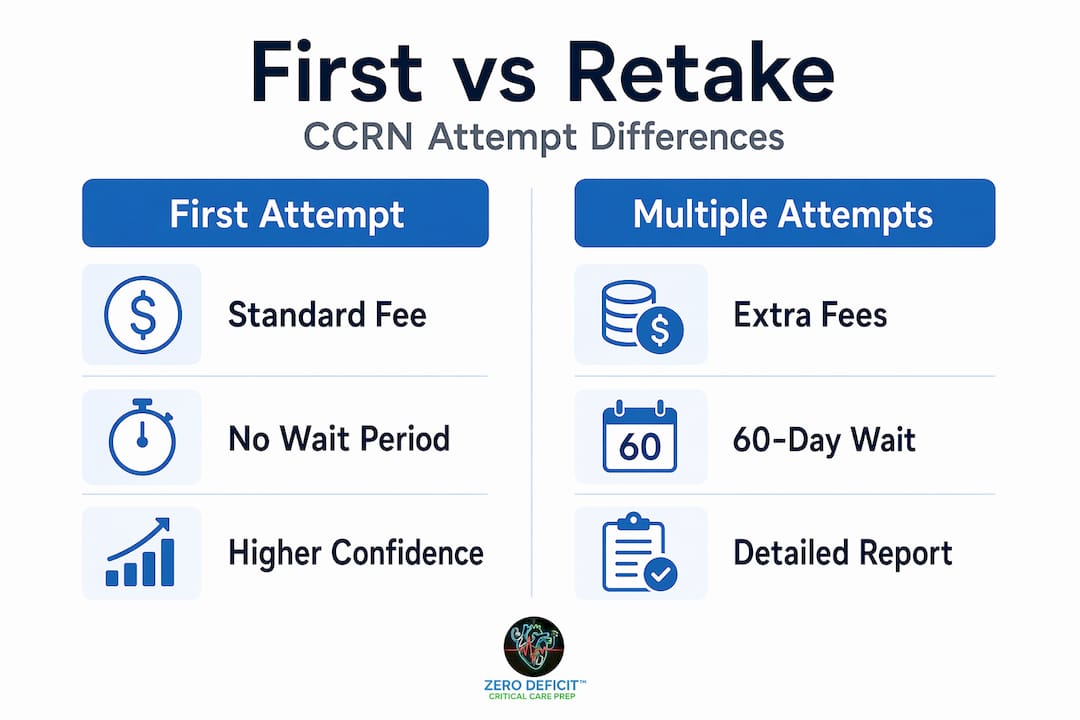
| Factor | First attempt | Multiple attempts |
|---|---|---|
| AACN fees | Standard application fee | Additional fee per retake attempt |
| Wait time | None | 45-day minimum between attempts |
| Pass likelihood | Higher with strong preparation | Drops significantly without strategy change |
| Emotional load | High but focused | Compounded stress and doubt |
| Timeline to certification | Fastest possible path | Extended by weeks or months |
| Retake limit | N/A | Up to four discounted retakes in 12 months |
After a first attempt that does not result in a pass, AACN provides a Candidate Performance Report. That report breaks down your performance by content domain and tells you exactly where your gaps live. Treat it as clinical data, not judgment. Nurses who use that report to restructure their preparation before a retake have a meaningfully better outcome than those who sit again without changing anything.
The AACN retake policy allows up to four discounted attempts within 12 months. After that window closes, you submit a new application. This structure gives you a real runway if you need it, but each attempt without a strategy adjustment narrows your odds.
My honest take on first attempt success
I’ve worked with hundreds of CCRN candidates, and what I’ve learned is this: nurses who pass on the first attempt rarely do it because they studied more hours than everyone else. They do it because they studied more purposefully. They treated every practice question as a reasoning exercise, not a content quiz.
What I’ve also seen is the toll that retakes take on nurses who genuinely know their material but underestimated the exam format or went in without enough timed practice. The content knowledge was there. The test execution wasn’t. That’s a fixable problem, but it costs time, money, and confidence that’s hard to rebuild.
My honest view is that passing on the first attempt matters. Not because failing makes you less of a nurse, but because the certification path is stressful enough without extending it. The nurses I’ve seen recover best from a failed first attempt are the ones who treat the Candidate Performance Report as a prescription and rebuild their plan from the ground up.
The goal isn’t perfection. The goal is mastery of the content the AACN tests and the reasoning skills to apply it under pressure. That’s what first attempt exam meaning comes down to, nurse to nurse.
— Zero
Start your first attempt preparation with Zero Deficit™
If you’re serious about passing the CCRN on your first sitting, your preparation tools need to match that goal. Zerodeficitccrnprep was built specifically for this. The platform gives you access to 695+ CCRN practice questions with full rationales organized by body system, so you’re not just drilling answers. You’re building the clinical reasoning the AACN actually tests.
The CCRN study guides cover all eight body systems aligned to the exam blueprint, including the high-weight cardiovascular and pulmonary content that determines most outcomes on test day. Progress tracking and performance analytics show you exactly where your preparation stands, by category, so you can adjust before exam day rather than after.
You can start with a free version with no credit card required. Explore the question bank, evaluate the rationale quality, and decide from there. Your first attempt is worth your best preparation.
FAQ
What is the passing score for the Adult CCRN exam?
The passing score for the Adult CCRN exam is 83 out of 125 scored questions. The exam contains 150 total questions, but 25 are unscored pretest items that do not count toward your result.
How many times can you retake the CCRN if you don’t pass on the first attempt?
AACN allows up to four discounted retakes within 12 months of your original application date. After that period, you must submit a new application to continue pursuing certification.
Does passing the CCRN on the first attempt affect your career?
Yes. First attempt success accelerates your certification timeline, which directly impacts eligibility for career advancement, clinical ladder promotions, and pay increases in many ICU settings.
What does “preliminary pass” mean on an exam?
A preliminary pass designation indicates a conditional passing status while final score validation is completed. For the CCRN, your immediate on-screen result is considered reliable, though understanding this terminology helps when you encounter it across other certification exams.
What should you do differently if you need to retake the CCRN?
Request your Candidate Performance Report from AACN and use it to identify your lowest-scoring content domains. Retaking with an unchanged study approach rarely produces a different result. Rebuild your plan around your specific gaps before scheduling your next attempt.
Recommended
Take a Respiratory practice quiz
Master ARDS, ventilation, ABGs, oxygenation, and pulmonary emergencies.
Get Your Free 20-Question CCRN Diagnostic
20 high-yield CCRN-style questions across every body system, with detailed rationales — emailed to you instantly.
No spam. One email + a couple of helpful follow-ups. Unsubscribe anytime.
Ready to pass your CCRN?
Join 12,000+ nurses using Zero Deficit — 695+ practice questions with rationales, AI-powered weak-area drilling, and spaced-repetition flashcards.
Start Free Trial →