Why Certification Retention Matters for Critical Care Nurses
TL;DR:
- Maintaining your CCRN requires ongoing clinical hours, targeted continuing education, and deliberate renewal efforts. Certification retention enhances patient safety, clinical confidence, and career opportunities by reflecting sustained expertise and competence. Proactive tracking, relevant practice-based CE, and early preparation are key to successful renewal and professional growth.
Passing the CCRN is a milestone worth celebrating. But here is what many nurses discover too late: why certification retention matters has nothing to do with the day you passed the exam. It has everything to do with what you do in the three years that follow. Certification is not a one-time achievement filed in a frame on the wall. It is a living credential that requires ongoing clinical hours, continuing education, and deliberate renewal. For ICU nurses managing high-acuity patients under relentless workload pressure, letting that credential lapse is not just a career setback. It is a patient safety issue.
Table of Contents
- Key takeaways
- Why certification retention matters: the renewal reality
- How retention improves patient care and clinical performance
- The career impact of maintaining your CCRN
- Practical strategies for managing your renewal cycle
- My take on why nurses underestimate this
- How Zerodeficitccrnprep supports your certification journey
- FAQ
Key takeaways
| Point | Details |
|---|---|
| Certification is an ongoing process | CCRN renewal requires 432 clinical hours and continuing education every 3 years, not a single exam. |
| Retention links to patient safety | Sustained competence and coping self-efficacy directly improve clinical decision quality under workload stress. |
| Employers value active credentials | 89% of employers prefer certified candidates, with 66% reporting stronger retention among certified staff. |
| Early tracking prevents lapse | Continuous logging of clinical hours and CE credits eliminates last-minute scrambles and penalties. |
| Renewal builds clinical confidence | Choosing evidence-based CE activities reinforces real-world skills, not just satisfying contact hour minimums. |
Why certification retention matters: the renewal reality
Many nurses treat their CCRN like a driver’s license. You pass once, and it just needs a quick renewal every few years. That framing is understandable but incomplete. Certification renewal is a structured eligibility process with specific clinical and educational requirements that many nurses misunderstand until they are facing a lapse deadline.
For the AACN CCRN specifically, renewal requires 432 clinical practice hours in critical care during the 3-year renewal period, including at minimum 144 hours in the most recent year before your renewal date. Those hours must be in direct patient care, not administrative or supervisory roles. That recency requirement catches nurses off guard more than anything else.
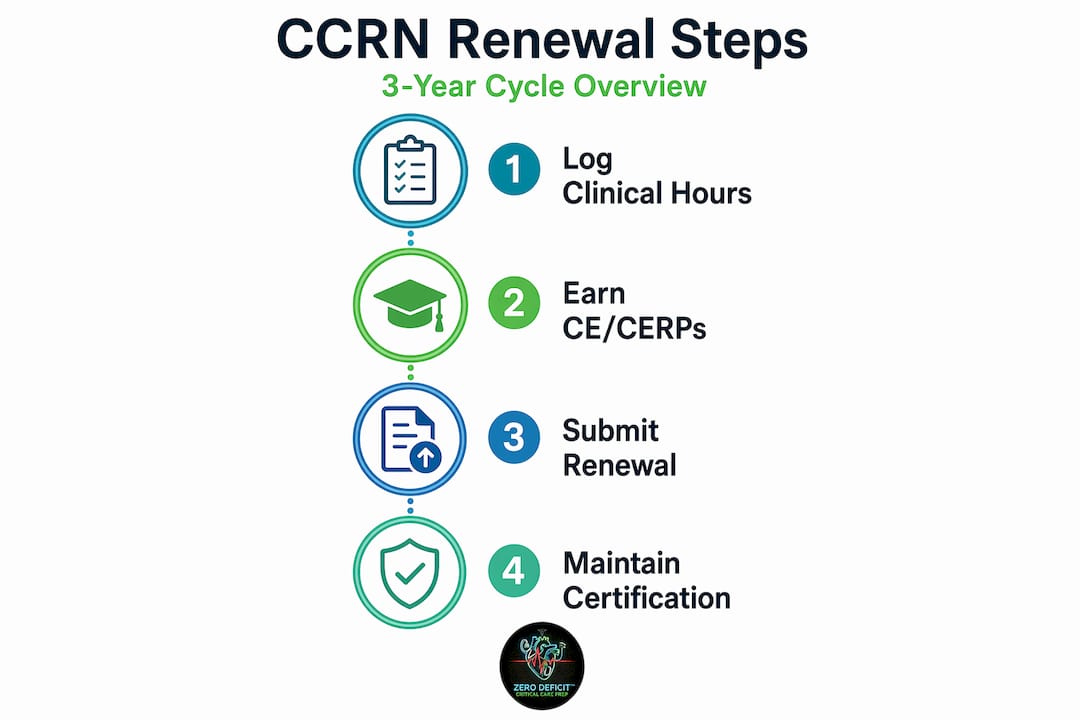
You have two pathways to renew: accumulate CERPs (Continuing Education Recognition Points) or retest. The CERP pathway requires 100 points over 3 years, including clinical inquiry and leadership activities. The retest pathway requires meeting the clinical hour threshold and passing the exam again. Both pathways share the same clinical hour eligibility gate.
ANCC certifications follow a different cadence. ANCC requires 75 CE contact hours every 5 years for recertification, with specialty-specific content requirements depending on your credential. This is separate from your state RN license renewal, which has its own CE requirements that vary by state.
Here is where nurses run into trouble most often:
- Failing to log clinical hours throughout the renewal cycle, then realizing they cannot document recency in the final year
- Confusing state license CE requirements with CCRN certification renewal requirements
- Waiting until 6 months before expiration to start accumulating CERPs
- Selecting CE activities that satisfy hour requirements but do not reinforce clinical relevance
Pro Tip: Treat your CCRN renewal like a patient care project. Open a simple spreadsheet the day you receive your certification, log every qualifying clinical shift and CE activity, and review it quarterly. Tracking early is the single most effective certification retention strategy available to you.
Certification renewal vs. license renewal: the key difference
Your RN license keeps you legally permitted to practice. Your CCRN certification signals that you meet a nationally recognized standard of critical care expertise. Letting your license lapse means you cannot work. Letting your CCRN lapse means you lose the credential that distinguishes your clinical competence. Both matter, but for different reasons.
How retention improves patient care and clinical performance
The importance of certification retention is not just a credentialing formality. The education you complete during renewal cycles directly affects how you perform at the bedside.
Structured EBP education programs improve hospital nurses’ knowledge, attitudes, and self-reported evidence-based practice at 3 months post-intervention. That finding matters because it shows that ongoing education has measurable clinical impact in a short window. The continuing education you complete for CCRN renewal is not passive box-checking. When you choose activities tied to current guidelines and real practice challenges, you are refreshing your decision-making framework.
Consider what this looks like in the ICU. A nurse who completes CE on updated hemodynamic monitoring protocols or ARDS ventilator management strategies is not just earning renewal points. They are closing the gap between what they learned at initial certification and where evidence-based practice stands today.
| Study area | Finding | Patient care impact |
|---|---|---|
| EBP education programs | Improved knowledge, attitudes, and practice at 3 months | Better alignment with current clinical guidelines |
| Coping self-efficacy under workload | Mediates prevention task performance during high workload | Sustained safety behaviors despite staffing pressure |
| Certification retention programs | Reinforce clinical decision frameworks | Reduced cognitive errors in high-acuity scenarios |
One finding that does not get enough attention: occupational coping self-efficacy fully mediates the relationship between nurse workload and medical device-related pressure injury prevention performance. In plain terms, it is not workload alone that degrades patient safety behaviors. It is how confident and capable a nurse feels managing that workload. Certification renewal activities that strengthen clinical confidence do not just feel good. They produce safer patient outcomes.
This is why the benefits of maintaining certifications extend beyond technical knowledge updates. When you engage with renewal education that targets real clinical challenges, including stress management, clinical reasoning under pressure, and evidence-based protocols, you are building the coping capacity that sustains your performance on a busy 12-hour shift.
Pro Tip: When selecting CE activities for renewal, ask yourself: “Would this change how I manage a patient today?” If the answer is no, find a different activity. Renewal content tied to practice sustains clinical decision quality far beyond accumulating minimum hours.
The career impact of maintaining your CCRN
The impact of certification on career is measurable, not just theoretical. Employers notice active credentials. They weight them in hiring decisions, advancement opportunities, and compensation structures.

89% of employers prefer certified candidates in allied health fields, 71% link certification to higher job performance, and 66% report stronger retention among certified employees. That last number matters for you personally. Certified nurses are less likely to leave their organizations, partly because certification correlates with professional engagement and institutional support.
The career advantages of certification renewal stack up across multiple dimensions:
- Compensation: Certified nurses frequently qualify for clinical ladder advancement and differential pay structures tied to specialty credentials.
- Advancement: Charge nurse, educator, and leadership roles consistently list active certification as a preference or requirement.
- Competitive positioning: Certification improves employee retention in 59% of organizations, which signals to administrators that credentialed staff are worth investing in.
- Professional identity: An active CCRN after your name signals ongoing competence, not just past achievement.
One misconception that needs clearing up: a certificate from a conference or workshop and an active professional certification are not the same thing. A certificate of attendance documents participation. An active CCRN documents that you meet a rigorously maintained national standard. Employers and colleagues know the difference, and so do accrediting bodies when hospitals pursue Magnet designation.
Why retain professional certifications through each renewal cycle? Because your credential speaks for you before you walk into any room, whether it is a hiring interview, a multidisciplinary care conference, or a performance review.
Practical strategies for managing your renewal cycle
Knowing why certification retention matters is only useful if you translate that knowledge into a system. Here is a practical framework you can start using today.
-
Set your renewal date as a recurring calendar milestone. Know your exact expiration date and work backward. Identify when you need to have your clinical hours documented and when your CE activities must be submitted.
-
Log clinical hours at the end of every month. Do not wait until renewal year to reconstruct your schedule. Meeting recency thresholds requires that 144 of your 432 hours fall in the final year of your renewal cycle, which is easy to prove only if you have been tracking throughout.
-
Prioritize CE activities tied to your ICU practice. Cardiovascular, pulmonary, neurological, and sepsis content should be at the top of your selection list because these align directly with both CCRN exam content and your daily clinical challenges. A neurology study module, for example, counts toward clinical competence and keeps your stroke and ICP management knowledge current.
-
Choose at least some CE that builds clinical resilience. Activities targeting evidence-based decision-making under pressure do double duty: they satisfy renewal requirements and they strengthen the coping self-efficacy that research links directly to patient safety performance.
-
Set a 6-month checkpoint. Halfway through your renewal cycle, review your logged hours and CERPs. If you are behind, you have time to correct course without scrambling or paying for expedited processing.
Pro Tip: If you are considering the retest pathway for renewal, use practice tests to assess your readiness early. Discovering knowledge gaps 6 weeks before your renewal deadline is manageable. Discovering them 6 days before is not.
Quick-reference: certification renewal requirements for ICU nurses
| Certification | Renewal cycle | Clinical hours required | CE/CERP requirement | Retest option |
|---|---|---|---|---|
| AACN CCRN (Adult) | 3 years | 432 total, 144 in final year | 100 CERPs | Yes |
| ANCC specialty certifications | 5 years | Varies by specialty | 75 contact hours | Yes |
| Both | Ongoing | Required for eligibility | Specialty content required | Credential-dependent |
These requirements exist because clinical practice evolves. What you knew when you first passed the CCRN is not sufficient for the patient you will see in three years. Renewal requirements reflect that reality.
My take on why nurses underestimate this
I have worked with hundreds of critical care nurses preparing for and renewing their CCRN, and I keep seeing the same pattern. Nurses treat initial certification as the finish line and renewal as an administrative inconvenience. Then something shifts. A near-miss at the bedside. A promotion that went to a colleague with an active credential. A renewal application rejected because clinical hour documentation was incomplete.
What I have learned is that the nurses who get the most out of their CCRN renewal are the ones who treat it as a development cycle, not a paperwork cycle. They choose CE that actually challenges their practice. They reflect on what has changed in critical care guidelines since their last renewal. They come out of the process sharper, not just compliant.
The contrarian view I hold is this: the clinical hour recency requirement, which most nurses find the most frustrating part of renewal, is actually the most valuable. It forces active bedside engagement. You cannot coast through renewal on conference attendance alone. You have to be in the unit, managing patients, staying current.
If you see your CCRN not just as a credential but as a record of sustained clinical excellence, retention stops feeling like a burden. It becomes the framework for the kind of nurse you are committed to being.
— Zero
How Zerodeficitccrnprep supports your certification journey
Maintaining your CCRN credential requires clinical hours, targeted CE, and a clear understanding of what the exam tests. Zerodeficitccrnprep is built specifically for critical care nurses who want to walk into any exam or renewal cycle fully prepared.
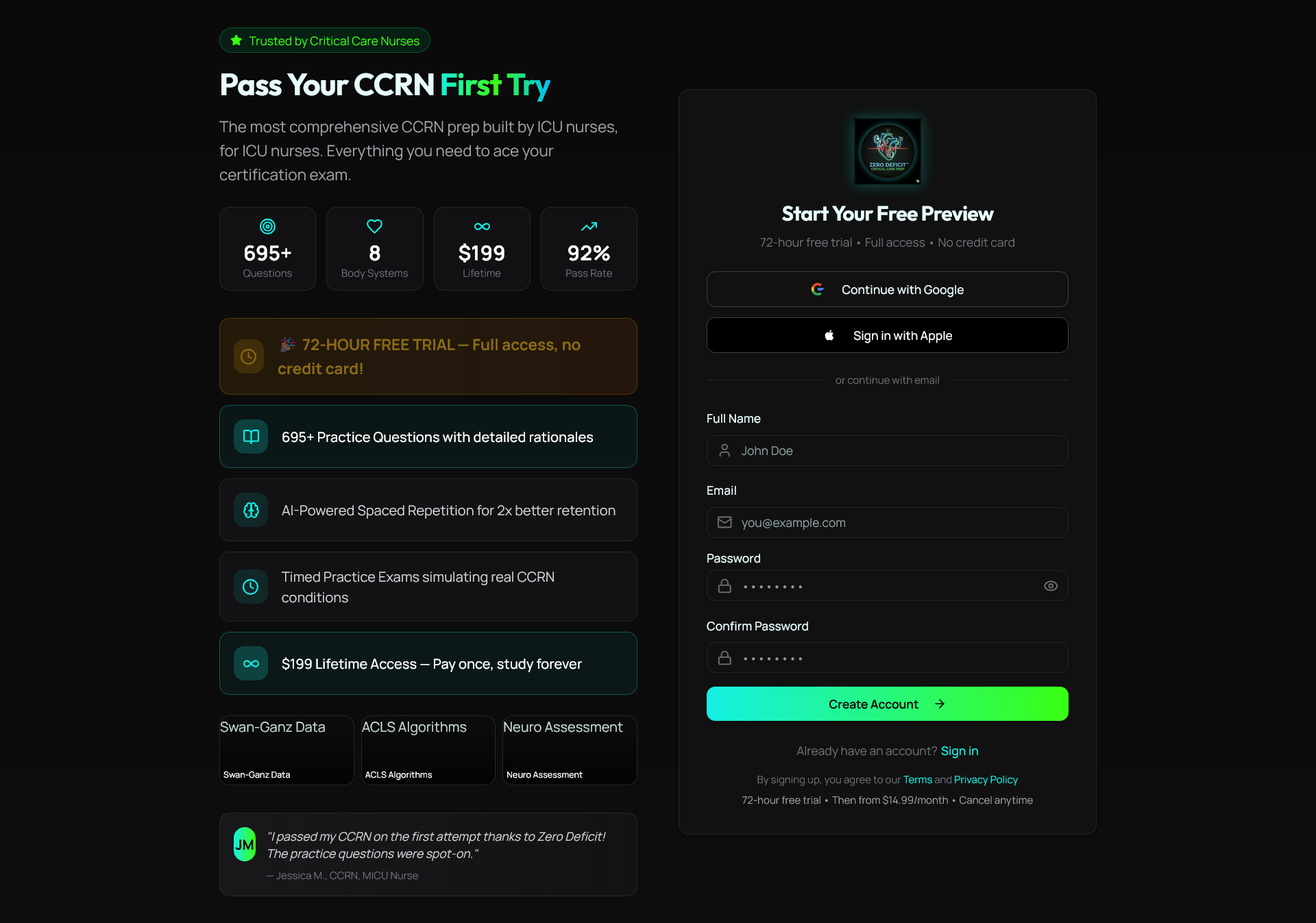
The platform offers over 695 practice questions with detailed clinical rationales, body system study guides aligned to the AACN exam blueprint, and AI-powered review tools that adapt to your knowledge gaps. Whether you are renewing via the retest pathway or building CE knowledge for your CERP submission, the subscription plan gives you structured, clinically relevant prep that goes beyond minimum hour accumulation. Use the question breakdown methods to master the reasoning skills that hold up under pressure, both on exam day and during your next ICU shift.
FAQ
What are the CCRN renewal requirements for clinical hours?
The AACN CCRN requires 432 clinical practice hours in critical care over the 3-year renewal period, with at least 144 of those hours completed in the most recent year before your renewal date.
How does certification retention affect patient safety?
Research shows that ongoing certification education sustains clinical competence and coping self-efficacy, which directly mediates safe patient care behaviors during high workload situations.
What is the difference between CE for license renewal and CCRN renewal?
State RN license renewal and CCRN recertification have separate CE requirements. ANCC requires 75 contact hours every 5 years for certification, while state license renewal requirements vary and are regulated independently.
How can I improve my certification retention rate?
Start tracking clinical hours and CE credits from day one of your renewal cycle, select evidence-based practice content tied to your ICU specialty, and review your progress every 6 months to avoid last-minute gaps.
Does an active CCRN really affect hiring and promotion decisions?
Yes. Industry data shows 89% of employers prefer certified candidates, with 71% linking certification directly to higher job performance. Active credentials signal sustained competence, not just past achievement.
Recommended
- Nursing Certification Terminology Explained for ICU Nurses | Zero Deficit CCRN Prep
- 2026 Trends in Critical Care Certification You Must Know | Zero Deficit CCRN Prep
- Pass the CCRN Exam: Proven Guide for Critical Care Nurses | Zero Deficit CCRN Prep
- How educators boost CCRN certification success for nurses | Zero Deficit CCRN Prep
Take a Neurological practice quiz
Test your knowledge of stroke, ICP, seizures, and neuro assessment.
Ready to pass your CCRN?
Join 12,000+ nurses using Zero Deficit — 695+ practice questions with rationales, AI-powered weak-area drilling, and spaced-repetition flashcards.
Start Free Trial →