2026 Trends in Critical Care Certification You Must Know
TL;DR:
- dramatically accelerates critical care certification changes with exam overhauls, AI competency requirements, and expanded specialties. Credentialing bodies update blueprints based on current ICU practices, emphasizing topics like ICP management and pulmonary vasodilators that reflect real-world clinical shifts. Staying current with updated study resources, spreading continuing education over the certification cycle, and understanding the broader specialty ecosystem are essential for exam success and professional growth.
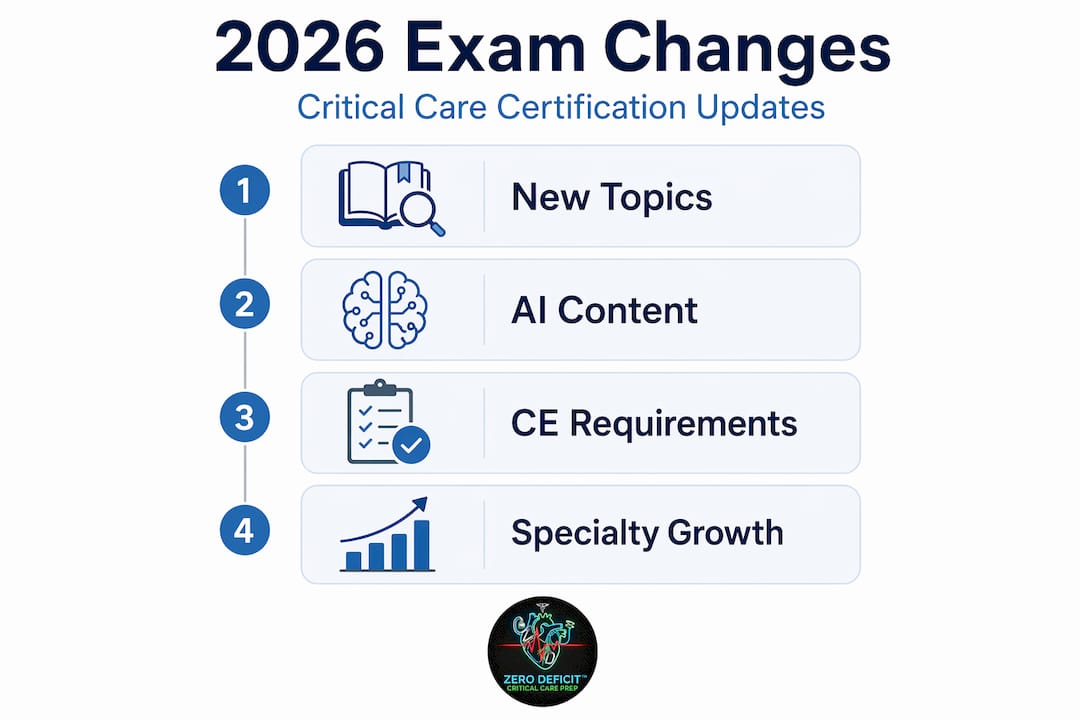
If you think critical care certifications change slowly, 2026 will correct that assumption fast. The 2026 trends in critical care certification include exam content overhauls, formal AI competency requirements, and an expanding specialty ecosystem that reshapes what you need to know before you sit for any credential. These are not minor tweaks. AACN, BCEN, and other credentialing bodies are updating blueprints to mirror what actually happens in modern ICUs, and nurses who prep with outdated materials will feel the gap.
Table of Contents
- Key takeaways
- 2026 trends in critical care certification and new exam content
- AI and technology’s role in 2026 certification
- Renewal and continuing education trends for 2026
- Expanding specialty certifications in critical care
- My honest take on managing 2026 certification shifts
- Prepare for 2026 with Zero Deficit CCRN Prep
- FAQ
Key takeaways
| Point | Details |
|---|---|
| Exam blueprints are updated | New topics like ICP management and pulmonary vasodilators reflect real 2026 ICU practice. |
| AI literacy is now assessed | Certification content includes AI ethics, safety, and algorithmic bias recognition. |
| Renewal requires strategic planning | Meeting 100 CE points over 3 years demands early, consistent credit accumulation. |
| Specialty certifications are expanding | CFRN, CTRN, and neurocritical care credentials signal broader knowledge expectations. |
| Updated prep resources matter | Studying from 2026-aligned materials protects you from knowledge gaps on exam day. |
2026 trends in critical care certification and new exam content
The single biggest misconception nurses carry into exam prep is that certification blueprints stay static. They do not. Certifying bodies like AACN and BCEN conduct thorough role delineation studies roughly every five years, surveying practicing clinicians to verify that every tested topic reflects actual job functions and current patient care standards. When results show a topic has gained clinical prevalence, it gets added. When a topic becomes setting-specific or outdated, it gets removed.
For 2026, the clearest example is the BCEN CFRN exam. CFRN content updates effective August 31, 2026 introduce new subjects including intracranial pressure management, aortic emergencies, and inhaled pulmonary vasodilators. These additions came directly from a 2025 Flight Nursing Role Delineation Study that documented how flight nursing practice has shifted toward mobile critical care delivery with advanced diagnostics and independent clinical decision making.
This matters to you even if you are not pursuing the CFRN. Content shifts in specialty exams signal what the broader critical care world considers clinically significant. ICP management and pulmonary vasodilators are not niche topics. They appear in adult ICU care daily. If your current study materials predate these updates, you risk arriving at your exam underprepared on questions that carry real weight.
Here is what the 2026 content changes mean for your study approach:
- New high-yield topics: ICP monitoring and management, inhaled nitric oxide and other pulmonary vasodilators, aortic emergency management
- Removed content: Topics with low clinical frequency or narrow setting specificity are being phased out, freeing your study time for material that matters
- Blueprint-driven focus: Role delineation studies ensure every tested competency ties back to verified clinical practice, not academic theory
Pro Tip: Cross-reference your current study guide against the most recent AACN or BCEN content outline before you schedule your exam. A 30-minute audit now saves hours of misdirected studying later.
AI and technology’s role in 2026 certification
Artificial intelligence is no longer a future consideration in the ICU. It is already there. Sepsis prediction algorithms, tele-critical care monitoring platforms, and AI-assisted ventilator management tools are part of daily workflow in many units. The certification world has caught up.

AACN’s position on AI in critical care makes clear that nurses need competencies well beyond basic technology familiarity. The expectation now includes understanding AI safety frameworks, recognizing when an algorithm may be producing biased outputs, and applying ethical nursing principles when AI is involved in clinical decisions. You are not just expected to use the tool. You are expected to advocate for your patient when the tool gets it wrong.
This is one of the most consequential critical care education advancements in recent memory. Certification content now assesses whether you understand accountability structures when AI contributes to patient care. What happens when a sepsis prediction algorithm flags a low-risk patient and you override it? What happens when it misses a high-risk one and you follow it? These are not hypothetical scenarios. They are real clinical situations that now carry certification-level scrutiny.
“Critical care nurses must be the check on AI, not just the operators of it. The algorithm does not carry nursing licensure. You do.” — Adapted from AACN’s AI in Critical Care framework
The practical implication for your prep: do not skip any questions or study content touching on clinical ethics, patient advocacy, or technology safety. These areas are being weighted more heavily precisely because AI creates new categories of clinical risk. Treating AI literacy as a separate technical skill misses the point. It is a nursing ethics issue.
Renewal and continuing education trends for 2026
Understanding renewal requirements is not glamorous, but an expired CCRN is a genuine professional setback. Here is what the 2026 renewal landscape looks like and how to stay ahead of it.
AACN offers two pathways for CCRN renewal:
- Synergy CERP pathway: Accumulate 100 CE points over 3 years, with at least 48 points in Category A (direct clinical practice content). The remaining points can fall under Category B, which includes professional development, leadership, and educational activities.
- Exam retake pathway: Pass the current CCRN exam again. Some nurses prefer this route when they want to refresh their full knowledge base, though it requires significant time investment.
Both pathways require clinical hour attestation. You must document that you are actively practicing in a critical care setting throughout the certification cycle.
The trend shaping 2026 healthcare certification changes is the move toward balanced, multi-category CE portfolios built consistently over the full three years. Spreading CE accumulation across your entire certification cycle reduces failure risk and keeps your knowledge current. Cramming 80 CE points into the final six months of your cycle is a stress you do not need, and it undermines the point of ongoing competency development.
AACN’s NTI 2026 conference is one of the most efficient CE opportunities available. It offers nearly 50 topics and up to 37.75 CE contact hours across in-person and on-demand sessions through October 31, 2026. A single conference can substantially close a CE gap while keeping you connected to the latest clinical evidence.
Pro Tip: Map your Category A and Category B CE targets at the start of your certification cycle, not near renewal. Knowing you need 48 Category A points gives you a clear benchmark to track against your study progress throughout the year.
If your certification has already lapsed, reinstatement is possible but involves additional requirements. Do not wait to find out what those are. Staying current is substantially easier than recovering from a lapse.
Expanding specialty certifications in critical care
The critical care certification ecosystem is broader in 2026 than most nurses realize, and awareness of that ecosystem sharpens your exam preparation in concrete ways. These are not separate silos. Specialty credential trends feed directly into the clinical knowledge expectations for the CCRN.
| Certification | Issuing Body | 2026 Development | Relevance to CCRN Prep |
|---|---|---|---|
| CFRN (Flight Registered Nurse) | BCEN | New content outline effective Aug 31, 2026 | ICP, aortic emergencies, pulmonary vasodilators now tested |
| CTRN (Certified Transport RN) | BCEN | 20th anniversary with updated exam offerings | Transport and stabilization competencies |
| CBRN (Certified Burn RN) | BCEN | Growth among nearly 55,000 BCEN-certified nurses | Specialized wound and critical injury management |
| Neurocritical Care | AOBS | New subspecialty certification in 2026 with remote proctored exam | Neuro content increasingly complex across care settings |
The neurocritical care subspecialty introduced by the American Osteopathic Board of Surgery is particularly significant. It signals that neuro-focused critical care has reached enough clinical complexity and interdisciplinary weight to justify its own credentialing pathway. For adult CCRN candidates, this underscores why neuro topics like ICP management, stroke protocols, and sedation management are not optional review areas. They are core competencies.
The specialty ecosystem also illustrates a broader trend in nursing certifications: credentials are becoming more specific and more clinically demanding at the same time. That is good news for your professional value. It also means you need to stay informed about shifts across the landscape, not just within your primary certification.
My honest take on managing 2026 certification shifts
I have watched many nurses approach certification with a plan built entirely around materials that were already two years old when they opened them. The content gaps this creates are real. Studying outdated outlines is not just inefficient. It gives you false confidence going into exam day.
What I have learned from tracking these trends closely is that the nurses who do best are the ones who treat certification as a living professional commitment rather than a one-time event. That means checking the current blueprint before you start studying, not after you get your score report. It means taking the AI and ethics content seriously, not skimming it because it feels abstract. The CCRN exam prep strategies that hold up year after year are the ones built around current content, not inherited study habits.
My advice on CE is equally direct. Do not wait until year three of your cycle to start accumulating points. Use NTI, use online modules, use your hospital’s professional development offerings. Map your Category A versus Category B split early and revisit it every six months. Treating renewal as a sprint is how nurses end up retaking the exam when they didn’t plan to.
The expanding specialty ecosystem is worth your attention even if you are not pursuing a CFRN or CTRN. When the flight and transport nursing community identifies ICP management as a core competency, that tells you something about where adult critical care practice is heading. Stay curious about the broader field. It will make your CCRN prep more grounded, not more complicated.
— Zero
Prepare for 2026 with Zero Deficit CCRN Prep
The content shifts outlined in this article require updated study materials that reflect what is actually on your exam. Zerodeficitccrnprep has you covered.
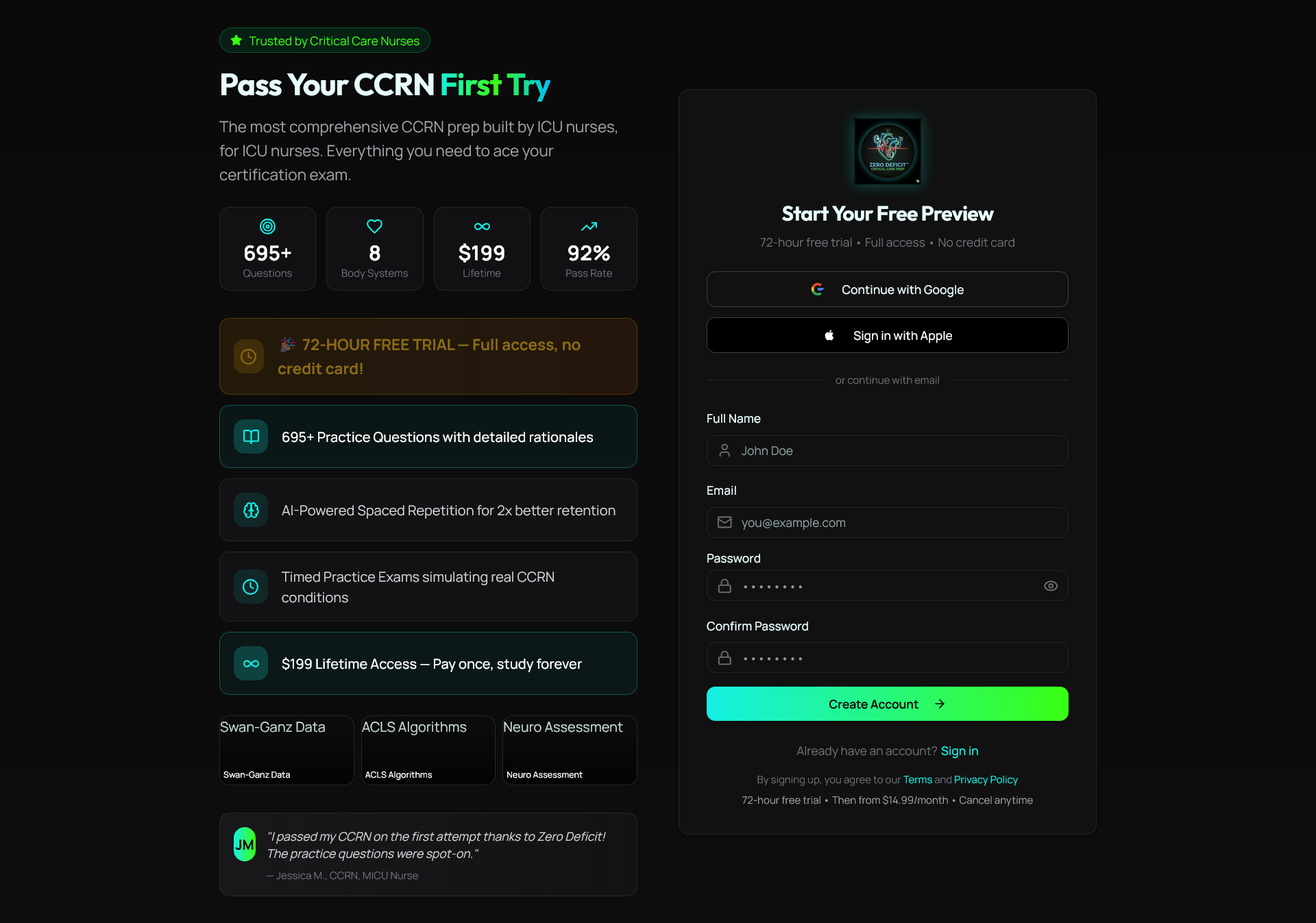
The 2026 CCRN exam guide at Zerodeficitccrnprep covers all eight body systems aligned with the current blueprint, including the neurological and cardiovascular content that has grown in clinical weight this cycle. The 695+ practice questions include detailed rationales that build real clinical reasoning, not just answer recognition. Progress tracking tools let you map your CE and study activity against renewal benchmarks so nothing falls through the cracks. Start studying free at Zero Deficit CCRN Prep today, no credit card required. You will know within minutes whether the material matches your level.
FAQ
What new topics appear on critical care certification exams in 2026?
The BCEN CFRN exam effective August 31, 2026 adds ICP management, aortic emergencies, and inhaled pulmonary vasodilators based on the 2025 Flight Nursing Role Delineation Study.
How many CE points does CCRN renewal require in 2026?
AACN requires 100 CE points over 3 years for Synergy CERP renewal, with at least 48 points in Category A clinical practice content plus clinical hour attestation.
Why does AI matter for critical care certification now?
Certification content now assesses AI safety accountability, ethical nursing practice, and recognition of algorithmic bias because AI tools are embedded in daily ICU workflows.
What is the best strategy for CCRN renewal CE accumulation?
Spread CE credits evenly across your full three-year certification cycle, mapping Category A and B requirements early to avoid last-minute gaps or potential certification lapses.
How do specialty certifications like CFRN affect adult CCRN prep?
Specialty exam updates signal clinical trends entering the broader critical care knowledge base, making awareness of CFRN and neurocritical care content directly relevant to CCRN study priorities.
Recommended
Take a Neurological practice quiz
Test your knowledge of stroke, ICP, seizures, and neuro assessment.
Get Your Free 20-Question CCRN Diagnostic
20 high-yield CCRN-style questions across every body system, with detailed rationales — emailed to you instantly.
No spam. One email + a couple of helpful follow-ups. Unsubscribe anytime.
Ready to pass your CCRN?
Join 12,000+ nurses using Zero Deficit — 695+ practice questions with rationales, AI-powered weak-area drilling, and spaced-repetition flashcards.
Start Free Trial →