Advantages of practice tests for CCRN exam success
TL;DR:
- Practice tests outperform passive review by actively strengthening recall and clinical reasoning essential for CCRN success. Regular, spaced practice attempts improve retention, build exam stamina, and significantly increase passing probability. Incorporating structured practice tests into study routines maximizes efficiency and confidence for critical care nurses preparing for certification.
The CCRN exam covers more than 150 clinical topics across eight body systems, and passing on your first attempt requires more than long study hours. It requires the right study method. As a critical care nurse juggling 12-hour shifts, you need every study minute to count. The advantages of practice tests go far beyond simple exam preparation: research shows they dramatically outperform passive review for retention, score improvement, and clinical reasoning under pressure. This article breaks down exactly why practice tests should anchor your CCRN study plan, with evidence and strategies you can use starting today.
Table of Contents
- Why practice tests beat re-reading for CCRN study
- Practice tests improve retention and CCRN exam scores
- Multiple practice attempts raise passing probability for CCRN candidates
- Effective strategies to maximize benefits of practice tests for CCRN prep
- Comparing practice tests with other CCRN study methods
- Why many nurses underestimate practice testing — and how to change that
- Start boosting your CCRN exam prep with Zero Deficit™ practice tests
- Frequently asked questions
Key Takeaways
| Point | Details |
|---|---|
| Practice tests improve retention | Active recall through practice tests reduces forgetting by over 300% compared to re-reading. |
| Repeated testing boosts passing odds | Each additional quiz attempt raises CCRN exam passing chances by about 10%. |
| Practice tests save study time | They help busy nurses improve exam scores up to 20% in half the study time. |
| Testing reveals knowledge gaps | Practice tests expose weak areas for targeted study unlike passive review. |
| Combine testing with spaced review | Spacing practice tests over weeks strengthens memory and builds exam stamina. |
Why practice tests beat re-reading for CCRN study
Most nurses default to re-reading textbooks or reviewing notes between shifts. It feels productive. The pages look familiar, the concepts seem clear, and there is a sense of comfort in recognizing material you have already seen. That comfort is the problem.
Re-reading promotes recognition, not recall. Recognition means you can identify the right answer when you see it. Recall means you can retrieve it under exam pressure when the only thing in front of you is a clinical scenario. The CCRN exam tests recall. Passive review almost never builds it.
Practice tests force your brain to actively reconstruct information from scratch. That process, known as retrieval practice, physically strengthens the neural pathways associated with that knowledge. Every time you successfully retrieve a concept about cardiac output, hemodynamic monitoring, or ventilator management, the memory becomes more durable and accessible. Missing it hurts in the short term but produces even stronger consolidation when you review the correct answer and test yourself again.

The data backs this up. Students using practice tests forgot only 13% of material after one week compared to 56% for those who re-read, a retention gap that matters enormously when your CCRN exam is weeks away. And this is not an isolated finding. Practice testing earned a “high utility” rating in educational psychologist John Dunlosky’s influential 2013 review, while re-reading and highlighting received “low utility.” That is as decisive as any research comparison gets.
Here is what practice tests specifically do for CCRN candidates:
- Reveal hidden knowledge gaps in high-weight domains like cardiac and respiratory critical care before exam day
- Force application of clinical reasoning, not just fact recognition, matching the CCRN’s scenario-based format
- Build tolerance for retrieval effort, the productive discomfort that turns struggling with a question into long-term mastery
- Provide instant feedback so you know exactly which body system or concept needs more attention
“Testing yourself when studying is far more effective than re-reading your notes, and the evidence is overwhelming.”
That is not motivation talk. It is the scientific foundation for why you should boost CCRN exam success by making practice tests your primary study tool, not a supplement.
Practice tests improve retention and CCRN exam scores
The retention gains from practice testing translate directly into better scores. That is the connection that matters most for nurses who need to pass the first time.
Practice tests can boost exam scores by up to 20% while achieving results in roughly half the study time compared to passive review. For a critical care nurse with limited study windows between shifts, that efficiency is not just convenient; it can be the difference between passing and failing. Getting more output from fewer study hours is exactly what a demanding ICU schedule requires.
Here is what that score improvement looks like in practice:
- Active recall accelerates memory consolidation for CCRN content across all eight body systems
- Repeated exposure to clinical question formats trains your brain to think in AACN terms, not just recall facts
- Score data from each practice session tells you where to focus next, eliminating wasted study on topics you already know
- Simulating 3-hour exam conditions builds the stamina and mental endurance the real CCRN demands
Key stat: Nurses using practice tests as their primary study method can see up to a 20% score improvement in less total study time than passive reviewers.
The stamina factor is underappreciated. The CCRN exam is 150 questions over three hours. Many nurses who know the material still struggle late in the exam because their brains are not conditioned for sustained clinical decision-making under time pressure. Practice tests build that conditioning. Sitting through 50 or 75-question blocks regularly is not just content review; it is mental training for exam day.
Take advantage of CCRN practice tests and quizzes that mirror the real exam’s structure and difficulty so your body and brain know exactly what to expect when you sit down to test.
Multiple practice attempts raise passing probability for CCRN candidates
Taking one practice test is a good start. Taking three or more is where the real gains happen.
Each additional practice quiz attempt raises your exam passing probability by approximately 10%, with substantial gains occurring after three or more attempts, even when initial accuracy is only moderate. That means a nurse who scores 60% on her first practice test and keeps going is still building meaningful advantage over a nurse who scores 80% once and stops.
Here is how to structure your practice attempts for maximum benefit:
- Take an initial diagnostic test without any specific preparation to identify your genuine starting point across all body systems
- Review every wrong answer immediately after the test, reading the full rationale to understand the clinical reasoning, not just the correct choice
- Return to weak domains in targeted study sessions using body system guides before your next full practice test
- Space your next practice test at least 48 to 72 hours after studying, allowing memory consolidation to occur before retrieval
- Repeat the cycle at least three times before your scheduled exam date, progressively increasing question block length
| Study method | Retention after 1 week | Score improvement | Time efficiency |
|---|---|---|---|
| Practice testing (3+ attempts) | ~87% | Up to 20% | High |
| Practice testing (1 attempt) | ~75% | Moderate | Moderate |
| Re-reading notes | ~44% | Minimal | Low |
| Highlighting/annotating | ~40% | Minimal | Low |
Practice testing also narrows the performance gap between nurses with different starting proficiency levels. A nurse newer to ICU may begin with lower scores but catches up faster through repeated retrieval than through additional passive review. The method is that consistent.
Pro Tip: After each practice test, flag every question you answered incorrectly or guessed on. Create a short list of those topics and schedule a focused review session before your next test. Retest those specific topics in a targeted quiz 48 hours later to confirm they have moved from recognition to genuine recall. Access CCRN practice questions to build this rotation systematically.
Effective strategies to maximize benefits of practice tests for CCRN prep
The value of practice assessments depends heavily on how you use them. Random, unplanned testing helps less than a structured approach. Here is how to get the most out of every session.
- Schedule practice tests on a consistent calendar. Aim for three sessions per week for at least eight weeks. The CCRN exam guide recommends combining practice tests with spaced repetition three times per week for 8 to 12 weeks for maximum retention and endurance
- Use low-stakes quizzes to simulate pressure without panic. Short 10 to 20 question quizzes early in your prep help you build confidence and familiarity with clinical question formats before longer test blocks
- Review rationales for both wrong and right answers. Knowing why the correct choice is correct deepens clinical judgment and prevents pattern-matching mistakes on novel exam scenarios
- Track your progress by body system. If your cardiac scores are strong but neurological scores lag, shift your study balance accordingly before your next test
- Treat practice tests as data, not grades. A low score on a practice test is valuable information, not a reason to worry. It tells you exactly where to direct your next study session
Pro Tip: Resist the urge to cram heavily with practice tests the week before your exam. Consistent, spaced self-assessment over weeks produces far more durable memory than an intensive last-minute push. Your brain consolidates memory during rest, not just during study.
The importance of practice tests lies partly in what they prevent: the dangerous illusion that familiarity equals readiness. Re-reading creates confidence that the real exam quickly dismantles. Practice tests create readiness that holds under pressure.
Comparing practice tests with other CCRN study methods
Not all study methods are equal for CCRN prep, and knowing where each one fits helps you build a smarter plan.
| Study method | Active recall | Instant gap identification | Exam condition simulation | Long-term retention |
|---|---|---|---|---|
| Practice testing | Yes | Yes | Yes | Highest |
| Flashcards | Yes | Partial | No | High |
| Study guides | No | No | No | Moderate |
| Re-reading notes | No | No | No | Low |
| Highlighting | No | No | No | Lowest |
Re-reading and highlighting receive “low utility” ratings in educational research while practice testing earns “high utility,” making it the most evidence-backed approach for CCRN prep.
The practical advantages of practice tests over other methods include:
- Immediate identification of clinical knowledge gaps, so you stop wasting time studying what you already know
- Forced clinical reasoning under time limits, which passive methods cannot replicate
- Realistic exposure to AACN question formats, reducing cognitive load on exam day because the format feels familiar
- Emotional preparation, because knowing you can handle a 75-question timed block makes the real exam feel less overwhelming
Study guides and flashcards are genuinely useful but work best as preparation for practice tests, not as replacements. Read your body system guide, then immediately test yourself on those concepts. That sequence maximizes the benefit of both. Learn more about why assessment matters for CCRN certification outcomes.
Why many nurses underestimate practice testing — and how to change that
Here is something the study strategy articles rarely say directly: most nurses know practice tests work. They just avoid doing them anyway.
The reason is simple. Practice testing feels harder than re-reading, and that difficulty triggers avoidance. When you sit down to answer 50 CCRN-style questions and get 30% wrong, it does not feel like studying. It feels like failing. Re-reading feels productive. It feels safe. And so nurses default to the method that protects their confidence in the short term while costing them their pass rate in the long term.
Nurses who could benefit most from practice tests often avoid them due to discomfort and low motivation, but structured incentives and peer support significantly improve engagement and outcomes. That is a clinical reality, not a moral judgment. The fix is not willpower alone; it is structure.
What actually works: set a non-negotiable practice test schedule, the same way you block off shifts. Find a study partner or accountability group. Reward yourself for completing sessions, not for achieving a particular score. Reframe low scores as diagnostic information rather than personal failure. The nurses who pass their CCRN on the first attempt are rarely the ones who found practice tests easy. They are the ones who kept going when the tests were hard.
There is also a growth mindset element worth naming. Every wrong answer on a practice test is a specific, fixable gap. That is a gift. It is far better to discover that gap on a practice question at home than on the real exam. Build that mental frame and practice testing goes from uncomfortable to genuinely motivating. Explore strategies to boost CCRN prep motivation and build the consistency that leads to exam day confidence.
Start boosting your CCRN exam prep with Zero Deficit™ practice tests
You now know the science, the strategies, and the evidence behind practice testing for CCRN success. The next step is putting that knowledge to work with a resource built specifically for critical care nurses.
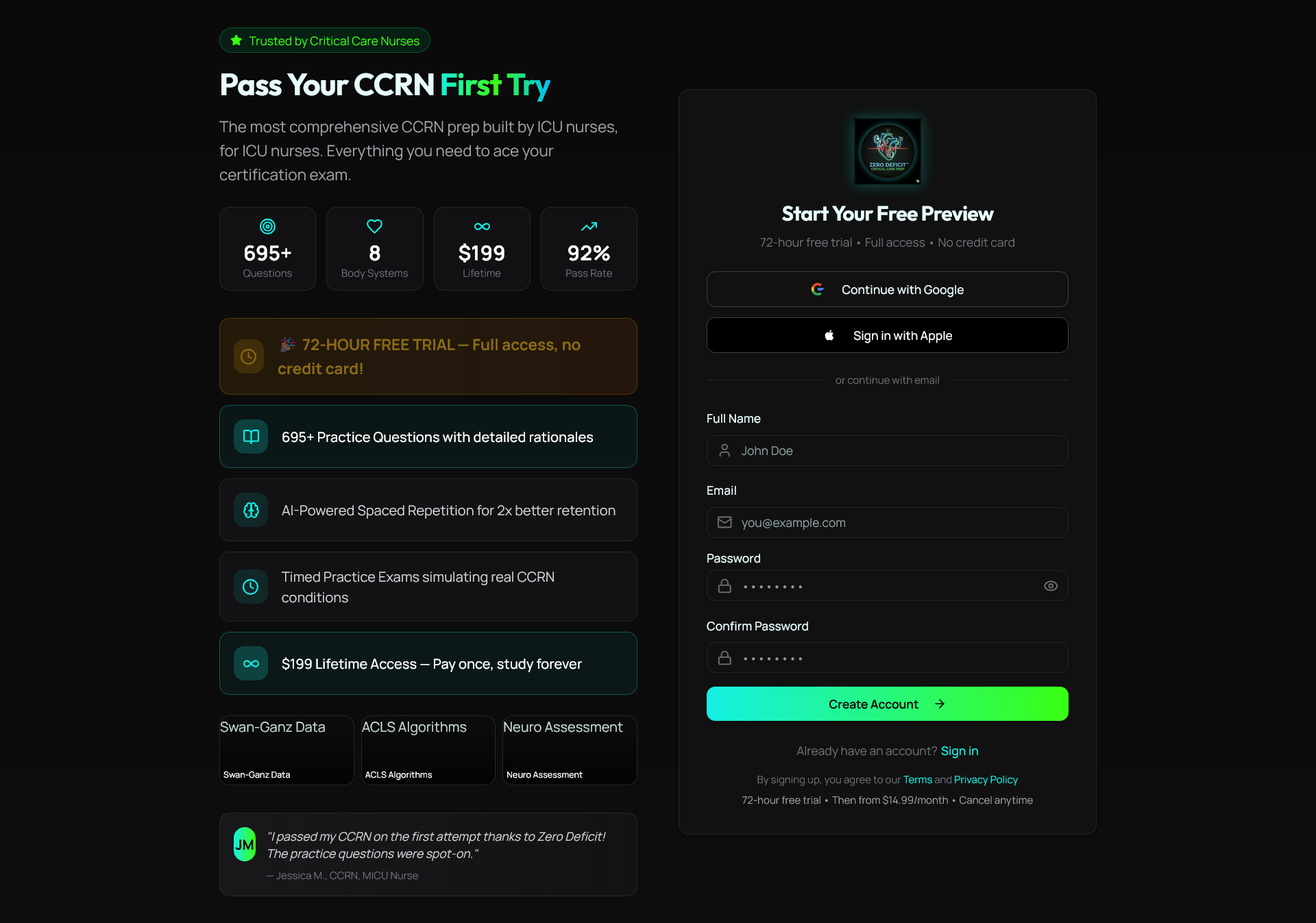
Zero Deficit™ CCRN Exam Prep gives you access to over 695 CCRN practice questions and sample tests mapped directly to the AACN exam blueprint across all eight body systems. Every question includes a detailed rationale so you learn from every attempt, not just score it. You can take CCRN practice tests and quizzes under timed conditions that replicate the real exam, track your progress by body system, and identify weak spots before they cost you on exam day. Pair your test sessions with comprehensive CCRN study guides to reinforce the concepts your scores tell you to prioritize. Start studying free at Zero Deficit CCRN Prep today, no credit card required, and see exactly what your CCRN prep has been missing.
Frequently asked questions
How do practice tests improve long-term retention for CCRN exam candidates?
Practice tests require active recall, which rebuilds memory pathways far more durably than passive review. Students using practice tests forgot only 13% of material after one week compared to 56% for those who re-read, a gap that directly impacts exam performance.
Is it better to take many practice tests or focus on a few high-quality ones?
Volume and spacing both matter. Each additional practice quiz attempt raises your exam passing probability by roughly 10%, with the biggest gains appearing after three or more tests, even when your early accuracy is moderate.
Can practice tests reduce test anxiety for busy critical care nurses?
Yes. Repeated exposure to timed, exam-style questions builds familiarity and mental stamina, which directly reduces anxiety. Low-stakes quizzes build endurance and turn the discomfort of forgetting into a tool for retention rather than a source of panic.
What study strategies enhance the effectiveness of practice testing?
Spacing your tests across weeks and reviewing wrong-answer rationales immediately after each session produces the strongest results. Combining practice tests with spaced repetition three times per week for 8 to 12 weeks gives CCRN candidates the retention and endurance they need on exam day.
Recommended
Take a Neurological practice quiz
Test your knowledge of stroke, ICP, seizures, and neuro assessment.
Get Your Free 20-Question CCRN Diagnostic
20 high-yield CCRN-style questions across every body system, with detailed rationales — emailed to you instantly.
No spam. One email + a couple of helpful follow-ups. Unsubscribe anytime.
Ready to pass your CCRN?
Join 12,000+ nurses using Zero Deficit — 695+ practice questions with rationales, AI-powered weak-area drilling, and spaced-repetition flashcards.
Start Free Trial →