CCRN EKG Interpretation: Critical Care Nurse Guide
TL;DR:
- CCRN EKG interpretation is essential for analyzing cardiac rhythms and guiding clinical decisions, directly influencing exam scores. A systematic approach involving rhythm, rate, axis, and interval assessment, combined with focused study plans and scenario-based practice, improves accuracy and efficiency under exam conditions. Recognizing electrolyte, medication, and ischemic effects on the EKG is critical for advanced understanding and timely intervention.
CCRN EKG interpretation is the process critical care nurses use to analyze cardiac electrical activity, identify life-threatening rhythms, and apply those findings to clinical decisions as a core competency for passing the Adult CCRN exam. The AACN weights cardiovascular content at 17% of the exam, roughly 21 scored questions covering ACS, shock, and dysrhythmias. That means your EKG skills directly affect your score. This guide gives you the systematic approach, study strategies, and high-yield clinical knowledge you need to master cardiac strips for both the exam and the ICU.
What does CCRN EKG interpretation actually require?
CCRN EKG interpretation goes beyond naming a rhythm. The formal term used in clinical education is electrocardiogram (ECG) interpretation, and the CCRN exam uses both “ECG” and “EKG” interchangeably. What the exam actually tests is your ability to read a strip, connect it to a clinical picture, and select the correct intervention.

The 12-lead ECG provides 12 vector views of cardiac electrical activity, enabling diagnosis of arrhythmias, ischemia, and conduction abnormalities. That breadth is exactly why it appears so heavily in CCRN-level questions. A single strip can reveal a STEMI, a hyperkalemia pattern, or a drug toxicity before any lab result returns.
The table below summarizes the core EKG components you must know cold for the exam.
| EKG Component | Normal Range | Clinical Significance |
|---|---|---|
| P wave | Upright, <120 ms | Atrial depolarization; absent in A-fib |
| PR interval | 120–200 ms | AV conduction time; prolonged in heart block |
| QRS complex | <120 ms | Ventricular depolarization; wide in BBB or hyperkalemia |
| ST segment | Isoelectric | Elevated in STEMI; depressed in ischemia |
| T wave | Upright in most leads | Peaked in hyperkalemia; inverted in ischemia |
| QT interval | <440 ms (male), <460 ms (female) | Prolonged by hypokalemia, medications; risk for Torsades |
The systematic reading method
The systematic EKG approach evaluates rhythm, rate, axis, intervals, and morphology in the same order every time. This method outperforms pattern recognition alone because it catches findings you would miss when you jump straight to the diagnosis.
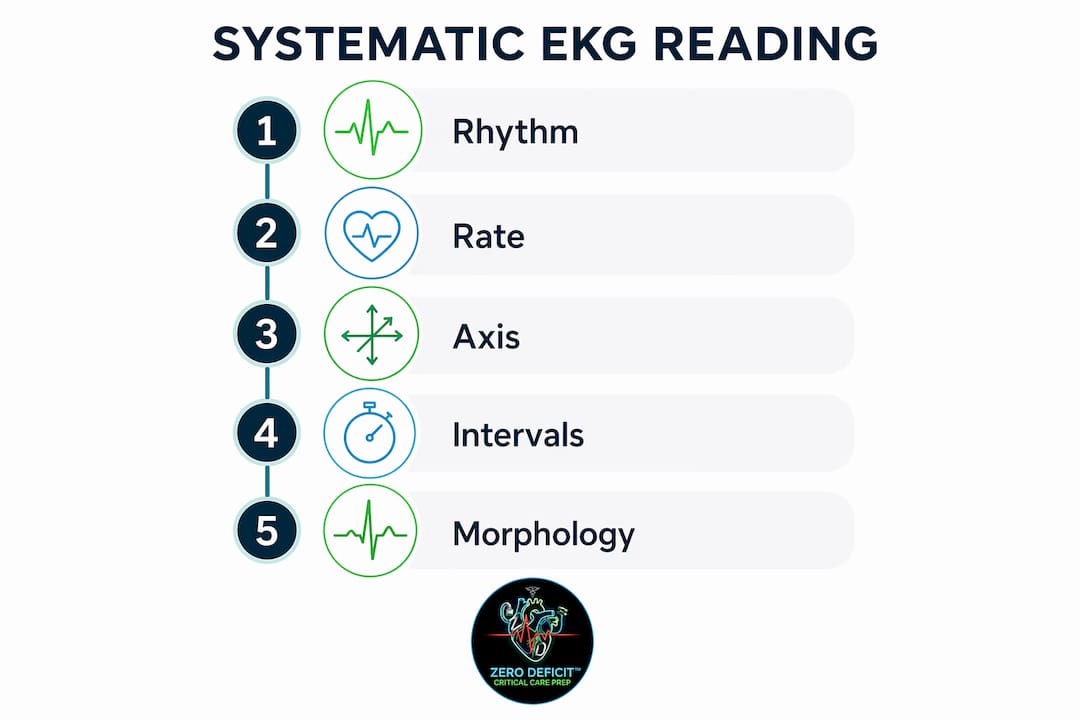
Start with rhythm: is it regular or irregular? Move to rate: count the R-R intervals or use the 300 method. Check axis using leads I and aVF. Measure PR, QRS, and QT intervals. Finally, assess P wave morphology, ST segments, and T waves. Every strip, every time.
Pro Tip: Do not skip the QT interval on exam strips. A QT greater than 500 ms in a patient on amiodarone or haloperidol is a high-yield trigger for intervention questions.
How should you prepare your EKG skills for the CCRN exam?
Structured preparation beats random review. A 10–12 week focused study schedule with at least 1,000 timed practice questions correlates with greater than 90% pass probability. That number reflects discipline, not just volume. Here is how to build that structure around EKG content specifically.
- Weeks 1–2: EKG foundations. Cover all waveform components, normal intervals, and lead placement. Use the Zerodeficitccrnprep 12-week CCRN study plan to anchor your cardiovascular blocks.
- Weeks 3–4: Arrhythmia identification. Practice SVT, A-fib, A-flutter, heart blocks (first, second Mobitz I and II, third degree), VT, and VF. Use an arrhythmia flowchart to build decision speed.
- Weeks 5–6: 12-lead interpretation. Focus on STEMI localization by lead group, LBBB versus RBBB, and axis deviation. Create flashcards for each STEMI territory: inferior (II, III, aVF), anterior (V1–V4), lateral (I, aVL, V5–V6).
- Weeks 7–8: Electrolyte and medication effects. Add hypokalemia, hyperkalemia, hypomagnesemia, digoxin toxicity, and QT-prolonging drugs to your review.
- Weeks 9–10: Timed practice blocks. Complete full cardiovascular question sets under exam conditions. Target 80% or higher on every block before moving on.
- Weeks 11–12: Full-length practice exams. Scoring consistently above 80% on full-length timed tests strongly predicts passing the CCRN. Use your error log to identify weak EKG topics and revisit them.
Pro Tip: Practice identifying STEMI patterns and critical arrhythmias within 60 seconds per strip. That speed reflects real ICU demands and mirrors how the CCRN exam is designed to test you under time pressure.
One more timing note: stretching prep beyond 4 months causes content fade, where early material erodes before exam day. Keep your study window tight and your review consistent.
What are the common pitfalls in CCRN EKG interpretation?
Most nurses who struggle with EKG questions on the CCRN are not failing rhythm identification. They are missing the broader picture. Nurses often misinterpret EKG study as arrhythmia-only identification, overlooking electrolyte and medication effects that alter morphology and demand urgent intervention.
The comparison below shows where arrhythmia-focused thinking ends and advanced EKG analysis begins.
| Category | Example | Key EKG Finding | Clinical Urgency |
|---|---|---|---|
| Primary arrhythmia | Third-degree heart block | No relationship between P waves and QRS | Immediate pacing |
| Electrolyte effect | Hyperkalemia | Peaked T waves, wide QRS, sine wave pattern | Calcium gluconate, kayexalate |
| Electrolyte effect | Hypokalemia | Flattened T waves, U waves, QT prolongation | Potassium replacement |
| Medication effect | Digoxin toxicity | Scooped ST depression, bradycardia, heart blocks | Hold digoxin, digoxin immune Fab |
| Ischemia pattern | Posterior STEMI | Tall R waves in V1–V2, ST depression anteriorly | Emergent cath lab activation |
Electrolyte imbalances like hypokalemia and hypomagnesemia produce QT prolongation, which requires urgent attention when the QT exceeds 500 ms. That threshold is a direct trigger for Torsades de Pointes, a rhythm that can deteriorate to VF without warning.
Additional pitfalls to watch for in your prep:
- Confusing Mobitz II with complete heart block. Both have dropped beats, but Mobitz II has a constant PR interval before the dropped QRS, while complete heart block shows full AV dissociation.
- Missing a posterior STEMI because you only look at ST elevation. Reciprocal ST depression in V1–V3 with a tall R wave is the posterior STEMI signal.
- Ignoring rate in the context of hemodynamics. A wide-complex tachycardia at 160 bpm in a hypotensive patient is VT until proven otherwise.
Integrate clinical context with every strip. The CCRN exam will give you a blood pressure, a medication list, or a potassium level alongside the EKG. Use all of it.
How do you apply EKG knowledge in CCRN exam scenarios?
The CCRN exam does not ask you to name a rhythm in isolation. It presents a patient scenario and asks what you do next. That requires you to connect the strip to hemodynamics, medications, and interventions. AACN requires 83 correct answers out of 125 scored questions to pass the Adult CCRN. Cardiovascular questions are your highest-leverage domain.
Use the ABCD triage method to work through rhythm strips under exam pressure:
- A (Atrial activity): Are P waves present? Are they organized? What is their relationship to the QRS?
- B (Beats and rate): What is the ventricular rate? Is it regular?
- C (Conduction): Measure PR and QRS intervals. Is conduction normal, delayed, or absent?
- D (Diagnosis and decision): Name the rhythm, identify the clinical threat, and select the intervention.
This method works because it forces you to gather data before you commit to a diagnosis. High-performing CCRN candidates use EKG interpretation as a rapid triage tool rather than a pattern-matching exercise. That mindset shift is what separates a 78% practice score from a 90%.
For STEMI localization, memorize these lead groupings:
- Inferior STEMI: ST elevation in II, III, aVF. Right ventricular involvement if ST elevation appears in V1 or V4R.
- Anterior STEMI: ST elevation in V1–V4. Proximal LAD occlusion.
- Lateral STEMI: ST elevation in I, aVL, V5–V6. Circumflex territory.
- Posterior STEMI: No direct ST elevation. Look for tall R waves and ST depression in V1–V3.
Pair your EKG findings with the shock flowchart from Zerodeficitccrnprep to connect rhythm recognition with hemodynamic management. A patient in cardiogenic shock with an anterior STEMI needs a very different intervention pathway than one in distributive shock with sinus tachycardia.
The top CCRN study topics always include cardiovascular content because it integrates with nearly every other body system. Your EKG skills amplify your performance across pulmonary, renal, and sepsis questions too.
Key takeaways
Mastering CCRN EKG interpretation requires a systematic reading method, domain-weighted study planning, and the ability to connect strip findings to clinical decisions under timed conditions.
| Point | Details |
|---|---|
| Systematic method wins | Read every strip in the same order: rhythm, rate, axis, intervals, morphology. |
| Cardiovascular is high-yield | Cardiovascular content is 17% of the CCRN exam, roughly 21 scored questions. |
| Study window matters | A 10–12 week focused plan with 1,000+ timed questions maximizes retention and pass rates. |
| Go beyond arrhythmias | Electrolyte and medication effects on EKG morphology are tested as heavily as rhythm ID. |
| ABCD triage under pressure | Use the Atrial, Beats, Conduction, Diagnosis method to work through exam strips efficiently. |
What i’ve learned from watching nurses struggle with EKG questions
The nurses who come to Zerodeficitccrnprep frustrated with EKG content almost always have the same problem. They know their rhythms cold. They can name A-fib, VT, and third-degree heart block in seconds. But they freeze when the question adds a potassium of 2.8, a QT of 520 ms, and asks what you do first.
That gap is not a knowledge gap. It is a practice gap. You need to see hundreds of scenario-based questions before the pattern of “strip plus clinical data equals intervention” becomes automatic. Memorizing waveforms is the floor, not the ceiling.
The other thing I see consistently: nurses underestimate the time pressure. The CCRN gives you 3 hours for 150 questions. That is roughly 72 seconds per question. If you spend 3 minutes working through a complex EKG scenario, you are borrowing time from every question that follows. Speed comes from repetition, not from reading more content.
My honest advice is to stop adding new study materials after week 8. At that point, you know enough. What you need is practice under conditions that mirror the real exam. Full-length timed tests, error logs, and targeted review of your weak spots. That is the work that moves the needle.
Use Zerodeficitccrnprep’s practice question bank to build that repetition. The rationales are written to teach you the clinical reasoning behind each answer, not just confirm the right letter. That is what builds the kind of confidence that holds up on exam day.
— Zero
Build your CCRN EKG confidence with Zerodeficitccrnprep
If you are ready to move from reading about EKG interpretation to actually practicing it under exam conditions, Zerodeficitccrnprep has the tools built for exactly that. The platform’s cardiovascular content covers every high-yield EKG topic on the AACN blueprint, with detailed rationales that explain the clinical reasoning behind every answer.
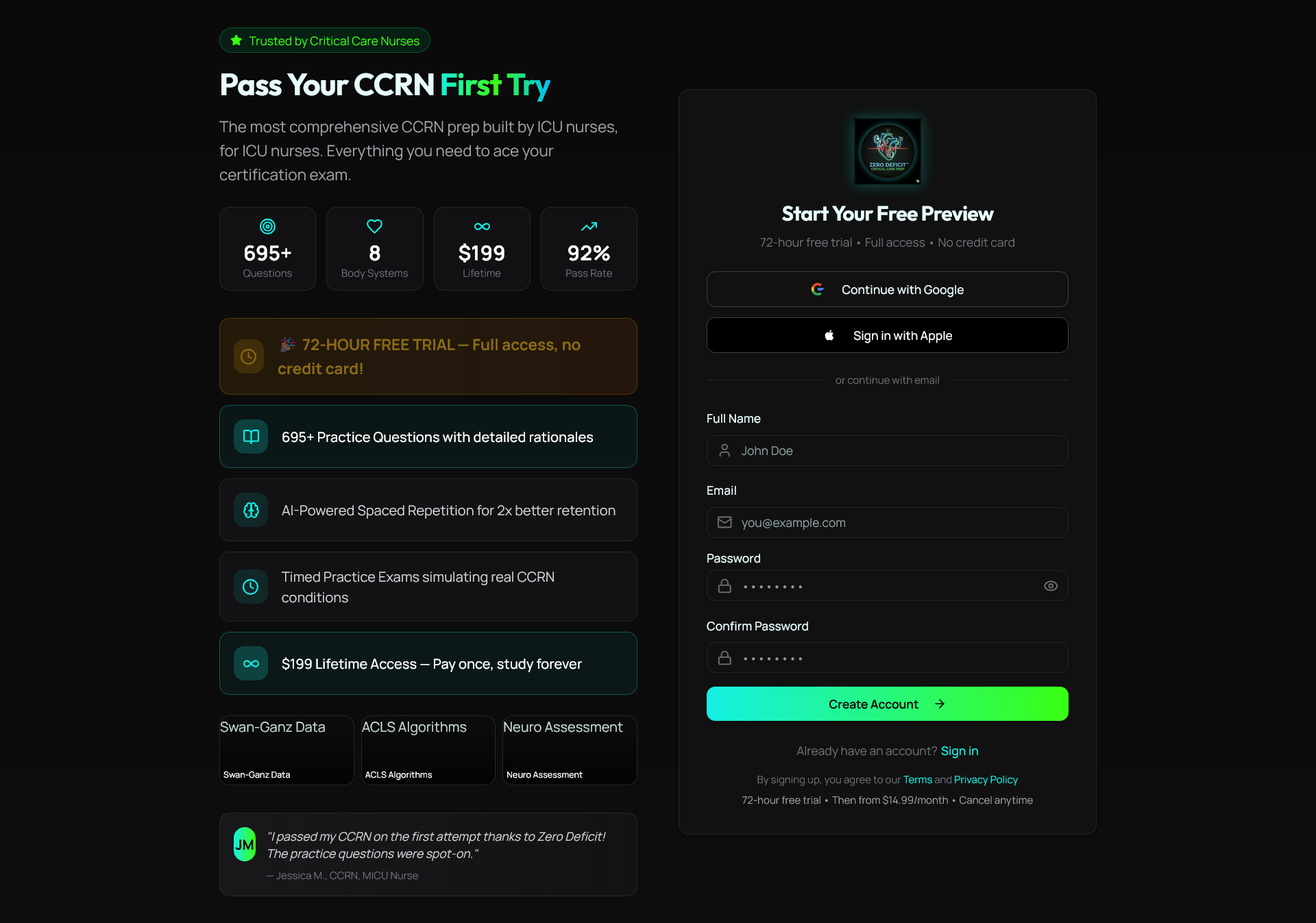
Start with the CCRN practice tests covering all 8 body systems, including a full cardiovascular section with EKG-focused scenarios. When your scores consistently hit 80% or above, you are ready to schedule your exam. No credit card required to start. Try it, test it, and build the confidence you need to pass on your first attempt.
FAQ
What percentage of the CCRN exam covers EKG and cardiovascular content?
Cardiovascular content accounts for approximately 17% of the Adult CCRN exam, totaling about 21 scored questions. This includes dysrhythmias, ACS, shock, and related EKG interpretation scenarios.
How many practice questions should i complete before taking the CCRN?
A 10–12 week study plan with at least 1,000 timed practice questions correlates with greater than 90% pass probability. Aim for consistent scores above 80% on full-length practice exams before scheduling your test date.
What EKG findings are most commonly tested on the CCRN exam?
STEMI localization by lead group, third-degree heart block, VT versus SVT differentiation, and electrolyte effects such as hyperkalemia and QT prolongation are the highest-yield EKG topics. Pair each rhythm with its clinical intervention to answer scenario-based questions correctly.
How does QT prolongation appear on an EKG and why does it matter for the CCRN?
QT prolongation appears as a lengthened interval from the start of the QRS to the end of the T wave, with a value greater than 500 ms indicating high risk for Torsades de Pointes. The CCRN exam tests your ability to identify the cause, whether hypokalemia, hypomagnesemia, or a QT-prolonging medication, and select the correct intervention.
What is the fastest way to improve EKG interpretation speed for the exam?
Practice the ABCD method (Atrial activity, Beats and rate, Conduction intervals, Diagnosis) on every strip until it takes less than 60 seconds to reach a working diagnosis. Rapid rhythm triage is a skill built through repetition, not through reading more theory.
Recommended
- Arrhythmia Flowchart for CCRN Exam Prep: Enhance Your Study with Zero Deficit™
- Types of Critical Care Certifications: Your 2026 Guide | Zero Deficit CCRN Prep
- Nursing Mnemonics for CCRN: Top Picks That Actually Work | Zero Deficit CCRN Prep
- CCRN Exam Question Breakdown Methods: Master the Exam with Step-by-Step Guides | Zero Deficit™
Take a Cardiovascular practice quiz
Test your mastery of hemodynamics, ACLS, MI, arrhythmias, and heart failure.
Get Your Free 20-Question CCRN Diagnostic
20 high-yield CCRN-style questions across every body system, with detailed rationales — emailed to you instantly.
No spam. One email + a couple of helpful follow-ups. Unsubscribe anytime.
Ready to pass your CCRN?
Join 12,000+ nurses using Zero Deficit — 695+ practice questions with rationales, AI-powered weak-area drilling, and spaced-repetition flashcards.
Start Free Trial →