CCRN Infection Control Review Topics: ICU Nurse Guide
TL;DR:
- CCRN infection control emphasizes rapid sepsis bundle execution, transmission-based precautions, and antimicrobial stewardship to reduce ICU mortality. Nurses must prioritize antibiotic timing, escalate precautions based on clinical syndromes, and perform daily line necessity reviews to prevent infections. mastering these components enhances clinical judgment and exam performance in critical care settings.
CCRN infection control review topics are defined by four clinical pillars: rapid sepsis bundle execution, transmission-based precautions, device-associated infection prevention, and antimicrobial stewardship. These are not peripheral exam topics. The AACN Adult CCRN blueprint weights sepsis and infection management heavily because they directly drive ICU mortality. You need to know the Surviving Sepsis Campaign Hour-1 bundle cold, understand when to escalate from contact to airborne precautions, and recognize that daily central line necessity review is an infection control intervention, not just a rounding checkbox. Mastering these areas as part of your CCRN exam study guide approach gives you both exam points and clinical precision.
1. CCRN infection control review: the Hour-1 sepsis bundle
The Surviving Sepsis Campaign Hour-1 bundle defines five mandatory interventions that must begin within 60 minutes of sepsis recognition. These are not sequential steps you complete in order. They run in parallel, and your ability to manage them simultaneously is exactly what the CCRN tests.
The five elements are:
- Measure lactate immediately. A lactate ≥2 mmol/L confirms tissue hypoperfusion even when blood pressure appears stable. If lactate is elevated, remeasure within 2 to 4 hours to assess treatment response.
- Obtain blood cultures before antibiotics whenever possible. The operational window is approximately 45 minutes. Do not delay antibiotics beyond that window waiting for cultures.
- Administer broad-spectrum antibiotics within 1 hour. Early antibiotics carry a hazard ratio of 0.65 for mortality reduction. That number means a 35% lower risk of death when antibiotics start within the first hour.
- Rapid crystalloid infusion at 30 mL/kg for hypotension or lactate ≥4 mmol/L. Timely fluid resuscitation carries a hazard ratio of 0.72 for mortality reduction, meaning a 28% lower risk of death.
- Vasopressors if MAP remains below 65 mmHg despite fluid resuscitation. Norepinephrine is the first-line agent per SCCM guidelines.
The exam frequently tests the culture-versus-antibiotic sequencing question. The correct answer is always: do not delay antibiotics for cultures. Cultures are ideal first, but antibiotic timing takes priority when the two conflict operationally.
Pro Tip: If a CCRN scenario describes a patient with suspected sepsis and a nurse who delays antibiotics to obtain a second set of blood cultures, the answer is almost always that the nurse acted incorrectly. Mortality data does not support that delay.

2. Standard vs. transmission-based precautions in the ICU
Standard precautions apply to every patient, every time, regardless of diagnosis or infection status. Standard precautions include hand hygiene, appropriate PPE, respiratory hygiene, and environmental cleaning. They are the baseline. Transmission-based precautions layer on top when a specific pathogen or clinical syndrome is identified or suspected.
The table below shows the three transmission-based precaution categories and their ICU-specific requirements:
| Precaution type | Transmission route | Room requirement | PPE required |
|---|---|---|---|
| Contact | Direct or indirect contact | Private room preferred | Gloves, gown |
| Droplet | Respiratory droplets >5 microns | Private room, door may be open | Surgical mask |
| Airborne | Droplet nuclei <5 microns | Negative pressure room, door closed | N95 respirator, eye protection |
Airborne precautions apply to tuberculosis, measles, varicella, and suspected COVID-19 with aerosol-generating procedures. The CCRN tests whether you know to escalate to airborne based on clinical syndrome and transmission risk, not just confirmed lab results. Escalating isolation precautions immediately based on suspected route protects staff and patients better than waiting for culture confirmation.
Key behavioral requirements you must apply consistently:
- Perform hand hygiene at all five WHO moments: before patient contact, before aseptic tasks, after body fluid exposure, after patient contact, and after touching patient surroundings.
- Don PPE before entering the room. Remove it outside the room in the correct sequence: gloves first, then gown, then mask.
- Apply contact precautions for MRSA, VRE, C. difficile, and multidrug-resistant organisms.
- Use droplet precautions for influenza, pertussis, and meningococcal disease.
Hand hygiene compliance averages less than 50% in many healthcare settings, which is why regulatory bodies enforce it with direct observation programs. As the bedside nurse, you are the last line of defense against transmission.
3. CLABSI prevention bundles: insertion and maintenance
Central line-associated bloodstream infection (CLABSI) prevention is built on two distinct bundles. The insertion bundle controls risk at the time of line placement. The maintenance bundle controls risk every day the line remains in place. Bundle compliance above 95% across all elements produces the greatest infection reduction. Skipping one element undermines the entire bundle.
Insertion bundle components:
- Perform hand hygiene before line placement.
- Apply maximal sterile barriers: cap, mask, sterile gown, sterile gloves, and large sterile drape. Randomized controlled trials found a 6-fold reduction in CLABSI with maximal barriers compared to standard precautions. That is not a marginal benefit.
- Use chlorhexidine gluconate for skin antisepsis. Allow it to dry completely before needle insertion.
- Select the subclavian vein as the preferred site when clinically feasible. Femoral sites carry the highest infection risk.
- Conduct a daily necessity review. If the line is not needed, remove it.
Maintenance bundle components:
- Perform hand hygiene before every line access.
- Scrub the hub with chlorhexidine or 70% alcohol for 15 seconds before accessing any port.
- Perform daily chlorhexidine baths for all ICU patients with central lines.
- Change transparent dressings every 5 to 7 days, or immediately when soiled or loose.
- Replace administration sets per CDC guidelines: standard sets every 96 hours, blood and lipid sets every 24 hours.
Routine scheduled line replacement at fixed intervals is not supported by current evidence. The correct exam answer is always daily necessity review with prompt removal when the line is no longer clinically required.
Pro Tip: During rounds, you have standing authority to raise the question: “Does this patient still need this line?” That question, asked daily, is one of the most evidence-based infection prevention techniques available to a bedside nurse.
4. Antimicrobial stewardship and the nurse’s role
Antimicrobial stewardship is defined as a coordinated program that optimizes antibiotic selection, dose, and duration to improve patient outcomes and minimize the development of resistance. Stewardship programs require multidisciplinary leadership and active coordination between microbiology, infection prevention, and frontline providers. As the bedside ICU nurse, you are a frontline provider.
Your specific stewardship responsibilities include:
- Collect cultures correctly and promptly. Two sets of blood cultures from separate sites before antibiotics whenever operationally possible. Contaminated cultures drive unnecessary antibiotic use.
- Advocate for de-escalation. When culture results return and sensitivities are known, raise the question of whether broad-spectrum coverage can be narrowed. This is diagnostic stewardship in practice.
- Educate patients and families. Patients who understand why antibiotics are being stopped or changed are less likely to resist the decision.
- Recognize signs of treatment failure. Persistent fever, rising WBC, or worsening hemodynamics after 48 to 72 hours of antibiotics warrant reassessment of the regimen and source control.
- Collaborate with the pharmacist and infectious disease team. Stewardship is not a solo activity. The CCRN tests your understanding of interprofessional roles, not just individual nursing tasks.
The connection between stewardship and infection control is direct. Overuse of broad-spectrum antibiotics selects for resistant organisms like Clostridioides difficile, MRSA, and carbapenem-resistant Enterobacteriaceae. These organisms then require more intensive isolation precautions and are harder to treat. Stewardship breaks that cycle upstream.
5. Exam-focused tips for applying infection control in CCRN scenarios
CCRN infection control questions frequently test nuance, not just recall. Knowing the bundle components is necessary but not sufficient. You also need to know how to apply them when the scenario introduces a complication or a competing priority.
“In CCRN infection control, both transmission prevention measures and rapid sepsis care bundles are deeply intertwined; nurses must simultaneously manage isolation and urgent treatment steps.” — Clinical Database
Common exam-tested nuances and how to handle them:
- Antibiotics vs. cultures timing: If the scenario forces a choice, antibiotics win. Do not delay beyond 45 minutes for culture collection.
- Isolation escalation without lab confirmation: Escalate to airborne precautions based on clinical syndrome. A patient with productive cough, night sweats, and weight loss gets airborne precautions before TB is confirmed.
- Fluid resuscitation with comorbidities: The 30 mL/kg crystalloid target applies to sepsis-induced hypoperfusion. In patients with heart failure or ARDS, reassess frequently and titrate based on dynamic fluid responsiveness markers such as pulse pressure variation or passive leg raise response.
- Sterile technique breaches: You have both the authority and the responsibility to stop a procedure if sterile technique is broken. Checklists used during central line insertion reduce CLABSI rates by supporting this behavior.
- Line necessity as infection control: Framing daily line removal discussions as infection prevention, not just care simplification, aligns with current evidence and gives you clinical standing to advocate for it.
Reviewing top CCRN study topics alongside infection control content helps you see how these scenarios connect to broader critical care priorities like hemodynamic management and respiratory failure.
Key takeaways
Mastering CCRN infection control requires integrating sepsis bundle timing, transmission-based precautions, device-associated infection bundles, and antimicrobial stewardship into a single, exam-ready clinical framework.
| Point | Details |
|---|---|
| Hour-1 bundle priority | Administer broad-spectrum antibiotics within 1 hour; do not delay for blood cultures beyond 45 minutes. |
| Precaution escalation | Escalate to airborne precautions based on clinical syndrome, not confirmed lab results. |
| CLABSI bundle compliance | Bundle compliance above 95% across all elements produces the greatest infection reduction. |
| Daily line necessity review | Removing unneeded central lines is an evidence-based infection prevention intervention, not optional rounding. |
| Stewardship collaboration | Advocate for de-escalation when culture sensitivities return; involve pharmacy and infectious disease proactively. |
What I’ve learned from teaching infection control for the CCRN
Most nurses I work with know the sepsis bundle. They can list the five elements. Where they lose exam points is in the sequencing questions and the “what do you do first” scenarios. The exam is not testing your memory. It is testing your clinical judgment under pressure.
The detail that trips up the most candidates is the culture-versus-antibiotic question. Every instinct in nursing training says: get the cultures first, then treat. That instinct is correct in most situations. But in sepsis, the mortality data is unambiguous. A 35% reduction in mortality with antibiotics in the first hour is not a nuance. It is the answer.
I also see nurses underestimate the infection control weight of daily line necessity review. It sounds administrative. It is not. Removing a central line that is no longer needed is one of the highest-yield infection prevention techniques available at the bedside. When you raise that question during rounds, you are practicing evidence-based infection control, not just tidying up the care plan.
The other area worth your attention is isolation escalation. Experienced ICU nurses do not wait for lab confirmation to escalate precautions. They act on clinical syndrome and transmission risk. The CCRN rewards that proactive thinking. If a scenario describes a patient with respiratory symptoms consistent with an airborne pathogen, the correct answer is to apply airborne precautions now.
Study infection control as two integrated streams: sepsis bundle execution and transmission prevention. The exam merges them in scenarios that require you to manage both simultaneously. That is exactly what you do on every shift.
— Zero
Build your infection control mastery with Zerodeficitccrnprep
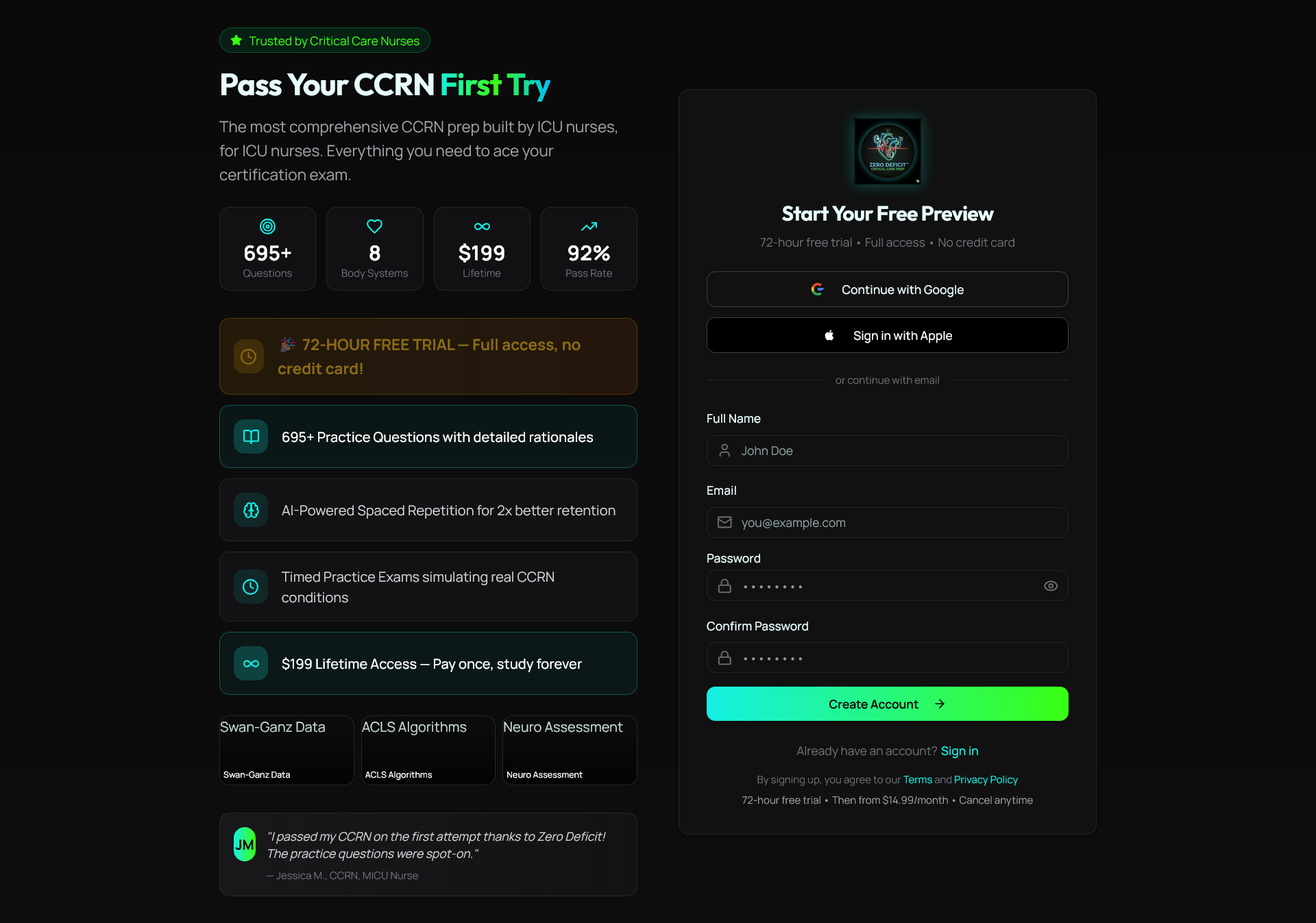
Zero Deficit™ CCRN Prep gives you targeted practice on every infection control topic covered here, including sepsis bundle sequencing, isolation precaution decisions, CLABSI bundle compliance, and antimicrobial stewardship scenarios. The platform’s question breakdown methods teach you how to dissect infection control scenarios step by step, so you stop guessing and start reasoning through the answer. With over 695 practice questions across all 8 body systems and detailed rationales for every answer, you build the clinical judgment the CCRN actually tests. Start your free version at Zero Deficit CCRN Prep today, no credit card required.
FAQ
What sepsis bundle elements does the CCRN test most?
The CCRN most frequently tests antibiotic timing and the culture-versus-antibiotic sequencing decision. Antibiotics must start within 1 hour of sepsis recognition; do not delay beyond 45 minutes waiting for blood cultures.
When do you escalate from contact to airborne precautions?
Escalate to airborne precautions based on clinical syndrome and suspected transmission route, not confirmed lab results. A patient with symptoms consistent with tuberculosis or measles requires a negative pressure room and N95 respirator immediately.
Is routine central line replacement recommended for CLABSI prevention?
Routine scheduled replacement at fixed intervals is not supported by current evidence. The evidence-based practice is daily necessity review with prompt removal when the line is no longer clinically required.
What is the nurse’s role in antimicrobial stewardship?
Bedside nurses collect cultures correctly and promptly, advocate for antibiotic de-escalation when culture sensitivities return, and collaborate with pharmacy and infectious disease to optimize antibiotic selection and duration.
How does hand hygiene compliance affect ICU infection rates?
Hand hygiene compliance averages less than 50% in many healthcare settings, making it a primary driver of healthcare-associated infection transmission. Consistent adherence to all five WHO hand hygiene moments is the single most effective infection prevention technique available to ICU nurses.
Recommended
Take a Multisystem practice quiz
Master sepsis, shock, MODS, and multi-organ failure scenarios.
Get Your Free 20-Question CCRN Diagnostic
20 high-yield CCRN-style questions across every body system, with detailed rationales — emailed to you instantly.
No spam. One email + a couple of helpful follow-ups. Unsubscribe anytime.
Ready to pass your CCRN?
Join 12,000+ nurses using Zero Deficit — 695+ practice questions with rationales, AI-powered weak-area drilling, and spaced-repetition flashcards.
Start Free Trial →