CCRN question formats: master every scenario for exam success
You already know critical care. You’ve managed vents, titrated pressors, and recognized early sepsis before the attending walked in. But the CCRN exam is 150 multiple-choice questions, with 125 scored and 25 unscored pretest items, all designed to test whether you can think through clinical complexity under timed pressure. That gap between knowing your content and actually passing comes down, more often than you’d expect, to how well you understand the question formats themselves. This article breaks down exactly what those formats look like, how they differ by domain, and which study strategies close the gap fastest.
Table of Contents
- How the CCRN exam is structured
- The core CCRN question formats explained
- Question format comparison: content focus and tactics
- Best study practices for mastering CCRN question formats
- Rethinking CCRN prep: why question format fluency beats rote review
- Next steps: elevate your CCRN readiness with targeted training
- Frequently asked questions
Key Takeaways
| Point | Details |
|---|---|
| Understand the exam structure | Knowing what domains and question types are tested lets you target your study plan. |
| All CCRN questions are scenario MCQs | Expect only four-option, scenario-based multiple-choice questions on the exam. |
| Practice with real exam formats | Use practice tests that mirror actual CCRN questions to build clinical reasoning and prioritization skills. |
| Prioritization questions dominate | Focus your strategies on selecting the best or priority interventions in high-weighted domains. |
| Use rationales to drive improvement | Review answer explanations to understand clinical reasoning and avoid repeated mistakes. |
How the CCRN exam is structured
Before you can master question formats, you need a clear picture of the exam itself. The CCRN is a 3-hour, computer-based test built around two major content areas: Clinical Judgment, which accounts for 80% of scored questions, and Professional Caring and Ethical Practice, which makes up the remaining 20%.

Clinical Judgment breaks down into specific systems and domains. Knowing the exact weights helps you prioritize where to invest study time. Here’s how the current breakdown looks following the November 2025 exam update:
| Content area | Domain | Weight |
|---|---|---|
| Clinical Judgment | Cardiovascular | 17% |
| Clinical Judgment | Respiratory | 15% |
| Clinical Judgment | Multisystem | 14% |
| Clinical Judgment | Neurological | 12% |
| Clinical Judgment | Renal/Genitourinary | 6% |
| Clinical Judgment | Gastrointestinal | 6% |
| Clinical Judgment | Hematological/Immunological | 5% |
| Clinical Judgment | Endocrine | 5% |
| Prof. Caring/Ethics | Advocacy, Caring Practices, etc. | 20% |
A few key facts worth keeping front and center:
- The exam was revised in November 2025 to reflect updated practice analysis data, meaning the current version aligns more closely with real ICU practice patterns.
- Cardiovascular, respiratory, and multisystem together account for 46% of scored questions, making them the single highest-leverage area for your prep.
- The CCRN first-time pass rate sits at approximately 72%, which means roughly 1 in 4 first-time candidates does not pass.
That 72% pass rate is not a warning to fear; it’s data. It tells you that unfocused studying leaves real gaps. Use it to sharpen your approach. Our CCRN exam guide maps the full test plan so you can allocate your study hours with precision.
Stat callout: Cardiovascular questions alone represent 17% of your score. Eleven wrong answers in that domain alone can move your result from pass to fail.
With the exam’s structure established, the next step is dissecting the specific formats you will face.
The core CCRN question formats explained
Here is something that surprises many candidates: all CCRN questions are four-option multiple-choice. No select-all-that-apply. No hotspot images. No drag-and-drop. Every single question presents a brief patient scenario, four answer options, and asks you to choose one. That structural consistency is actually an advantage when you know how to use it.
What varies is the clinical reasoning demanded within that consistent format. Scenario-based questions draw from real ICU presentations and ask you to demonstrate one of several core competencies:
- Prioritization: What do you do first? These questions often list interventions that are all technically correct but differ in urgency.
- Clinical judgment: Given these labs, vitals, and history, what is happening with this patient?
- Best action: Among four reasonable responses, which one is most appropriate for this specific scenario?
- Intervention selection: Post-op respiratory failure, rising ICP, or cardiogenic shock; each scenario tests applied knowledge in context.
Pay close attention to question stems that use trigger words: best, priority, first, most appropriate, most likely. Those words narrow your reasoning process considerably. They tell you this is not a recall question. It’s a judgment question.
For example, a cardiovascular question might describe a patient with hypotension, elevated CVP, and muffled heart sounds after a central line placement. The question asks what you should do first. All four options may be valid clinical actions, but only one is the correct immediate priority. That’s the format in action. You can explore practice question samples that mirror this exact style to build your pattern recognition before exam day.
Scenario variety comes from the clinical context, not the question structure. You might see a shock flowchart strategy applied to a distributive shock question one moment and a respiratory acidosis interpretation question the next. The clinical content shifts constantly, but the four-option format stays the same throughout.
“The CCRN rewards nurses who can reason through ambiguity, not just recall protocols. Recognizing question intent before choosing an answer is a skill you build through deliberate practice, not passive review.”
Understanding these formats builds the foundation for effective selection and prioritization on exam day.
Question format comparison: content focus and tactics
Each clinical domain tests reasoning differently because the clinical dilemmas in each domain are different. A cardiovascular question about hemodynamic instability requires interpretation of invasive monitoring data. A respiratory question about ventilator weaning requires understanding of arterial blood gas trends and PEEP changes. A multisystem question about sepsis might require you to sequence interventions across organ systems simultaneously.
Here’s a side-by-side comparison of how the top-weighted domains differ in scenario style and what strategies work best:
| Domain | Typical scenario style | Key reasoning demand | Top strategy |
|---|---|---|---|
| Cardiovascular | Hemodynamic instability, arrhythmia, post-cath | Interpret PA pressures, rhythm strips, perfusion | Rule out before selecting; anchor on hemodynamics |
| Respiratory | Vent management, ABG interpretation, weaning | ABG trends, compliance changes, oxygenation math | Use the ABG systematically; check pH first |
| Multisystem | Sepsis, MODS, trauma patients | Prioritize across failing systems | Identify primary driver; ABC hierarchy |
| Neurological | ICP management, stroke, seizure | Timing of interventions, neuro assessment changes | Know normal values cold; ICP math matters |
| Endocrine | DKA, thyroid storm, SIADH | Lab trend interpretation | Watch for subtle electrolyte cues in the scenario |
The AACN test plan recommends prioritizing practice with hemodynamic interpretation and prioritization questions for edge cases like shock states, which directly maps to how cardiovascular and multisystem questions are written.
Here are five proven tactics for the highest-weighted domains:
- Read the stem twice. Clinical details like the phrase “2 hours post-CABG” versus “5 days post-CABG” completely change the priority answer.
- Identify what the question is really asking. Is it asking for an assessment action, an intervention, or a notification? Don’t conflate these.
- Eliminate clearly wrong answers first. On a well-designed four-option question, two options are usually eliminable within seconds, leaving a genuine decision between two strong options.
- Prioritize safety over comfort. When two answers seem equally valid, the one that addresses immediate physiological safety is almost always correct.
- Watch for delegation traps. Some questions present a correct action paired with the wrong role. Knowing scope of practice saves points.
Our question breakdown methods walk through these tactics step by step, applied to real exam-style scenarios across every domain. For domain-specific content review, the study guides organize everything by body system so you can move from weak area to strong area efficiently.
Zooming in, let’s address how you can use these insights to sharpen your practice and reinforce critical content.
Best study practices for mastering CCRN question formats
Knowing the format is step one. Practicing with it until you recognize question intent in under 30 seconds is step two. Here’s how to get there efficiently.
Practice with exam-accurate formats every session. Avoid review materials that use knowledge recall questions (e.g., “What is the normal CVP range?”) as your primary practice vehicle. The actual exam uses scenario-based clinical reasoning. If your practice doesn’t match, your skills won’t transfer. Work with practice test resources built to reflect the AACN test plan, not just general nursing knowledge.
Review every rationale, including the answers you got right. This is where most candidates leave improvement on the table. Getting an answer correct through elimination instead of reasoning is a sign you need to reinforce that concept. The rationale tells you why each option is right or wrong, and that nuance is exactly what differentiates a passing score from a failing one.
Target 80% or higher on full-length mock exams. Scoring 80%+ on 125-question practice tests is the widely cited benchmark for genuine exam readiness. Don’t attempt your actual exam if you’re consistently scoring in the 65-70% range on mocks. Identify the domains pulling your score down and drill those specifically.
Key best practices for your daily and weekly prep:
- Complete timed, full-length practice sessions at least twice before exam day to build stamina and pacing
- After each session, categorize every missed question by domain so you can spot patterns, not isolated errors
- Use AACN handbook samples to familiarize yourself with the exact language and scenario structure the exam uses
- Drill cardiovascular and respiratory questions heavily since those two domains combined represent 32% of your scored content
- Spend time on Professional Caring and Ethical Practice scenarios, which many candidates underweight despite being 20% of the exam
Pro Tip: When you miss a question, don’t just read the rationale and move on. Write down what reasoning error you made. Did you misread the stem? Did you confuse a priority? Did you lack a specific piece of clinical knowledge? Tracking your error type is more valuable than tracking your error count.
With a strong handle on study tactics, it’s time for a holistic perspective on how CCRN question format fluency shapes your ultimate result.
Rethinking CCRN prep: why question format fluency beats rote review
Most study plans treat content mastery and question practice as two separate phases. Study the material first, then do questions to check your knowledge. That sequence has a fundamental flaw.
The CCRN doesn’t test whether you know what cardiac tamponade is. It tests whether you can recognize it in a scenario, prioritize your response, and select the best next action from four plausible options within roughly 72 seconds per question. That skill set requires practice with the format itself, not just the clinical content. And yet the majority of prep materials still default to flashcards, lecture notes, and content outlines as the primary vehicle.
We see it consistently: candidates who score well on content-recall quizzes sometimes struggle on full practice exams. Not because they lack knowledge, but because they haven’t trained their clinical reasoning within the specific constraints of the question format. They read too deeply into stems, second-guess eliminations, and run out of time on questions they actually know.
The more productive approach is to make scenario-based questions the center of your study, not the end of it. When you miss a question, go back to your detailed breakdown strategies and identify where your reasoning broke down. Was it a knowledge gap? A prioritization error? A language trap in the stem? Each missed question is clinical feedback about your decision-making process, not just your recall.
“Nurses who pass the CCRN on their first attempt share one common habit: they practice like they’re taking the real exam. Timed, scenario-based, full-length sessions with detailed rationale review afterward. Content review supports that process; it doesn’t replace it.”
Question format fluency is the differentiator that most study plans don’t name directly. Name it, build it deliberately, and your pass rate odds shift meaningfully in your favor.
Next steps: elevate your CCRN readiness with targeted training
You now understand exactly what the CCRN tests, how every question is structured, what differs by domain, and which study behaviors build the reasoning skills that transfer to real exam performance. That clarity is a genuine advantage.
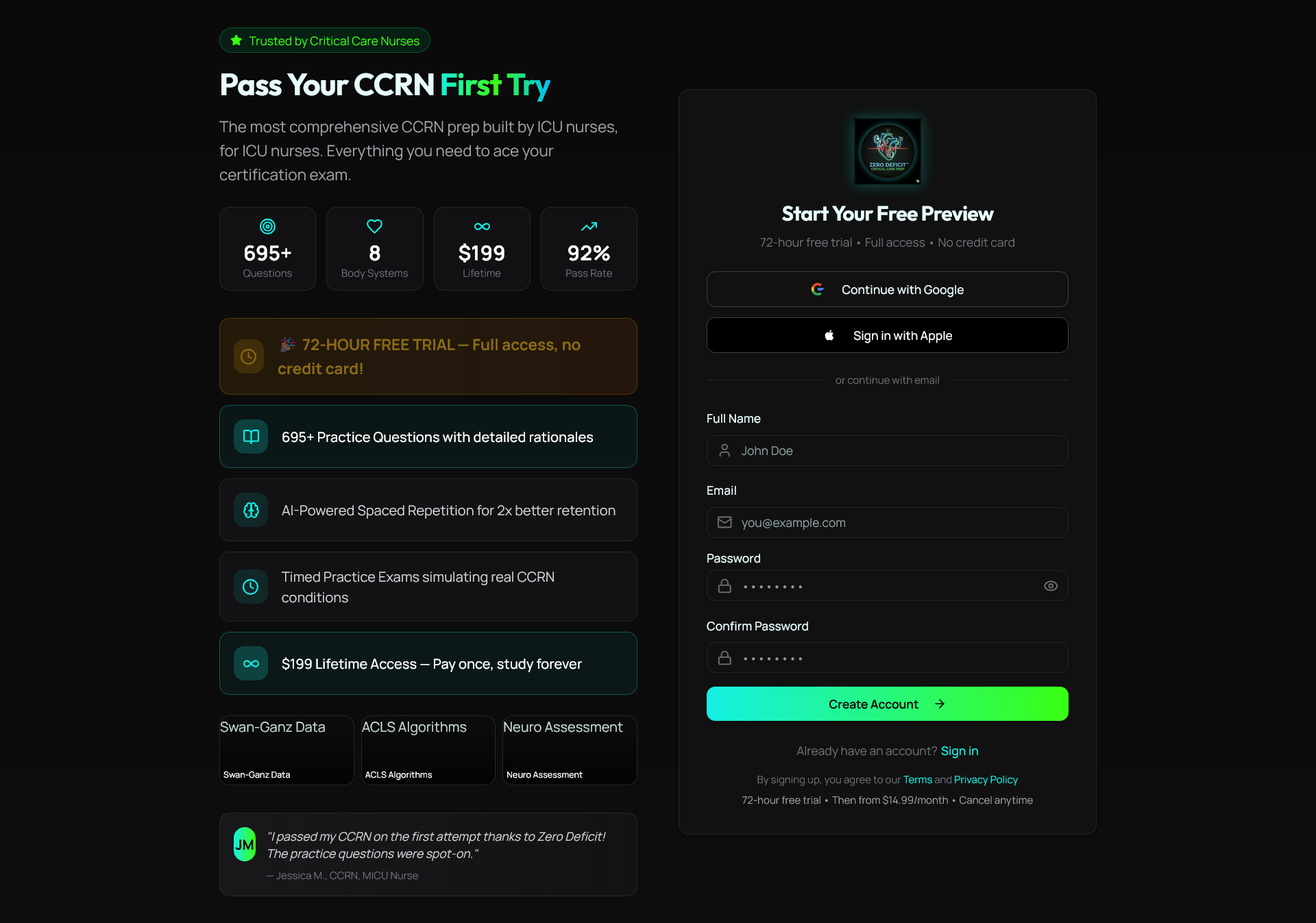
Zero Deficit™ CCRN Exam Prep is built for exactly this kind of targeted preparation. Start with our question breakdown methods course to internalize a step-by-step approach to every scenario-based question format. Then work through our full question bank of over 695 exam-style questions with detailed rationales, organized by domain and difficulty. You can start with a free version with no credit card required, so you can evaluate the quality of the material before committing. Your first attempt is your best attempt. Let’s make it count.
Frequently asked questions
How many types of questions appear on the CCRN exam?
All CCRN exam questions are scenario-based, four-option multiple-choice with no alternative formats such as essays, hotspots, or select-all-that-apply.
What is the pass rate for the CCRN exam?
The CCRN first-time pass rate is approximately 72% based on recent 2024 data, meaning targeted preparation makes a measurable difference in your outcome.
Does the CCRN exam include select-all-that-apply or essay questions?
No. The CCRN format uses only four-option multiple-choice questions throughout the entire 150-question exam, so every question follows the same structural pattern.
What practice score indicates strong readiness for the CCRN exam?
Scoring 80% or higher on full 125-question practice exams is the established benchmark indicating you are well-prepared for exam day.
Are any domains more heavily tested on the CCRN exam?
Yes. Clinical Judgment accounts for 80% of the exam, with cardiovascular at 17%, respiratory at 15%, and multisystem at 14% representing the single most heavily tested content areas.
Recommended
Take a Respiratory practice quiz
Master ARDS, ventilation, ABGs, oxygenation, and pulmonary emergencies.
Get Your Free 20-Question CCRN Diagnostic
20 high-yield CCRN-style questions across every body system, with detailed rationales — emailed to you instantly.
No spam. One email + a couple of helpful follow-ups. Unsubscribe anytime.
Ready to pass your CCRN?
Join 12,000+ nurses using Zero Deficit — 695+ practice questions with rationales, AI-powered weak-area drilling, and spaced-repetition flashcards.
Start Free Trial →