CCRN Spaced Repetition: Study Smarter for Certification

TL;DR:
- Spaced repetition is an evidence-based study method that improves long-term CCRN content retention by scheduling reviews at increasing intervals. It outperforms cramming and reinforces clinical reasoning through active recall, helping nurses prepare effectively for the exam. Combining spaced practice with timed practice tests enhances application skills and exam readiness over consistent, daily study routines.
CCRN spaced repetition is a proven study method that improves long-term retention by timing your reviews at increasing intervals based on how well you recall each concept. The standard term for this approach is spaced practice, and the research behind it is solid. A meta-analysis of 317 experiments by Cepeda et al. (2006) confirmed that spaced study produces better recall than massed practice. For critical care nurses preparing for the AACN Adult CCRN exam, this means replacing last-minute cramming with a structured, daily review system built around tools like Anki and FlashRecall.
What is CCRN spaced repetition and why does it beat cramming?
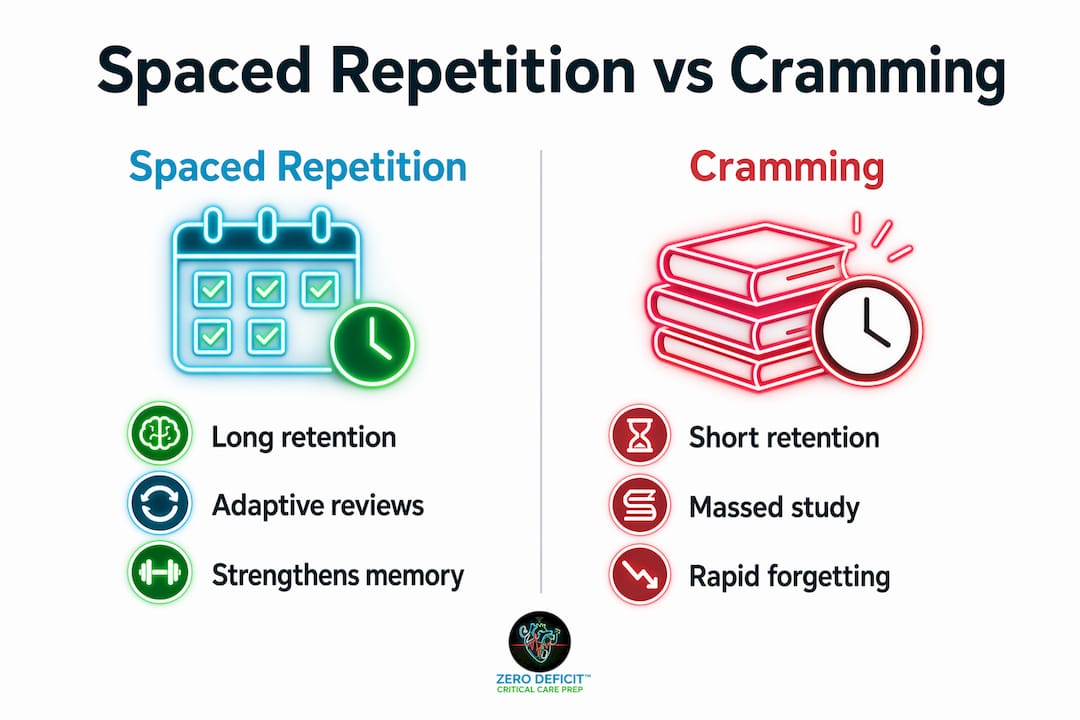
Spaced repetition works by scheduling each flashcard review just before you are about to forget it. This timing exploits the forgetting curve, a psychological model showing that memory decays predictably over time. By reviewing content at the right moment, you force your brain to reconstruct the memory, which strengthens the neural pathway each time.
Cramming loads information into short-term memory right before an exam. That information fades within days. Spaced practice, by contrast, builds durable recall by distributing review across weeks and months. For a CCRN candidate managing vasopressor drips, ARDS management, and the Synergy Model simultaneously, that durability is the difference between passing and retaking.
The second mechanism is the testing effect, also called retrieval practice. A review by Rowland (2014) confirms that active recall outperforms restudying for building exam-ready memory. Every time you attempt to retrieve an answer before flipping a card, you strengthen encoding more than rereading a textbook ever could.
| Feature | Spaced Repetition | Cramming |
|---|---|---|
| Memory duration | Weeks to months | Days |
| Review timing | Algorithm-driven, spaced | Massed, close to exam |
| Cognitive load | Distributed, manageable | High, concentrated |
| Clinical reasoning | Reinforced over time | Surface-level recall |
| Exam readiness | High | Unreliable |
Pro Tip: The discomfort you feel when you cannot recall an answer is a signal the method is working. Research calls this “desirable difficulty.” Getting it wrong, then seeing the correct answer, strengthens encoding more than getting it right on the first try.
Which tools work best for CCRN exam spaced repetition?
Anki is the most widely used spaced repetition software in medical education. A 2026 systematic review links regular Anki use to better licensing exam outcomes, with dose-dependent benefits. That means the more consistently you use it, the better your results. For CCRN prep, Anki’s open-source format lets you build custom decks organized by AACN exam blueprint categories: cardiovascular, pulmonary, neuro, sepsis, renal, and endocrine.

FlashRecall is a CCRN-specific alternative worth considering. It schedules reviews based on your difficulty rating after each attempt, which keeps the forgetting curve benefit intact without requiring you to configure settings manually. That matters when you are working 12-hour shifts and have limited mental bandwidth for app management.
When choosing a spaced repetition tool for CCRN test preparation, look for these features:
- Adaptive scheduling: The app adjusts intervals based on your self-rated recall, not a fixed calendar.
- Active recall prompts: Cards should require you to produce an answer, not just recognize one.
- Clinical context: Decks should frame questions around decision-making, not isolated lab values.
- Progress tracking: You need to see which topics are weak so you can prioritize them.
| Tool | Best For | Adaptive Scheduling | CCRN-Specific Content |
|---|---|---|---|
| Anki | Custom deck builders | Yes (FSRS algorithm) | Community decks available |
| FlashRecall | Nurses wanting ready-made CCRN cards | Yes | Yes |
| BoardMaster | AI-assisted flashcard optimization | Yes | Medical exam focus |
Pro Tip: Do not start with a 1,000-card pre-made deck on day one. Import 20–30 cards per topic, master them, then expand. This keeps your daily review load from collapsing into a cramming session.
How to set up a CCRN spaced repetition study routine
A consistent daily routine is what separates nurses who pass on the first attempt from those who retake. Here is a step-by-step framework you can start this week.
- Set your daily new card limit. Cap new cards at 10–20 per day. Adding too many new cards destroys the spacing effect by flooding your review queue and forcing you to cram catch-up sessions.
- Organize decks by AACN blueprint category. Build separate decks for cardiovascular, pulmonary, neuro, renal, sepsis/MODS, and endocrine. This mirrors how the CCRN exam is weighted and helps you track topic-level gaps.
- Write reasoning-based cards, not fact cards. Instead of “What is the normal CVP?” write “Your patient has a CVP of 2 mmHg, MAP of 58, and cool extremities. What is your first intervention and why?” Reasoning cards yield higher retention than single-fact prompts.
- Do your reviews before new cards. Complete all due reviews first each session. This preserves the spacing intervals the algorithm calculated for you.
- Trust the algorithm. Anki’s FSRS scheduler and FlashRecall’s adaptive system personalize intervals based on your memory difficulty for each card. Manual overrides undermine this. Let the system work.
- Review missed practice questions the same day. When you miss a question on a practice test, convert the rationale into a new flashcard immediately. This ties your spaced repetition system directly to exam-format feedback.
| Study Day Snapshot | Activity | Time |
|---|---|---|
| Morning (15 min) | Due card reviews in Anki or FlashRecall | 15 minutes |
| Afternoon (20 min) | New cards for today’s topic (max 15) | 20 minutes |
| Evening (30 min) | Practice questions + convert missed Qs to cards | 30 minutes |
| Total daily investment | Focused, spaced learning | ~65 minutes |
Pro Tip: Study every day, even if only for 15 minutes. Consistency and regularity in spaced practice yield better generalization than long sessions twice a week. A short daily session on a rest day beats skipping entirely.
How do you troubleshoot spaced repetition problems during CCRN prep?
Most nurses who abandon spaced repetition do so because their review queue grew unmanageable. That is a setup problem, not a method problem. Here is how to fix the most common issues.
Deck overload. If your daily review count exceeds 150 cards, you added too many new cards too fast. Pause new cards for one week. Work through the backlog at a steady pace. Once your daily reviews drop below 80, resume new cards at a lower daily limit.
Burnout from repetitive cards. Flat, fact-only cards feel tedious because they do not engage clinical reasoning. Audit your deck and rewrite low-quality cards as scenario-based prompts. A card asking you to prioritize interventions for a patient in cardiogenic shock is more engaging and more useful than a card asking for a normal ejection fraction range.
Missing days and losing streaks. Missing one day does not ruin your schedule. The algorithm accounts for gaps. Missing five or more consecutive days does create a catch-up problem. If life gets in the way, reduce your daily new card limit to zero and just clear reviews until you are back on track.
- Convert rationale explanations from missed practice questions into new cards immediately after each session.
- Pair your spaced repetition work with top CCRN study topics to make sure your decks cover high-yield content.
- Avoid manual interval adjustments. Let FSRS or the app’s native algorithm manage timing.
“The goal is not a perfect streak. The goal is consistent exposure over time. One missed day followed by a return to routine is still spaced practice.”
Pro Tip: If you feel overwhelmed, check your new card count first. That single setting controls 80% of your review load. Lower it before changing anything else.
Does spaced repetition work better with practice tests for CCRN prep?
Spaced repetition and practice tests are not competing methods. They are complementary. Spaced repetition builds the knowledge base. Practice tests stress-test that knowledge under exam conditions. Using both together creates a feedback loop that accelerates learning faster than either method alone.
Combining spaced repetition with active practice tests improves both recognition and clinical reasoning skills. The CCRN exam does not ask you to recite facts. It asks you to apply them in complex patient scenarios. Practice questions expose the gaps in your reasoning that flashcards alone cannot reveal.
Passive rereading, by contrast, creates an illusion of mastery. You recognize the content when you see it, but you cannot produce it under pressure. Active recall through spaced repetition and timed practice questions trains production, not just recognition.
Here is how the methods compare for CCRN exam study tips:
| Method | Builds Knowledge Base | Tests Application | Simulates Exam Pressure |
|---|---|---|---|
| Spaced repetition | Yes | Partially | No |
| Practice tests | No | Yes | Yes |
| Passive rereading | Weakly | No | No |
| Combined SRS + practice tests | Yes | Yes | Yes |
For CCRN topic prioritization within your spaced repetition decks, weight your cards toward the AACN blueprint. Cardiovascular accounts for the largest portion of the exam. Build more cards there first. You can review advantages of practice tests to understand how timed question sessions reinforce what your flashcard reviews build.
Key takeaways
Spaced repetition is the most evidence-backed study method for CCRN exam prep because it times reviews to prevent forgetting, builds clinical reasoning, and compounds retention over weeks.
| Point | Details |
|---|---|
| Space beats cramming | Cepeda et al. confirmed spaced practice outperforms massed study across 317 experiments. |
| Active recall is non-negotiable | Retrieval practice builds stronger memory than rereading; use cards that require you to produce answers. |
| Limit new cards daily | Cap new cards at 10–20 per day to preserve spacing intervals and prevent review overload. |
| Write reasoning-based cards | Scenario cards tied to clinical decision-making retain better than single-fact prompts. |
| Combine with practice tests | Pairing spaced repetition with timed practice questions closes the gap between knowledge and application. |
What i have learned after watching nurses prep with spaced repetition
I have seen two types of CCRN candidates use spaced repetition. The first group treats it like a productivity tool. They obsess over card counts, streak numbers, and deck organization. They spend more time building the system than using it. The second group keeps it simple: 15 minutes of reviews every morning, new cards tied to whatever topic they studied the night before, and every missed practice question turned into a card by bedtime. That second group passes.
The insight most study guides miss is this: the card type matters more than the app you choose. A well-written reasoning card in a basic flashcard app beats a poorly written fact card in the most sophisticated spaced repetition software available. If your card asks “What is the normal PCWP?” you are memorizing a number. If your card asks “Your patient has a PCWP of 22 mmHg, crackles bilaterally, and an SpO2 of 88% on 6L. What does this indicate and what do you do first?” you are practicing the CCRN exam.
The other thing I want you to hear: failing a card is not failure. It is the mechanism. The discomfort of retrieval failure followed by correct feedback is exactly what drives durable encoding. Nurses who mark every card “easy” to keep their streak clean are cheating themselves. Rate your difficulty honestly. Let the algorithm push hard cards back sooner. That is the whole point.
You are already doing the hard work of critical care every shift. Spaced repetition just makes your study time match that same standard of precision.
— Zero
Build your CCRN prep around a system that works
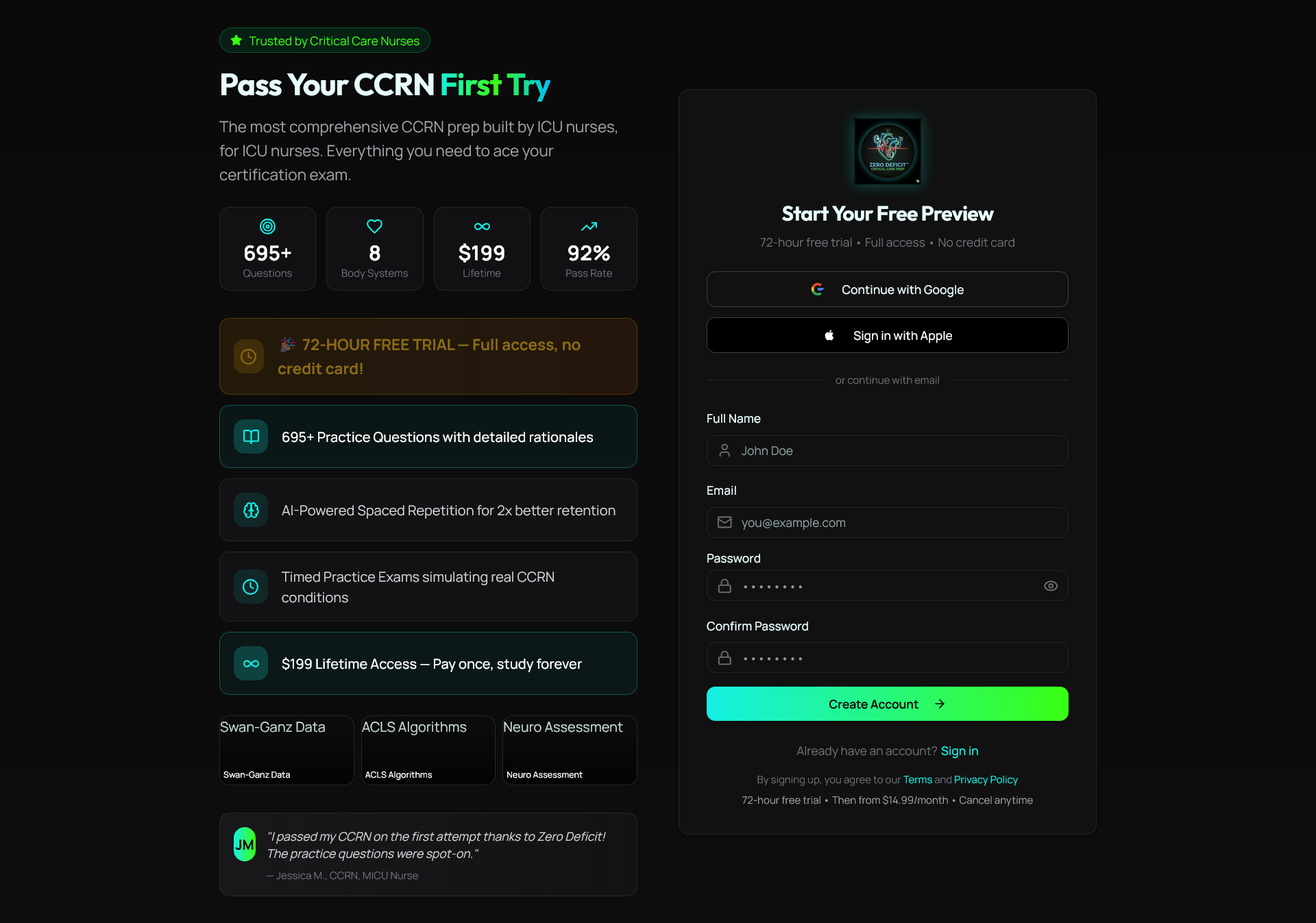
Spaced repetition gives you the method. Zerodeficitccrnprep gives you the content. The platform includes 695+ practice questions written to reflect real CCRN exam reasoning, organized across all 8 body systems in the AACN blueprint. Every question comes with a detailed rationale, which is exactly the source material you need to build high-yield flashcards. You can also use the step-by-step question breakdown methods to analyze why you missed a question and convert that reasoning into your next spaced repetition card. Start studying free at Zero Deficit CCRN Prep today, no credit card required, and see how targeted CCRN practice tests fit directly into your daily review routine.
FAQ
What is spaced repetition for CCRN exam prep?
Spaced repetition is a study method that schedules flashcard reviews at increasing intervals based on your recall performance. It prevents forgetting by timing each review just before memory fades, building durable long-term retention for complex CCRN content.
How many new anki cards should i add per day for CCRN prep?
Limit new cards to 10–20 per day. Adding more than that collapses the spacing intervals and turns your review queue into a cramming session, which defeats the purpose of the method.
Is anki or FlashRecall better for CCRN spaced repetition?
Anki offers more customization and uses the FSRS adaptive scheduler, making it ideal for nurses who want to build their own clinical reasoning decks. FlashRecall provides ready-made CCRN content with built-in adaptive scheduling, which suits nurses who prefer a faster setup.
Should i use spaced repetition alone or combine it with practice tests?
Combine both methods. Spaced repetition builds your knowledge base, while timed practice tests train clinical application and exam-format reasoning. Research confirms that combining these methods improves both recognition and reasoning outcomes.
How long before the CCRN exam should i start spaced repetition?
Start at least 8–12 weeks before your exam date. Spaced repetition requires time to work. The spacing effect compounds over weeks, so starting early gives the algorithm enough cycles to move high-priority content into long-term memory before exam day.
Recommended
- CCRN Study Guides: Prepare for Your Certification Exam | Zero Deficit™
- Advantages of practice tests for CCRN exam success | Zero Deficit CCRN Prep
- CCRN Exam Question Breakdown Methods: Master the Exam with Step-by-Step Guides | Zero Deficit™
- CCRN Practice Tests & Quizzes 2026 — All 8 Body Systems | Zero Deficit™
Take a Respiratory practice quiz
Master ARDS, ventilation, ABGs, oxygenation, and pulmonary emergencies.
Ready to pass your CCRN?
Join 12,000+ nurses using Zero Deficit — 695+ practice questions with rationales, AI-powered weak-area drilling, and spaced-repetition flashcards.
Start Free Trial →