CCRN study badge: Motivation, preparation, and peer support
If you’ve ever heard a colleague mention a “CCRN study badge” and wondered whether it’s an official credential from AACN or simply a custom sticker someone made in the break room, you’re not alone. The term circulates widely among critical care nurses, but no formal CCRN study badge exists as an official item issued by the American Association of Critical-Care Nurses (AACN). What does exist is a rich, informal culture of signaling exam readiness, building accountability, and fueling peer motivation. This article cuts through the confusion, explains what the CCRN study badge actually means, and shows you how to channel that energy into real exam results.
Table of Contents
- Understanding the CCRN study badge: Origins and misconceptions
- Motivation and peer support: Why nurses use CCRN study badges
- Evidence-based CCRN exam preparation: What actually works
- Study badge pitfalls: Avoiding miscommunication and maximizing value
- Why the myth of the CCRN study badge persists, and what really drives exam success
- Next steps for CCRN exam success: Study guides, prep tools, and tracking progress
- Frequently asked questions
Key Takeaways
| Point | Details |
|---|---|
| No official badge | AACN does not issue formal CCRN study badges; usage is informal among candidates. |
| Motivation tool | Study badges foster accountability and collaboration but do not guarantee exam success. |
| Preparation is key | Evidence-based study methods and high practice exam scores are what truly drive CCRN exam results. |
| Avoid confusion | Always distinguish study badges from certified badges to prevent miscommunication in clinical settings. |
| Group benefits | Engaging with peers and study groups is more effective for exam prep than relying on symbolic badges alone. |
Understanding the CCRN study badge: Origins and misconceptions
The first thing to get straight: AACN has not issued any official CCRN study badge for nurses in the process of preparing for the exam. The term “study badge” is informal, community-generated, and used in clinical settings to distinguish candidates from certified nurses.
What AACN does offer is a CCRN retractable badge holder, a merchandise item designed for nurses who have already earned their certification. This badge holder displays “CCRN” on the nurse’s ID badge, functioning as a symbol of certification pride. It is a reward for having passed, not a tool for the journey toward passing.
This distinction matters more than it might seem. When a nurse wears something labeled “CCRN” and hasn’t yet passed the exam, there’s real potential for miscommunication with supervisors, patients, and colleagues. Understanding the difference between a study badge and a certified badge protects your professional integrity.
| Feature | CCRN study badge | CCRN certified badge holder |
|---|---|---|
| Issued by AACN | No | Yes |
| Indicates certification | No | Yes |
| Purpose | Signals exam preparation | Displays earned credential |
| Where to get it | Informal, self-made or custom | AACN official store |
| Risk of confusion | Moderate to high | None |
Here’s what the informal study badge actually represents:
- A self-declared status: You are actively studying for the CCRN exam and want your unit to know it.
- An accountability anchor: Wearing it publicly creates a small but meaningful commitment.
- A conversation starter: Peers who see it may join a study group or offer encouragement.
- A motivational symbol: It makes your goal visible, which research on behavioral commitment suggests increases follow-through.
“The badge is not a credential. It’s a conversation. And in critical care, conversations about certification push the whole unit forward.”
The confusion between study and certified badges typically starts when nurses see a colleague wearing something with “CCRN” on it and assume it means certification. If you use a study badge, label it clearly. Something like “CCRN Candidate” or “CCRN in Progress” keeps the meaning transparent.
Motivation and peer support: Why nurses use CCRN study badges
Once you understand what a study badge actually is, the next question is obvious: why bother wearing one at all? The answer sits at the intersection of psychology and critical care culture.

Nurses studying for the CCRN exam often report feeling isolated in their preparation. The exam is demanding, covering twelve body system categories and requiring both clinical knowledge and judgment-based reasoning. Informal signals like CCRN study badges foster collaboration, motivate peers, and help form the study groups that make a real difference in preparation quality.
Here’s how that plays out on a real ICU unit:
- Visibility drives accountability. When your charge nurse and your peers know you’re studying, you’re less likely to skip your practice session after a brutal twelve-hour shift. The badge makes your intention public.
- Peer identification accelerates group formation. Rather than awkwardly asking around to see who else is prepping for the CCRN, a visible badge signals your status instantly. Study groups form faster, and they tend to be more focused.
- Social reinforcement compounds over time. Colleagues ask how your prep is going. That question, repeated over weeks, keeps your motivation from fading during the harder stretches of study.
- Badge-wearing creates a habit anchor. Behavioral psychology identifies “implementation intentions” as powerful predictors of goal completion. A badge worn daily is a physical implementation intention.
- It normalizes certification culture. When multiple nurses on a unit wear study badges, certification stops feeling like an individual pursuit and starts feeling like a team standard.
Pro Tip: Before you make or order a study badge, decide exactly what text you want on it. “CCRN Candidate,” “CCRN Study Mode,” or “CCRN in Progress” all communicate your status clearly without implying certification. Clear labeling is the difference between a helpful signal and an awkward misunderstanding.
If you want your badge to point somewhere productive, pair it with access to solid practice test resources that reinforce what you’re learning each week. The badge is the signal. The practice is the substance.
“When the whole unit knows you’re studying, the unit becomes your study partner. That’s a force multiplier no textbook provides.”
Study badges work best when they exist inside a broader culture of preparation. One nurse wearing a badge in isolation is motivating. Five nurses wearing badges while sharing questions after shift is transformative.
Evidence-based CCRN exam preparation: What actually works
Study badges are motivational tools, and motivation matters. But motivation alone does not pass the CCRN exam. What passes the exam is a structured, evidence-based preparation strategy executed consistently over time.
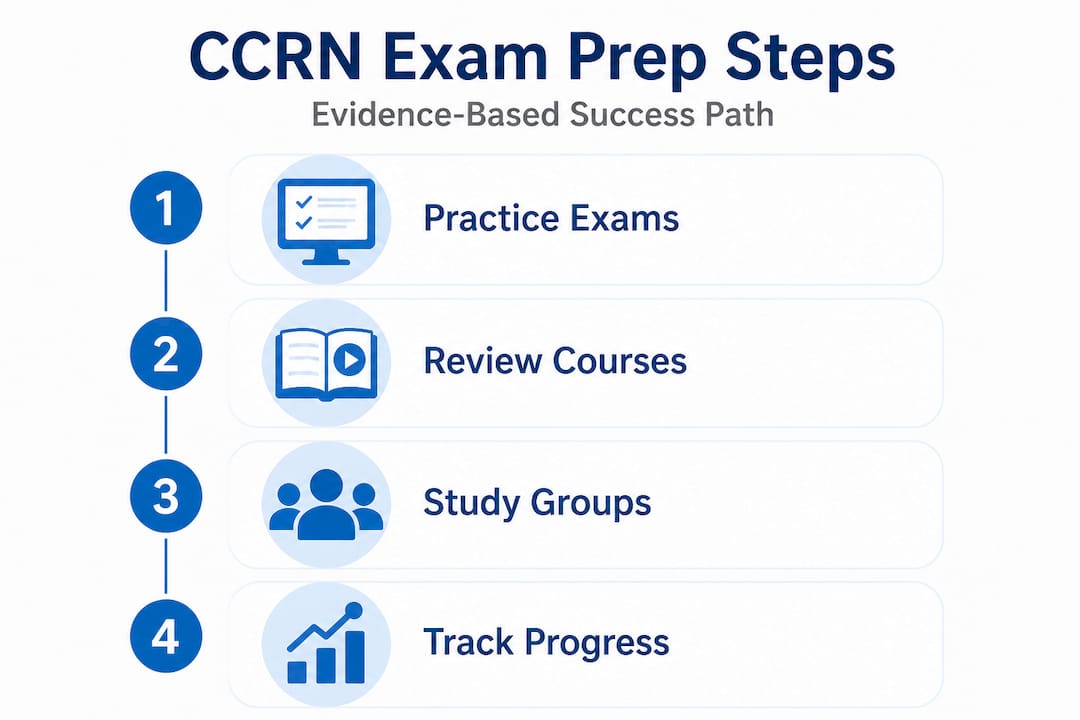
AACN’s own recommended study resources include exam handbooks, practice exams, and review courses. These are not optional enhancements. They are the foundation of your prep. And with revised CCRN exams launching in November 2025, ensuring your materials reflect the updated exam blueprint is more important than ever.
Empirical benchmarks for CCRN success are specific. Nurses who score consistently at 80% or above on timed practice exams tend to pass at significantly higher rates. That threshold is your target, and reaching it requires deliberate, repeated practice rather than passive reading.
There is no empirical data suggesting that study badges improve exam outcomes. The evidence points clearly toward clinical judgment practice, structured review, and active recall as the mechanisms of success.
Evidence-based prep strategies ranked by impact:
- Complete a full-length timed practice exam early. Identify your weakest body systems in the first two weeks, not the last two.
- Review rationales for every question you get wrong. The reasoning matters more than the answer itself. This is where clinical judgment develops.
- Study high-yield systems first. Cardiovascular, pulmonary, and neurology consistently carry the most exam weight.
- Use spaced repetition for pharmacology and labs. Recall improves dramatically when content is reviewed at increasing intervals.
- Join a structured study group. Verbally explaining a concept to a peer is one of the most effective learning techniques available.
- Track your progress weekly. If you’re not measuring, you’re guessing. Analytics show where your time needs to go.
| Prep strategy | Evidence level | Impact on pass rate |
|---|---|---|
| AACN-aligned practice exams | High | Strongly correlated with passing |
| Clinical judgment case review | High | Directly tested on exam |
| Passive textbook reading | Low to moderate | Helpful but not sufficient alone |
| Study group participation | Moderate to high | Improves retention and accountability |
| Wearing a study badge | Minimal | Motivational only, no direct link to outcomes |
If you’re looking for a structured starting point, the comprehensive CCRN exam guide breaks down the blueprint by system and prioritizes what you actually need to know. For a specific clinical scenario that shows up frequently, the shock flowchart guide is worth reviewing early in your prep.
Pro Tip: Don’t wait until you “feel ready” to take a full-length practice exam. Take one in week one, even if your score hurts. That baseline score is your most honest advisor.
Study badge pitfalls: Avoiding miscommunication and maximizing value
The study badge is a tool. Like any tool, it can be used well or poorly. Understanding the risks helps you get the most value from it without creating problems on your unit.
The biggest risk is confusion between a study badge and an official CCRN certification badge. This confusion can mislead peers or supervisors about your actual credential status. In a clinical setting where credentials carry direct responsibility for patient safety, ambiguity about certification is not trivial.
A few additional pitfalls to watch for:
- Generic labeling: A badge that just says “CCRN” without context will almost certainly be misread as certification by anyone unfamiliar with study badge culture.
- Substituting the badge for preparation: Some nurses focus so much on the social and motivational aspects of certification culture that actual study time gets crowded out. The badge should add to your prep, not replace it.
- Using it as a pressure point: If wearing the badge creates anxiety rather than motivation, it may be doing more harm than good. Accountability tools should energize you, not paralyze you.
- Skipping the study group follow-through: A badge signals your intention. That signal is only meaningful if you actually follow through with structured preparation and peer collaboration.
Here’s how to use a study badge effectively:
- Label it precisely: “CCRN Candidate” or “CCRN Exam Prep in Progress” leaves no ambiguity.
- Pair it with a concrete study schedule that you share with at least one colleague.
- Use it as an opening to invite a peer into a study group.
- Combine it with a tracking tool to hold yourself accountable on measurable outcomes.
Pro Tip: When you pass the CCRN exam, retire your study badge publicly. Make the moment visible on your unit. It signals to every other candidate around you that the goal is achievable, and it models the exact culture of certification that study badges are meant to inspire.
For deeper strategy on how to work through high-difficulty questions without losing confidence, the question analysis techniques resource is worth bookmarking before your next practice session.
Why the myth of the CCRN study badge persists, and what really drives exam success
Here’s a perspective that might reframe how you think about all of this. The study badge persists not because nurses are confused about credentials, but because critical care culture genuinely runs on symbols. The certification badge means something in the ICU. It commands respect. So naturally, candidates want to participate in that symbolism before they’ve earned the right to the official version.
That’s not a flaw. It’s a feature of a profession that takes its standards seriously.
But here’s what we’ve observed time and again: the nurses who pass the CCRN exam on their first attempt are not the ones who wore the most visible badge during prep. They’re the ones who treated their exam preparation strategies as non-negotiable, who worked through hard questions systematically, who reviewed their wrong answers with the same discipline they bring to a patient’s deteriorating rhythm. The evidence is consistent: no data links badge wearing to better outcomes.
What the badge does well is social. It creates peer accountability. It starts conversations that lead to study groups. It makes your commitment visible. Those are real and valuable outcomes, and we’d never dismiss them. But the badge cannot substitute for clinical judgment practice, consistent question drilling, or systematic body-system review.
The nurses we see succeed fastest are the ones who treat their preparation like a clinical protocol. Structured. Measurable. Adjusted based on data. The badge might be the spark, but your preparation is the fuel.
Next steps for CCRN exam success: Study guides, prep tools, and tracking progress
You’ve spent time understanding the real meaning behind CCRN study badges, and now the focus shifts to action. Motivation is the starting line, but structured preparation is what gets you across the finish line.
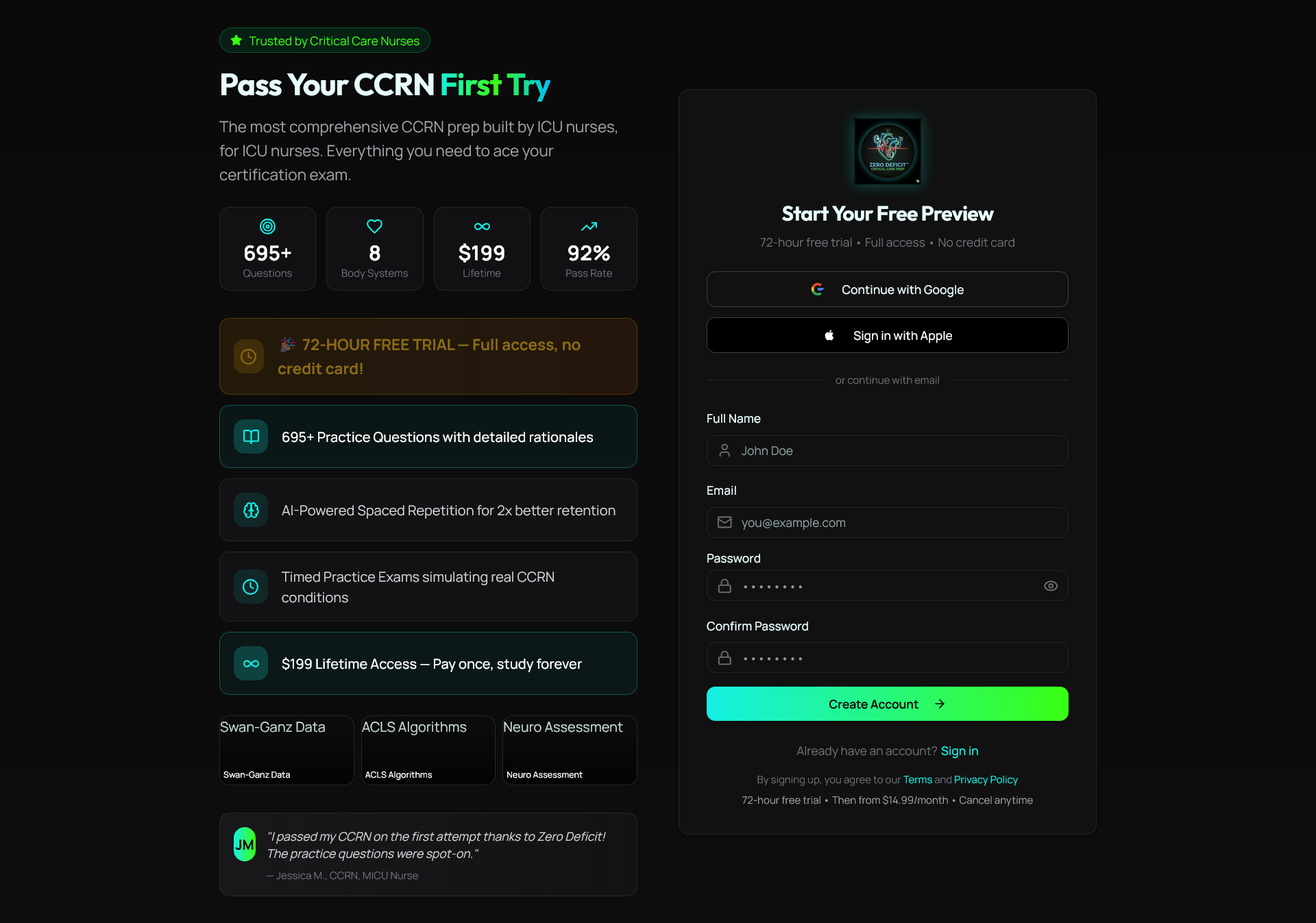
Zero Deficit™ CCRN Exam Prep gives you everything you need in one place, built specifically for critical care nurses who want to pass on their first attempt. Start with the CCRN exam guide to map out your preparation by system priority and understand what the exam actually tests. Then work through the study guides overview to access content organized by body system, so you study what matters most and skip the noise. And as you build momentum, use the study progress tracking tools to measure your growth, identify gaps, and stay on a clear path to certification. No credit card required to start.
Frequently asked questions
Is there an official CCRN study badge from AACN?
No, AACN does not issue an official CCRN study badge. Any badge used during exam preparation is an informal, community-created motivational tool.
What is the difference between a CCRN study badge and a certified badge?
A study badge signals that you are actively preparing for the exam, while the CCRN certified badge holder is an official AACN merchandise item available only to nurses who have already earned their certification.
Do CCRN study badges improve exam pass rates?
No, there is no empirical evidence that study badges directly improve pass rates. Consistent practice with AACN-aligned resources and achieving 80% or above on timed practice exams are the strongest predictors of success.
What motivates nurses to use CCRN study badges?
Study badges serve as informal signals that encourage peer accountability, spark study group formation, and keep individual motivation high throughout the often demanding exam preparation period.
How can I prepare for the CCRN exam most effectively?
Use AACN-recommended materials including practice exams and review courses, target a consistent score of 80% or above on timed practice exams, and prioritize clinical judgment content across high-yield body systems.
Recommended
- Zero Deficit™ CCRN Exam Prep: Choose Your Subscription Plan
- CCRN Exam Prep: Pass Your Certification with Zero Deficit™
- CCRN Exam Question Breakdown Methods: Master the Exam with Step-by-Step Guides | Zero Deficit™
- CCRN Study Guides: Prepare for Your Certification Exam | Zero Deficit™
- Build Self-Awareness: Practical Steps for Personal Growth
- Boost A Level maths grades with structured exam prep
Take a Neurological practice quiz
Test your knowledge of stroke, ICP, seizures, and neuro assessment.
Get Your Free 20-Question CCRN Diagnostic
20 high-yield CCRN-style questions across every body system, with detailed rationales — emailed to you instantly.
No spam. One email + a couple of helpful follow-ups. Unsubscribe anytime.
Ready to pass your CCRN?
Join 12,000+ nurses using Zero Deficit — 695+ practice questions with rationales, AI-powered weak-area drilling, and spaced-repetition flashcards.
Start Free Trial →