Master critical care nursing terminology for the CCRN exam

Terminology is not just background knowledge in critical care nursing. It is the foundation for every clinical decision you make at the bedside and every correct answer you choose on the CCRN exam. CCRN certification eligibility requires nurses providing direct care to or influencing care of acutely and critically ill patients, which means the language you use must be precise, applied, and deeply understood. If you approach terminology as a list of definitions to memorize, you will struggle. This guide will show you how to learn critical care terms the right way, connecting language to clinical judgment, exam performance, and real patient outcomes.
Table of Contents
- Why terminology matters in critical care and the CCRN exam
- Core frameworks: The Synergy Model and care domains you need to know
- Common critical care terms, abbreviations, and what they really mean
- Practical strategies for learning terminology: Study plans, resources, and real-world context
- The overlooked truth about mastering CCRN terminology
- Move from terminology to mastery with Zero Deficit™ CCRN prep
- Frequently asked questions
Key Takeaways
| Point | Details |
|---|---|
| Terms drive clinical decisions | Understanding terminology anchors your clinical judgment and exam answers. |
| Frameworks guide learning | Study by domain and context, not just isolated definitions, for maximum retention. |
| Practice with real cases | Apply terms in real-world ICU and practice test scenarios to truly master them. |
| Leverage top resources | AACN handbooks and focused study guides are the gold standard for CCRN preparation. |
Why terminology matters in critical care and the CCRN exam
Many nurses assume the CCRN exam is mostly about memorizing facts. The reality is far more demanding. The CCRN exam structure consists of 150 multiple-choice questions (125 scored) delivered over three hours, with 80% of the exam dedicated to Clinical Judgment and 20% to Professional Caring and Ethical Practice. That means the vast majority of questions are testing your ability to think through complex scenarios, not simply recall a definition.
When you encounter a question about a patient in septic shock with evolving MODS (Multiple Organ Dysfunction Syndrome), you do not just need to know what MODS stands for. You need to understand what it looks like, how it progresses, how it differs from SIRS (Systemic Inflammatory Response Syndrome), and what interventions should be prioritized. The terminology is embedded within a problem-solving framework.
Consider what happens when terminology breaks down clinically. A nurse who confuses “preload” with “afterload” may misinterpret hemodynamic data on a Swan-Ganz catheter readout and administer the wrong intervention. In a busy ICU, that kind of confusion can escalate quickly. The stakes on the exam mirror the stakes at the bedside.
Here is what terminology knowledge directly impacts on the CCRN exam:
- Clinical scenario interpretation: You cannot identify the correct nursing priority without understanding what the described findings mean.
- Question stem analysis: Many distractor answers use near-synonyms or related terms designed to catch nurses who only partially understand a concept.
- Intervention selection: Terms like “vasoactive,” “inotrope,” and “vasopressor” describe different mechanisms and lead to different actions.
- Lab value context: Knowing that a lactate of 4.2 mmol/L signals significant tissue hypoperfusion requires understanding what lactate represents physiologically.
“The CCRN is not a vocabulary test, but you cannot pass it without vocabulary mastery. Every scenario-based question is built on a foundation of precise terminology.”
Using question breakdown methods that dissect exam stems by key terms will give you a major strategic edge. Reviewing CCRN study guides organized by system further reinforces how terms cluster together in clinical practice. AACN’s official resources remain the gold standard for understanding what knowledge is expected of certified critical care nurses.
Core frameworks: The Synergy Model and care domains you need to know
Now that you know why terminology matters, understanding how key terms fit into broader frameworks will help anchor your learning.
The most important conceptual framework for the CCRN is the AACN Synergy Model, which organizes critical care practice around the relationship between patient characteristics and nurse competencies. The Synergy Model defines eight patient characteristics: resiliency, vulnerability, stability, complexity, resource availability, participation in care, participation in decision-making, and predictability. It also defines eight nurse competencies including clinical judgment, advocacy, collaboration, and systems thinking.

Understanding these terms is not optional. They shape how the exam frames nursing priorities and ethical considerations. When a question describes a patient with “low resiliency and high vulnerability,” you need to recognize that this patient has little reserve to absorb stressors and is at high risk for rapid deterioration. That understanding directly guides your answer choice.
Beyond the Synergy Model, the CCRN test plan divides content into major care domains. Each domain carries its own cluster of terminology, and knowing how terms connect within each domain accelerates your learning significantly.
| CCRN domain | Representative terms |
|---|---|
| Cardiovascular | Preload, afterload, cardiac index, MAP, dysrhythmia |
| Respiratory | PaO2/FiO2 ratio, PEEP, tidal volume, compliance, ARDS |
| Neurology | ICP, CPP, herniation syndromes, GCS, cerebral autoregulation |
| Renal | BUN, creatinine, CRRT, AKI stages, oliguria |
| Hematology | INR, PTT, DIC, thrombocytopenia, coagulopathy |
| Multisystem | SIRS, MODS, sepsis, vasoactive agents, cytokine storm |
| Endocrine | DKA, HHS, thyroid storm, adrenal insufficiency |
| Professional practice | Synergy Model, advocacy, clinical judgment |
Pro Tip: Organize your study by domain, not alphabetical term lists. When you learn terms within their clinical context, your brain encodes them alongside relevant interventions and lab values, making recall under pressure much more reliable.
The Synergy Model also explains why terms like “advocacy” and “moral distress” appear on an exam that is heavily clinical. These concepts reflect the professional caring domain and are tested in scenarios involving family dynamics, end-of-life care, and ethical conflicts. Use the shock flowchart resource to see how terminology clusters around one of the most complex multisystem topics. For neurological terms specifically, the neurology study guide provides structured domain-based learning that reflects exactly how the exam tests this content.
Common critical care terms, abbreviations, and what they really mean
With frameworks in mind, let us look at the most commonly tested and clinically relevant ICU terms and how to make them stick.
Common ICU abbreviations include ABG, ARDS, ECMO, CRRT, SIRS, and MODS, and each one carries layers of meaning that go far beyond its spelled-out name. The challenge is not spelling them out. The challenge is understanding the clinical picture each one represents and the decisions it drives.
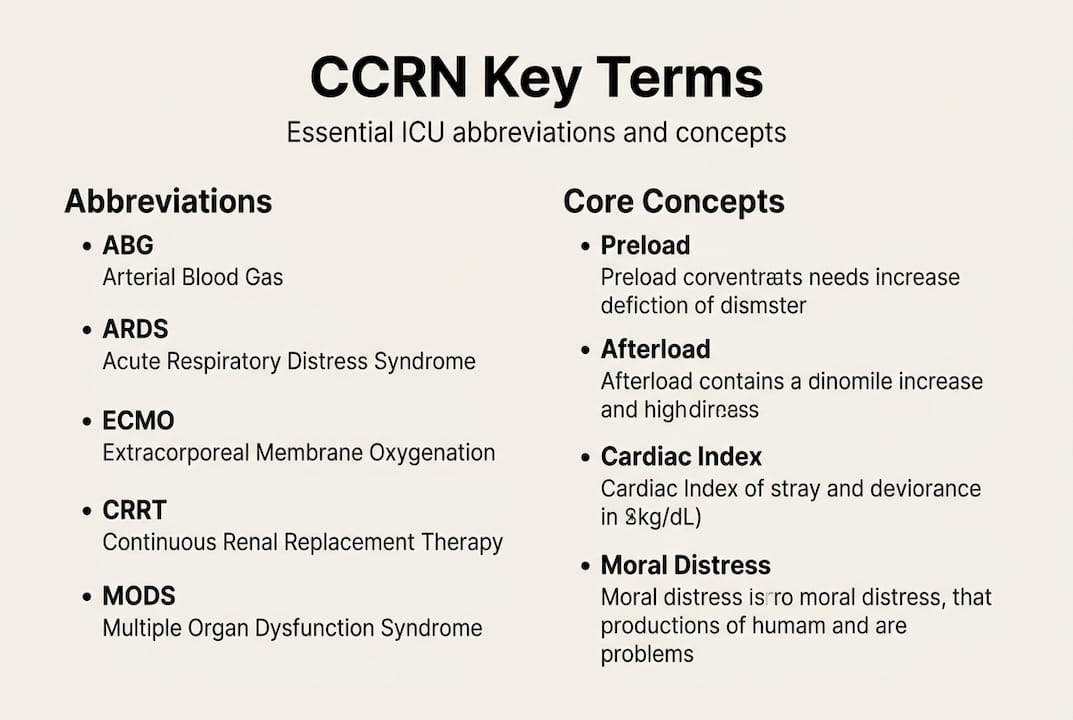
| Abbreviation | Full term | What it means | Why it matters on the CCRN |
|---|---|---|---|
| ABG | Arterial Blood Gas | Measures pH, PaCO2, PaO2, HCO3, and oxygen saturation | Used to identify respiratory vs. metabolic acid-base disorders |
| ARDS | Acute Respiratory Distress Syndrome | Diffuse alveolar damage causing severe hypoxemia | Drives ventilator management decisions including low tidal volume strategy |
| ECMO | Extracorporeal Membrane Oxygenation | Mechanical support oxygenating blood outside the body | Tested in refractory cardiac or respiratory failure scenarios |
| CRRT | Continuous Renal Replacement Therapy | Slow, continuous dialysis for hemodynamically unstable patients | Preferred over intermittent HD for critical patients with AKI |
| SIRS | Systemic Inflammatory Response Syndrome | Criteria-based inflammatory response (fever/hypothermia, HR, RR, WBC changes) | Distinguishes inflammatory response from confirmed infection or sepsis |
| MODS | Multiple Organ Dysfunction Syndrome | Progressive failure of two or more organ systems | Signals high mortality risk; requires prioritizing supportive care |
Several abbreviations trip up even experienced nurses because they look or sound similar. Consider these common confusions:
- SVR vs. PVR: Systemic vascular resistance vs. pulmonary vascular resistance. Both reflect vascular tone, but one governs left heart afterload and the other governs right heart afterload. Confusing these on the exam leads to completely opposite interventions.
- CVP vs. PCWP: Central venous pressure reflects right heart preload; pulmonary capillary wedge pressure reflects left heart preload. Both are measured in the same units (mmHg), making them easy to mix up under pressure.
- PAP vs. MAP: Pulmonary artery pressure vs. mean arterial pressure. Both are “pressures,” but their normal ranges and clinical implications are entirely different.
Key terms you will almost certainly encounter on the CCRN include:
- Cerebral perfusion pressure (CPP): MAP minus ICP. Maintaining CPP above 60 mmHg is a core neurological priority.
- Compliance: In respiratory care, how easily the lungs expand. Decreased compliance is a hallmark of ARDS.
- Vasopressor: A medication that constricts blood vessels to raise blood pressure, such as norepinephrine. Distinct from an inotrope, which increases cardiac contractility.
- Inotrope: A drug affecting the force of cardiac contraction. Dobutamine is a positive inotrope used in cardiogenic shock.
- Hemodynamic instability: A state in which blood pressure, heart rate, or cardiac output cannot be maintained without intervention.
“There is no single comprehensive AACN glossary. This means real exam prep requires active integration of terms across clinical scenarios, study guides, and practice questions rather than passive review of word lists.”
For respiratory terms and oxygenation concepts, the respiratory study guide breaks down the most tested content. For renal terms including CRRT and AKI staging, the renal study guide provides structured, system-specific coverage. Understanding how patients with complex inpatient conditions require coordinated care also helps you contextualize many of the multisystem terms tested on the exam.
Practical strategies for learning terminology: Study plans, resources, and real-world context
Armed with key terms, let us explore the most effective ways to lock them in for both the test and the bedside.
The CCRN pass rate sits at approximately 74 to 84% on the first attempt for adult CCRN candidates. That means a meaningful portion of test-takers do not pass the first time. Terminology gaps are often a significant contributing factor, not because nurses do not study, but because they study the wrong way.
AACN Practice Alerts provide evidence-based guidance on critical care topics including alarm management, family presence, and sedation protocols. Reading these alerts does something vocabulary lists cannot: they show you terms in action, embedded in clinical reasoning and real-world decision-making. That is exactly how the exam will present them.
Follow this step-by-step approach to build genuine terminology mastery:
- Start with the CCRN test plan. Download the official AACN exam blueprint and identify the major domains and their weighted percentages. This tells you exactly where to focus your time and energy.
- Map terms to domains. For each domain, list the core terms, abbreviations, and concepts. Use the domain table in this article as a starting point and expand it using your study guides.
- Learn terms in clinical context. For every new term, ask yourself: What does it look like in a patient? What labs or vitals accompany it? What nursing intervention does it trigger?
- Practice with scenario-based questions. Use practice exams that mirror the CCRN format, focusing on how terms appear within complex clinical situations rather than isolated definitions.
- Review your errors analytically. When you get a question wrong, identify whether the error was a terminology gap, a reasoning gap, or a knowledge gap. Each requires a different fix.
- Reinforce with spaced repetition. Revisit high-yield terms regularly across your study timeline. Spacing review intervals builds long-term retention far more effectively than cramming.
Pro Tip: Use real ICU case scenarios to anchor terms in memory. After a shift, mentally narrate the clinical story using the precise terminology: “This patient developed oliguric AKI secondary to septic shock, with rising creatinine and decreased urine output requiring CRRT initiation.” This turns passive vocabulary into active clinical language.
Track where your knowledge is strongest and where gaps remain by using a system that reflects your progress over time. The practice CCRN tests at Zero Deficit™ are built to surface those gaps efficiently, and you can track your study progress to ensure you are improving in the right areas. For domain-specific depth, the hematology guide and cardiovascular guide are two of the highest-yield resources you will find.
The overlooked truth about mastering CCRN terminology
Here is something most study resources will not tell you directly: the nurses who struggle most with terminology are not the ones who studied less. They are the ones who studied differently. They collected definitions. They built glossaries. They made flashcards with perfect spelling. And then they sat in the exam room and could not apply any of it under pressure.
True terminology mastery means you can reconstruct the clinical picture behind every word. When you read “MODS,” your brain should immediately surface: elevated lactate, rising creatinine, worsening PaO2/FiO2 ratio, coagulopathy, and a mortality risk that demands immediate team-based response. That is what clinical judgment in multisystem failure actually looks like in practice.
The same principle applies to a term like “vasoactive.” Knowing it means “affecting vascular tone” is a starting point, not a destination. You need to know which agents are purely vasopressive, which are inotropic, which are vasodilatory, and how each fits into the management of different shock states. That level of connected understanding is what produces correct answers to complex CCRN questions and what prevents dangerous errors at the bedside.
For candidates preparing for advanced content areas, the advanced neurology prep module is an excellent example of how deep, connected learning outperforms surface-level memorization every single time.
Move from terminology to mastery with Zero Deficit™ CCRN prep
Ready to translate this understanding into a passing score and more confident practice? Zero Deficit™ CCRN Exam Prep is built specifically for this moment in your career.
Our platform gives you access to a full CCRN exam guide covering all major domains, over 695 practice questions with detailed rationales, and AI-powered tools that adapt to your individual learning needs. You can follow proven step-by-step exam methods that train you to break down complex scenarios with confidence. And with comprehensive CCRN study guides organized by body system, you will always know exactly where you stand and what to tackle next. Start studying free at Zero Deficit CCRN Prep today, no credit card required.
Frequently asked questions
What is the most efficient way to learn critical care terminology for the CCRN exam?
Focus on the core domains in the exam blueprint, using practice scenarios and AACN official handbooks to build contextual understanding rather than memorizing isolated definitions.
Which critical care abbreviations are most commonly tested?
Frequently tested abbreviations include ARDS, ABG, ECMO, CRRT, SIRS, and MODS, each requiring clinical understanding beyond just spelling out the full term.
Does the CCRN exam have a glossary or list of required terms?
No official glossary exists; terminology is embedded within the CCRN test plan and care domain frameworks rather than published as a separate reference list.
What is the CCRN exam pass rate and how does terminology knowledge affect it?
The CCRN pass rate sits at roughly 74 to 84% on the first attempt, and strong terminology knowledge improves your performance by sharpening how you interpret complex scenario-based questions and eliminate distractor answers.
Recommended
Take a Multisystem practice quiz
Master sepsis, shock, MODS, and multi-organ failure scenarios.
Get Your Free 20-Question CCRN Diagnostic
20 high-yield CCRN-style questions across every body system, with detailed rationales — emailed to you instantly.
No spam. One email + a couple of helpful follow-ups. Unsubscribe anytime.
Ready to pass your CCRN?
Join 12,000+ nurses using Zero Deficit — 695+ practice questions with rationales, AI-powered weak-area drilling, and spaced-repetition flashcards.
Start Free Trial →