Master the CCRN exam with proven nursing strategies

The first-time CCRN pass rate dropped to 72.02% in 2025, down from 81% in 2023, meaning more than one in four candidates are leaving the testing center without the result they worked for. That gap isn’t about intelligence or bedside experience. It’s about preparation strategy. Critical care nurses who build a deliberate, structured study plan consistently outperform those who rely on clinical intuition alone. This article breaks down exactly what you need to know: how the exam is structured, which resources actually work, and the techniques that translate study hours into a passing score.
Table of Contents
- Understanding the CCRN exam structure and requirements
- Key tools and resources: What works and what to skip
- High-yield study methodologies for mastering content
- Test-taking strategies: From theory to exam-day execution
- Verification and reflection: Measuring readiness and adapting
- Our perspective: What experienced CCRN candidates know that others miss
- Continue your CCRN journey with Zero Deficit™
- Frequently asked questions
Key Takeaways
| Point | Details |
|---|---|
| Know the exam structure | Understanding the format and scoring helps focus your study efforts for the CCRN. |
| Use combined resources | Mix official AACN materials and third-party Qbanks for comprehensive preparation and practice volume. |
| Adopt high-yield methods | Target cardiovascular, respiratory, and multisystem content first and practice daily. |
| Practice exam-day tactics | Employ clinical judgment strategies, prioritize safety, and simulate time limits for optimal performance. |
| Verify and reflect | Aim for 85%+ on practice exams, review mistakes diligently, and adapt your approach to boost confidence. |
Understanding the CCRN exam structure and requirements
Before diving into strategies, it’s essential to know exactly what you’re up against. You can’t build an effective study plan without understanding the exam’s architecture from the inside out.
The CCRN consists of 150 questions, but only 125 are scored. The remaining 25 are unscored pilot questions used by AACN to evaluate future exams. You’ll have 3 hours to complete the exam. The content is divided into two major domains based on the AACN Synergy Model: 80% clinical judgment and 20% professional caring and ethical practice. That 20% matters far more than most candidates realize.
| Exam component | Details |
|---|---|
| Total questions | 150 (125 scored) |
| Time allowed | 3 hours |
| Passing cut score | 83 out of 125 (66.4%) |
| Clinical judgment weight | 80% |
| Professional caring/ethics weight | 20% |
| 2025 first-time pass rate | 72.02% |
The cut score of 83 out of 125 might seem reachable, but consider this: that 72% pass rate means roughly 4,800 candidates out of 17,151 failed in 2025 alone. Understanding the content breakdown tells you where to invest your study hours. Clinical judgment spans cardiovascular, pulmonary, neurological, renal, endocrine, gastrointestinal, hematology/immunology, and multisystem topics. Professional caring covers advocacy, caring practices, collaboration, and systems thinking.
- Clinical judgment (80%): Cardiovascular, pulmonary, neuro, renal, GI, multisystem, endocrine, hematology
- Professional caring/ethical practice (20%): Advocacy, collaboration, caring practices, response to diversity, facilitation of learning, systems thinking
- Question format: All multiple-choice, four-option questions
- Scoring: Scaled score, not raw; pilot questions don’t count for or against you
Knowing this structure lets you allocate study time rationally rather than spreading effort evenly across all topics. Cardiovascular and pulmonary together account for a significant portion of clinical judgment questions, making them the highest-yield areas to master first.
Key tools and resources: What works and what to skip
Now that you understand the exam format, let’s identify practical resources to build your study plan.
Not all CCRN prep materials are created equal. Some resources go deep on content but light on practice. Others offer thousands of questions but poor rationales. The best approach is a strategic combination rather than picking one tool and hoping for the best.
AACN’s official resources are your foundation. The CCRN Exam Handbook includes the official test plan, eligibility requirements, and content weightings directly from the organization that writes the exam. AACN also offers official practice exams and an Adult CCRN Review Course that aligns tightly with the current practice analysis updated in November 2025. Starting with official materials means you’re studying to the actual exam blueprint, not someone’s interpretation of it.
Third-party resources add volume and variety. BoardVitals and Kaplan both offer question banks exceeding 1,000 questions. Nicole Kupchik’s review course is widely praised among critical care nurses for its high-yield, real-world clinical focus that mirrors the complexity of actual exam scenarios. The trade-off with third-party resources is occasional misalignment with the most current AACN practice analysis, so always cross-reference with the official test plan.

| Resource type | Strengths | Limitations |
|---|---|---|
| AACN official exam handbook | Directly blueprinted to exam | Limited practice volume |
| AACN review course | Exam-aligned, updated content | Higher cost |
| Nicole Kupchik course | High-yield, real-world focus | Less systematic by body system |
| BoardVitals/Kaplan Qbank | Large question volume | Variable rationale quality |
| Zero Deficit™ platform | 695+ questions, AI-powered, analytics | Specialized CCRN focus |
Pro Tip: Don’t save practice questions for the end of your study period. Start them in week one. Question breakdown methods help you understand why wrong answers are wrong, which is as valuable as knowing why the right answer is right.
Learning how to study effectively means mixing content review sessions with active practice. Passive reading doesn’t build the clinical reasoning the CCRN demands. Active recall, spaced repetition, and consistent practice questions reinforce retention at a neurological level.
High-yield study methodologies for mastering content
With your resources in hand, here’s how to use them with focus and discipline to cover what matters most.
A scattered approach wastes time. A structured 6 to 10 week plan organized by system and weighted by exam content gives you a clear direction every day. Here’s a framework you can adapt:
- Week 1 to 2: Cardiovascular and pulmonary. These two systems alone dominate the clinical judgment domain. Focus on hemodynamic monitoring, dysrhythmias, heart failure, ARDS, mechanical ventilation, and oxygenation concepts.
- Week 3: Neurological and renal. Neuro covers ICP management, stroke, seizures, and GBS. Renal focuses on AKI, CKD, fluid and electrolyte balance, and renal replacement therapy. The multisystem study guide is particularly useful for understanding how organ systems interact under critical illness.
- Week 4: Endocrine, GI, hematology, and immunology. These are lower-volume content areas but can still yield multiple questions. DKA, HHS, GI bleeding, DIC, and immunosuppression are high-frequency topics within these systems.
- Week 5 to 6: Multisystem and professional caring. Sepsis, MODS, trauma, and toxic ingestion fall under multisystem. Professional caring covers ethical frameworks, patient advocacy, family-centered care, and collaborative practice. This is the 20% that too many candidates underestimate.
- Week 7 to 8: Full review and timed simulations. Complete two to three full-length, 125-question timed practice exams under realistic conditions. Log every missed question by error type.
- Week 9 to 10 (if needed): Targeted remediation based on performance analytics. Return to weakest systems, retest, and refine.
Aim for 180 to 300 practice questions per week throughout your study period. That pace builds both content knowledge and question endurance. Log your errors by category: knowledge gaps, misinterpretation of clinical data, or prioritization errors. Each error type calls for a different remediation strategy.
“Consistent daily practice, rationale review, and targeted reflection on missed questions outperform marathon study sessions without direction.” — Expert consensus from CCRN prep educators
Research on stress management also supports the value of recovery time. Building short rest periods and self-care into your weekly study schedule sustains cognitive performance across a multi-week prep cycle. Burnout mid-prep is a real risk for nurses already managing demanding clinical shifts.
Don’t neglect the 20% professional caring and ethics questions. Many candidates who score well on clinical content miss enough ethical practice questions to fall below the cut score. Familiarize yourself with the AACN Synergy Model principles. Practice questions in this domain often require you to identify the best collaborative or advocacy-based response, which differs from clinical problem-solving.
Pro Tip: Create a dedicated “miss log” in a notebook or digital document. Write each missed question in your own words, note why you got it wrong, and write the correct concept. Revisit this log every three days.
Test-taking strategies: From theory to exam-day execution
Effective study habits set you up, but mastering exam-day tactics ensures you translate preparation into results.
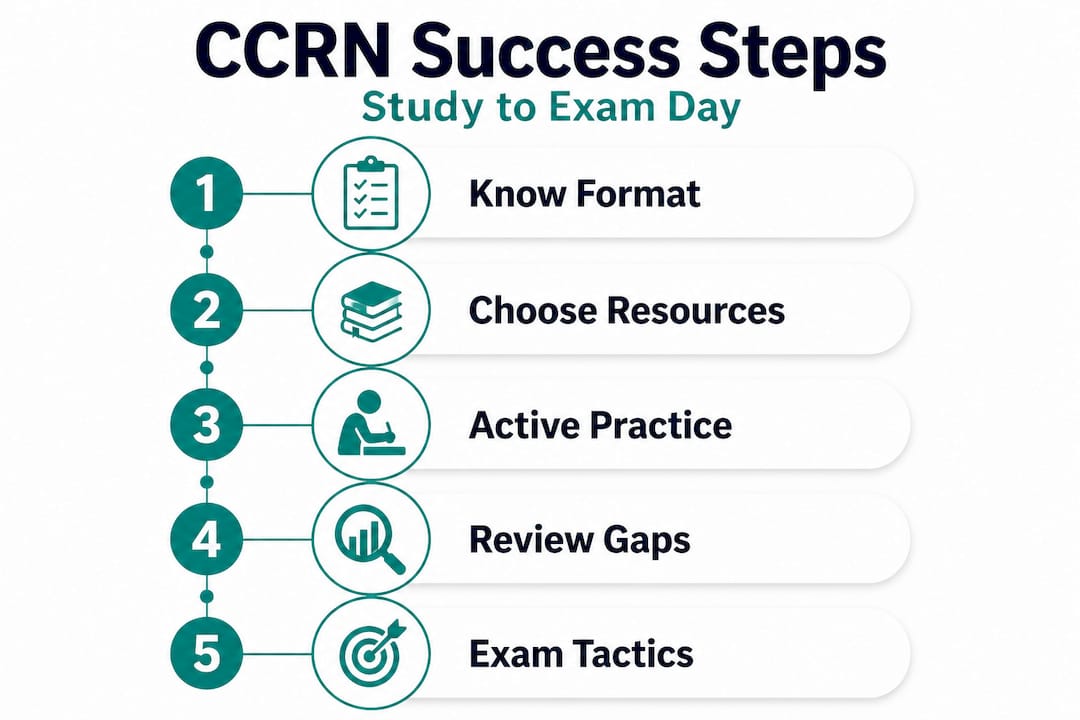
The CCRN tests clinical reasoning, not memorization. That means how you think through each question matters as much as what you know. Applying a consistent approach to every question reduces errors from careless reading and improves your decision-making speed under pressure.
Prioritize immediate threats to patient safety in any scenario-based question. If a question presents a hemodynamically unstable patient with multiple nursing concerns, the correct answer almost always addresses the most life-threatening issue first. This mirrors the priority-setting you do at the bedside but requires you to apply it systematically in a testing environment.
- Use physiological trends: A single lab value rarely tells the full story. Look for direction of change, the clinical context, and what the trend implies about organ function.
- Distinguish “best next” from “best overall”: “What should the nurse do first?” calls for the immediate intervention. “What is the priority goal?” calls for the broader outcome. These require different answer selection criteria.
- Eliminate unsafe options first: Any answer choice that could cause patient harm is almost never correct. Remove it immediately and work from the remaining options.
- Use time checkpoints: With 3 hours for 150 questions, you have roughly 72 seconds per question. Check your progress at the 50, 100, and 130 question marks to stay on pace.
- Don’t change answers based on anxiety: Your first clinical instinct, informed by solid preparation, is usually right. Change an answer only if you have a clear, specific reason.
“Clinical reasoning, not rote memory, is what the CCRN ultimately tests. Nurses who practice applying knowledge to scenarios outperform those who only memorize facts.” — Preppool CCRN guidance
The CCRN exam guide also provides insight into how to approach the specific question stems used most frequently on the exam. Recognizing common question patterns during prep means you spend less cognitive energy decoding the question format on exam day and more energy applying clinical knowledge.
The advice for internationally trained nurses emphasizes that adaptive test-taking requires understanding not just content but also the cultural and institutional assumptions embedded in U.S.-based clinical exams. Even for domestic nurses, this reminder holds: the exam reflects U.S. standard-of-care practices and ethical frameworks, so alignment with those standards in your answers is essential.
Verification and reflection: Measuring readiness and adapting
After applying exam techniques, verification is key. Here’s how to ensure you’re ready for certification day.
Practice scores are your most honest readiness indicator. The empirical benchmark is 85% or higher on full-length practice exams, which is approximately 106 out of 125 questions. Reaching that threshold consistently gives you a strong confidence buffer above the 83-question cut score, accounting for variability in actual exam difficulty.
| Performance benchmark | What it signals |
|---|---|
| Below 70% on practice exams | Significant content gaps remain; delay testing if possible |
| 70 to 79% | Foundational knowledge present; targeted review needed |
| 80 to 84% | Approaching readiness; focus on weak systems and strategies |
| 85% and above | Strong readiness; simulate exam day and maintain momentum |
Use the practice tests available through your chosen platforms to track your score progression across systems. If cardiovascular questions consistently pull your score down, return to the study guides for that system before retesting. Targeted remediation is more efficient than reviewing everything again.
Consistent daily review, especially in the final three weeks before your exam, reinforces retention better than occasional long sessions. Use mnemonics for labs and critical formulas, such as the 5 Ts for cardiac tamponade or MAP calculation. Apply the teach-back method: explain a topic aloud as if teaching a new nurse. If you stumble, that’s your gap to address.
Simulating exam-day conditions means sitting for a full 3-hour practice session with no interruptions, no phone, and no pausing. Do this at least once before your actual exam date. The cognitive fatigue of question 130 feels different from question 30, and experiencing that in practice reduces the surprise on test day.
Our perspective: What experienced CCRN candidates know that others miss
Strong clinical nurses sometimes carry a blind spot into their CCRN prep: the assumption that bedside experience will carry them through. We’ve seen it consistently. A nurse with eight years in a cardiac ICU walks into the exam confident and walks out without a passing score. The reason is almost always the same. They underestimated the professional caring and ethical practice questions and over-relied on clinical intuition rather than structured test-taking strategy.
Here’s what experienced candidates learn the hard way: practice volume alone doesn’t build mastery. A nurse who completes 2,000 questions passively, clicking through answers without reflecting on rationales, often scores lower than someone who completes 800 questions with deep, intentional review. The renal study guide is a good example of this principle in action. Renal content isn’t the largest section, but nurses who understand the physiological reasoning behind acid-base compensation, fluid shifts, and renal replacement therapy criteria can apply that reasoning to novel scenarios they’ve never seen before.
Real-world clinical scenarios on the exam are deliberately designed to feel unfamiliar. They present complex, multi-system patients where the “obvious” answer is rarely correct. Flexibility in reasoning matters more than pattern recognition. The candidates who pass aren’t necessarily the ones who have seen the most similar cases. They’re the ones who have practiced thinking through new information with a disciplined framework.
Benchmarking your performance at 85% isn’t about perfection. It’s about building the confidence margin that holds when exam-day nerves and question fatigue set in. Confidence built on performance data is durable. Confidence built on “I know this stuff” often isn’t.
Continue your CCRN journey with Zero Deficit™
Ready to take your preparation further? The resources designed for your next steps are already here.
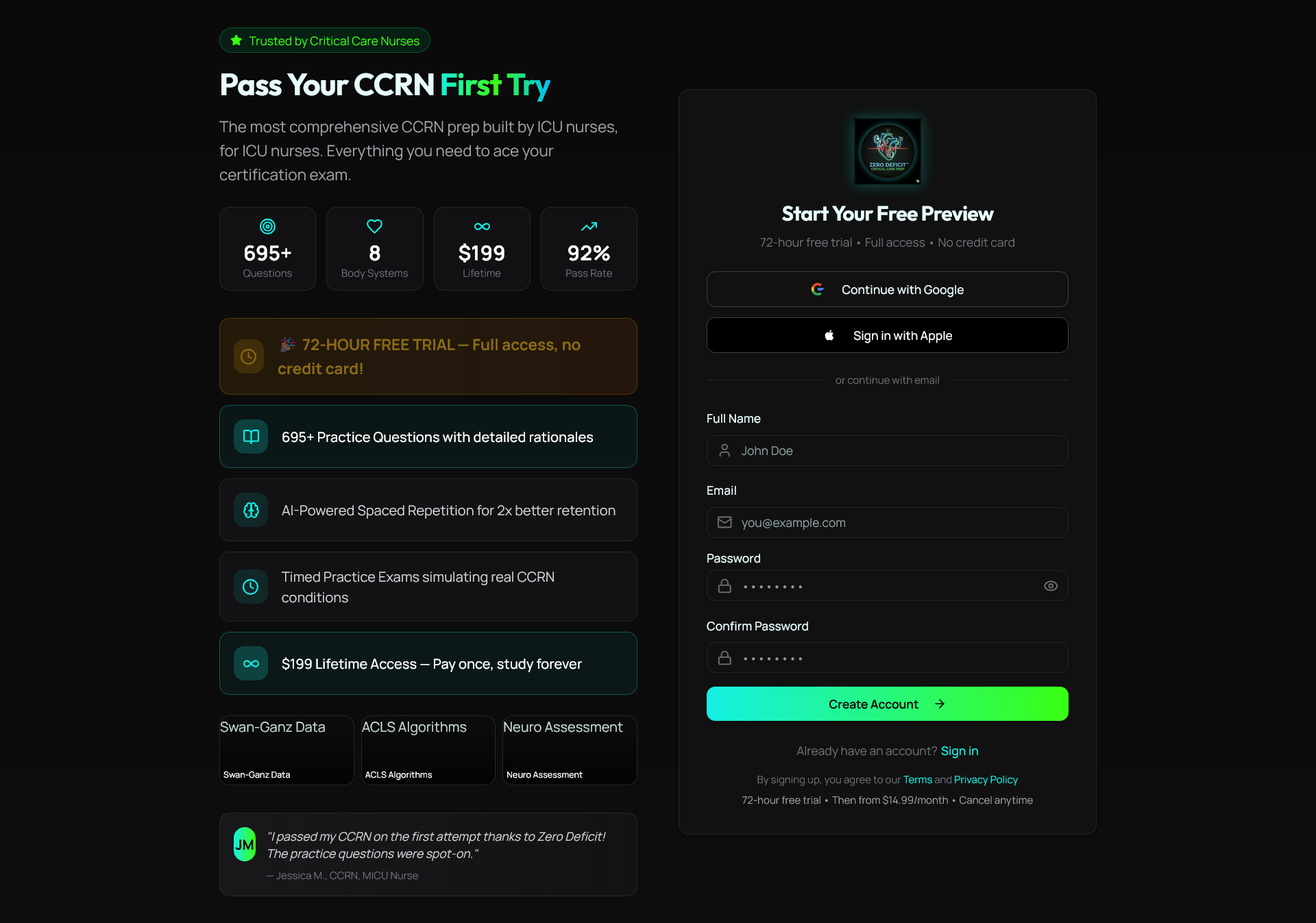
Zero Deficit™ CCRN Exam Prep was built specifically for critical care nurses who want to pass on their first attempt. The platform gives you access to an organized CCRN exam guide, body-system-specific resources like the renal study guide, and a question bank with over 695 practice questions supported by detailed rationales. AI-powered tools adapt to your performance, directing your focus where it matters most. Study analytics and progress tracking show you exactly where you stand. You can explore flexible subscription plans with a free version and no credit card required. Your passing score starts with the right preparation.
Frequently asked questions
What score do I need to pass the CCRN exam?
You need a scaled score of 83/125, which equals approximately 66.4% of scored questions answered correctly as of November 2025.
How long should I study for the CCRN exam?
A 6 to 10 week structured plan with daily practice questions targeting high-yield content is the recommended preparation window for most candidates.
What resources are best for CCRN exam preparation?
AACN recommends the CCRN Exam Handbook, practice exams, review courses, and study books, and most successful candidates supplement these with high-volume third-party question banks for added practice.
Why do many strong clinical nurses fail the CCRN?
Many underestimate the 20% professional caring and ethical practice questions, focusing almost entirely on clinical content while leaving a significant portion of the exam under-prepared.
How can I boost my confidence before the exam?
Aim for 85% or higher on full-length practice exams, simulate exam-day conditions with uninterrupted timed sessions, and use the teach-back method to confirm you truly understand the material.
Recommended
Take a Renal practice quiz
Master AKI, dialysis, electrolytes, and fluid balance for the CCRN.
Get Your Free 20-Question CCRN Diagnostic
20 high-yield CCRN-style questions across every body system, with detailed rationales — emailed to you instantly.
No spam. One email + a couple of helpful follow-ups. Unsubscribe anytime.
Ready to pass your CCRN?
Join 12,000+ nurses using Zero Deficit — 695+ practice questions with rationales, AI-powered weak-area drilling, and spaced-repetition flashcards.
Start Free Trial →