Mastering CCRN exam question types and formats
TL;DR:
- The CCRN exam emphasizes clinical judgment and applying knowledge to real patient scenarios, not just recall. It consists of 150 multiple-choice questions, mostly focused on scenario interpretation, prioritization, and ethical decision-making. Mastery requires practicing scenario-based questions aligned with current exam blueprints to enhance reasoning and confidence on test day.
Walking into the CCRN exam without knowing what the questions actually look like is one of the most common reasons candidates underperform, even when they have solid clinical knowledge. The format matters just as much as the content. This article breaks down every major question type you’ll encounter on the CCRN, explains how the exam is structured, and gives you proven strategies to approach each item with confidence. Whether you’re just starting your prep or doing a final review, understanding the item formats transforms how you study and how you perform on test day.
Table of Contents
- How CCRN exam questions are organized
- Major types of CCRN exam questions explained
- Key differences: Clinical judgment vs. factual recall
- Adapting your study plan to modern CCRN exam types
- Why mastering CCRN question styles is your secret advantage
- Next steps: Go from CCRN theory to confident mastery
- Frequently asked questions
Key Takeaways
| Point | Details |
|---|---|
| Official blueprint matters most | The CCRN exam structure and content follows the official AACN blueprint, so align your prep with it for best results. |
| Clinical judgment dominates | Eighty percent of CCRN questions test critical thinking in patient scenarios, not just memorization. |
| Trending: scenario-based items | Success requires fluency with prioritization, trend interpretation, and ethical dilemmas in realistic vignettes. |
| Prep needs to match recent updates | New AACN test plans affect item emphasis—use modern resources that mirror the 2025+ exam. |
| Real-world reasoning wins | Master ‘best next’ and ‘best overall’ action logic to outperform simple rote study approaches. |
How CCRN exam questions are organized
The CCRN isn’t a random collection of nursing trivia. It follows a precise, published structure that tells you exactly what to expect before you ever sit down in the testing center. Understanding that structure is your first strategic advantage.
All CCRN exam items are multiple-choice with four answer options each. No fill-in-the-blank, no drag-and-drop, no select-all-that-apply. Every question gives you one correct answer from four choices. That consistency is actually helpful once you understand the logic behind how those four choices are constructed.
The exam runs three hours and contains 150 total items. Of those, 125 are scored and 25 are unscored pretest items distributed throughout the test. Those unscored items are being evaluated for future use, and you cannot tell which ones they are. This matters for your mindset: treat every question as if it counts, because you genuinely can’t tell the difference.

The content weighting is where the real strategic insight lives. According to the CCRN exam blueprint, 80% of scored items fall under clinical judgment and 20% address professional caring and ethical practice. That ratio tells you exactly where to spend the majority of your study time.
Here’s a quick reference for how the exam breaks down:
| Category | Percentage | Items (of 125 scored) |
|---|---|---|
| Clinical judgment | 80% | ~100 items |
| Professional caring and ethical practice | 20% | ~25 items |
| Total scored items | 100% | 125 items |
| Unscored (pretest) items | N/A | 25 items |
The CCRN exam format also organizes content into specific body system domains. Major areas include cardiovascular, pulmonary, neurological, renal, endocrine, hematology, gastrointestinal, musculoskeletal, psychosocial, and behavioral. Cardiovascular questions typically carry the heaviest weighting because cardiac patients represent the majority of ICU census in adult critical care.
If you’re working from a 12-week CCRN study plan, aligning your weekly focus with these domain weights will ensure you’re spending proportional time on the highest-yield content.
Key takeaways from the exam structure:
- Four-option multiple-choice format throughout
- Three-hour time limit across 150 total items
- Only 125 questions count toward your score
- Clinical judgment dominates at 80% of scored content
- Body system domains are weighted based on real ICU patient volumes
Major types of CCRN exam questions explained
With the structure and domains established, let’s clarify what kinds of questions you’ll actually see on test day and how they differ from standard nursing exams.
CCRN questions aren’t testing whether you can recall a definition. They’re testing whether you can apply clinical knowledge to a real patient scenario under pressure. That shift is significant, especially if you’ve been studying primarily from textbooks or using materials built for generalist licensing exams.
Clinical judgment tasks such as prioritization and interpretation of physiologic changes, including hemodynamics and ventilation, are the core of most CCRN questions, not simple factual recall. Here are the five major question types you’ll encounter:
-
Prioritization questions. These present an urgent or rapidly changing scenario and ask what you should do first. The key isn’t just knowing the right intervention. It’s knowing which patient need takes precedence in that specific moment. For example, a question might describe a ventilated patient with a sudden drop in SpO2, rising peak airway pressures, and tracheal deviation, then ask you to identify the most immediate nursing action.
-
Trend interpretation questions. These items give you a series of vital signs, lab values, or hemodynamic readings over time and ask you to interpret the clinical significance. You might see a patient’s pulmonary artery occlusion pressure rising over four hours alongside worsening urine output, and the question asks what this pattern most likely indicates. Pattern recognition and physiologic reasoning are everything here.
-
Scenario-based application questions. These are multi-sentence patient vignettes that require you to synthesize assessment data, history, and current status before selecting the best nursing action. Real-life critical care scenarios like these test whether you can function as a clinical decision-maker, not just a knowledge repository.
-
Best outcome vs. best immediate action questions. These questions require a specific mindset shift. You must distinguish between the single next action and the overall best goal. Many candidates get these wrong by selecting a correct long-term intervention when the question is asking for the immediate step. Reading every stem word carefully is essential.
-
Ethical and professional practice questions. These cover informed consent, advocacy, end-of-life decision-making, and scope of practice. AACN’s certification review content is explicitly designed around these scenarios with real-life test-taking strategies and practice questions with detailed rationales.
“The exam rewards nurses who think the way they do at the bedside: rapidly assessing, prioritizing, and adjusting. If your study method doesn’t require you to reason, it isn’t fully preparing you.”
Pro Tip: When reviewing CCRN practice questions, practice reading the last sentence of the stem first. It tells you exactly what the question is asking, which helps you read the vignette with focus rather than absorbing unnecessary detail.
Understanding these five question types lets you approach your study sessions differently. Each type requires a slightly different cognitive strategy. Prioritization items need triage thinking. Trend interpretation items need physiologic reasoning. Scenario items need synthesis. Recognizing the item type quickly during the exam saves time and sharpens your answer selection. You can explore question breakdown methods to build this recognition skill systematically.
Key differences: Clinical judgment vs. factual recall
Now that you know the main types, what sets CCRN exam questions apart from most nursing tests?
The most important distinction is the depth of thinking required. Factual recall questions ask you to retrieve stored information, like a normal CVP range or the mechanism of action of vasopressin. Clinical judgment questions ask you to take that stored knowledge and apply it to a dynamic, evolving patient in real time.
On the CCRN, effective study mirrors test plan domains and emphasizes application to patient scenarios rather than memorizing isolated terms. That’s a direct signal from AACN about where your energy should go.
Here’s a side-by-side comparison of how these question styles differ:
| Feature | Factual recall | Clinical judgment |
|---|---|---|
| Cognitive level | Remember or understand | Apply, analyze, evaluate |
| Stem length | Short, direct | Longer scenario vignette |
| Data provided | Minimal | Rich: vitals, labs, history |
| Single right answer | Often obvious from recall | Requires reasoning to eliminate |
| Frequency on CCRN | Low | High (approximately 80%) |
| Best study method | Flashcards, definitions | Case-based practice, CCRN prep strategies |
The practical implication is that you can’t simply memorize your way to a passing score. Understanding why a septic patient’s SVR drops, what that means for cardiac output, and what intervention addresses it in a specific clinical context is far more valuable than recalling a definition of sepsis. That reasoning chain is exactly what clinical judgment items test.
Many CCRN candidates underestimate how much this shift in thinking style requires deliberate practice. You can know your cardiovascular pharmacology cold and still miss a question because you selected the right drug for the wrong clinical moment. Consistent scenario-based practice, with detailed answer rationales, is what trains your brain to navigate this.
Adapting your study plan to modern CCRN exam types
Recognizing these item types is only half the battle. Mastering the latest test means actively adjusting your study routine to match the current blueprint.
The biggest update in recent years is significant. AACN updated the CCRN exam effective November 12, 2025, based on a comprehensive 2024 practice analysis. This means any study materials developed before that update may not fully reflect current content weighting, domain organization, or question style emphasis. If you’re preparing now, this is not a minor footnote. It’s a critical factor in choosing your resources.
Here’s how to adapt your study plan to the current exam:
- Review the official AACN handbook. The exam blueprint is publicly available and tells you exactly which domains are tested and at what weight. Make this your study roadmap.
- Focus sessions on trend analysis. Rather than studying lab values in isolation, practice interpreting sequences. What does a rising lactate with falling MAP and increasing vasopressor requirements tell you? That kind of thinking is what the exam rewards.
- Use only updated practice questions. Materials based on the pre-November 2025 test plan may cover different domain weights or include outdated clinical scenarios. Confirm your resources reflect the current blueprint.
- Practice with timed question sets. The three-hour window for 150 items gives you approximately 72 seconds per question. That pace is faster than most candidates expect. Timed practice builds the cognitive endurance and decision speed you need.
- Use CCRN study guides organized by body system. Systematic content review by domain ensures you’re allocating study time proportional to exam weighting.
Pro Tip: Use a resource like the shock flowchart for prep to build rapid pattern recognition for high-yield cardiovascular scenarios. When you can immediately classify shock type from hemodynamic data, an entire category of exam questions becomes significantly easier.
Tracking your CCRN study progress by domain is also essential. Knowing that you’re strong in pulmonary but need more work in endocrine allows you to redirect effort before test day rather than reviewing everything equally. Focused prep, based on your actual performance data, is far more efficient than covering the same ground repeatedly.
Why mastering CCRN question styles is your secret advantage
Here’s the honest truth that most study guides won’t tell you: many CCRN candidates fail not because they lack clinical knowledge, but because they’ve been practicing with the wrong kind of questions.
Candidates who focus on high-yield CCRN practice that replicates scenario-based, multi-layered questions consistently outperform those who rely solely on content flashcards or simple definition review. That pattern shows up again and again in how repeat testers describe their experience. They knew the material. They didn’t know the exam.
The mindset shift that separates top scorers is learning to ask two distinct questions before selecting any answer: “What is the single best action right now?” versus “What is the overall best outcome to work toward?” These are not the same question, and the CCRN tests both. Conflating them is one of the most consistent sources of wrong answers on this exam.
The real exam rewards your ability to think on your feet under time pressure in a scenario you may not have memorized specifically, using principles you’ve internalized through repeated exposure. That’s a skill built through practice, not through passive reading. It requires active engagement with scenario-based items, careful review of rationales when you get answers wrong, and honest self-assessment of where your clinical reasoning breaks down. No amount of re-reading a textbook chapter builds that skill. Only working through exam-quality questions does.
Next steps: Go from CCRN theory to confident mastery
Understanding question types and formats is a genuine strategic advantage. Now it’s time to put that understanding into practice with resources built specifically around the current CCRN blueprint.
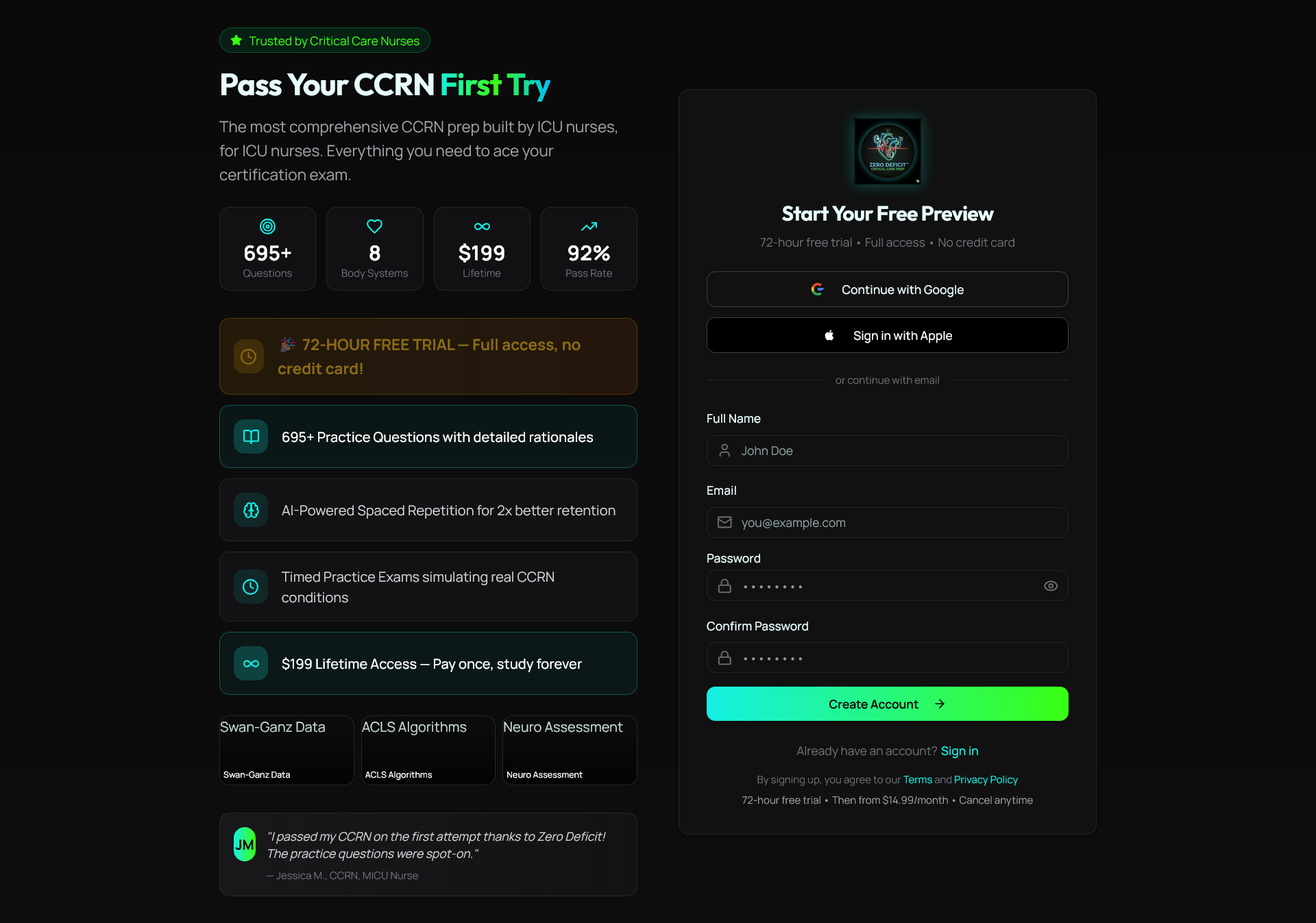
Zero Deficit™ CCRN Exam Prep maps every study resource directly to the modern AACN test plan, including the November 2025 updates. The platform’s all-in-one CCRN study guides walk you through every body system with clinical depth and exam-relevant focus. The question breakdown methods section teaches you how to systematically approach scenario items, eliminate distractors, and choose the correct answer with confidence. And when you’re ready to test yourself under realistic conditions, the CCRN practice exams offer timed, scenario-based sets with detailed rationales for every answer. Start studying free at Zero Deficit CCRN Prep today, no credit card required.
Frequently asked questions
Are all CCRN exam questions multiple-choice?
Yes, all CCRN exam items are multiple-choice with four answer options each. There are no alternate-format items such as select-all-that-apply or drag-and-drop.
What percentage of the CCRN exam is clinical judgment versus ethics?
Approximately 80% of scored items test clinical judgment and 20% address professional caring and ethical practice. This weighting directly shapes where you should invest the majority of your study time.
How do I know if my practice questions match the updated CCRN test plan?
Check that your materials reflect the AACN test plan updated after November 12, 2025, following the 2024 practice analysis. Any resource developed before that date may not accurately reflect current domain weights or question emphasis.
Do the unscored CCRN items look different from scored ones?
No, unscored pretest items are mixed throughout the exam and are indistinguishable from scored items. You will not know which questions are unscored during the test, so treat every item as if it counts.
What’s the best way to practice CCRN-style clinical judgment questions?
Practice with clinical judgment tasks that require prioritization and trend interpretation rather than simple recall. Focus on scenario-based items that require you to synthesize multiple data points and reason through the best action for a specific patient context.
Recommended
Take a Respiratory practice quiz
Master ARDS, ventilation, ABGs, oxygenation, and pulmonary emergencies.
Ready to pass your CCRN?
Join 12,000+ nurses using Zero Deficit — 695+ practice questions with rationales, AI-powered weak-area drilling, and spaced-repetition flashcards.
Start Free Trial →