Nursing Certification Success Workflow for CCRN Prep
TL;DR:
- A successful nursing certification workflow involves structured content review, practice testing, and self-care to maximize CCRN pass rates.
- Most candidates need 6 to 12 weeks of focused study while incorporating active recall and spaced repetition to improve retention and performance.
A nursing certification success workflow is a deliberate, step-by-step plan that combines focused content review, practice testing, and self-care to maximize your chances of passing the CCRN exam. The AACN Adult CCRN exam tests clinical judgment across eight body systems, and passing it requires more than reading a textbook. Cognitive science research confirms that methods like active recall and spaced repetition outperform passive study by a wide margin. This guide gives you a practical, evidence-based framework built specifically for ICU nurses balancing 12-hour shifts with serious exam prep.
What is the ideal nursing certification success workflow timeline?
A sustainable prep timeline for the CCRN spans 6–12 weeks, with focused sessions totaling 3–6 hours per week for nurses managing clinical shifts. That range is not arbitrary. It gives you enough time to cover all AACN blueprint domains without burning out before exam day.
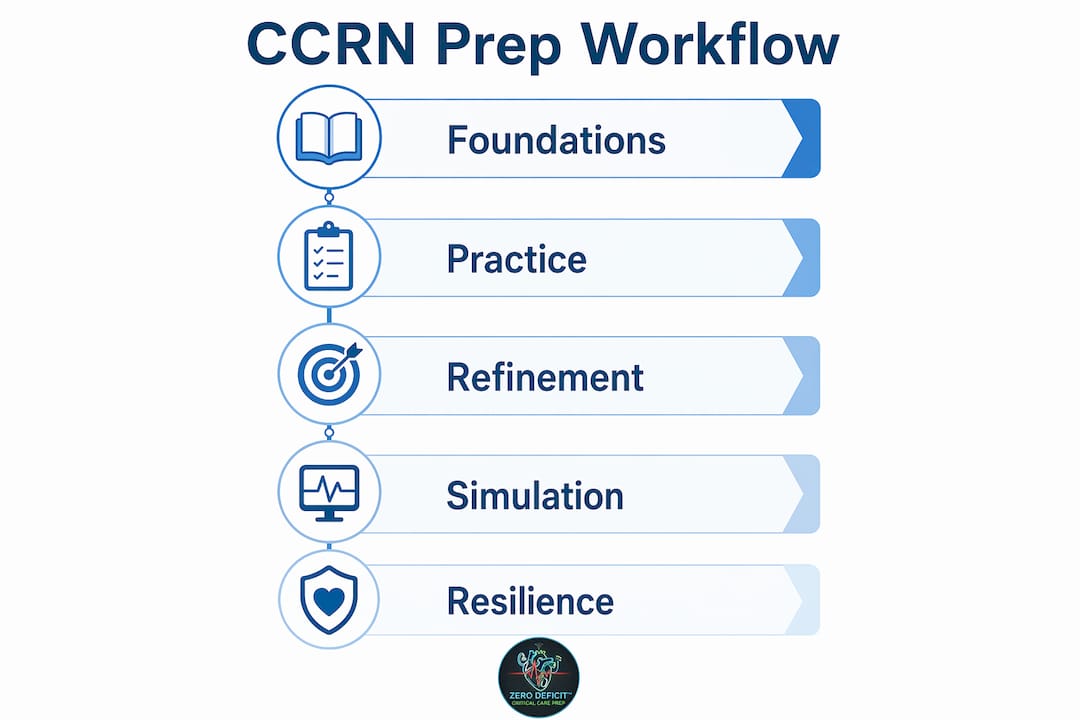
The most effective approach divides prep into three phases. Phase one covers content foundation: body systems, hemodynamics, shock states, ARDS, and sepsis. Phase two shifts to heavy practice testing with error analysis. Phase three focuses on refinement, targeting your weakest domains and simulating full-length exam conditions.

| Week | Focus Area | Primary Activity |
|---|---|---|
| 1–2 | Cardiovascular and pulmonary | Content review, AACN blueprint mapping |
| 3–4 | Neuro, renal, and endocrine | Concept review plus first practice sets |
| 5–6 | Sepsis, MODS, and multisystem | Practice questions and rationale review |
| 7–8 | All systems integration | Full-length practice exams |
| 9–10 | Weak area refinement | Targeted review and timed question sets |
| 11–12 | Final simulation and rest | Full exam simulation, rest day before exam |
Efficiency matters more than raw hours. Nurses who study with focused intent for 3–6 hours weekly consistently outperform those who log heavy but unfocused hours.
Pro Tip: Do not schedule your exam on a fixed calendar date before you are ready. Schedule it only after you consistently score 85% or higher on full-length randomized practice exams. Competency, not the calendar, should drive your exam date.
How to apply evidence-based study methods to boost exam success
Active recall and spaced repetition are the two most effective study methods for nursing certification prep. Passive reading and highlighting feel productive but yield only about 60% comprehension. That gap between feeling ready and actually being ready is where most first-attempt failures happen.
Active recall combined with spaced repetition produces 30–40% higher pass rates compared to passive review. Spaced repetition alone can boost retention from 20% to 80% after 30 days. Those numbers reflect a real shift in how your brain encodes clinical information under pressure.
Here is how to build these methods into your daily workflow:
- Start with a diagnostic practice exam. Take a full-length test before you study a single topic. Your score map tells you exactly where to spend your time.
- Use active recall on every topic. After reading about vasopressor management, close the material and write out everything you remember. Then check your gaps.
- Apply spaced repetition to high-yield content. Review cardiovascular hemodynamics on day one, day three, day seven, and day fourteen. Each review cements the concept deeper.
- Treat every wrong answer as a data point. Do not just note what you got wrong. Identify whether the error was a knowledge gap, a reasoning flaw, or a misread question stem.
- Align your study topics with the AACN blueprint. Cardiovascular accounts for the largest portion of the CCRN exam. Study proportionally, not randomly.
Pro Tip: Begin every new study week with a short diagnostic quiz on the prior week’s content. If you score below 75%, revisit that content before moving forward. This prevents false confidence from building up.
Candidates who use practice testing as their primary study method score 20–30% higher than peers who review materials passively. Successful CCRN candidates typically complete 500 to 2,000 or more practice questions before exam day.
How to structure your weekly workflow for content and practice exams
A well-structured weekly workflow balances content mastery with increasing volumes of practice questions as your exam date approaches. The ratio shifts across phases. Early weeks are content-heavy. Later weeks are practice-heavy.
Phase 1: Foundation (weeks 1–4)
Spend 60–70% of your study time on content review during this phase. Use high-yield topic guides aligned to the AACN blueprint, covering cardiovascular, pulmonary, and neuro first. Complete 10–20 practice questions per topic immediately after reviewing it. This locks in the content while it is fresh.
Phase 2: Practice and analysis (weeks 5–8)
Flip the ratio. Spend 60–70% of your time on practice questions and error analysis. Treat practice exams as diagnostic tools to expose reasoning flaws, not just knowledge gaps. Review every wrong answer with its full rationale before moving to the next question set.
Phase 3: Refinement and simulation (weeks 9–12)
Run full-length timed practice exams under real conditions. Use the multi-pass exam strategy: answer the questions you know first, flag difficult ones, then return to flagged items with remaining time. This approach reduces anxiety and maximizes your score.
Key habits that separate passing candidates from retakers:
- Review rationales for both correct and incorrect answers
- Track your performance by AACN domain, not just overall score
- Limit each study session to 60–90 minutes to maintain focus
- Use CCRN practice question strategies to analyze question stems, not just answer choices
- Simulate exam timing at least twice before your actual test date
Managing physical and mental resilience during certification prep
Confidence and physical well-being directly improve exam performance by reducing anxiety and sharpening clinical judgment under pressure. The CCRN does not just test what you know. It tests how clearly you think when the stakes feel high.
High-stakes exams measure emotional regulation alongside clinical knowledge. A nurse who knows the hemodynamic profile of cardiogenic shock but freezes under pressure will still miss questions. Managing your mental state is part of the prep, not a bonus.
“Mastering exams requires managing physical and mental resilience, including anxiety control, nutrition, sleep, and avoiding cramming.” Nurses who build these habits into their prep workflow perform more consistently on exam day.
Practical steps to protect your resilience:
- Schedule rest days. Build at least one full rest day per week into your study plan. Your brain consolidates memory during rest, not during study.
- Prioritize sleep. Aim for 7–8 hours, especially in the final two weeks. Sleep deprivation impairs the clinical reasoning the CCRN specifically tests.
- Eat before study sessions. Blood glucose stability affects concentration. A light meal before a 90-minute session outperforms studying on an empty stomach.
- Avoid cramming in the final 24 hours. Managing anxiety and avoiding cramming before the exam are as critical as content mastery. Rest the night before.
- Use testing accommodation resources if exam anxiety is severe. Formal accommodations exist and are worth exploring if anxiety consistently disrupts your practice exam performance.
Common mistakes in nursing certification study workflows
The most common mistake is scheduling your exam before you are ready. Scheduling first leads to calendar-focused study instead of competency-focused study. You end up cramming to meet a date rather than building real readiness. The fix is simple: set your exam date only after hitting 85% or higher on multiple full-length practice exams.
Other high-cost mistakes and how to correct them:
- Relying on passive study. Reading and re-reading notes feels safe but produces shallow retention. Replace at least half of your reading time with active recall and practice questions.
- Skipping error analysis. Getting a question wrong and moving on is the single biggest waste of study time. Every wrong answer contains a lesson about your reasoning process.
- Ignoring the AACN blueprint. The blueprint tells you exactly how much each domain counts. Studying sepsis and MODS at the same depth as endocrine emergencies misallocates your time.
- Neglecting physical health. Fatigue and poor nutrition degrade the clinical judgment the exam measures. Treat sleep and meals as part of your prep, not interruptions to it.
Pro Tip: Precision in study habits focused on high-yield topics drives certification success more than sheer hours of effort. Study smarter by letting your diagnostic practice scores tell you where to spend your time.
Key Takeaways
A structured, evidence-based nursing certification success workflow combining active recall, spaced repetition, and competency-based scheduling produces the highest pass rates for the CCRN exam.
| Point | Details |
|---|---|
| Timeline and pacing | Plan 6–12 weeks of prep at 3–6 focused hours per week, divided into three phases. |
| Evidence-based methods | Active recall and spaced repetition raise pass rates 30–40% over passive study. |
| Practice exam strategy | Complete 500 or more practice questions and analyze every wrong answer for reasoning errors. |
| Competency-based scheduling | Set your exam date only after scoring 85% or higher on full-length practice exams. |
| Physical and mental resilience | Sleep, nutrition, and rest days are non-negotiable parts of an effective study workflow. |
What I have learned from watching nurses pass and fail the CCRN
The nurses who pass the CCRN on their first attempt share one habit that retakers almost never have: they treat their prep like a clinical protocol, not a personal challenge. They follow a plan, track their data, and adjust based on results. They do not study harder when they are struggling. They study differently.
The biggest trap I see is emotional attachment to study hours. A nurse logs 40 hours of prep and feels entitled to pass. But if those 40 hours were passive reading with no practice testing, the score will not reflect the effort. The CCRN rewards clinical reasoning, not time spent with a highlighter.
Working ICU shifts while prepping is genuinely hard. You come home after a 12-hour night shift and the last thing you want is a 90-minute study session. The nurses who succeed build their prep around their schedule, not against it. Three focused sessions per week beat seven exhausted ones every time.
The other thing I believe strongly: you need nurse-to-nurse support during this process. Study groups, colleagues who have already passed, and resources built by ICU nurses for ICU nurses all matter. The CCRN is not a general nursing exam. It requires critical care-specific reasoning, and your prep resources should reflect that.
— Zero
Zerodeficitccrnprep resources built for your study workflow
Zerodeficitccrnprep was built by ICU nurses who know exactly what the AACN CCRN exam demands. Every resource aligns directly to the exam blueprint so you spend your study time where it counts.
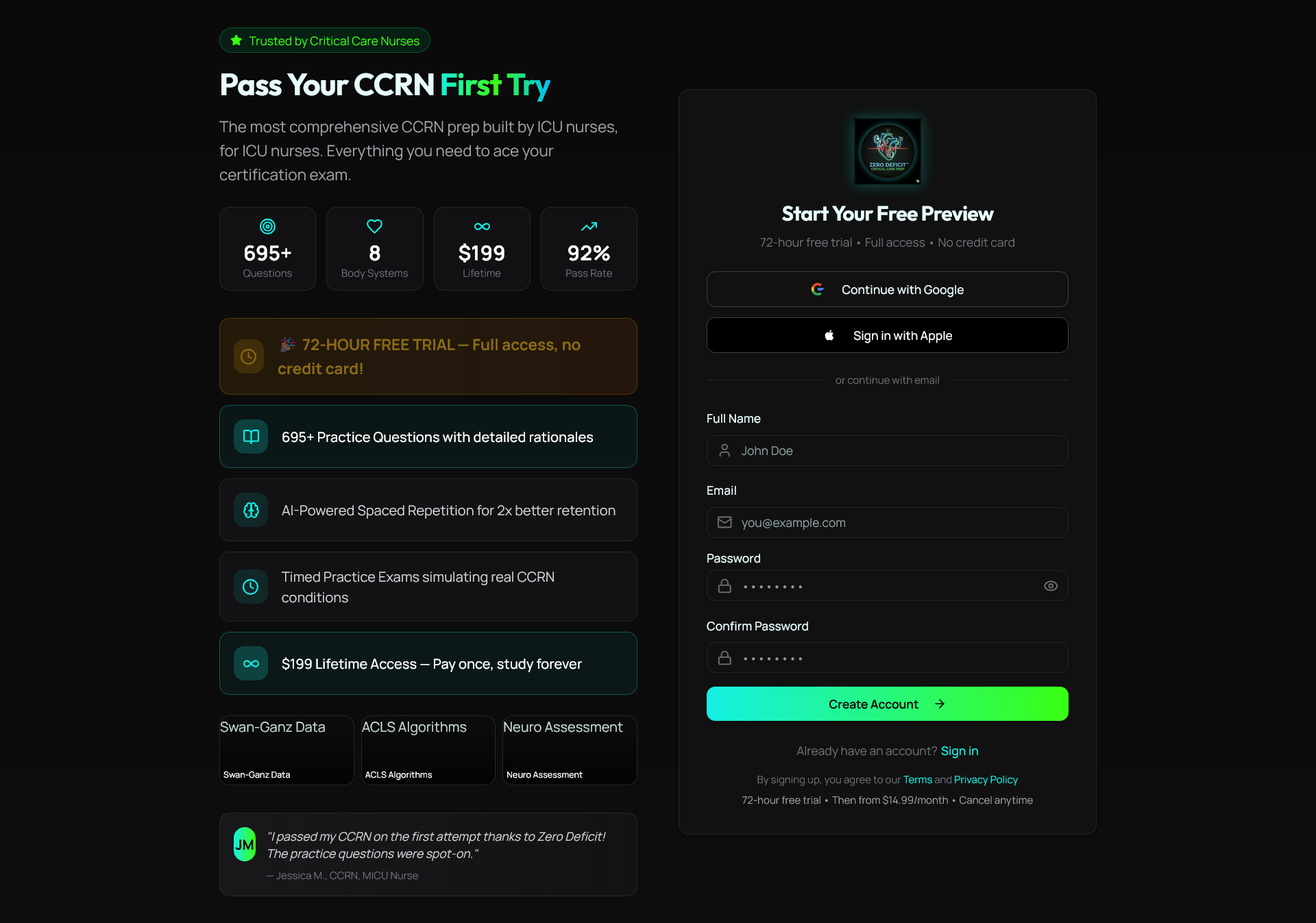
The CCRN study guides cover all eight body systems with detailed rationales, normal lab value ranges, and clinical reasoning frameworks. The 695+ practice question bank gives you the volume you need to build real exam confidence, with AI-powered review tools that personalize your prep based on your performance. Many nurses report passing on their first attempt after using Zerodeficitccrnprep as their primary study resource. Start with a diagnostic practice test today and let your results guide every study session from that point forward.
FAQ
What is a nursing certification success workflow?
A nursing certification success workflow is a structured, phased study plan that combines content review, practice testing, and self-care to prepare you for exams like the CCRN. It replaces random studying with a repeatable, evidence-based process.
How many weeks should I prepare for the CCRN exam?
Most candidates need 6–12 weeks of preparation, studying 3–6 focused hours per week. Nurses balancing clinical shifts can pass within this window by prioritizing high-yield AACN blueprint topics.
How many practice questions do I need before the CCRN?
Successful candidates typically complete 500 to 2,000 or more practice questions before exam day. Volume matters, but reviewing rationales for every wrong answer matters more.
When should I schedule my CCRN exam date?
Schedule your exam only after consistently scoring 85% or higher on full-length randomized practice exams. Setting a date before reaching that threshold leads to calendar-driven cramming rather than genuine readiness.
Does anxiety affect CCRN exam performance?
Yes. Confidence and physical well-being directly affect clinical reasoning under pressure, which the CCRN specifically tests. Managing sleep, nutrition, and anxiety is part of effective exam preparation, not separate from it.
Recommended
- Types of Critical Care Certifications: Your 2026 Guide | Zero Deficit CCRN Prep
- Checklist for Exam Day: CCRN and NCLEX Nurse Guide | Zero Deficit CCRN Prep
- CCRN Spaced Repetition: Study Smarter for Certification | Zero Deficit CCRN Prep
- How educators boost CCRN certification success for nurses | Zero Deficit CCRN Prep
Take a Multisystem practice quiz
Master sepsis, shock, MODS, and multi-organ failure scenarios.
Get Your Free 20-Question CCRN Diagnostic
20 high-yield CCRN-style questions across every body system, with detailed rationales — emailed to you instantly.
No spam. One email + a couple of helpful follow-ups. Unsubscribe anytime.
Ready to pass your CCRN?
Join 12,000+ nurses using Zero Deficit — 695+ practice questions with rationales, AI-powered weak-area drilling, and spaced-repetition flashcards.
Start Free Trial →