Nursing Mnemonics for CCRN: Top Picks That Actually Work
TL;DR:
- The CCRN exam emphasizes clinical judgment, requiring memory tools like mnemonics that prompt actions, not just recall. Effective mnemonics are decision-triggering, guideline-aligned, concise, and system-specific, especially when paired with practice questions. Integrating well-understood mnemonics into targeted study plans enhances clinical reasoning and exam readiness.
The CCRN exam is not a trivia contest. The AACN CCRN exam dedicates 80% of its 150 questions to clinical judgment, meaning you need memory tools that trigger decisions, not just definitions. That is exactly where nursing mnemonics for CCRN become powerful. The right mnemonic does not just help you recall a list. It tells you what to do next at the bedside and on the exam. This article gives you the highest-yield nursing mnemonics for critical care, explains the clinical reasoning behind each one, and shows you how to use them as part of a study strategy that actually sticks.
Table of Contents
- Key takeaways
- Nursing mnemonics for CCRN: what makes one worth using
- 1. ABCDE for primary patient assessment
- 2. Updated MONA for ACS management
- 3. SLUDGE for cholinergic toxicity
- 4. VIP for shock resuscitation priorities
- 5. FAST for stroke recognition
- 6. ARDS criteria with the Berlin definition framework
- 7. ROME for ABG interpretation
- 8. Cranial nerve mnemonic for neuro assessment
- 9. SBAR for clinical communication
- 10. I WATCH DEATH for delirium causes in the ICU
- Comparing mnemonic types for CCRN study
- How to integrate mnemonics into your full CCRN prep plan
- My honest take on mnemonics in CCRN prep
- Put your mnemonics to work with Zero Deficit CCRN Prep
- FAQ
Key takeaways
| Point | Details |
|---|---|
| Clinical judgment first | Choose mnemonics that trigger actions, not just recall of facts. |
| Update your mnemonics | Outdated tools like unrevised MONA can lead to wrong answers and unsafe practice. |
| Match format to learning style | Acronym, phrase, and image mnemonics each have different strengths for exam use. |
| Integrate with practice questions | Mnemonics work best when paired with rationale review and clinical scenarios. |
| Eight systems, one framework | Cover all AACN blueprint domains with targeted mnemonics for each body system. |
Nursing mnemonics for CCRN: what makes one worth using
Not every mnemonic deserves a spot in your study notes. The CCRN exam is built around clinical decision-making, so a mnemonic that only lists facts without prompting action is only half useful. Here is how to evaluate whether a mnemonic is worth your time.
Strong mnemonics share these qualities:
- Decision-triggering. Each letter or phrase should cue a specific nursing action or assessment step, not just a definition.
- Guideline-aligned. The tool must reflect current evidence. Outdated mnemonics like the original MONA taught nurses to give oxygen routinely in ACS. Current guidelines reserve oxygen for SpO2 below 90%.
- Concise and clinically specific. If a mnemonic takes 30 seconds to decode under exam stress, it will slow you down rather than help you.
- Anchored to a body system. The AACN blueprint is organized by system. Mnemonics tied to cardiovascular, pulmonary, or neuro content carry more exam weight.
Mnemonic types you will encounter in CCRN prep include acronyms (where each letter stands for a word), phrase-based tools (a full sentence where first letters cue a list), and image-based associations (tying a concept to a vivid mental picture). Acronyms dominate critical care nursing because they are fast to recall mid-scan or mid-question.
Pro Tip: Before committing a mnemonic to memory, test it against a practice question. If the mnemonic helps you choose the right answer and explain why, keep it. If it only helped you name a list without knowing what to do, revise it.
1. ABCDE for primary patient assessment
Airway, Breathing, Circulation, Disability, Exposure. This systematic survey is the foundation of every critical care assessment and appears across CCRN scenarios involving rapid deterioration, trauma, and post-procedure monitoring.

The power of ABCDE is in its sequence. You address airway patency before you worry about blood pressure, because an obstructed airway kills faster than a borderline MAP. On the exam, when a question presents a deteriorating patient, running ABCDE mentally keeps you from jumping to intervention before assessment is complete. Check for assessment framework depth to understand how this integrates into clinical judgment questions.
2. Updated MONA for ACS management
Morphine, Oxygen, Nitrates, Aspirin. You have almost certainly seen this mnemonic before. The problem is that the original version taught nurses to give all four interventions routinely, and current AHA guidelines no longer support that.
Use MONA as a conditional framework. Morphine is now Class IIa, meaning use it cautiously and only when other pain relief options have failed. Oxygen is appropriate only when SpO2 drops below 90%. Nitrates remain indicated for ischemic chest pain with no contraindications. Aspirin is still standard unless the patient has a true allergy. Reframing MONA from a checklist to a decision tree makes it both safer and more exam-accurate.
3. SLUDGE for cholinergic toxicity
Salivation, Lacrimation, Urination, Defecation, Gastrointestinal upset, Emesis. This pharmacology mnemonic covers the classic signs of cholinergic excess, which you will see in organophosphate poisoning, anticholinesterase overdose, and excessive cholinergic drug dosing.
In the ICU, SLUDGE matters most when managing patients on reversal agents like neostigmine or when caring for patients post-nerve agent exposure. On the CCRN, pharmacology questions often test whether you can recognize a toxidrome pattern and connect it to an intervention. SLUDGE tells you the presentation. Your next step is atropine and supportive care.
4. VIP for shock resuscitation priorities
Volume, Inotropes, Pressors. This three-letter mnemonic gives you the order of thinking when a patient is hypotensive and you need to act fast. Start with volume status assessment, then consider cardiac contractility support, then vasopressor therapy if perfusion pressure remains inadequate.
VIP works especially well for distributive and hypovolemic shock scenarios, where volume is often the first intervention. It also maps directly onto the hemodynamic monitoring questions on the exam, where you are asked to interpret a low CVP, low CO, and low SVR and decide what to titrate first. For more on shock and vasopressor decision frameworks, organized high-yield topic guides break this down by shock type.
5. FAST for stroke recognition
Face drooping, Arm weakness, Speech difficulty, Time to call. FAST is familiar from public education campaigns, but its value in the CCRN context goes beyond recognition. It connects directly to the 4.5-hour tPA window, the importance of accurate last-known-well time documentation, and the nurse’s role in activating stroke protocols.
Neuro questions on the CCRN frequently test time-sensitive decision-making. Knowing FAST is less about recall and more about knowing what actions follow each finding immediately.
6. ARDS criteria with the Berlin definition framework
Acute onset, Ratio of PaO2/FiO2 less than 300 (mild), less than 200 (moderate), less than 100 (severe), Bilateral infiltrates on chest X-ray, not fully explained by cardiac failure. The mnemonic frame here is the Berlin criteria, and you can anchor it with the phrase A-B-C: Acute onset, Bilateral infiltrates, Criteria met by P/F ratio.
This matters on the exam because ARDS management questions will ask about PEEP titration, tidal volume targets (6 mL/kg ideal body weight), prone positioning thresholds, and FiO2 weaning. Knowing the severity tiers by P/F ratio lets you connect patient status to the correct intervention level.
7. ROME for ABG interpretation
Respiratory Opposite, Metabolic Equal. If the pH and the primary disturbance move in opposite directions, it is respiratory. If they move in the same direction, it is metabolic. ROME is the fastest path to correct ABG categorization on a timed exam.
Pair ROME with a quick check of compensation: is the secondary value moving in the right direction to compensate? On CCRN questions, you will often see a mixed disorder or a partially compensated picture. Stopping at the primary label is not enough. ROME gets you to the right category. Clinical reasoning takes you the rest of the way.
8. Cranial nerve mnemonic for neuro assessment
“Oh Oh Oh To Touch And Feel Very Good Velvet, Ah Heaven” helps you recall all twelve cranial nerves in order: Olfactory, Optic, Oculomotor, Trochlear, Trigeminal, Abducens, Facial, Vestibulocochlear, Glossopharyngeal, Vagus, Accessory, Hypoglossal.
In the ICU, cranial nerve assessment appears in stroke, TBI, Guillain-Barré, and elevated ICP scenarios. The CCRN will test your ability to connect a cranial nerve deficit to its clinical meaning. A patient who cannot swallow safely likely has CN IX or X involvement. Knowing the sequence helps you locate the deficit and anticipate complications like aspiration.
9. SBAR for clinical communication
Situation, Background, Assessment, Recommendation. SBAR is one of the most tested nursing exam mnemonics when it comes to the Professional Caring and Ethical Practice domain of the CCRN, which accounts for 20% of the exam.
SBAR questions often involve escalating a deteriorating patient to a physician or presenting a patient for transfer. The wrong answers usually skip the Assessment or Recommendation step. SBAR reminds you that a complete handoff requires your clinical interpretation, not just a list of vitals.
10. I WATCH DEATH for delirium causes in the ICU
Infectious, Withdrawal, Acute metabolic, Trauma, CNS pathology, Hypoxia, Deficiencies (nutritional), Endocrine, Acute vascular, Toxins, Heavy metals. This mnemonic covers the differential for ICU delirium and acute mental status changes, which appear regularly in CCRN scenario questions.
When a question presents a post-operative patient who becomes agitated and confused on day two, I WATCH DEATH gives you a structured way to eliminate or prioritize causes. It also connects to the PADIS guidelines (Pain, Agitation, Delirium, Immobility, Sleep) that govern ICU delirium management in current practice.
Comparing mnemonic types for CCRN study
| Mnemonic type | Ease of recall | Clinical focus | Exam utility | Best used for |
|---|---|---|---|---|
| Acronym (e.g., SLUDGE) | High | Symptom recognition | High | Pharmacology, assessment sequences |
| Phrase-based (e.g., cranial nerves) | Medium | Sequential recall | Medium | Ordered lists, anatomy |
| Decision framework (e.g., ROME) | High | Interpretation and action | Very high | Labs, ABGs, hemodynamics |
| Image-based association | Low at first, high long-term | Conceptual anchor | Medium | Complex pathophysiology |
Acronyms dominate exam performance because they are fastest under timed conditions. Decision frameworks like ROME and VIP are more valuable than pure recall tools because they integrate clinical reasoning directly into the answer-selection process.
You can also create your own mnemonics. Start with the clinical concept you struggle with most, pull the key decision points, and build an acronym that triggers each action. Tie it to a patient you actually cared for. Personal mnemonics rooted in real clinical experiences tend to outlast anything you copy from a textbook because the memory has emotional weight.
Pro Tip: When you build a custom mnemonic, write it out on a practice question rationale sheet. Seeing it applied to an actual exam-style question cements the connection between the tool and the clinical action.
How to integrate mnemonics into your full CCRN prep plan
Mnemonics are a support structure. They do not replace understanding. Here is how to use them well without letting them become a crutch.
- Attach each mnemonic to a body system. Work through the AACN blueprint by system. Assign two to three mnemonics per system and review them together with the corresponding CCRN study guides for that topic.
- Use spaced repetition. Review each mnemonic on day one, day three, day seven, and day fourteen. This pattern locks retrieval pathways without requiring hours of daily review.
- Apply them to practice questions, not just flashcards. An exam question breakdown is where mnemonics prove their value. If you cannot use the mnemonic to reach the correct answer, you need to revisit your understanding of the concept behind it.
- Validate against current guidelines. Before your exam, confirm that each mnemonic reflects 2020 or later AACN, AHA, or SCCM guidance. Outdated content can cost you correct answers on exam day.
- Pair mnemonics with rationale review. Reading the explanation for why an answer is correct teaches you the “why” that the mnemonic shortcodes. Together, they produce both recall speed and depth.
Pro Tip: Track which mnemonics you use correctly across practice questions. If you get a question right because of a mnemonic, mark it. If you get it wrong despite using a mnemonic, that tool needs revision or deeper concept work.
My honest take on mnemonics in CCRN prep
I have seen candidates walk into the CCRN with twenty mnemonics memorized and still struggle on exam day. I have also seen nurses pass on their first attempt with five well-chosen tools they understood deeply. The difference is not the number of mnemonics. It is whether those tools are connected to real clinical reasoning.
The most dangerous mnemonic is one you trust without questioning. I have watched candidates freeze on an ACS question because MONA told them to give oxygen, and the correct answer required them to withhold it. The mnemonic was not wrong. Their understanding of when it applies was incomplete. That is a preparation gap, not a memory gap.
What I have found works: build your mnemonic library alongside your rationale review practice, not separate from it. Every time you encounter a mnemonic in a question explanation, write it down and note the threshold or trigger condition attached to it. That habit transforms memory aids into genuine clinical decision tools.
The CCRN also requires 1,750 hours of direct critical care experience for a reason. Mnemonics are not a substitute for that bedside knowledge. They are a way to organize and retrieve what you already know under time pressure. Use them that way, and they will serve you well.
— Zero
Put your mnemonics to work with Zero Deficit CCRN Prep
You know the mnemonics. Now test whether they hold up under exam pressure.
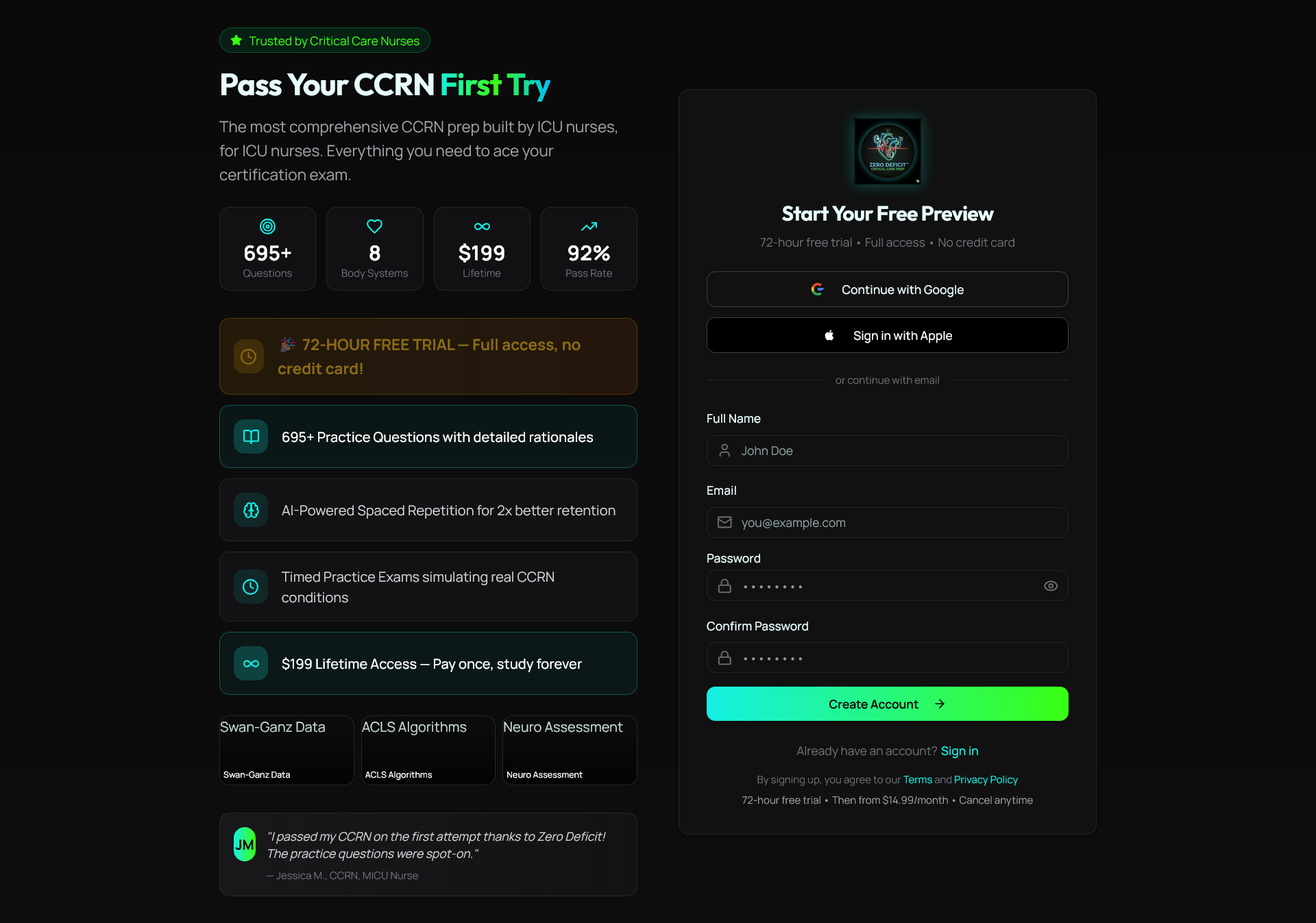
Zerodeficitccrnprep offers body-system study guides that pair clinical concepts with decision frameworks for all eight AACN blueprint systems. Every guide is built around the same clinical judgment focus the exam uses, so you study the way the exam thinks. Beyond the guides, the platform gives you access to 695+ CCRN practice questions with detailed rationales that show you exactly how to apply each concept, including the ones your mnemonics cover. You can start with a free version and no credit card required. Your mnemonics are only as good as the practice you test them against.
FAQ
What are the best mnemonics for CCRN exam prep?
The highest-yield nursing mnemonics for CCRN include ABCDE for primary assessment, ROME for ABG interpretation, SLUDGE for cholinergic toxicity, VIP for shock prioritization, and updated MONA for ACS. These tools directly support the clinical judgment focus of the AACN exam blueprint.
Is MONA still a valid mnemonic for CCRN?
MONA is valid only if you use its updated version. Current AHA guidelines recommend oxygen only below SpO2 90% and treat morphine as a conditional option. Using the original MONA without those updates can lead to incorrect answers on the CCRN.
How many mnemonics should I study for the CCRN?
Quality beats quantity. A focused set of eight to twelve mnemonics that cover all major AACN blueprint systems, tested repeatedly through practice questions, will outperform a list of thirty tools you have only seen on flashcards.
Can mnemonics replace understanding for the CCRN exam?
No. The CCRN exam is 80% clinical judgment, so mnemonics must be tied to clinical reasoning. Use them to retrieve knowledge quickly, but build the underlying understanding through rationale review and practice scenarios.
How do I create my own CCRN mnemonic?
Identify the clinical decision points you need to recall, pull the key actions or thresholds, and build an acronym or phrase from the first letters. Tie each element to a patient scenario you have actually experienced. Personal associations rooted in clinical memory improve long-term retention significantly.
Recommended
Take a Respiratory practice quiz
Master ARDS, ventilation, ABGs, oxygenation, and pulmonary emergencies.
Get Your Free 20-Question CCRN Diagnostic
20 high-yield CCRN-style questions across every body system, with detailed rationales — emailed to you instantly.
No spam. One email + a couple of helpful follow-ups. Unsubscribe anytime.
Ready to pass your CCRN?
Join 12,000+ nurses using Zero Deficit — 695+ practice questions with rationales, AI-powered weak-area drilling, and spaced-repetition flashcards.
Start Free Trial →