The Role of AI in Exam Preparation for CCRN Success
TL;DR:
- Nearly all nursing students now employ AI tools, but strategic use distinguishes successful exam takers from those who struggle. It is essential to verify AI-generated clinical information against trusted guidelines and focus on short, frequent study sessions that promote active recall and critical reasoning. Combining AI-driven practice with evidence-based resources and human discussion optimizes CCRN exam preparation while minimizing risks of misinformation and superficial memorization.
You are already using AI. So is nearly every other nurse studying for certification right now. 95% of students now report using AI in their academic practice, and critical care nurses are no exception. But there is a significant difference between using AI as a shortcut and using it as a precision study tool. The role of AI in exam preparation is genuinely powerful when you apply it with clinical rigor and the right strategy. This article breaks down what actually works, what to watch out for, and how to blend AI tools with the kind of evidence-based prep that passes the CCRN on the first attempt.
Table of Contents
- Key takeaways
- The role of AI in exam prep: what tools actually exist
- Benefits and limitations of AI in CCRN prep
- How to integrate AI into your CCRN study plan
- Traditional prep vs. AI-enhanced study workflows
- My honest take on AI and the CCRN exam
- Take your AI-driven prep further with Zero Deficit™
- FAQ
Key takeaways
| Point | Details |
|---|---|
| AI adoption is near-universal | Nearly all nursing students now use AI tools, but strategy separates those who pass from those who struggle. |
| Verify all clinical AI output | AI can generate incorrect drug dosages or physiology explanations, so always cross-check with AACN and SCCM guidelines. |
| Hybrid study wins every time | Combining AI personalization with spaced retrieval and practice testing produces the strongest exam outcomes. |
| Short sessions beat marathon cramming | Frequent AI-driven practice sessions of 20 to 30 minutes outperform long, unfocused study blocks. |
| AI is a tool, not the examiner | AI cannot replicate the clinical judgment the CCRN exam tests. Use it to support, not replace, deep conceptual learning. |
The role of AI in exam prep: what tools actually exist
Before you can use AI effectively, you need to know what you are actually working with. The category is broader than most nurses realize, and each tool type serves a different function in your study plan.
Conversational AI for concept explanation. Tools like ChatGPT can explain complex pathophysiology, walk through hemodynamic calculations, or generate practice questions on demand. Ask it to explain why a patient with ARDS on high PEEP suddenly becomes hypotensive, and you will get a usable response in seconds. The key is asking it to teach you, not just answer you.
Flashcard apps with spaced repetition. Anki and Quizlet use algorithms to show you cards at the exact moment you are most likely to forget them. That is spaced repetition, and it is one of the most validated learning methods in cognitive science. These are not passive review tools. Used correctly, they force active recall every single session.
AI tutors using Socratic questioning. Tools like Khanmigo engage students in problem-solving rather than feeding them direct answers. For critical care content, this matters. The CCRN does not ask you to memorize. It asks you to reason. An AI tutor that pushes back, asks “why,” and makes you defend your clinical logic is replicating what the exam actually demands.
Study management assistants. Some AI platforms summarize lecture notes, build study schedules, and organize content by topic area. The more advanced platforms now include context-aware memory, which means you do not have to re-explain your weak areas every session. They carry that data forward, making each session more efficient than the last.
- Use conversational AI for “why does this happen” questions, not just “what is the answer” questions
- Use Anki for high-yield facts: normal hemodynamic values, vasopressor mechanisms, ventilator settings
- Use Socratic AI tutors for scenario-based clinical reasoning practice
- Use study managers to block your prep time around your ICU schedule and prioritize your lowest-scoring body systems
Pro Tip: When you prompt a conversational AI like ChatGPT, frame your questions as a clinician, not a student. Instead of “Explain sepsis,” try “I have a patient with MAP of 58, lactate of 4.2, and on norepinephrine. Walk me through my assessment priorities and why.” You will get far more exam-relevant output.
Benefits and limitations of AI in CCRN prep
Here is the honest version, not the marketing version.
The efficiency gains are real. AI-powered assessment generation cuts question creation time from 2 to 3 hours down to 5 to 10 minutes, with better topic alignment and built-in rationales. For a nurse working three 12-hour shifts a week, that matters. You can generate 20 targeted questions on pulmonary mechanics in the time it used to take to find a single good practice set.

Personalization is another genuine advantage. AI algorithms identify patterns in your performance and surface your weak areas automatically. If you keep missing questions on renal replacement therapy or CRRT troubleshooting, a good AI platform will keep pulling those topics back into rotation. That kind of adaptive learning approach is something static textbooks simply cannot replicate.
AI tools with gamification features, like badges, progress tracking, and leaderboards, also improve motivation when they are tied to real learning goals. That is not trivial when you are studying for months while working full-time in a high-acuity unit.
Now for the caution you need to hear.
AI hallucinations are a real risk in clinical exam prep. These are confident, well-formatted, completely wrong answers. An AI might give you an incorrect medication dosage, misstate a normal CVP range, or describe a pathophysiologic mechanism that sounds right but contradicts current AACN or SCCM guidelines. AI-generated clinical misinformation is not rare. It happens, and in critical care content, it is dangerous to your exam performance.
The rule is non-negotiable: never accept AI-generated clinical content without validating it against a primary source. Use your AACN CCRN study materials, SCCM guidelines, and peer-reviewed references as the authority. AI is your study assistant, not your clinical authority. It also cannot replace human judgment when it comes to interpreting nuanced clinical scenarios or selecting the most appropriate exam strategy for your learning needs.
How to integrate AI into your CCRN study plan
The most effective AI study approach is hybrid. That means combining the efficiency of AI with the cognitive rigor of spaced retrieval, active recall, and reflective error analysis. Here is how to build that system.
-
Audit your weak areas first. Before you open any AI tool, run a baseline practice test across all 8 body systems. Use your score breakdown to rank your weakest topics. This becomes your AI-driven study priority list. Start with cardiovascular and pulmonary because they make up the largest portion of the CCRN blueprint.
-
Use AI to generate targeted practice, not passive review. Ask your AI tool to create 10 to 15 scenario-based questions specifically on your lowest-scoring system. Review each one with a rationale. Do not just check if you got it right. Understand why each distractor was wrong. That analysis builds the clinical reasoning muscle the CCRN tests.
-
Run short, frequent sessions. Blended learning pilots show an average 12 to 18% improvement on unit tests when short AI-driven sessions are combined with teacher-led or mentor-led review. Aim for 25 to 30 minute focused sessions instead of two-hour blocks. Your retention will be higher and your burnout risk will be lower.
-
Document every error. Keep a running error log, whether in a notebook or a digital doc. Write down the question stem, your wrong answer, the correct answer, and your one-sentence explanation of the concept. Review this log before every study session. This transforms your mistakes into your best study material.
-
Validate AI content before you internalize it. Any clinical fact that AI gives you, check it. Vasopressor dosing ranges, ventilator parameters, ICP management thresholds. All of it. Cross-reference with your CCRN study guides or primary AACN resources before it goes into your Anki deck.
-
Bring your hardest questions to a peer group or mentor. AI cannot replicate the discussion that happens when two ICU nurses debate a vasopressor titration question. Human dialogue surfaces clinical nuance that no algorithm captures yet.
Pro Tip: Build a weekly rhythm: Monday, Wednesday, and Friday are AI-driven targeted practice sessions. Tuesday and Thursday are reflective review days where you revisit your error log, update your Anki deck, and read through your study guide rationales. This structure prevents the trap of doing endless practice without ever consolidating what you learned.
Traditional prep vs. AI-enhanced study workflows
Understanding where AI actually adds value helps you allocate your study time more precisely.
| Study Task | Traditional Approach | AI-Enhanced Approach |
|---|---|---|
| Creating practice questions | 2 to 3 hours per topic set | 5 to 10 minutes with targeted prompts |
| Identifying weak areas | Manual score tracking, self-assessment | Automatic adaptive algorithms surface gaps |
| Feedback quality | Delayed, limited to answer keys | Immediate, detailed rationale per question |
| Personalization | One-size study guide for all learners | Differentiated question sets by learner level |
| Clinical accuracy validation | Built into textbook content | Requires manual cross-check every time |
| Study scheduling | Self-managed, often inconsistent | AI schedulers adapt to your availability and pace |
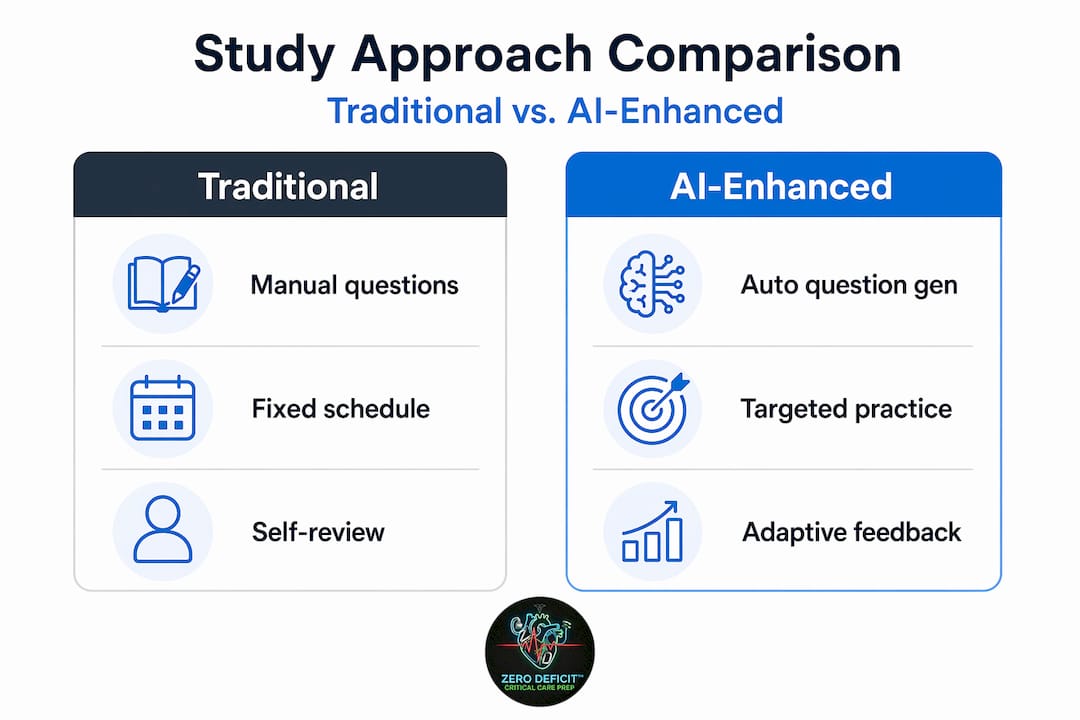
The efficiency gap is significant. What takes hours in a traditional prep model takes minutes with AI tools. But the table above also shows where traditional methods still win: clinical accuracy. A well-written study guide from a trusted certification platform has been vetted. AI output has not.
A practical approach is to use AI tools for volume and personalization, then anchor your content understanding in clinically verified materials. The question breakdown methods that help you dissect complex CCRN stems, for instance, are something no AI prompt replaces. That analytical skill comes from structured practice with expert-developed content.
- AI handles the volume problem: generating more practice reps faster
- Verified platforms handle the accuracy problem: ensuring what you study matches what AACN actually tests
- You handle the integration problem: turning practice into retained clinical knowledge
My honest take on AI and the CCRN exam
I have watched a lot of nurses come through CCRN prep, and I have seen the AI trap play out more times than I want to count. A nurse spends weeks generating AI practice questions, feels productive, and walks into the exam underprepared. Why? Because AI gave them volume without depth, and they never stopped to truly understand the underlying physiology.
Here is what I have found actually works. AI is exceptional at revealing what you do not know. When it gives you a question you cannot answer, and you cannot even articulate why you are confused, that is gold. That confusion is the exact gap you need to close.
What I learned personally is that AI accelerated my study planning and helped me stop wasting time on topics I already had locked down. But every time an AI-generated explanation felt slightly off, my clinical instinct flagged it. And almost every time I checked, the flag was right. That is the verification habit that protects you.
The uncomfortable truth about AI in critical care exam prep is this: the exam tests judgment, not recall. AI can drill you on facts endlessly. It cannot yet replicate the scenario complexity of a well-written CCRN question that requires you to synthesize hemodynamics, ventilator management, and medication response simultaneously. Your ICU experience and your human mentor do that.
Use AI. Use it aggressively. But keep your clinical brain engaged the entire time.
— Zero
Take your AI-driven prep further with Zero Deficit™
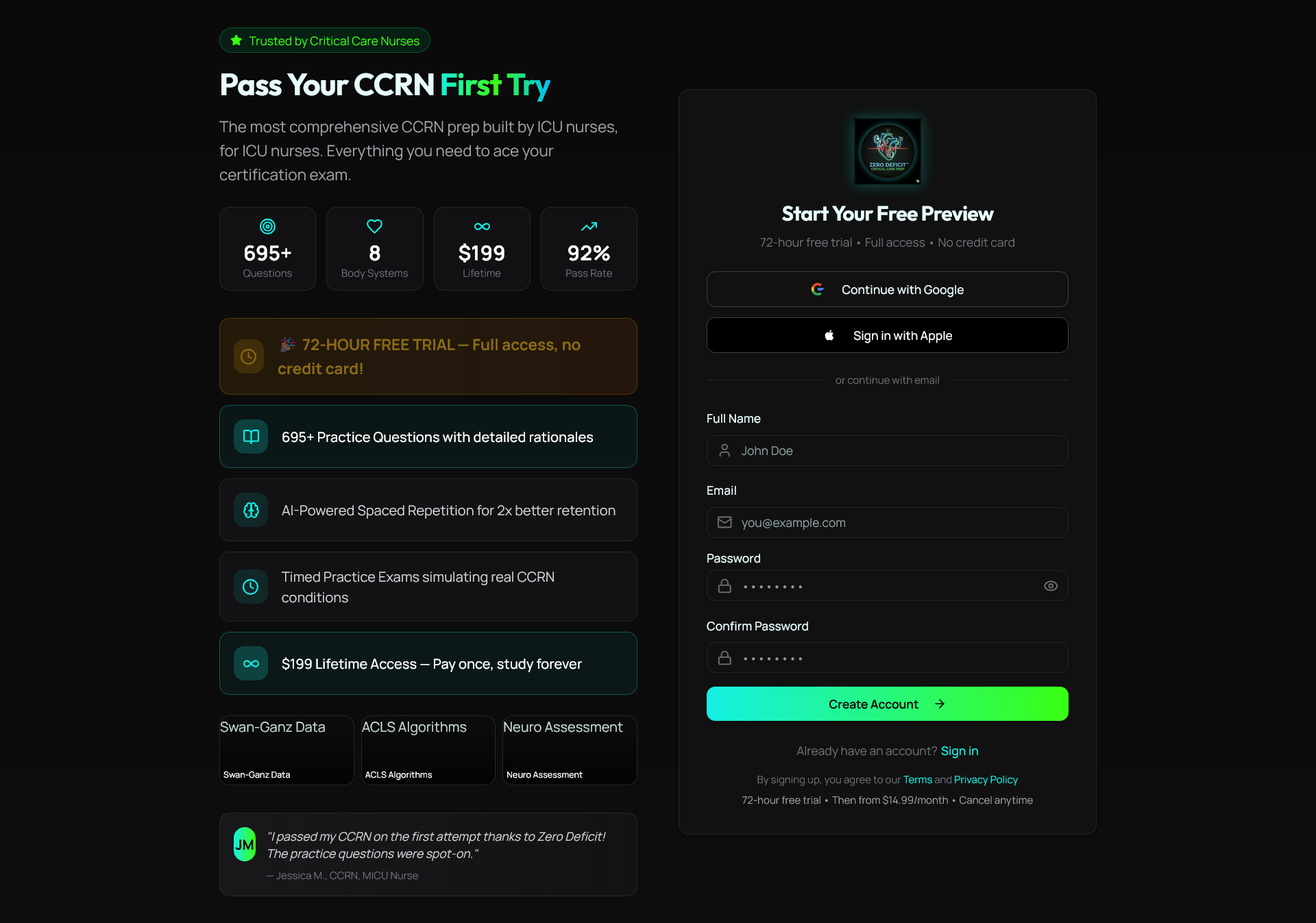
AI tools are most powerful when the content they work with is clinically accurate and exam-aligned. That is exactly what Zerodeficitccrnprep is built to deliver. The platform gives you access to 695+ CCRN practice questions built around the AACN Adult CCRN blueprint, complete with detailed rationales you can trust. Pair those questions with AI-driven study sessions, and you get the best of both: volume and accuracy. You can also use the structured question breakdown methods to build the analytical process that makes hard CCRN questions solvable. No credit card required to start. Get in and see what your actual gaps are, then build your AI-enhanced study plan around content you know is right.
FAQ
What is the role of AI in exam preparation for nurses?
AI supports exam preparation by generating personalized practice questions, identifying weak areas through adaptive algorithms, and providing immediate feedback. For CCRN candidates, the key is using AI tools alongside clinically verified resources to maintain accuracy.
Can AI replace traditional CCRN study materials?
No. AI tools improve study efficiency and personalization but cannot guarantee clinical accuracy. All AI-generated content should be validated against AACN guidelines and trusted CCRN study platforms before you internalize it.
How do I use AI for CCRN study planning?
Start with a baseline practice test to identify your weakest body systems, then use AI to generate targeted scenario-based questions on those topics. Run short daily sessions, log every error, and review your mistakes before each new session.
What are the biggest risks of using AI in test preparation?
The primary risk is AI hallucinations: confident but incorrect clinical information. Drug dosages, hemodynamic values, and pathophysiology explanations generated by AI should always be cross-checked with primary clinical sources before you study from them.
How many questions should I do per AI study session?
Research supports short, focused sessions. Aim for 15 to 25 questions per sitting with full rationale review rather than 50 to 100 questions without reflection. Quality of analysis matters far more than raw question volume.
Recommended
- How educators boost CCRN certification success for nurses | Zero Deficit CCRN Prep
- Why assessment matters: Boost CCRN exam success | Zero Deficit CCRN Prep
- Top CCRN study topics to master for exam success | Zero Deficit CCRN Prep
- Pass the CCRN Exam: Proven Guide for Critical Care Nurses | Zero Deficit CCRN Prep
Take a Respiratory practice quiz
Master ARDS, ventilation, ABGs, oxygenation, and pulmonary emergencies.
Ready to pass your CCRN?
Join 12,000+ nurses using Zero Deficit — 695+ practice questions with rationales, AI-powered weak-area drilling, and spaced-repetition flashcards.
Start Free Trial →