The Role of Ethics in Critical Care: 2026 ICU Guide
TL;DR:
- Ethics in critical care involves applying core moral principles systematically to guide decision-making and patient management in ICUs. Structured frameworks, like the AACN’s six-step process, reduce moral distress and improve transparency, documentation, and patient-centered outcomes. Governance structures and ethical training are essential to support clinicians, prevent burnout, and ensure responsible use of emerging AI tools in end-of-life care decisions.
Ethics in critical care is the deliberate application of core moral principles to guide decision-making, patient management, and interdisciplinary collaboration in ICU settings. The field formally calls this clinical ethics, and it operates as a structured, repeatable process rather than a set of abstract ideals. The AACN describes a structured ethical decision-making process that includes recognizing ethical issues, gathering information, applying principles, weighing options, and communicating decisions clearly. For ICU nurses and ethics committees, understanding this process is not optional. It is the foundation of patient-centered care, clinician well-being, and defensible clinical judgment.
What are the core ethical principles guiding critical care practice?
Critical care ethics principles form the framework every ICU clinician applies when a patient cannot speak for themselves, when families disagree with the care team, or when resources are limited. These principles are not interchangeable. Each one addresses a distinct dimension of the clinical relationship.
The four foundational principles in biomedical ethics are:
- Autonomy: Patients have the right to make informed decisions about their own care. In the ICU, this often means honoring advance directives, surrogate decision-makers, or documented values when the patient lacks capacity.
- Beneficence: Every intervention should be aimed at producing a genuine benefit for the patient. This principle pushes clinicians to ask whether a treatment actually improves outcomes or merely prolongs suffering.
- Nonmaleficence: The obligation to avoid harm is distinct from the obligation to do good. Continuing futile life-sustaining treatment when prognosis is poor can itself constitute harm.
- Justice: Resources in the ICU are finite. Ventilators, CRRT machines, and ICU beds must be allocated fairly, based on clinical need and transparent criteria rather than social status or implicit bias.
A fifth principle, often emphasized in nursing ethics, is fidelity, which refers to honoring commitments and maintaining trust with patients and families. The AACN’s Synergy Model reinforces this by framing the nurse’s role around matching clinical competencies to patient needs, which requires ethical perception at every step.
These principles do not operate in isolation. A decision about withdrawing vasopressors from a patient with multi-organ failure simultaneously involves nonmaleficence, autonomy, and justice. Recognizing that tension is the first step in ethical decision making in healthcare. The importance of ethics in nursing is clearest in these moments, where clinical skill and moral judgment must work together.

How do structured ethics frameworks reduce moral distress in the ICU?
Structured frameworks exist because ad hoc ethical reasoning under pressure produces inconsistent outcomes and increases clinician distress. The AACN’s model provides a repeatable sequence that any ICU team can apply regardless of the specific dilemma.
The six-step process works as follows:
- Recognize the ethical issue. Name it explicitly. Is this a conflict between autonomy and beneficence? A resource allocation problem? Identifying the type of dilemma focuses the conversation.
- Gather relevant information. This includes the patient’s medical history, documented wishes, family input, prognosis data, and applicable institutional policies.
- Apply ethical principles. Map the four core principles to the specific situation. Which ones are in tension? Which one carries the most weight given the clinical context?
- Consider all available options. This step prevents premature closure. Teams often default to the first viable option rather than evaluating the full range of choices.
- Make and communicate the decision. Document the reasoning clearly. Transparency protects both the patient and the care team.
- Evaluate the outcome. Revisit the decision as the clinical picture evolves. Ethics is not a one-time event.
A 2026 Brazilian ICU study demonstrated what happens when this kind of structure is applied to family conferences. In that study, 73.9% of family conferences led to value-based decisions about life-sustaining treatment, and 55% of patients had their treatment modified to align with documented values. That is a measurable, patient-centered outcome produced by structured ethical deliberation.
Ethics consultations embedded in ICU workflows produce similar results. When ethics teams act as active mediators, they reduce decisional stress, close documentation gaps, and resolve conflicts before they escalate. The key word is embedded. An ethics committee that only convenes on formal request is too slow for the pace of critical care.
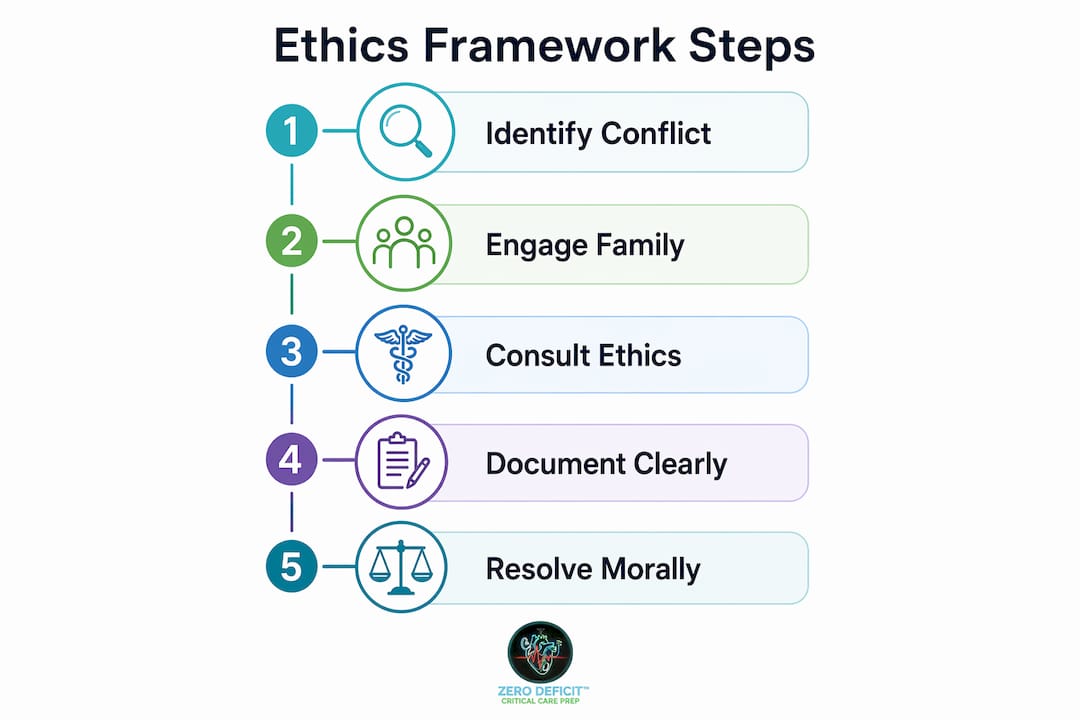
Pro Tip: When you identify an ethical conflict early in a patient’s ICU stay, document it in the chart immediately. Early documentation creates a paper trail that protects the patient’s values and supports the care team if the situation escalates.
What challenges does moral distress pose to ICU staff?
Moral distress is defined as the psychological suffering that occurs when a clinician knows the ethically correct action but is prevented from taking it. It is not a rare experience. A 2026 meta-analysis found that more than half of ICU nurses experienced moral distress, making it one of the most prevalent occupational hazards in critical care.
The triggers are specific and well-documented:
- Providing care perceived as futile, particularly prolonged life support with no realistic chance of meaningful recovery
- Communication breakdowns between physicians, nurses, and families that leave nurses without clear direction
- Hierarchical structures that silence nursing input in goals-of-care conversations
- Ethical dilemmas with no satisfying resolution, such as resource scarcity during surge events
The consequences extend beyond individual suffering. Moral distress leads to burnout, compassion fatigue, and measurable declines in care quality. Left unaddressed, it creates a negative feedback loop where distressed nurses disengage, which further erodes ethical culture on the unit.
“Moral distress results from structural constraints; organizational and team-based supports are key to mitigation alongside individual coping skills.” — Structural Causes of Moral Distress, 2026
Ethics education is one of the most evidence-based interventions available. A 2026 study using a flipped-classroom model with NICU and PICU nurses showed that moral distress scores dropped from 70.44 ± 26.35 to 50.60 ± 36.46 after the intervention, with the effect persisting at a two-week follow-up. That is a clinically meaningful reduction achieved through education alone. The flipped-classroom format works because it builds moral sensitivity, which is the ability to perceive ethical dimensions in clinical situations before they become crises.
Education is necessary but not sufficient. Organizational and team-based supports must accompany training. Debriefs after difficult deaths, protected time for ethics discussions, and clear escalation pathways all interrupt the distress cycle at the structural level where it originates.
How do governance frameworks shape ethical practice in the ICU?
ICU governance provides the institutional architecture that makes ethical deliberation consistent and accountable. Without governance, ethics depends entirely on individual clinicians, which produces variable outcomes and exposes institutions to legal and reputational risk.
The core components of ICU ethical governance include accountability, deliberation, documentation, and oversight. A 2026 scoping review protocol found that clinical ethics committees and consultations improve transparency, support shared decision-making, and reduce ICU length of stay in cases with poor prognosis. That last finding matters operationally. Ethical clarity about goals of care directly affects resource utilization.
The table below compares governance structures by function and reported outcome:
| Governance structure | Primary function | Reported outcome |
|---|---|---|
| Clinical ethics committee | Policy development, case review | Improved transparency and institutional accountability |
| Bedside ethics consultation | Conflict mediation, real-time guidance | Reduced decisional stress, faster resolution |
| Triage and palliative care protocols | Resource allocation, end-of-life planning | Reduced ICU length of stay in poor-prognosis cases |
| Ethics education programs | Staff moral sensitivity training | Lower moral distress scores, stronger ethical perception |
One challenge worth naming directly: governance frameworks designed for well-resourced ICUs in high-income settings do not translate automatically to low- and middle-income environments. Resource constraints, staffing ratios, and cultural norms around family involvement all affect how governance structures function in practice. Ethics services should produce measurable outcomes, including transparency, accountability, and clinician support, not just case-by-case advice.
What ethical considerations arise with AI in critical care end-of-life decisions?
AI-based decision support tools are entering critical care workflows faster than governance frameworks can keep pace. The ethical risks are real and specific. The Italian Society of Anesthesia, Analgesia, Resuscitation and Intensive Care (SIAARTI) published 2026 ethical reflections emphasizing that AI governance must preserve clinician responsibility and avoid reducing ethical dialogue to a procedural checklist.
The core concerns fall into three categories. First, black-box decision-making: many AI tools cannot explain their recommendations in terms a clinician can evaluate, which makes it impossible to apply the standard ethical principles of transparency and accountability. Second, bias and fairness: AI models trained on historical data inherit the inequities embedded in that data, raising serious justice concerns in resource allocation. Third, accountability diffusion: when an AI tool recommends withdrawing life support and the clinician follows that recommendation without independent deliberation, ethical responsibility becomes unclear.
The deeper risk is what SIAARTI describes as the erosion of authentic clinician-patient dialogue. AI-driven end-of-life tools risk shifting ethical responsibility away from clinicians to technology, which oversimplifies patient identity and introduces ethical ambiguity at the most critical moments of care.
Pro Tip: Treat any AI recommendation in a goals-of-care conversation as one data point among many, not a decision. Document your independent clinical and ethical reasoning separately from the AI output.
Governance responses to AI in the ICU must include transparency requirements, auditability standards, and explicit policies on when AI input is appropriate versus when it must be excluded from the decision process entirely.
Key takeaways
Ethics in critical care functions as a structured, repeatable discipline that protects patients, supports clinicians, and produces measurable outcomes when applied through formal frameworks and governance.
| Point | Details |
|---|---|
| Core principles guide every decision | Autonomy, beneficence, nonmaleficence, and justice apply simultaneously in most ICU dilemmas. |
| Structured frameworks reduce distress | AACN’s six-step model and embedded ethics consultations lower decisional stress and improve documentation. |
| Moral distress is prevalent and preventable | Over 50% of ICU nurses experience it; flipped-classroom education and organizational support reduce it measurably. |
| Governance produces measurable outcomes | Ethics committees and consultations reduce ICU length of stay and improve transparency in poor-prognosis cases. |
| AI requires explicit ethical governance | Clinicians must retain accountability and document independent reasoning when AI tools inform end-of-life decisions. |
Why ethics in the ICU is a clinical skill, not a soft skill
I want to be direct about something that gets lost in most ethics discussions: ethical reasoning is a clinical competency, the same way hemodynamic monitoring or vent management is a clinical competency. You would not manage a patient in cardiogenic shock without knowing the physiology. You should not manage a goals-of-care conversation without knowing the ethical framework.
What I have seen consistently is that nurses who struggle most with moral distress are not ethically deficient. They are structurally unsupported. They know what the right answer is. They cannot act on it because no one has given them a formal pathway to raise the concern, document it, or escalate it. That is a governance failure, not a personal one.
The best ICU teams I have encountered treat ethics consultation the way they treat pharmacy consultation: routine, non-stigmatized, and built into the workflow. When you can call an ethics consult as easily as you call a rapid response, the culture shifts. Nurses speak up earlier. Families get clearer information. Physicians document their reasoning more carefully. Everyone benefits.
The AI question is the one I watch most carefully right now. The risk is not that AI will make bad recommendations. The risk is that busy clinicians will defer to AI recommendations without deliberating, and that deference will gradually erode the skill of ethical reasoning itself. You cannot outsource moral judgment. You can use tools to inform it, but the accountability stays with you.
If you are preparing for the CCRN, treat the Synergy Model and ethics content the way you treat the cardiovascular section: with rigor, with practice questions, and with a clear understanding of how the principles connect to real clinical scenarios. The exam tests your ability to apply these concepts, not just recall them.
— Zero
Prepare for CCRN ethics questions with Zero Deficit™
Ethics and the Synergy Model appear on every CCRN exam, and the questions are designed to test application, not memorization. Zero Deficit™ CCRN Exam Prep gives you practice questions with detailed rationales that walk through the ethical reasoning behind each answer, so you understand the why, not just the what. The platform’s question breakdown methods are built specifically for complex clinical scenarios, including ethical dilemmas where multiple principles are in tension. With over 695 practice questions and AI-powered review tools, Zero Deficit™ helps you build the confidence to pass on your first attempt. Start your free version at ZeroDeficitCCRNPrep.com, no credit card required.
FAQ
What is the role of ethics in critical care?
Ethics in critical care is the structured application of moral principles, including autonomy, beneficence, nonmaleficence, and justice, to guide clinical decisions, patient management, and interdisciplinary communication in the ICU. The AACN defines it as a repeatable process that supports transparent reasoning among all stakeholders.
What are the most common ethical dilemmas in the ICU?
The most common ethical dilemmas involve futile life-sustaining treatment, surrogate decision-making when patient wishes are undocumented, resource allocation during surge events, and conflicts between family preferences and clinical judgment. Each requires applying structured ethical frameworks rather than individual judgment alone.
How does moral distress affect ICU nurses?
More than half of ICU nurses experience moral distress, which leads to burnout, compassion fatigue, and compromised care quality. Structured ethics education, particularly flipped-classroom models, and organizational support systems are the most evidence-based interventions for reducing it.
When should an ethics consultation be requested in the ICU?
Request an ethics consultation when there is unresolved conflict between the care team and family, when a patient’s documented wishes conflict with current treatment, or when clinicians experience significant moral distress about the direction of care. Early consultation produces better outcomes than waiting for a crisis.
How does the CCRN exam test ethics knowledge?
The CCRN exam tests ethics through scenario-based questions that require applying the Synergy Model and core bioethical principles to clinical situations. Questions focus on ethical decision making in realistic ICU contexts, not abstract definitions.
Recommended
- 2026 Trends in Critical Care Certification You Must Know | Zero Deficit CCRN Prep
- Pass the CCRN Exam: Proven Guide for Critical Care Nurses | Zero Deficit CCRN Prep
- The Role of Exam Rationales in CCRN Certification Success | Zero Deficit CCRN Prep
- How to review CCRN rationales: A critical care nurse’s guide | Zero Deficit CCRN Prep
Take a Renal practice quiz
Master AKI, dialysis, electrolytes, and fluid balance for the CCRN.
Ready to pass your CCRN?
Join 12,000+ nurses using Zero Deficit — 695+ practice questions with rationales, AI-powered weak-area drilling, and spaced-repetition flashcards.
Start Free Trial →