The Role of Study Analytics for Nurses in CCRN Prep
TL;DR:
- Study analytics measures and analyzes learner performance data to optimize nursing exam preparation and identify knowledge gaps. Strong, personalized guidance with actionable next steps significantly enhances learning outcomes and reduces exam anxiety. Effective tools involve real-time, targeted insights, involving nurses in design to align with clinical practice.
Study analytics is defined as the measurement, collection, analysis, and reporting of learner data to understand and optimize learning environments, a definition established by the Society for Learning Analytics Research (SoLAR). For nurses preparing for the CCRN exam, this isn’t abstract theory. The role of study analytics for nurses is direct and practical: it tells you exactly where your knowledge gaps are, what to study next, and whether your current approach is actually working. Tools like Elsevier’s HESI Personalized Learning Plan and platforms like Zerodeficitccrnprep already apply these principles to critical care certification prep, turning raw performance data into a personalized study roadmap.
How does study analytics work in nursing education and exam preparation?
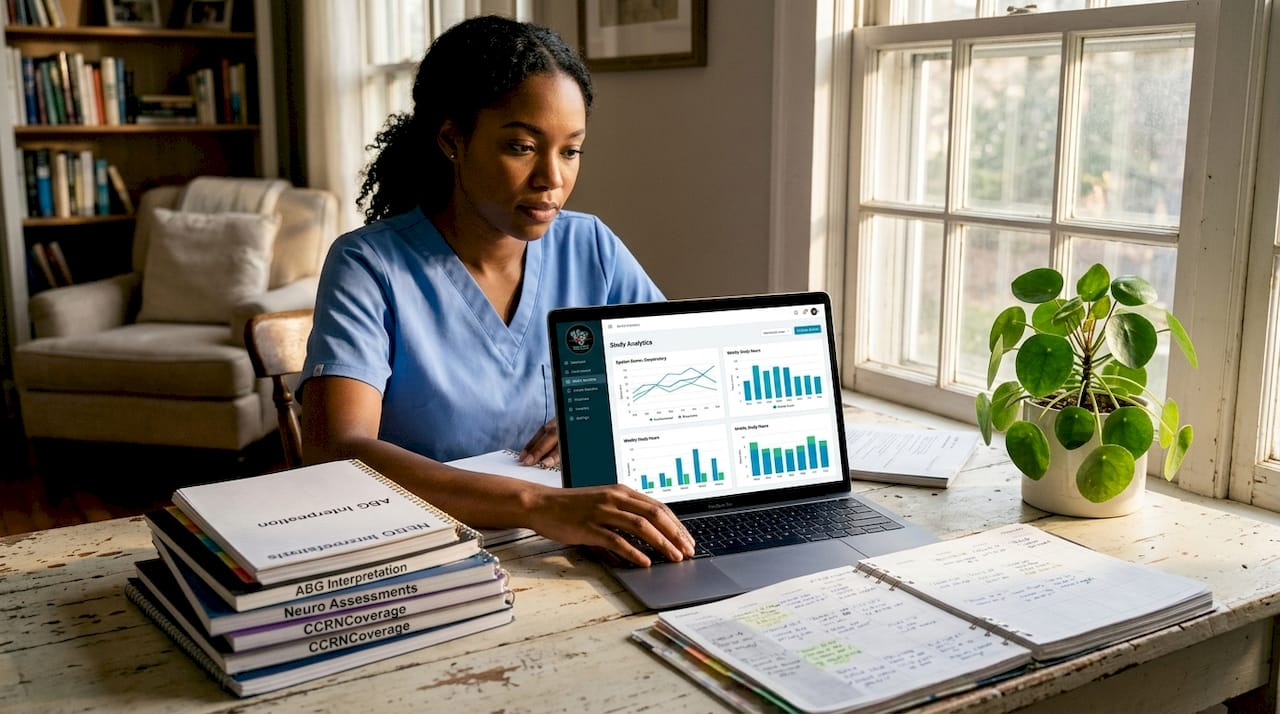
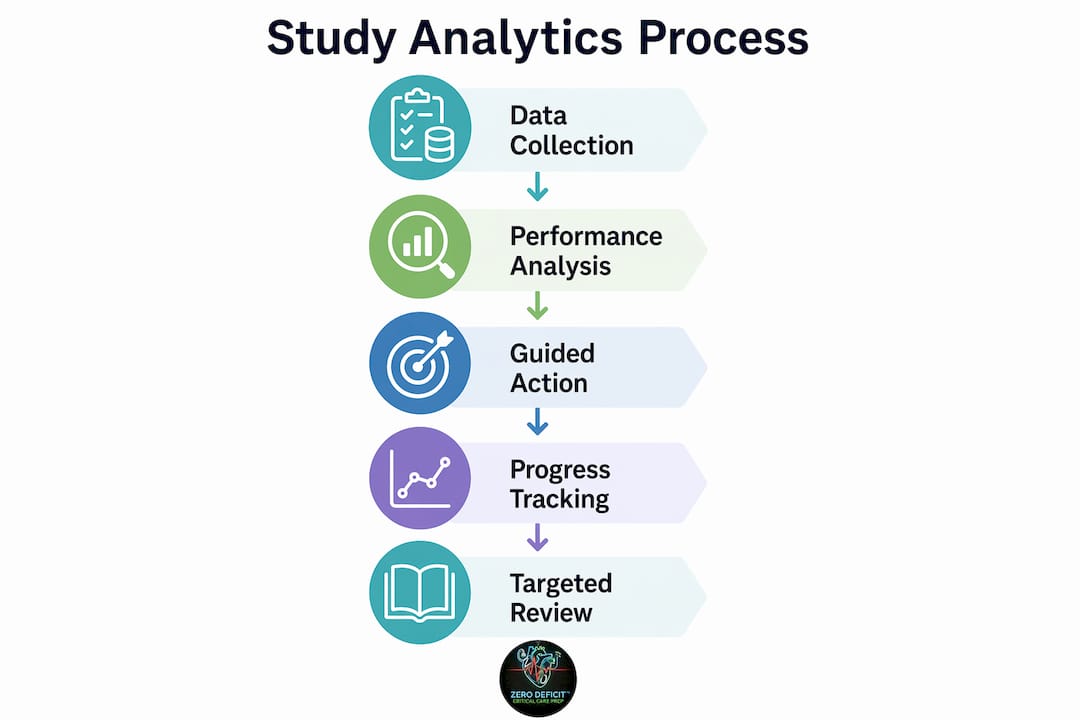
Study analytics operates by collecting data from every interaction you have with a learning platform. Every practice question you answer, every simulation you complete, and every timed quiz you take generates data points. The platform then processes that data through several analytical layers to produce guidance you can act on.
The four core types of analytics each serve a different purpose:
- Descriptive analytics answers “what happened.” It shows your score history, time spent per topic, and question accuracy by body system.
- Diagnostic analytics answers “why.” It identifies patterns, such as consistently missing hemodynamic questions after getting cardiovascular anatomy correct, pointing to a gap in application rather than recall.
- Predictive analytics answers “what will happen.” Based on your current trajectory, it estimates your readiness for the CCRN exam and flags high-risk content areas before test day.
- Prescriptive analytics answers “what to do.” This is the most clinically useful layer. It generates specific next steps: review ARDS management, attempt 10 more ventilator weaning questions, or revisit the Synergy Model before moving forward.
The critical distinction is between data delivery and guided action. A 2026 study on learning analytics found that strong guidance, meaning personalized and actionable next steps, produced measurable gains in self-regulated learning and academic performance, while minimal guidance, meaning data alone, did not. That finding matters enormously for how you choose your prep tools. A dashboard that only shows your score is not the same as a system that tells you what to do with it.
Pro Tip: When evaluating any study platform, ask one question: does it tell me what to study next, or just what I got wrong? The answer separates effective analytics tools from score trackers.
Why is the role of study analytics important for nurses and nursing students?
The CCRN exam covers 150 questions across eight body systems, with cardiovascular content alone representing 17% of the exam blueprint. Studying without analytics means guessing which topics need the most attention. Studying with analytics means knowing.
AI-personalized educational interventions in nursing have demonstrated a mean knowledge improvement of +17.48 and a mean skills improvement of +10.66 (p<0.001) compared to standard instruction. Those are statistically significant gains, not marginal differences. For a nurse retaking the CCRN after a first attempt, or a new ICU grad building foundational critical care knowledge, that magnitude of improvement can be the difference between passing and not.
The specific benefits for nurses preparing for high-stakes exams include:
- Targeted remediation: Instead of re-reading entire study guides, you focus on the exact competencies where your performance data shows weakness.
- Reduced exam anxiety: Knowing your weak areas and having a plan to address them replaces vague worry with directed effort.
- Active learning over passive review: Analytics shift you from reading to doing. You answer questions, review rationales, and adjust your plan based on results.
- Ongoing self-assessment: You track progress over time, not just at the end of a study block.
“Analytics without actionable next-step guidance leads to minimal impact on learning outcomes. Pairing each metric with specific study actions is what drives real gains.” — Learning analytics research, 2026
The nursing analytics importance extends beyond exam prep. Nurses who develop data-driven study habits also build the reflective practice skills that translate directly to clinical decision-making in the ICU. The same analytical thinking that helps you interpret your practice test performance helps you interpret a patient’s hemodynamic trends.
How do nursing education tools use study analytics to support exam preparation?
The most concrete example of study analytics in nursing education is Elsevier’s HESI Personalized Learning Plan, which uses real-time analytics and AI-powered item-level recommendations to guide nursing students through high-stakes assessment preparation. The system tracks milestone progress, identifies specific content gaps at the question level, and generates individualized study paths rather than generic topic lists. That item-level precision is what separates modern analytics tools from older score-report formats.
A 2026 qualitative study introduced another approach: data comics as a learning analytics tool for nursing students. Data comics translate performance data into visual narrative panels, making patterns easier to interpret and more engaging than raw tables. Nursing students in the study found them more accessible than traditional dashboards, though researchers noted they should supplement rather than replace standard analytics displays.
The table below compares the key features of these two approaches:
| Feature | HESI Personalized Learning Plan | Data comics |
|---|---|---|
| Data format | Real-time dashboard with item-level detail | Narrative visual panels |
| Personalization | AI-driven, adaptive recommendations | Reflective, story-based interpretation |
| Best use case | Structured exam prep with milestone tracking | Supplemental reflection and engagement |
| Limitation | Requires platform access and structured curriculum | Should not replace quantitative dashboards |
| Engagement style | Data-forward, precision-focused | Narrative-forward, emotionally accessible |
Zerodeficitccrnprep applies similar principles through its practice tests and analytics, tracking performance across all eight body systems and surfacing the specific content areas where you need the most work before the CCRN exam.
Pro Tip: Use your analytics data at the body-system level first, then drill down to the question level. Fixing a cardiovascular gap is more efficient when you know whether the issue is with hemodynamics, arrhythmias, or ACS management specifically.
What are best practices and challenges in using study analytics for nurses?
Study analytics tools are only as useful as the habits you build around them. The following practices maximize the impact of data-driven nursing study:
- Act on recommendations within 24 hours. Analytics lose their value when you review your data and then return to your existing study plan unchanged. The prescriptive layer of any analytics system is designed to redirect your effort immediately.
- Interpret dashboards as process indicators, not ability scores. Many learners misread dashboards as a fixed measure of their intelligence or clinical competence. A low score on renal questions means you need more renal practice. It does not mean you cannot pass the CCRN.
- Prioritize platforms with co-designed, human-centered tools. A 2026 Penn LDI report found that nurses as co-designers of AI and analytics systems produce tools that better reflect clinical realities and avoid workflow disruptions. When a platform is built with nurse input, the analytics categories and recommendations align with how nurses actually think and practice.
- Watch for visual noise in data displays. Overly complex dashboards can create cognitive overload rather than clarity. If a visualization requires more than 30 seconds to interpret, it is not serving you. Seek platforms that present data simply and clearly.
- Combine analytics with structured content review. Analytics identify the gap. Study guides and rationale-based question review fill it. Neither works as well without the other.
The ethical dimension of analytics tools also matters. Transparency about how data is collected, stored, and used protects you as a learner. Platforms that clearly explain their data practices and give you control over your information are more trustworthy than those that treat analytics as a black box. The AI role in nursing report from Penn LDI is explicit: nurses should be active interpreters of their data, not passive recipients of automated outputs.
Pro Tip: Set a weekly analytics review appointment with yourself. Spend 10 minutes reviewing your performance trends, identify the one body system with the lowest accuracy, and make that your primary focus for the next study block.
Key takeaways
Study analytics for nurses works only when paired with strong, personalized guidance that converts performance data into specific next steps rather than leaving raw scores for learners to interpret alone.
| Point | Details |
|---|---|
| Define analytics correctly | Study analytics measures, collects, analyzes, and reports learner data to optimize preparation, per SoLAR. |
| Strong guidance is non-negotiable | Personalized, actionable next steps produce measurable gains; data alone does not improve outcomes. |
| AI-personalized tools show real results | Research shows mean knowledge gains of +17.48 and skills gains of +10.66 with AI-personalized interventions. |
| Dashboards are process tools, not grades | Misinterpreting analytics as ability scores is common and counterproductive. Use them to direct study effort. |
| Nurse involvement improves tool quality | Co-designed analytics systems better reflect clinical realities and support safe, effective use. |
What I’ve learned about analytics and the nurses who actually use them
I’ve watched nurses sit down with a practice test score and do one of two things. Some look at the number, feel relieved or discouraged, and move on. Others look at the breakdown, find the pattern, and adjust. The second group passes the CCRN at a higher rate. That’s not a coincidence.
The impact of data analytics in nursing education is real, but it only activates when you treat your performance data as a clinical problem to solve. You wouldn’t look at a patient’s lactate of 4.2 and shrug. You’d ask why, trace the cause, and intervene. Your analytics dashboard deserves the same response.
What I’ve also seen is that nurses underestimate how much the quality of the analytics tool matters. A platform that shows you a percentage score is not the same as one that tells you your sepsis management questions are 58% accurate while your cardiovascular questions are 84% accurate. That specificity is what makes the difference between a vague study session and a targeted one.
The best analytics tools are built with nurses in mind, not just for nurses. There’s a difference. When the categories reflect actual CCRN exam domains, when the recommendations align with how critical care nurses think about pathophysiology, and when the feedback is written in clinical language rather than educational jargon, adoption goes up and outcomes follow. That’s why I believe nurse involvement in designing these systems isn’t optional. It’s the factor that determines whether the tool gets used or ignored.
If you’re preparing for the CCRN right now, use your analytics data every single week. Not as a report card. As a clinical assessment of your own readiness.
— Zero
How Zerodeficitccrnprep uses analytics to sharpen your CCRN readiness
Zerodeficitccrnprep is built around the principle that knowing your gaps is more valuable than reviewing content you’ve already mastered.
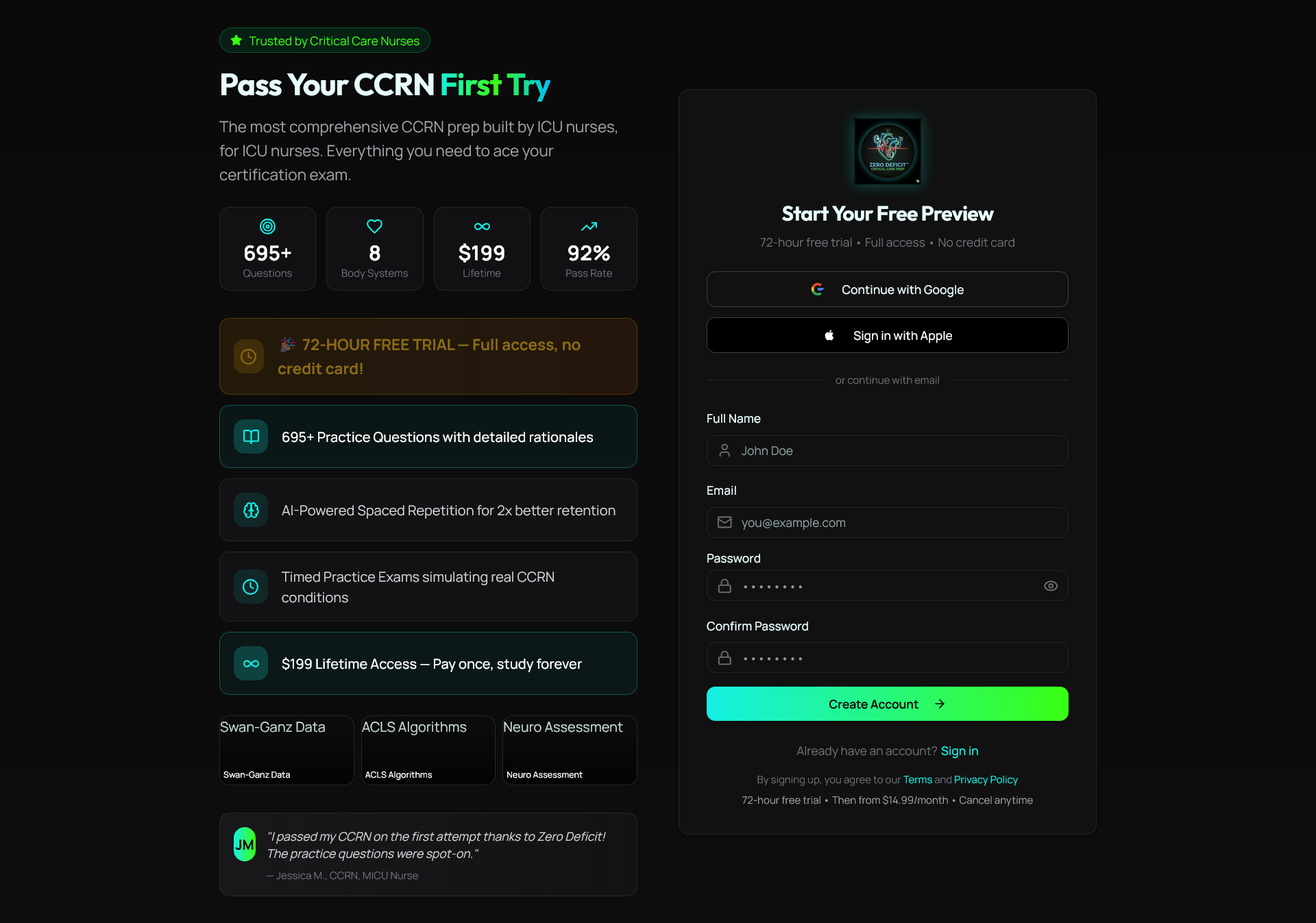
The platform tracks your performance across all eight body systems, surfaces the specific topics where your accuracy is lowest, and connects you directly to the content that closes those gaps. The question breakdown methods at Zerodeficitccrnprep teach you how to analyze CCRN-style questions systematically, so you’re not just memorizing answers but building the clinical reasoning skills the exam tests. Pair that with the CCRN study guides covering all eight body systems and over 695 practice questions, and you have a data-driven prep system built specifically for critical care certification. Start studying free at Zero Deficit CCRN Prep today, no credit card required.
FAQ
What is the role of study analytics for nurses?
Study analytics measures and analyzes learner performance data to identify knowledge gaps and guide targeted study. For nurses, it converts practice test results into specific, prioritized study recommendations rather than generic score reports.
How does study analytics work in CCRN exam prep?
Analytics platforms collect data from practice questions and quizzes, then apply descriptive, diagnostic, predictive, and prescriptive analysis to generate personalized next steps. The prescriptive layer, which tells you what to study next, produces the greatest improvement in exam readiness.
Why is strong guidance important in study analytics?
Research shows that analytics paired with personalized, actionable guidance produces measurable gains in self-regulated learning and academic performance, while data presented without guidance does not improve outcomes.
What tools use study analytics in nursing education?
Elsevier’s HESI Personalized Learning Plan uses real-time AI-powered analytics for nursing exam prep. Zerodeficitccrnprep applies performance tracking and body-system-level analytics to CCRN preparation specifically.
Can study analytics reduce CCRN exam anxiety?
Yes. When you know exactly which topics need work and have a clear plan to address them, unfocused anxiety is replaced by directed effort. Analytics give you a measurable picture of your progress, which builds confidence as your accuracy improves over time.
Recommended
- Why assessment matters: Boost CCRN exam success | Zero Deficit CCRN Prep
- How to track CCRN progress: a critical care nurse’s guide | Zero Deficit CCRN Prep
- How educators boost CCRN certification success for nurses | Zero Deficit CCRN Prep
- Pass the CCRN Exam: Proven Guide for Critical Care Nurses | Zero Deficit CCRN Prep
Take a Respiratory practice quiz
Master ARDS, ventilation, ABGs, oxygenation, and pulmonary emergencies.
Ready to pass your CCRN?
Join 12,000+ nurses using Zero Deficit — 695+ practice questions with rationales, AI-powered weak-area drilling, and spaced-repetition flashcards.
Start Free Trial →