Master Trauma DCR With 695 CCRN Practice Questions

For CCRN candidates, the core trauma resuscitation principle to master is damage-control resuscitation (DCR): early hemorrhage control, permissive hypotension (except in traumatic brain injury), and balanced blood-product resuscitation. This framework anchors nearly every trauma question you’ll see on the Adult CCRN exam. The clinical evidence behind it comes from AACN, SCCM, and AAST/ACS guidance, and mastering it means pairing that evidence with deliberate practice, which is exactly what Zero Deficit™ CCRN Exam Prep is built for.
TL;DR:
- Early activation of massive transfusion protocol is crucial once a trauma patient shows signs of persistent or worsening response to initial fluid resuscitation, reducing mortality risk.
- Maintaining permissive hypotension targets a systolic pressure of 90 to 100 mmHg for most patients, with higher pressures required if traumatic brain injury is suspected.
- Blood product resuscitation should follow a 1:1:1 ratio of packed red blood cells, plasma, and platelets, with whole blood as an alternative where available.
- Lactate clearance and the resolution of metabolic acidosis are more reliable predictors of patient stability than blood pressure alone.
- Trauma questions on the exam are system-based, requiring integrated knowledge of shock, pulmonary, and multisystem management rather than isolated trauma content.
Table of Contents
- Trauma Resuscitation CCRN Basics: DCR and the ABCDE Survey
- Recognizing Hemorrhagic Shock and Activating MTP
- Airway, Ventilation, and Chest Trauma Management
- Monitoring, End Points, and Common Resuscitation Pitfalls
- Mapping This Content to Your CCRN Study Plan
- What Actually Separates a Pass From a Retake
- Study Trauma Resuscitation With Zero Deficit™ CCRN Exam Prep
- Sources
- FAQ
Trauma Resuscitation CCRN Basics: DCR and the ABCDE Survey
Damage-control resuscitation exists to interrupt one deadly cycle before it starts. Uncontrolled bleeding drives coagulopathy, acidosis, and hypothermia, and each of those three worsens the other two. Once a trauma patient is caught in this lethal triad, survival odds drop fast. That’s why DCR front-loads three moves: stop the bleeding early, tolerate a lower blood pressure than you normally would, and replace blood with blood, not liters of clear fluid.
Statistic callout: Meta-analyses and guideline reviews consistently link balanced blood-product resuscitation and early massive transfusion protocol implementation to reduced mortality in hemorrhagic trauma. The CCRN wants you to know why that pattern holds, not just that it does.
The primary survey still runs on ABCDE, and the exam tests your ability to sequence interventions under pressure, not just recite the letters.
- Airway: Assess patency first; a patient who can’t protect their airway needs intervention before anything else, including a hemorrhage that looks more dramatic.
- Breathing: Check for symmetric rise, breath sounds, and immediate life threats like tension pneumothorax.
- Circulation: Control external hemorrhage, establish access, and start thinking about blood products before your patient decompensates.
- Disability: A quick neuro check (GCS, pupils) tells you whether a brain injury changes your resuscitation targets.
- Exposure: Fully undress the patient to find the injury you’d otherwise miss, while preventing hypothermia.
For vascular access, FCCS guidance supports two large-bore IVs, 18-gauge minimum, with warmed isotonic crystalloid limited to roughly 1 liter given empirically. If your patient doesn’t respond, the next step is blood, not another liter of saline. Permissive hypotension targets a systolic pressure of 90 to 100 mmHg in most trauma patients, but that number flips for suspected TBI, where you maintain a higher pressure to protect cerebral perfusion. Know that exception cold. It’s a favorite CCRN twist.
Recognizing Hemorrhagic Shock and Activating MTP
Advanced hemorrhage presents with tachycardia, narrowing pulse pressure, altered mental status, and falling urine output. How your patient responses to an initial fluid challenge tells you what to do next, and this is where FCCS response categories become essential exam vocabulary.
- Rapid responder: Vitals normalize and stay normal. Ongoing blood loss is unlikely to be the driver.
- Transient responder: Vitals improve, then slide back. This patient is still bleeding and needs escalation, not more crystalloid.
- Non-responder: No improvement at all. This is a surgical or interventional radiology emergency, not a fluid problem.
Massive transfusion protocol activation shouldn’t wait for a transient responder to become a non-responder. The AAST/ACS damage-control resuscitation protocol notes that each minute of delay in MTP activation raises mortality risk, which is why early recognition matters more than perfect diagnostic certainty.
Ratio-based resuscitation, generally 1:1:1 packed red blood cells to plasma to platelets, or increasingly whole blood where available, is the practical application of the PROPPR trial findings behind balanced transfusion. Once MTP is running, your nursing priorities shift fast.
Pro Tip: Citrate in stored blood products binds calcium, so hypocalcemia during massive transfusion is common and often overlooked. Check ionized calcium proactively and expect to give IV calcium, not just react to a low number on a chemistry panel.
- Keep blood products warmed; a hypothermic patient can’t clot no matter how much plasma you give.
- Track strict input and output, including every unit and every milliliter of fluid.
- Document transfusion timing precisely. MTP audits and CCRN case questions both hinge on sequence.
Airway, Ventilation, and Chest Trauma Management
Trauma patients often need rapid sequence intubation for airway protection, impending respiratory failure, or a rapidly deteriorating GCS. Once the tube is in, confirmation and setup matter as much as the intubation itself.
- Confirm placement immediately with continuous ETCO2 waveform capnography, then verify with a chest X-ray.
- Sedate appropriately to prevent self-extubation and blunt the stress response without masking a worsening neuro exam.
- Choose ventilator settings with ARDS risk in mind. Trauma patients are prone to post-injury ARDS, so lung-protective tidal volumes (roughly 4 to 8 mL/kg ideal body weight) and readiness to consider proning apply here just as they do in medical ARDS, a connection the CCRN blueprint tests directly.
- Watch chest tube output closely. An immediate drainage of more than 1,500 mL, or ongoing losses exceeding 200 mL per hour over several hours, signals a likely thoracotomy candidate. Autotransfusion setups may be used where your unit has the capability.
- Reassess how thoracic injury changes your resuscitation math. A hemothorax bleeding into the pleural space is still hemorrhage, and it factors into your MTP decision the same way external bleeding does.
Monitoring, End Points, and Common Resuscitation Pitfalls
Normal vital signs can lie to you. A trauma patient can compensate hard enough to look stable while still bleeding internally, which is why the CCRN leans heavily on lactate and base deficit as objective end points rather than trusting blood pressure alone.
Statistic callout: FCCS trauma guidance identifies lactate clearance and resolution of metabolic acidosis as more reliable predictors of survival than vital sign normalization alone. If lactate isn’t trending down, resuscitation isn’t finished, no matter how the monitor looks.
Mean arterial pressure, pulse pressure, and urine output all give you useful information, but each has blind spots. A young trauma patient can maintain a near-normal MAP right up until sudden decompensation. Track trends, not single readings.
Watch for these recurring pitfalls:
- Giving excess crystalloid instead of escalating to blood products, which worsens dilutional coagulopathy.
- Failing to actively rewarm, which perpetuates the lethal triad even after bleeding slows.
- Delaying blood product administration while waiting for lab confirmation of what your bedside assessment already told you.
Mapping This Content to Your CCRN Study Plan
The AACN blueprint doesn’t file trauma under one neat category. It shows up woven through cardiovascular, pulmonary, and multisystem clinical judgment items, so studying it in isolation leaves gaps. Build your review around how trauma content actually appears on the exam.
- Study by system, not by diagnosis. Pull trauma-related hemodynamic questions into your shock review and trauma ventilator questions into your ARDS review, since that’s how the blueprint actually tests them.
- Memorize normal ranges cold. Lactate under 2 mmol/L, base deficit within 0 to negative 2, and urine output above 0.5 mL/kg/hr are the numbers you need instantly, not after a minute of hesitation.
- Drill algorithm application, not recall. Practice deciding the next immediate step after a transient responder, not just defining the term. That kind of applied judgment is what separates a pass from a retake.
- Use targeted question sets. Zero Deficit’s shock and hemorrhage question blocks pair each item with a full rationale, and the platform’s step-by-step question breakdown method walks you through exactly why an answer is right or wrong.
- Build a short daily rhythm. Fifteen to twenty focused questions, one topic review, and a rationale debrief beats an occasional marathon study session every time.
What Actually Separates a Pass From a Retake
Know your numbers cold: permissive hypotension targets, MTP activation triggers, and how to read lactate as a trend rather than a single value. These aren’t trivia. They’re the same judgment calls you make on shift, just compressed into a four-answer question. Your bedside experience matters more than which unit’s name is on your badge. The CCRN tests acuity-based judgment, and time spent managing real hemorrhagic shock builds that judgment faster than any flashcard deck. Convert what you already know into exam-ready pattern recognition by working questions methodically and reading every rationale, even the ones you got right.
— Zero
Study Trauma Resuscitation With Zero Deficit™ CCRN Exam Prep
Textbooks explain DCR in theory. Zero Deficit™ CCRN Exam Prep turns it into the applied judgment the exam actually tests, with over 695 practice questions and detailed rationales written by ICU nurses who’ve managed these patients firsthand.
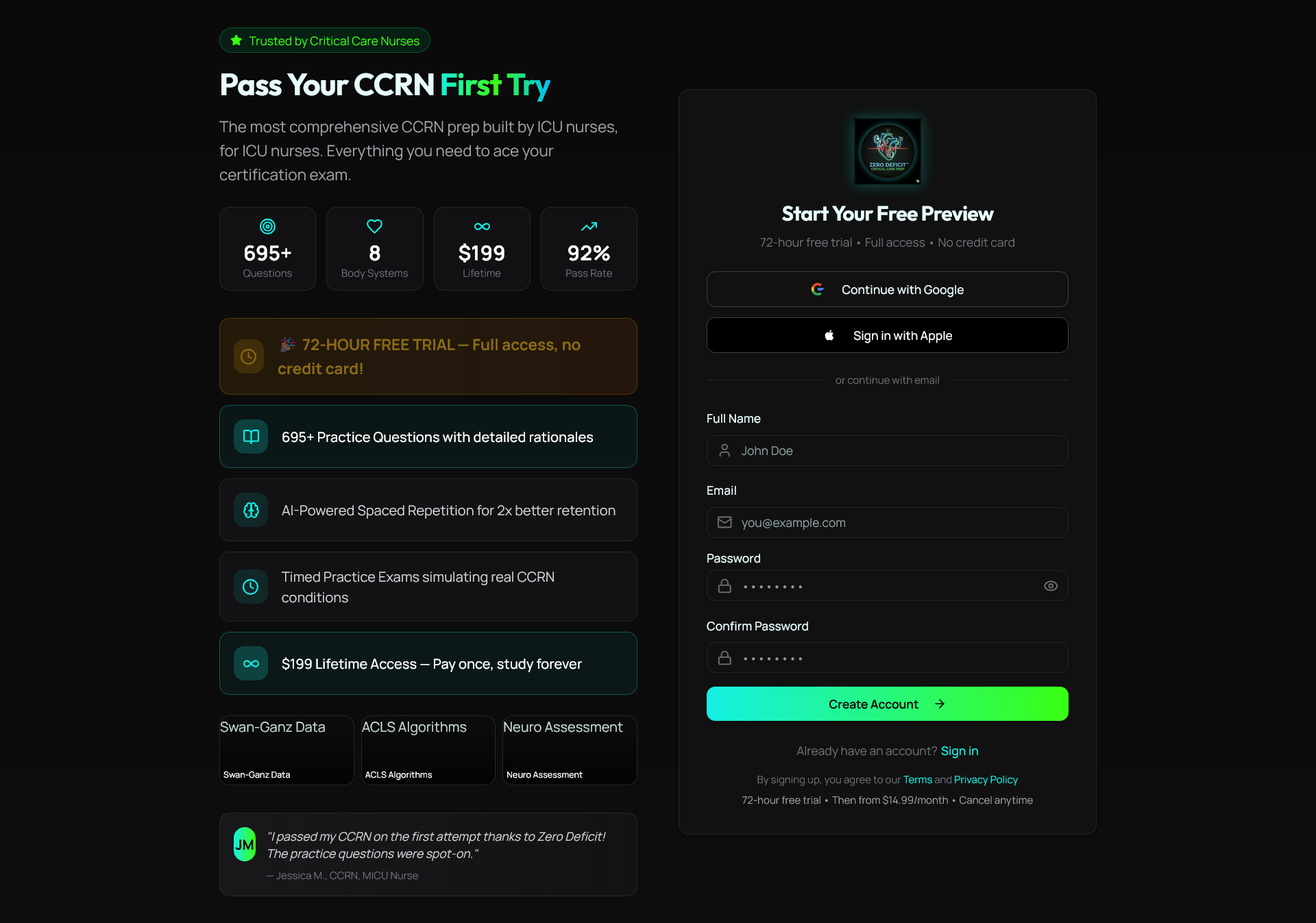
Trauma content on the CCRN rarely shows up as an isolated topic. It’s buried inside shock, pulmonary, and multisystem judgment questions, which is exactly why Zero Deficit organizes practice around system-based topic guides and dedicated high-yield hemorrhage and shock question sets. The platform’s AI-powered review adapts to the gaps you actually have, whether that’s MTP triggers, permissive hypotension exceptions, or lactate interpretation, so your study time goes where you need it most.
If you’re ready to see how these concepts show up in exam-style questions, start with the CCRN practice questions or check plan options on the subscription page for current pricing details.

Sources
For deeper study, review the AAST/ACS damage-control resuscitation protocol, SCCM’s FCCS trauma and burn support guidance, and AACN’s CCRN Adult certification eligibility page.
This article is general information, not a substitute for advice from a qualified doctor. Consult a qualified healthcare professional about your own circumstances before acting on anything here.
- Damage-control resuscitation evidence summary (PMC7141982)
- FCCS Basic Trauma and Burn Support (SCCM)
FAQ
What Is Damage-Control Resuscitation in Trauma?
Damage-control resuscitation is an approach that prioritizes early hemorrhage control, permissive hypotension, and balanced blood-product transfusion over large-volume crystalloid. It’s designed to prevent the lethal triad of coagulopathy, acidosis, and hypothermia, and it’s the core evidence-based framework behind current trauma guidelines.
What Blood Pressure Target Defines Permissive Hypotension?
Most non-TBI trauma patients are managed toward a systolic blood pressure of 90 to 100 mmHg until bleeding is controlled. Patients with suspected traumatic brain injury are the exception, since they need a higher pressure to preserve cerebral perfusion.
When Should a Nurse Expect Massive Transfusion Protocol Activation?
MTP activation should happen early in transient responders or non-responders to initial fluid challenge, not after repeated crystalloid boluses fail. Guideline data shows that delays in MTP activation increase mortality risk, so early recognition matters more than diagnostic certainty.
How Does the CCRN Exam Test Trauma Content?
Trauma isn’t a standalone domain on the AACN blueprint. It’s tested through cardiovascular, pulmonary, and multisystem clinical judgment questions, so effective study means reviewing trauma physiology within those system categories rather than in isolation.
Does Zero Deficit Cover Trauma and Shock Topics?
Yes. Zero Deficit™ CCRN Exam Prep includes dedicated shock and hemorrhage question sets with detailed rationales, part of its library of over 695 practice questions across all CCRN blueprint domains. Current plan pricing is available on the subscription page.
Recommended
Take a Multisystem practice quiz
Master sepsis, shock, MODS, and multi-organ failure scenarios.
Get Your Free 20-Question CCRN Diagnostic
20 high-yield CCRN-style questions across every body system, with detailed rationales — emailed to you instantly.
No spam. One email + a couple of helpful follow-ups. Unsubscribe anytime.
Ready to pass your CCRN?
Join 12,000+ nurses using Zero Deficit — 695+ practice questions with rationales, AI-powered weak-area drilling, and spaced-repetition flashcards.
Start Free Trial →