What Is Critical Thinking in Nursing? A Clinical Guide
TL;DR:
- Critical thinking in nursing is a self-regulatory, disciplined reasoning process crucial for patient safety and clinical judgment. It involves analyzing, evaluating, and inferring from data, distinct from evidence-based decision-making, and is best developed through simulation, reflection, and targeted practice. Mastery of these skills improves both exam performance and real-world patient outcomes.
Critical thinking in nursing is defined by the American Nurses Association as a self-regulatory, disciplined process/06%3A_Comprehensive_Health_Assessment_and_Physical_Examination/6.01%3A_Critical_Thinking_in_Assessment) of clinical problem identification, solution selection, and outcome evaluation. It is not intuition, and it is not checklist adherence. It is the structured reasoning that separates a nurse who notices a patient deteriorating from one who simply documents vital signs. For nursing students and ICU nurses preparing for the CCRN exam, understanding what critical thinking in nursing actually means, and how to build it deliberately, is the foundation of both safe practice and certification success.
What is critical thinking in nursing, exactly?
Critical thinking in nursing is the intellectually disciplined application of logical reasoning and clinical judgment to patient care problems. The American Nurses Association frames it as a continuous loop: assess, identify the problem, select the best response, implement, and evaluate. That loop never stops, and it operates differently from clinical decision-making, which focuses specifically on evidence-based treatment planning.

A 2025 systematic review clarifies this distinction directly. Critical thinking is the logical reasoning process. Clinical decision-making is the evidence-based action that follows. Both are required in the ICU, but confusing them leads to gaps in nursing education and assessment. A nurse who can recite sepsis bundle components but cannot reason through why a patient’s lactate is trending up despite fluids is demonstrating clinical knowledge without critical thinking.
The nursing literature also acknowledges that no universally accepted definition of critical thinking exists across all specialties. This is not a weakness in the concept. It is a signal that critical thinking is context-dependent, and that specific behaviors like interpretation, prioritization, and reflection are more useful targets than a single abstract score. For CCRN candidates, this means your goal is not to “think critically” in the abstract. Your goal is to practice specific reasoning behaviors under clinical pressure.
What are the core critical thinking skills in nursing?
Critical thinking skills in nursing fall into two categories: cognitive skills and intellectual dispositions. Both are trainable, and both show up directly in CCRN exam questions.
Cognitive skills include:
- Analysis: Breaking down complex clinical data into components. Example: separating a patient’s respiratory distress into oxygenation failure versus ventilation failure using ABG values.
- Evaluation: Judging the credibility and relevance of clinical information. Example: weighing a SpO2 reading against a patient’s skin perfusion and mental status before acting.
- Inference: Drawing conclusions from incomplete data. Example: recognizing early sepsis before the full SIRS criteria are met.
- Explanation: Articulating your clinical reasoning to the team. Example: presenting your assessment of a hemodynamic change to the intensivist with clear cause-and-effect logic.
- Self-regulation: Reviewing your own reasoning for bias or error. Example: asking yourself whether you anchored on the first diagnosis and missed new data.
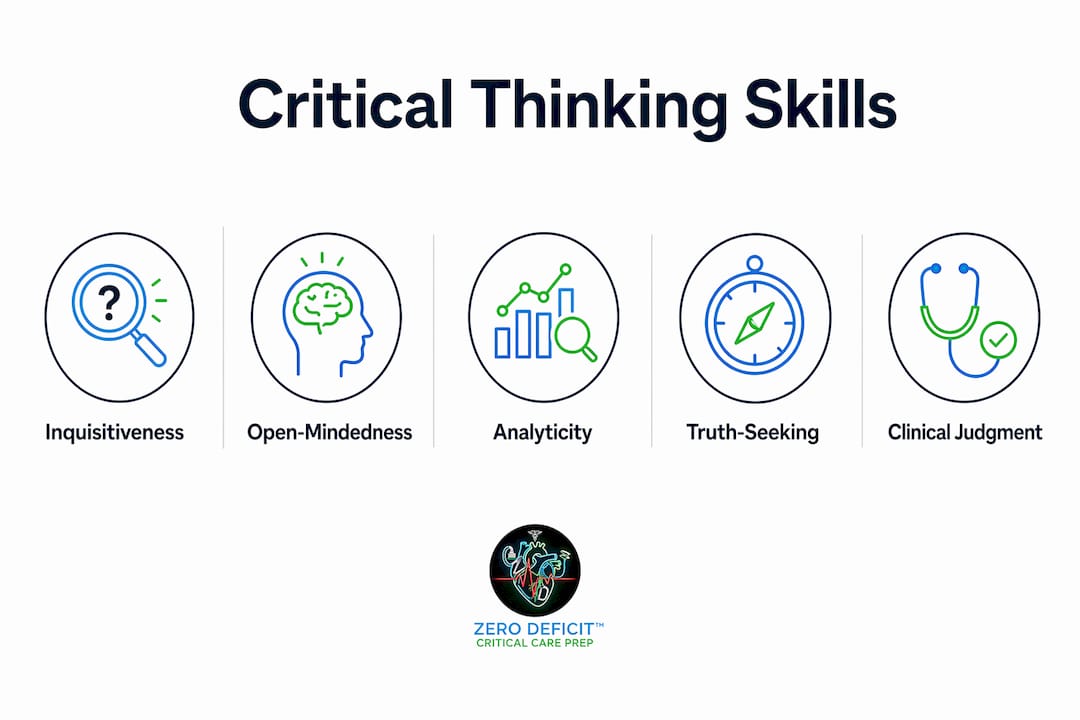
Intellectual dispositions include inquisitiveness, open-mindedness, analyticity, and a drive toward truth-seeking. These are not personality traits you either have or lack. They are habits you build through deliberate practice.
Two frameworks organize these skills for clinical use. Rosalinda Alfaro-LeFevre’s 4-Circle Critical Thinking Model places the nurse’s knowledge, experience, competencies, and personal characteristics at the center of clinical reasoning. The AACN’s Clinical Judgment Measurement Model, used in the Next Generation NCLEX and increasingly referenced in critical care education, maps clinical judgment across six cognitive processes: recognize cues, analyze cues, prioritize hypotheses, generate solutions, take action, and evaluate outcomes.
Pro Tip: When you review a CCRN practice question, identify which of the six Clinical Judgment Measurement Model steps the question is testing. This turns passive review into active reasoning practice.
| Skill | Clinical application |
|---|---|
| Analysis | Separating oxygenation from ventilation failure using ABGs |
| Inference | Recognizing early sepsis before full SIRS criteria appear |
| Self-regulation | Checking your reasoning for anchoring bias after a diagnosis is made |
| Evaluation | Weighing conflicting data points before acting on a single value |
How is critical thinking assessed and developed in nursing education?
Assessment of critical thinking in nursing has moved away from global scoring toward specific, observable behaviors. The Nursing Critical Thinking in Clinical Practice Questionnaire is one of the most psychometrically sound tools available, with a Cronbach’s alpha of approximately 0.96. That level of internal consistency means the instrument reliably measures what it claims to measure across clinical nurses and educators. Reliable measurement matters because you cannot improve what you cannot accurately assess.
Common assessment methods used in nursing education include self-assessment surveys, structured case studies, direct clinical observation, and reflective journaling. Each method targets different aspects of reasoning. Case studies test inference and prioritization. Direct observation captures real-time decision-making under pressure. Reflective journaling builds the self-regulation habit that separates good nurses from great ones.
Simulation-based learning is the most powerful educational tool for developing critical thinking at scale. A 2025 scoping review found that computer simulations, human-patient simulators, and virtual reality environments all improve nursing students’ critical thinking when paired with realistic scenarios and structured debriefing. Realism and feedback are the two non-negotiable design elements. A simulation without debriefing is just practice. A simulation with structured debriefing is learning.
Barriers to critical thinking development in clinical training include time pressure, hierarchical team cultures that discourage questioning, and inconsistent feedback from preceptors. Enablers include psychological safety, access to varied patient scenarios, and mentors who model reasoning out loud. Research shows that critical thinking disposition correlates significantly with nurses’ training needs (r = 0.358, p < 0.01 in a sample of 370 nurses), meaning nurses who score higher on critical thinking disposition also recognize more clearly where their knowledge gaps are. That self-awareness is itself a critical thinking skill.
Pro Tip: After each shift, write two sentences: what clinical decision you made and what reasoning led you there. This micro-reflection habit builds the self-regulation component of critical thinking faster than any formal course.
Why is critical thinking important in adult critical care nursing?
Critical thinking is the mechanism by which ICU nurses convert raw data into patient safety. In a unit where a patient’s status can shift from stable to critical within minutes, the ability to reason through conflicting signals is not a soft skill. It is a clinical competency with direct mortality implications.
Consider three common ICU scenarios where critical thinking determines outcomes:
- Hemodynamic interpretation: A patient’s MAP drops to 58 mmHg post-cardiac surgery. The nurse who applies critical thinking does not immediately reach for a vasopressor. She analyzes preload (CVP, fluid responsiveness), afterload, and contractility before acting. The nurse who skips that reasoning step may worsen the patient’s condition by treating the wrong problem.
- Sepsis recognition: Early sepsis often presents without the full SIRS picture. Critical thinking allows a nurse to integrate physical, emotional, and environmental data/06%3A_Comprehensive_Health_Assessment_and_Physical_Examination/6.01%3A_Critical_Thinking_in_Assessment) including subtle behavioral changes, skin perfusion, and urine output trends to recognize sepsis before lactate confirms it.
- Ventilator management: A patient on volume control ventilation develops rising peak pressures. Critical thinking drives the nurse to distinguish between increased airway resistance (bronchospasm, secretions) and decreased compliance (pneumothorax, worsening ARDS) before calling the respiratory therapist with a specific, reasoned concern.
Experienced nurses apply critical thinking as a transition from data collection to problem identification/06%3A_Comprehensive_Health_Assessment_and_Physical_Examination/6.01%3A_Critical_Thinking_in_Assessment). They do not just gather information. They move quickly to what the information means for patient safety. That transition is exactly what the CCRN exam tests, and it is exactly what your patients need at the bedside.
How to improve critical thinking in nursing: strategies that work
Improving critical thinking is a deliberate process, not a passive one. These strategies are grounded in current evidence and directly applicable to both bedside practice and CCRN exam preparation.
-
Practice reflective debriefing after clinical simulations. Structured reflection paired with simulation training is the most evidence-supported method for consolidating critical thinking into reliable clinical judgment. The debriefing component forces you to justify your reasoning, which reinforces correct reasoning patterns and exposes flawed ones.
-
Use case discussions with peers and mentors. Interprofessional case review exposes you to reasoning frameworks you would not develop alone. When a pharmacist explains why a drug interaction changes your hemodynamic management plan, you build inference skills that transfer to the next novel patient scenario.
-
Align your study to your specific knowledge gaps. Research confirms that training aligned to individual needs is more effective than generic review. Use study analytics to identify which body systems or clinical concepts you consistently miss, then target those areas with focused case study review.
-
Work through CCRN practice questions with rationale review. Practice questions are not just memorization tools. When you read the rationale for a wrong answer, you are practicing the evaluation and inference steps of critical thinking. The question breakdown method used in structured CCRN prep teaches you to identify what the question is actually asking before selecting an answer, which is a direct application of analytical reasoning.
-
Seek mentorship from experienced ICU nurses. Nurses who verbalize their reasoning at the bedside model the cognitive process you are trying to build. Ask your preceptor to think out loud during complex patient situations. That narrated reasoning is a master class in applied critical thinking.
-
Read nursing career advancement resources that frame critical thinking as a long-term professional competency, not just an exam skill. Understanding how nursing career pathways reward clinical reasoning ability reinforces the motivation to build this skill continuously.
Pro Tip: When you get a CCRN practice question wrong, do not just read the correct answer. Write out why your reasoning led you to the wrong choice. That written analysis is the self-regulation step that accelerates critical thinking development.
Key takeaways
Critical thinking in nursing is a trainable, disciplined reasoning process that directly determines the quality of clinical decisions and patient safety outcomes in every care setting.
| Point | Details |
|---|---|
| Core definition | Critical thinking is a self-regulatory reasoning process, not intuition or checklist adherence. |
| Distinct from clinical decision-making | Critical thinking is the logical reasoning step; clinical decision-making is the evidence-based action that follows. |
| Measurable and teachable | Tools like the Nursing Critical Thinking in Clinical Practice Questionnaire reliably assess specific CT behaviors. |
| Simulation plus debriefing works | Structured reflection after simulation is the strongest evidence-based method for building clinical judgment. |
| CCRN relevance | The CCRN exam directly tests critical thinking behaviors including inference, prioritization, and evaluation. |
What I’ve learned about critical thinking after years in critical care
Most nurses I talk to think of critical thinking as something you either have or you develop over years of bedside experience. I used to believe that too. What I’ve learned is that experience alone does not build critical thinking. Reflected experience does.
I’ve watched nurses with ten years in the ICU miss early sepsis because they anchored on a familiar presentation. I’ve also watched second-year nurses catch a subtle hemodynamic shift because they had been trained to reason through data systematically, not just recognize patterns. The difference was not time on the unit. The difference was whether they had been taught to question their own reasoning.
For CCRN candidates, this matters more than most people realize. The exam is not testing what you know. It is testing how you reason under uncertainty. A question about a patient with worsening ARDS and rising plateau pressures is not asking you to recall a fact. It is asking you to work through a clinical problem in real time. That is critical thinking, and it is a skill you can build before you sit for the exam.
The nurses who pass the CCRN on their first attempt are not always the most experienced. They are the ones who have practiced reasoning, not just reviewing. Use assessment-focused study to identify your weak points, then target them with deliberate practice. That is the approach that works.
— Zero
Sharpen your clinical reasoning with Zero Deficit CCRN Prep
Zero Deficit™ CCRN Prep is built specifically for ICU nurses who want to pass the CCRN on their first attempt by developing real clinical reasoning, not just memorizing facts. The platform’s practice tests and quizzes are designed to mirror the decision-making demands of the actual AACN exam, placing you in scenario-based questions that require inference, prioritization, and evaluation. Every question includes a detailed rationale that explains the reasoning behind the correct answer, turning each review session into a critical thinking exercise. The CCRN study guides cover all eight body systems with the depth your patients and your exam require. Start studying free at Zero Deficit CCRN Prep today, no credit card required.
FAQ
What is the clinical definition of critical thinking in nursing?
Critical thinking in nursing is a self-regulatory, intellectually disciplined process of clinical problem identification, solution selection, and outcome evaluation, as defined by the American Nurses Association. It operates as a continuous reasoning loop distinct from simple pattern recognition or checklist adherence.
How does critical thinking differ from clinical decision-making?
Critical thinking is the logical reasoning process used to analyze and interpret clinical data, while clinical decision-making is the evidence-based action that follows that reasoning. A 2025 systematic review confirms these are related but distinct competencies that require separate educational focus.
What are the most effective ways to improve critical thinking as a nurse?
Structured simulation with debriefing, reflective journaling after clinical events, and targeted practice question review with rationale analysis are the three most evidence-supported methods. Training aligned to your individual knowledge gaps produces faster gains than generic review.
How is critical thinking tested on the CCRN exam?
The CCRN exam tests critical thinking through scenario-based questions that require you to analyze clinical data, prioritize patient problems, and select evidence-based interventions. Questions aligned with the AACN’s Clinical Judgment Measurement Model assess inference, evaluation, and self-regulation under time pressure.
Can critical thinking in nursing be measured reliably?
Yes. The Nursing Critical Thinking in Clinical Practice Questionnaire demonstrates a Cronbach’s alpha of approximately 0.96, indicating high reliability and internal consistency. Assessment experts recommend measuring specific behaviors like cue interpretation and prioritization rather than a single abstract critical thinking score.
Recommended
- The Role of Study Analytics for Nurses in CCRN Prep | Zero Deficit CCRN Prep
- Why assessment matters: Boost CCRN exam success | Zero Deficit CCRN Prep
- Pass the CCRN Exam: Proven Guide for Critical Care Nurses | Zero Deficit CCRN Prep
- Top CCRN study topics to master for exam success | Zero Deficit CCRN Prep
Take a Respiratory practice quiz
Master ARDS, ventilation, ABGs, oxygenation, and pulmonary emergencies.
Ready to pass your CCRN?
Join 12,000+ nurses using Zero Deficit — 695+ practice questions with rationales, AI-powered weak-area drilling, and spaced-repetition flashcards.
Start Free Trial →