What Is Evidence-Based Prep for CCRN Certification?
TL;DR:
- Evidence-based prep uses validated learning strategies like spaced repetition and active recall to improve retention and exam performance. It emphasizes personalized study plans, continual evaluation, and avoiding passive review methods that weaken memory. This approach helps nurses prepare effectively for the CCRN exam by focusing on clinical reasoning and durable learning practices.
Evidence-based prep is the deliberate use of learning strategies validated by rigorous empirical research to maximize retention and exam performance. For critical care nurses preparing for the AACN Adult CCRN exam, this approach replaces guesswork and habit with methods that cognitive science has proven to work. The difference between passing on your first attempt and retaking the exam often comes down to how you study, not just how long. Frameworks like the Evidence-Based Behavioral Practice (EBBP) model and techniques like spaced repetition and active recall form the foundation of this approach. Understanding what is evidence-based prep gives you a clear advantage before you open a single study guide.
What does evidence-based prep look like in nursing certification?
Evidence-based preparation is defined as studying with methods that rigorous research validates, not methods that feel comfortable or familiar. That distinction matters because most nurses default to rereading notes or highlighting text. Both are cognitively passive and produce weak long-term retention.
The two techniques with the strongest evidence behind them are spaced practice and retrieval practice.
- Spaced practice means distributing your study sessions across days and weeks rather than concentrating them before the exam. Your brain consolidates memory during the gaps between sessions, not during the sessions themselves.
- Retrieval practice means actively pulling information from memory, through practice questions, flashcards, or self-quizzing, rather than re-exposing yourself to the material passively.
- Instructional coherence means aligning every study topic with the AACN CCRN exam blueprint cognitive demands. You study cardiovascular hemodynamics at the application level because that is what the exam tests, not because it appears first in a textbook.
- Avoiding passive review means cutting out rereading, re-watching lectures, and highlighting as primary methods. These feel productive but do not build the retrieval strength you need under exam pressure.
Pro Tip: Build a 10–12 week study calendar before you read a single page. Assign specific AACN blueprint topics to each week, schedule two to three short retrieval sessions per topic, and leave the final two weeks for full-length practice tests. Structure prevents the drift toward passive review.
Effective test prep builds durable learning over months, not days. Nurses who treat CCRN prep as a sprint almost always struggle with the depth of reasoning the exam requires.

How does the EBBP framework guide your prep decisions?
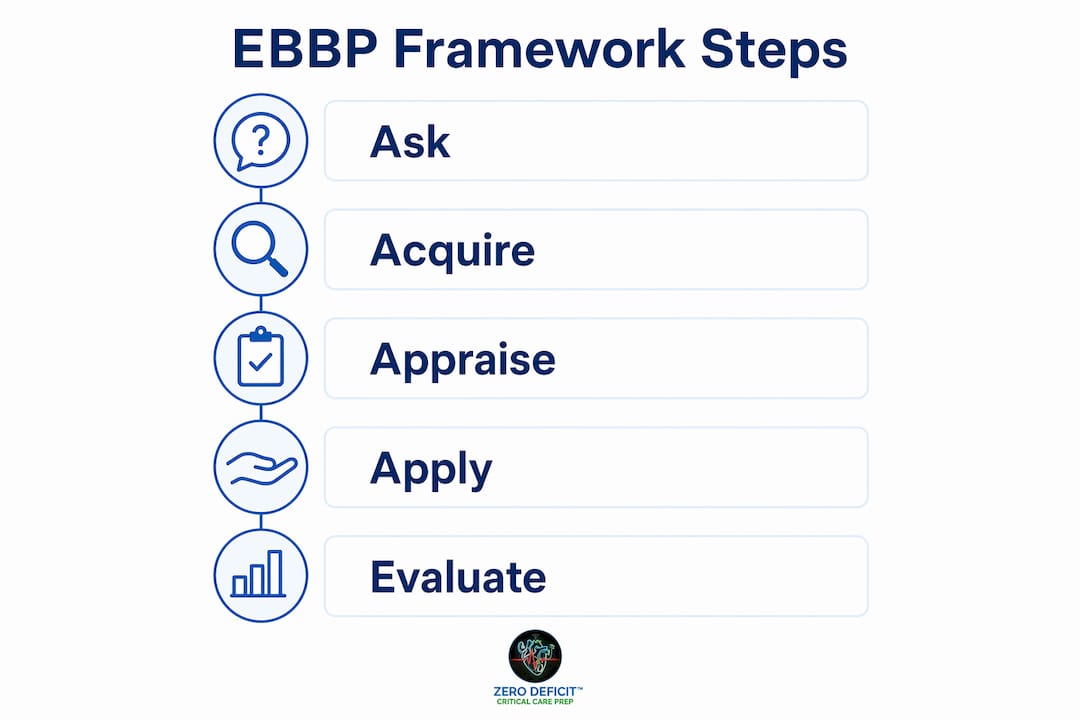
The Evidence-Based Behavioral Practice (EBBP) framework is a five-step iterative process that integrates research evidence with clinical expertise and your personal learning context. It was developed for clinical decision-making, but its logic applies directly to exam preparation. The EBBP process prevents you from following generic advice that does not fit your schedule, learning style, or knowledge gaps.
| EBBP Step | What it means for CCRN prep |
|---|---|
| Ask | Identify your specific knowledge gap. “I consistently miss sepsis questions” is a better question than “How do I study?” |
| Acquire | Gather evidence on the best study methods for that gap. Spaced repetition works for factual recall; case-based practice works for clinical reasoning. |
| Appraise | Evaluate whether the method fits your schedule and learning preferences. A 90-minute daily session is not realistic for a night-shift ICU nurse. |
| Apply | Implement the chosen method with a defined timeline. Commit to four weeks of spaced retrieval on pulmonary content before moving on. |
| Evaluate | Measure your progress with a practice test. If your pulmonary scores have not improved, adjust the method, not just the effort. |
The EBBP model demands that you treat your own prep as a clinical problem to solve. Evidence-based practice integrates/04%3A_Epidemiology-_The_Study_of_Disease_Injury_and_Death_in_the_Community/4.03%3A_What_Does_Evidence-Based_Practice_Mean) objective research data with professional expertise and individual context. That means your 18 months of ICU experience is a legitimate input into how you prep, not something to set aside.
The iterative nature of the framework is its most underused feature. Most nurses run through their study plan once and never adjust it. The EBBP model builds in a feedback loop. You evaluate, you adapt, and you improve.
What are the common misconceptions about test preparation?
The most damaging myth in CCRN prep is that more hours automatically produce better results. Passive review methods like rereading notes are cognitively inefficient compared to active recall and spaced repetition. Spending four hours rereading a cardiovascular chapter produces far less retention than spending 90 minutes answering practice questions on the same content.
Common misconceptions that hurt CCRN candidates:
- Cramming works. Cramming produces short-term recall that collapses under the reasoning demands of the CCRN. The exam tests application and analysis, not memorization.
- Familiarity equals knowledge. Rereading a concept until it feels familiar is not the same as being able to retrieve and apply it under pressure. Familiarity is a false signal.
- Longer sessions are better. Cognitive load research shows that retention drops sharply after 45–60 minutes of focused study. Short, frequent sessions outperform marathon reviews.
- Practice tests are just for assessment. Practice exams create desirable difficulties that strengthen neural pathways. Every question you answer is a learning event, not just a measurement.
- Studying everything equally is safe. The AACN CCRN blueprint weights cardiovascular at roughly 25% of the exam. Treating all topics equally wastes time you do not have.
Pro Tip: Cap your study sessions at 50 minutes and take a 10-minute break before starting again. This prevents cognitive overload and keeps retrieval quality high throughout the session. Set a timer. Your brain will thank you on exam day.
The shift from passive to active study feels harder at first. Retrieval practice is more mentally demanding than rereading. That difficulty is the point. The struggle to recall information is exactly what builds the memory strength you need.
How to apply evidence-based prep strategies for CCRN success
Applying evidence-based preparation to the CCRN exam requires a structured plan, not just good intentions. These steps translate the research into daily practice for a working ICU nurse.
-
Map your study topics to the AACN blueprint. Download the current AACN CCRN exam blueprint and assign study time proportionally. Cardiovascular and pulmonary together represent nearly half the exam. Start there.
-
Build a spaced repetition schedule. Review a topic on day one, then again on day three, day seven, and day 14. Spaced repetition for CCRN dramatically outperforms single-session review for complex ICU content like hemodynamic calculations and vent management.
-
Use practice questions as your primary study tool. Do not save practice tests for the end. Use them throughout your prep to identify gaps and reinforce learning. The testing effect means every question you answer strengthens future retrieval, not just your score.
-
Study at the cognitive level the exam requires. The CCRN does not ask you to define ARDS. It asks you to prioritize interventions for a patient with a PaO2/FiO2 ratio below 100. Study by applying concepts to clinical scenarios, not by memorizing definitions.
-
Evaluate your progress weekly. Run a timed practice test every week and track your scores by body system. If renal scores are not moving, apply the EBBP framework: ask a sharper question, acquire a better resource, and adjust your approach.
-
Adapt to your context. A night-shift nurse studying at 0700 after a 12-hour shift needs a different session structure than a day-shift nurse with evenings free. Context-sensitive prep is not a compromise. It is a requirement for sustainable, effective study.
Evidence-based preparation is not a rigid formula. It is a framework you apply to your specific situation, your schedule, your knowledge gaps, and your exam date.
Key takeaways
Evidence-based prep is the most reliable path to CCRN certification because it replaces ineffective habits with methods that cognitive science has proven to build durable, retrievable knowledge.
| Point | Details |
|---|---|
| Active recall beats passive review | Retrieval practice and spaced repetition build stronger memory than rereading or highlighting. |
| EBBP framework structures your decisions | Use the five-step Ask, Acquire, Appraise, Apply, Evaluate cycle to personalize your prep. |
| Cramming is counterproductive | The CCRN tests clinical reasoning, not memorization; last-minute study does not build that skill. |
| Blueprint alignment saves time | Mapping study topics to AACN exam weights focuses your effort where it earns the most points. |
| Practice tests are learning tools | Every practice question strengthens future retrieval, not just your current score. |
What I’ve learned after watching nurses prep the wrong way
Most nurses I see come into CCRN prep with the same instinct: read everything, highlight the important parts, and hope it sticks. That approach works fine for a nursing school exam. It does not work for the CCRN.
The CCRN is a clinical reasoning exam. It asks you to manage a deteriorating patient in your head, weigh competing priorities, and choose the most defensible action. You cannot memorize your way to that skill. You have to practice it repeatedly, under conditions that simulate the real thing.
The nurses who pass on their first attempt share one habit: they treat practice questions as their primary study method, not their final check. They answer questions, read every rationale, and go back to the content when they miss something. That is retrieval practice in action, and it works.
The hardest part of switching to evidence-based study methods is tolerating the discomfort of not knowing. When you answer a question and get it wrong, that feels bad. But that moment of struggle is exactly when your brain is building the pathway you need. Rereading feels better. It is also far less effective.
My honest advice: commit to the method for four weeks before you judge it. Your practice scores will tell you everything you need to know.
— Zero
How Zerodeficitccrnprep supports your evidence-based CCRN prep
Zerodeficitccrnprep was built by expert ICU nurses who understand exactly how the CCRN tests clinical reasoning. Every resource on the platform reflects the principles of evidence-based preparation, from spaced content delivery to detailed question rationales that teach, not just score.
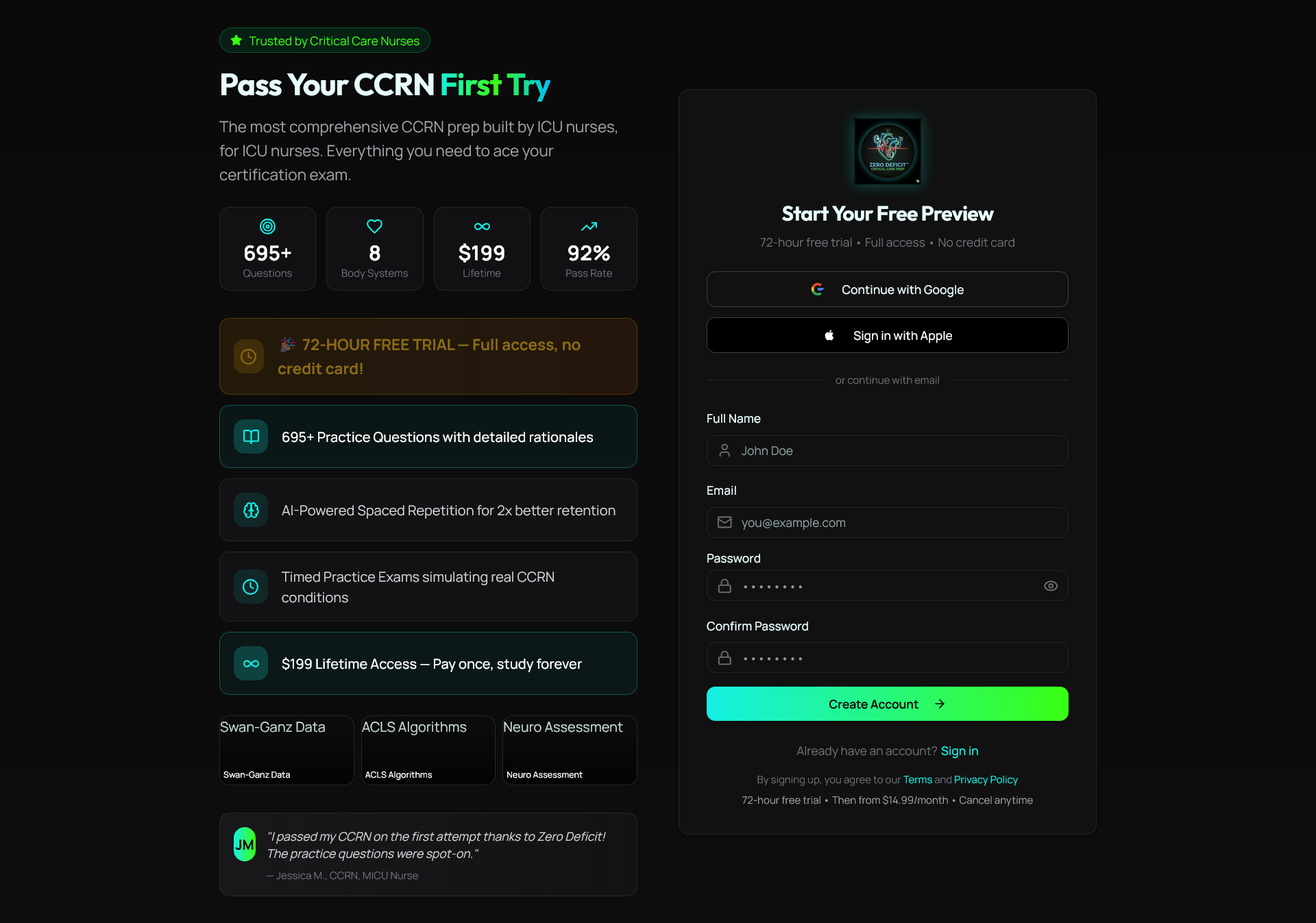
The CCRN study guides cover all eight body systems aligned to the AACN blueprint, so you study what the exam actually tests. The 695+ practice questions are designed as active learning tools, with rationales that explain the clinical reasoning behind every answer. If you are ready to prep with a method that works, start with the practice questions and let your scores guide the rest of your plan.
FAQ
What is evidence-based prep in simple terms?
Evidence-based prep is studying with methods that rigorous research has proven to improve retention and exam performance, such as spaced repetition and active recall, rather than relying on habit or intuition.
Why is retrieval practice better than rereading for the CCRN?
Retrieval practice forces your brain to reconstruct information from memory, which strengthens the neural pathways you need during the exam. Rereading creates familiarity without building the recall strength the CCRN requires.
How does the EBBP framework apply to exam prep?
The EBBP framework guides you through five steps: Ask, Acquire, Appraise, Apply, and Evaluate. Applied to CCRN prep, it means identifying your knowledge gaps, selecting the right study method, and adjusting your approach based on practice test results.
How far in advance should I start evidence-based CCRN prep?
Effective test prep builds durable learning over months, not days. A 10–12 week structured plan gives spaced repetition enough time to work and leaves room to adjust based on your progress.
Can I use evidence-based prep methods if I work night shift?
Yes. The EBBP framework explicitly requires adapting methods to your individual context and schedule. Short, frequent sessions of 45–50 minutes fit a night-shift lifestyle better than long marathon reviews and produce stronger retention.
Recommended
- How educators boost CCRN certification success for nurses | Zero Deficit CCRN Prep
- CCRN Spaced Repetition: Study Smarter for Certification | Zero Deficit CCRN Prep
- Why assessment matters: Boost CCRN exam success | Zero Deficit CCRN Prep
- What Is a Comprehensive Review? A Guide for CCRN Prep | Zero Deficit CCRN Prep
Take a Cardiovascular practice quiz
Test your mastery of hemodynamics, ACLS, MI, arrhythmias, and heart failure.
Get Your Free 20-Question CCRN Diagnostic
20 high-yield CCRN-style questions across every body system, with detailed rationales — emailed to you instantly.
No spam. One email + a couple of helpful follow-ups. Unsubscribe anytime.
Ready to pass your CCRN?
Join 12,000+ nurses using Zero Deficit — 695+ practice questions with rationales, AI-powered weak-area drilling, and spaced-repetition flashcards.
Start Free Trial →