What Is Exam Confidence for CCRN Candidates
TL;DR:
- Exam confidence involves cognitive, emotional, and behavioral readiness to perform under pressure, beyond just knowledge.
- Managing stress responses through techniques like active recall, sleep, preparation, and mindset reframing enhances exam success for ICU nurses.
You already know critical care. You’ve managed vasopressor titration at 3 a.m., recognized early septic shock before the attending called it, and kept a ARDS patient oxygenating through a vent crisis. So why does exam confidence feel like an entirely different skill set? What is exam confidence, exactly, and why do seasoned ICU nurses sometimes freeze when they sit down to take the CCRN? The answer isn’t about knowing more content. It’s about understanding the psychological and physiological machinery that governs performance under pressure, and learning to work with it instead of against it.
Table of Contents
- Key takeaways
- What exam confidence actually means
- Core strategies for building CCRN exam confidence
- Exam day mindset and body management
- Overcoming confidence barriers specific to ICU nurses
- My perspective on what actually moves the needle
- How Zerodeficitccrnprep builds your confidence from day one
- FAQ
Key takeaways
| Point | Details |
|---|---|
| Confidence goes beyond knowledge | Exam confidence includes cognitive, emotional, and behavioral readiness, not just content mastery. |
| Anxiety tanks recall | Test anxiety reduces performance by a full performance band, even in high-ability candidates. |
| Active recall beats rereading | Retrieval practice builds stronger neural pathways and prevents false confidence before the CCRN. |
| Reframe, don’t suppress anxiety | Treating pre-exam nerves as excitement preserves cognitive focus instead of draining it. |
| Mental maintenance wins the final 24 hours | Avoid new material the day before your exam to protect working memory and sharpen recall. |
What exam confidence actually means
Most nurses assume exam confidence is a byproduct of studying enough. Study hard, know the material, walk in confident. That’s a reasonable assumption. It’s also incomplete.
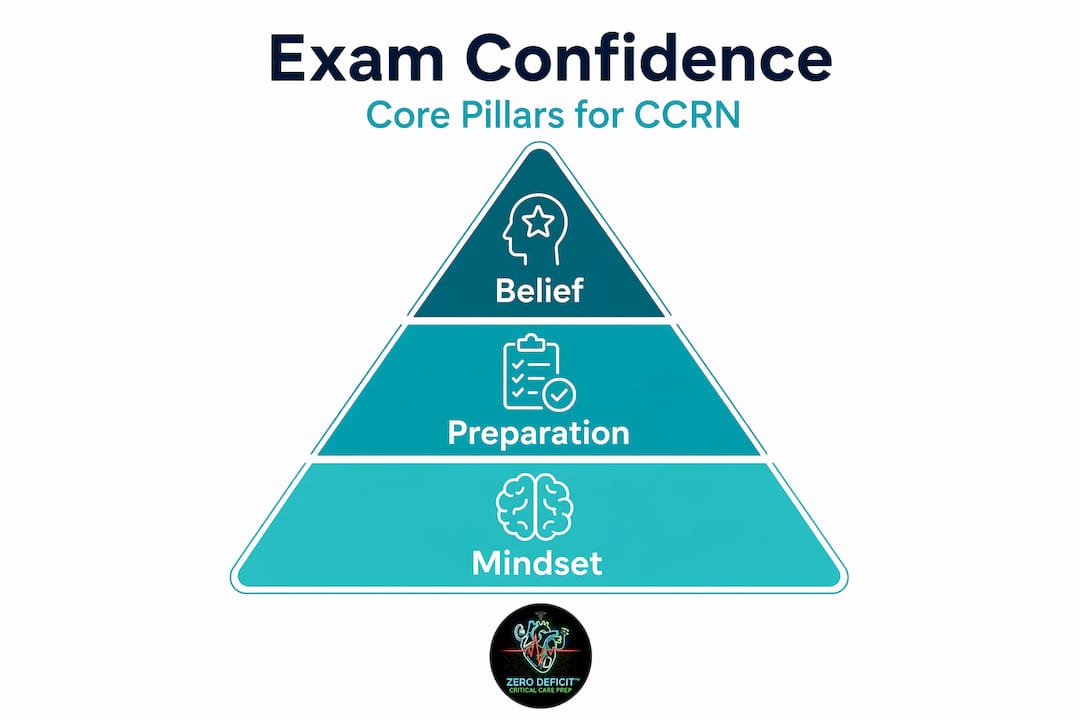
Exam confidence is your belief in your own ability to perform under actual test conditions. Not just your knowledge level, but your trust that you can access, organize, and apply that knowledge when a timer is counting down and the stakes are real. It has three interlocking dimensions: cognitive (how clearly you think under pressure), emotional (how well you regulate fear and doubt), and behavioral (how you physically manage exam conditions like pacing and question strategy).
Up to 20% of students meet clinical criteria for test anxiety, which means a significant portion of CCRN candidates aren’t just nervous. They’re physiologically impaired during the exam. Stress floods working memory with threat-related thoughts, leaving less cognitive bandwidth for reasoning and recall. The phenomenon psychologists call “choking under pressure” isn’t a character flaw. It’s what happens when your stress response hijacks your prefrontal cortex.
“High-stakes performance depends heavily on managing the physiological stress response, not just knowledge depth.”
For ICU nurses, this carries a particular irony. You are trained to perform in life-threatening situations. But clinical performance is different from exam performance. At the bedside, your body’s stress response sharpens you. During an exam, without the physical action outlets that clinical work provides, that same response can paralyze you. Understanding this distinction is the first step toward managing it deliberately.
Research confirms that confidence correlates more with exam success than motivation alone. You can be highly motivated to pass the CCRN and still underperform if anxiety is undermining your self-trust. Structured interventions focused on belief in ability, including how you manage self-talk and regulate anxiety, produce measurable score improvements. This is why understanding exam confidence is not a soft skill conversation. It’s a performance science conversation.
Core strategies for building CCRN exam confidence
Building genuine confidence before your CCRN exam means making deliberate choices throughout your study period, not just the week before the exam. Here’s what actually works, grounded in evidence and experience with critical care candidates.
-
Use active recall, not passive rereading. Rereading your notes feels productive. It isn’t. Retrieval practice builds robust neural pathways that hold up under stress, while passive review creates what researchers call “fool’s confidence.” You recognize material when you see it but can’t produce it under pressure. Use CCRN practice questions to force active retrieval every study session.
-
Prioritize sleep and nutrition. Sleep deprivation directly impairs working memory, which is the cognitive resource most taxed during exam reasoning. Aim for a full 8 hours the night before your exam. Eat a balanced meal beforehand. These aren’t wellness platitudes. They are performance variables.
-
Pack and prepare the night before. Organizing materials the night before and arriving early reduces cognitive load on exam day. Every logistical decision you make that morning (what to bring, which route to take, where to park) consumes mental energy you need for 150 CCRN questions. Eliminate those decisions in advance.
-
Practice breathing exercises before you sit down. Two to three minutes of slow deep breathing before entering the exam room measurably reduces physiological anxiety markers. This isn’t optional relaxation. It’s a clinical intervention you’re applying to yourself.
-
Use expressive writing to offload worry. Spend 10 minutes writing out your fears and concerns before a study session or the morning of your exam. Expressive writing before exams clears worry from working memory, freeing up cognitive capacity for actual exam performance. It sounds simple. The research behind it is not.
Pro Tip: Build practice exams into your schedule at the same time of day your CCRN is scheduled. Your body’s alertness rhythm matters. If your exam is at 8 a.m., don’t only practice at night.
For nurses working through specific clinical domains, the CCRN question breakdown methods at Zerodeficitccrnprep offer structured approaches to dissecting high-difficulty questions systematically, which is one of the strongest confidence-builders available during prep.
Exam day mindset and body management
You’ve studied. You’ve prepared. Exam day arrives, and your heart rate spikes before you’ve answered a single question. Here’s what to do with that response instead of fighting it.

The most powerful shift you can make is reframing anxiety as readiness. Research shows that cognitive reappraisal of anxiety as excitement improves performance on high-stakes tasks. When your heart races before the CCRN, your body isn’t betraying you. It’s mobilizing you. Tell yourself, “I’m activated, I’m ready,” rather than, “I’m panicking.” This isn’t positive thinking. It’s redirecting an existing physiological state toward a functional outcome.
For the 24 hours leading into your exam, your goal is mental maintenance, not new learning. Avoid introducing new material the night before your CCRN. A brief review of core formulas (cardiac output, oxygen delivery, MAP calculations) is fine. Attempting to learn new content overloads working memory and erodes the confidence you’ve built. Rest is preparation.
During the exam itself, apply these techniques:
- Anchor yourself to the question in front of you. When your mind pulls toward “What if I fail?” redirect attention back to the current stem. One question at a time is the only unit of work that matters.
- Use the two-pass method. Answer questions you’re confident about first. Flag uncertain ones and return. This protects your momentum and prevents one difficult question from derailing your focus.
- Reset between question blocks. Close your eyes, take three slow breaths, and reset. This is the same technique your ICU brain uses during a code. Apply it here.
- Watch your time without obsessing. Know the pace you need (roughly 1.2 minutes per question) and glance at the clock every 25 to 30 questions, not every 5.
Pro Tip: If you feel your focus fragmenting mid-exam, plant both feet flat on the floor, take one deep breath, and name three things you can see in the room. This brief grounding technique interrupts the anxiety spiral before it builds.
Overcoming confidence barriers specific to ICU nurses
The CCRN attracts high-performing nurses who often hold themselves to impossible standards. That same perfectionism that makes you an excellent clinician can quietly undermine your exam confidence if you’re not watching for it.
Here are the most common confidence barriers for critical care nurses, and how to address them:
- Perfectionism and fear of failure. You’re accustomed to zero errors at the bedside. The CCRN allows for a passing score, not a perfect one. Reframe your goal: pass, not perfect. A score of 76% correct still passes. You don’t need to know everything. You need to know enough, and know it reliably.
- Gaps in clinical experience. You may feel less confident in subspecialties your unit doesn’t see often, like burns or neurology. This is normal. The AACN blueprint is weighted, and cardiovascular, pulmonary, and multisystem together account for the majority of questions. Use targeted body system study guides to close specific knowledge gaps systematically rather than trying to review everything equally.
- Negative self-talk and impostor syndrome. “I’m not smart enough for this certification.” If you hear that thought, recognize it as anxiety speaking, not data. You passed nursing school, earned ICU experience, and chose to pursue advanced certification. That’s not an accident. Challenge the thought with evidence.
- Repeated exam attempts. If you’ve taken the CCRN before and didn’t pass, your confidence barrier is real and earned. The solution isn’t studying harder in the same way. It’s identifying which question types and content areas broke down, and changing your approach. Repeated practice test exposure normalizes exam stress over time. The exam format stops feeling like a threat and starts feeling familiar.
Confidence-building programs that include positive instructor feedback and structured peer engagement are particularly effective for retakers. You don’t need to prep in isolation.
My perspective on what actually moves the needle
I’ve worked with nurses who could rattle off Starling curves, interpret pulmonary artery waveforms, and describe every phase of septic shock physiology in clinical detail. Some of them walked out of the CCRN without passing. Not because they lacked knowledge. Because they hadn’t trained their mind to perform under exam conditions.
What I’ve found, consistently, is that the nurses who pass on the first attempt are not always the most knowledgeable. They’re the most prepared for the experience of taking the exam. They’ve sat through timed practice under realistic conditions enough times that the exam format stops triggering their threat response. The stress becomes a signal they know how to use.
I’ve also learned that conventional advice to “just study more” is not only incomplete, it can backfire. Overloading the final days before your exam with new content is one of the fastest ways to destroy the confidence you’ve spent weeks building. Protecting your working memory is as strategic as any study session.
The routine matters more than most nurses expect. Sleep, movement, consistent practice times, and a structured question review process build the psychological scaffolding that holds knowledge in place under pressure. Confidence in test-taking is a trained state, not a personality trait. You build it the same way you build clinical competence: deliberately, repeatedly, and with honest feedback on where you’re weak.
— Zero
How Zerodeficitccrnprep builds your confidence from day one
When you’re preparing for the CCRN, you need more than a stack of notes. You need tools that simulate the real exam experience so that exam day feels familiar, not foreign.
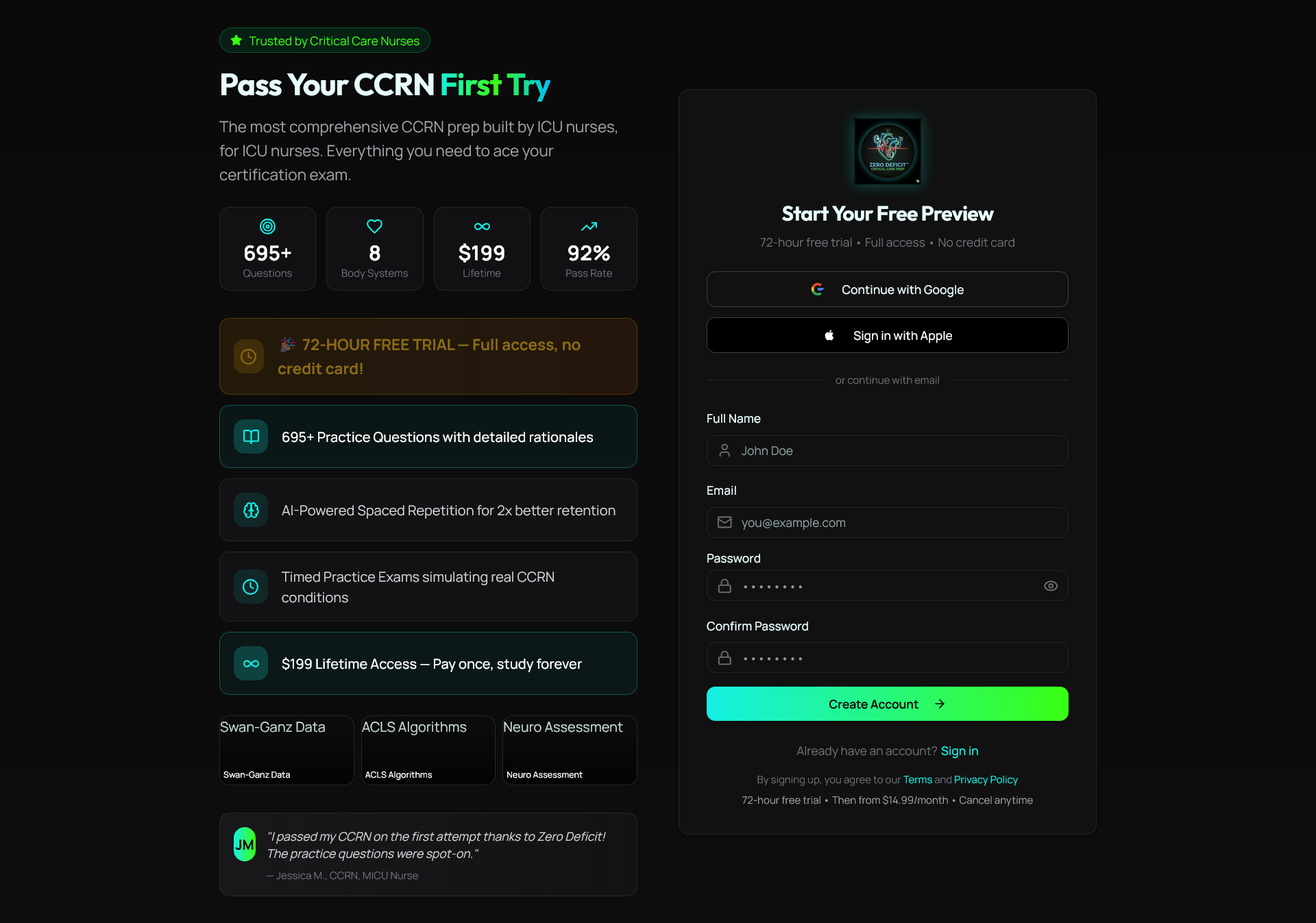
Zerodeficitccrnprep is built specifically for adult critical care nurses pursuing their CCRN certification. The platform includes 695+ practice questions mapped to the AACN blueprint, with detailed rationales that teach you how to think through the question, not just what the right answer is. The question breakdown methods help you develop a consistent approach to difficult stems, which is one of the most reliable confidence builders available. Study guides cover all eight body systems, progress tracking shows you exactly where your confidence gaps are, and the free version requires no credit card. Start building real exam confidence today at ZeroDeficitCCRNPrep.com.
FAQ
What is exam confidence for CCRN candidates?
Exam confidence is your belief in your ability to access and apply clinical knowledge under timed, high-stakes test conditions. It includes cognitive clarity, emotional regulation, and behavioral strategies specific to exam performance.
How does test anxiety affect CCRN exam scores?
Test anxiety can reduce performance by a full standard performance band by impairing working memory, even in nurses with strong clinical knowledge. Managing anxiety is as important as content mastery.
What are the best tips for exam confidence before the CCRN?
Use active recall during study sessions, sleep a full 8 hours before exam day, prepare all materials the night before, and practice two to three minutes of deep breathing immediately before the exam begins.
How do I handle impostor syndrome when preparing for my CCRN?
Counter negative self-talk with concrete evidence of your clinical experience and preparation progress. Structured practice with immediate performance feedback, like timed CCRN practice tests, rebuilds self-trust faster than encouragement alone.
Should I study new material the night before the CCRN?
No. The final 24 hours should focus on mental maintenance: light review of core formulas, adequate sleep, and protecting your working memory from cognitive overload.
Recommended
Take a Neurological practice quiz
Test your knowledge of stroke, ICP, seizures, and neuro assessment.
Ready to pass your CCRN?
Join 12,000+ nurses using Zero Deficit — 695+ practice questions with rationales, AI-powered weak-area drilling, and spaced-repetition flashcards.
Start Free Trial →