What Is Retention in Test Prep for CCRN Success

TL;DR:
- Retention in test preparation involves storing knowledge in long-term memory and retrieving it accurately under pressure. Active recall, spaced repetition, and feedback are proven strategies that significantly improve long-term retention for CCRN exam success. Focusing on practice questions and deliberate retrieval, rather than passive review, is essential for clinical reasoning under exam conditions.
Understanding what is retention in test prep is the difference between passing the CCRN on your first attempt and walking out of the test center wondering why nothing came back to you under pressure. Retention is not the comfortable feeling you get after rereading your notes. It is the ability to store clinical knowledge in long-term memory and retrieve it accurately, days or weeks later, when a high-stakes question puts you on the spot. For ICU nurses managing complex patients and preparing for certification at the same time, building real retention is not optional. It is the foundation everything else depends on.
Table of Contents
- Key takeaways
- What retention in test prep actually means
- Evidence-based strategies to improve retention
- Comparing common study methods and retention outcomes
- Fitting retention strategies into a busy ICU schedule
- My honest take on retention and CCRN prep
- Build your retention with Zero Deficit CCRN Prep™
- FAQ
Key takeaways
| Point | Details |
|---|---|
| Retention means long-term recall | Storing and retrieving knowledge weeks after studying is what the CCRN actually tests. |
| Retrieval practice outperforms rereading | Active recall builds 61% retention after one week versus 40% from restudying. |
| Spacing beats cramming every time | Distributing practice over days and weeks produces far stronger long-term memory than a last-minute push. |
| Feedback is non-negotiable | Reviewing why you got a question wrong corrects misconceptions and locks in accurate recall. |
| Busy nurses can make it work | Short, focused daily sessions built around your shift schedule are more effective than marathon weekend study sessions. |
What retention in test prep actually means
The word retention gets used loosely in study advice, so let’s be precise about it here. Retention is the ability to store information or skills in long-term memory and then retrieve and apply them later, not just recognize them moments after reading. That distinction matters enormously for the CCRN.
You have likely experienced this yourself. You read through a section on hemodynamic monitoring, understood it clearly in the moment, felt confident, and then two days later struggled to recall the relationship between SVR and MAP without your notes in front of you. That is short-term familiarity masquerading as learning. The CCRN does not test familiarity. It tests whether you can pull specific clinical reasoning from memory under timed pressure and apply it to a patient scenario you have never seen before.
Memory works in three stages: encoding, storage, and retrieval. Encoding is the initial processing of new information. Storage is how that information gets consolidated over time. Retrieval is the act of pulling it back out. Most nurses spend the majority of their study time on encoding, reading and rereading content, and almost no time deliberately practicing retrieval. That imbalance is where test prep memory retention breaks down.
“The act of retrieving information is not just a test of memory — it is the mechanism that strengthens memory itself.” This principle, known as the testing effect, explains why practice questions build durable knowledge in ways that rereading simply cannot match.
There is also a well-documented cognitive trap called the fluency illusion. When you reread familiar material, it feels smooth and easy. Your brain interprets that ease as mastery. It is not. Fluency during reading predicts how well you recognize material, not how well you can recall it independently. For the CCRN, where you will face novel scenarios without a reference in sight, recognition is not enough.
Evidence-based strategies to improve retention
Knowing the science is one thing. Applying it to your actual study schedule is another. Here are the strategies with the strongest evidence behind them, ordered by the impact they will have on your CCRN prep.
-
Use active recall through practice questions every session. Retrieval practice produces about 61% retention after one week compared to 40% for repeated studying with equal time invested. Every time you answer a practice question without looking at your notes first, you are strengthening a memory trace that will hold up on exam day. The effort of retrieval is the point. If it feels hard, it is working.
-
Space your practice across days and weeks. Spaced practice with intervals of roughly 10 to 20% of the time remaining until your exam consistently outperforms cramming on delayed retention tests. If your CCRN is eight weeks away, aim for review intervals of about one to two weeks for high-yield content like shock management, ARDS protocols, and hemodynamic drips. Spaced repetition flattens the forgetting curve and keeps retrieval effort high across the entire prep period.
-
Review every wrong answer with a full rationale. Retrieval practice with feedback outperforms retrieval without feedback by a significant margin in long-term retention studies. Getting a question wrong and then skipping the explanation is one of the most common and costly mistakes in CCRN prep. The wrong answer tells you exactly where your mental model is broken. The rationale fixes it. That combination, error plus correction, is what creates a durable and accurate memory trace.
-
Study with clinical case-based questions rather than isolated fact drills. Case-based questions better simulate the retrieval cues present during the actual exam, which reduces the “I studied this but can’t recall it” effect. When you practice in the same format you will be tested in, your memory is encoded with contextual cues that trigger recall more reliably. A question about a patient with a wedge pressure of 22 mmHg, oliguria, and cool extremities encodes cardiogenic shock differently than a flashcard that just lists the criteria.
-
Drop passive methods as your primary strategy. Rereading, highlighting, and watching lectures without follow-up testing all contribute to the fluency illusion. They are not worthless, but using them alone will not build the retrieval strength the CCRN demands. Use passive review as preparation for active practice, not as a substitute for it.
Pro Tip: Combine active recall with spaced repetition for the strongest retention outcomes. Answer practice questions on cardiovascular content today, review rationales, then return to that content in five to seven days before moving on. This two-step cycle, retrieval plus spaced return, consistently outperforms any single method used alone.
Comparing common study methods and retention outcomes
Most nurses preparing for the CCRN use a mix of methods without ever stopping to evaluate whether those methods are actually building long-term retention. This table makes the comparison direct.
| Study method | Effort level | Short-term confidence | Long-term retention | Best use |
|---|---|---|---|---|
| Rereading notes | Low | High | Weak | Initial orientation to new content only |
| Highlighting and annotating | Low | High | Weak | Identifying what to practice, not as primary method |
| Passive video/lecture review | Low to medium | Medium | Weak to moderate | Background understanding before active practice |
| Flashcards (passive review) | Medium | Medium | Moderate | Better when used for active self-testing, not just reading |
| Practice questions with rationale review | High | Medium initially | Strong | Primary study method for CCRN prep |
| Spaced retrieval practice | High | Lower short-term | Strongest | Ongoing sessions distributed across your prep timeline |
The key pattern here is that methods which feel easier during studying tend to produce weaker long-term retention. Cramming produces higher immediate confidence but consistently worse performance on delayed tests compared to spaced practice. If your study sessions feel smooth and comfortable, that is often a signal that you are not challenging your memory enough to build durable recall. Productive difficulty is part of the process.
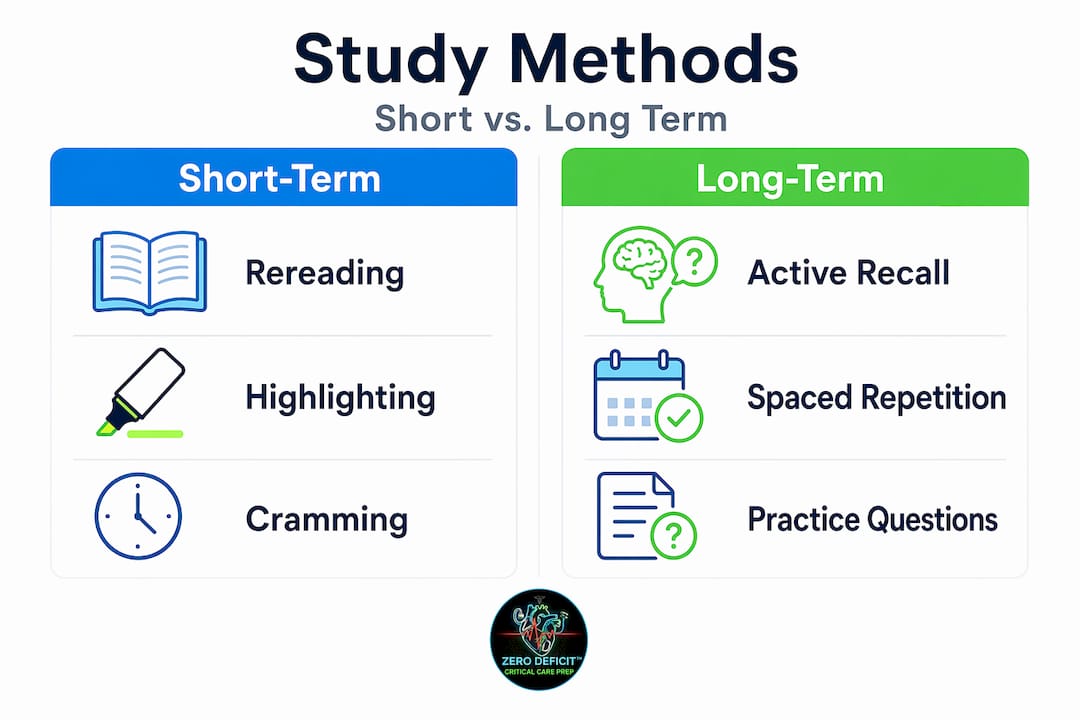
The nurses who score well on the CCRN are not necessarily the ones who studied the most hours. They are the ones whose study hours were structured around retrieval and spacing rather than passive review. That is a significant shift in how you think about what studying actually means.

Fitting retention strategies into a busy ICU schedule
You are working three twelve-hour shifts, managing critical patients, and trying to find time to study for a high-stakes certification exam. The good news is that effective retention strategies do not require marathon sessions. They require consistency and structure.
Here is how to make it work around your clinical life:
-
Short daily sessions outperform long weekend blocks. Forty minutes of practice questions after a day shift, spread across five days, produces better retention than a four-hour Saturday session. Your brain consolidates memory during rest. Distributed practice gives it repeated consolidation opportunities.
-
Leverage your existing resources strategically. Use body system study guides to orient yourself to a topic, then immediately shift to practice questions on that same content. The guide is your encoding tool. The questions are your retrieval tool.
-
Use spaced repetition technology. Several apps schedule review automatically based on your performance, showing you content you are forgetting at exactly the right interval. For CCRN-specific material, platforms that align spaced repetition with exam blueprint content, such as cardiovascular, pulmonary, and neuro, deliver better results than general-purpose tools.
-
Tie study content to your clinical shifts. If you cared for a patient in septic shock today, spend twenty minutes that evening on high-yield sepsis topics and answer five to ten practice questions on vasopressors and hemodynamics. Clinical experience reinforces contextual encoding. That patient becomes a memory anchor.
-
Track your performance over time. Reviewing which content areas you consistently miss tells you where your retrieval is weakest and where to direct your next spaced repetition cycle.
Pro Tip: Set a weekly goal of answering a minimum number of practice questions rather than a minimum number of study hours. This forces active retrieval into your schedule and prevents passive review from filling your available time without building real retention.
My honest take on retention and CCRN prep
I have worked with a lot of nurses going through CCRN prep, and the pattern I see most often is this: they study hard, they feel prepared, and then they sit down for the exam and feel like their memory abandoned them. That experience is not a sign of low intelligence or weak clinical knowledge. It is almost always a sign that their study method never actually built retrieval strength.
In my experience, the nurses who struggle most are the ones who spent most of their prep time rereading content. It feels productive. It feels like learning. But retrieval practice under test stress protects memory in a way that rereading simply cannot, and that difference shows up most when the pressure is highest.
What I tell every nurse who comes to me frustrated with their prep: stop measuring your study quality by how much material you covered and start measuring it by how many questions you answered, reviewed, and got wrong. Wrong answers are the raw material of real retention. They show you exactly where your memory needs reinforcement.
The CCRN tests clinical reasoning, not just recall. But clinical reasoning under pressure requires fast, accurate recall as its foundation. You cannot reason well about a patient in cardiogenic shock if you cannot quickly retrieve the hemodynamic profile from memory. Retention strategies are not just about passing an exam. They are about becoming the nurse who thinks clearly when it counts.
Be patient with yourself. This kind of studying feels harder than rereading. That is the point.
— Zero
Build your retention with Zero Deficit CCRN Prep™
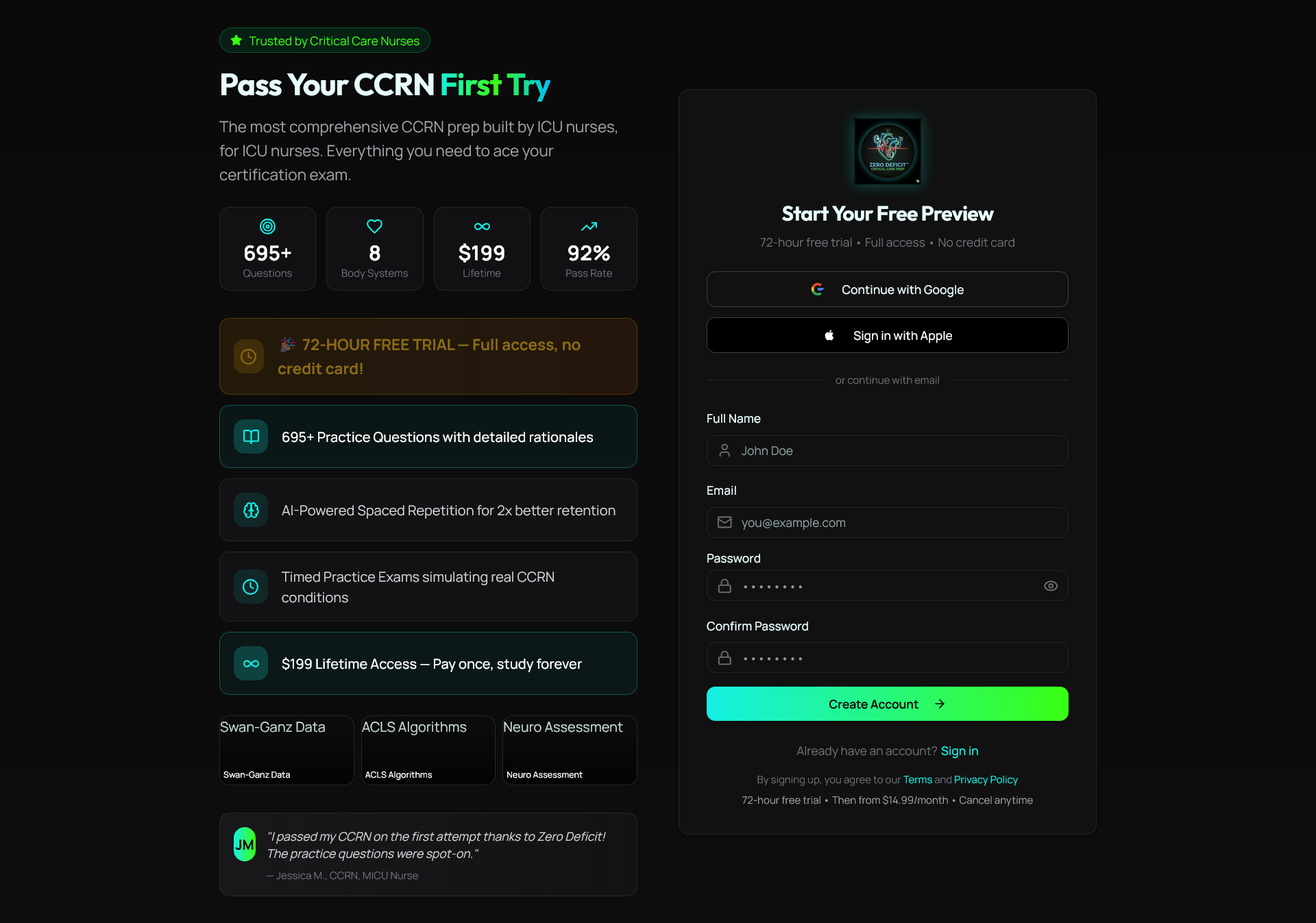
If you are ready to stop rereading and start building real retention, Zerodeficitccrnprep is built specifically for how critical care nurses learn and test. The platform’s 695+ practice questions are organized by body system, mirroring the AACN CCRN exam blueprint, so your retrieval practice targets the content that matters most. Every question comes with a detailed rationale so you correct misconceptions immediately, the same feedback mechanism that research confirms drives the strongest long-term retention gains.
Use the question breakdown methods to learn how to approach CCRN-style clinical scenarios systematically, so you are not just memorizing answers but building transferable reasoning skills. Pair that with the full practice test library to run spaced retrieval sessions across all eight body systems on your own schedule.
Start your free version today at Zero Deficit CCRN Prep. No credit card required.
FAQ
What does retention mean in test prep?
Retention in test prep means storing information in long-term memory and being able to retrieve and apply it accurately later, not just recognizing it right after studying. For CCRN candidates, this means recalling clinical facts and reasoning under timed exam pressure days or weeks after the material was first learned.
Why is retention more important than understanding for the CCRN?
Understanding without retention means you cannot recall the knowledge independently when a test question demands it. The CCRN tests your ability to apply clinical reasoning in novel scenarios, which requires fast and accurate retrieval from long-term memory, not just comprehension of concepts you recently reviewed.
What study method builds the strongest retention?
Retrieval practice with feedback consistently produces the strongest long-term retention across education research. For CCRN prep, this means answering practice questions, reviewing detailed rationales for every wrong answer, and spacing those sessions out over days and weeks rather than cramming them into a single block.
How does spaced repetition help with CCRN exam retention?
Spaced repetition spaces your review of content at expanding intervals timed to when your memory is beginning to fade. This expanding spaced retrieval approach flattens the forgetting curve and produces significantly stronger delayed retention compared to massed practice, making it one of the most efficient strategies for busy ICU nurses with limited study time.
Why does rereading feel effective but not build real retention?
Rereading creates a fluency illusion, where the smoothness of familiar material feels like mastery but only supports recognition, not independent recall. Students consistently overestimate how much they have learned from rereading, which leads to weaker exam performance compared to nurses who used active retrieval methods for the same amount of study time.
Recommended
- Advantages of practice tests for CCRN exam success | Zero Deficit CCRN Prep
- How educators boost CCRN certification success for nurses | Zero Deficit CCRN Prep
- Pass the CCRN Exam: Proven Guide for Critical Care Nurses | Zero Deficit CCRN Prep
- Top CCRN study topics to master for exam success | Zero Deficit CCRN Prep
Take a Neurological practice quiz
Test your knowledge of stroke, ICP, seizures, and neuro assessment.
Get Your Free 20-Question CCRN Diagnostic
20 high-yield CCRN-style questions across every body system, with detailed rationales — emailed to you instantly.
No spam. One email + a couple of helpful follow-ups. Unsubscribe anytime.
Ready to pass your CCRN?
Join 12,000+ nurses using Zero Deficit — 695+ practice questions with rationales, AI-powered weak-area drilling, and spaced-repetition flashcards.
Start Free Trial →