Why Exam Simulators Matter for CCRN Certification
TL;DR:
- Practicing with exam simulators under timed, adaptive conditions prepares nurses for the pressure of the actual CCRN exam.
- Skipping simulation practice often leads to interface confusion, timing failures, and heightened exam anxiety, impairing performance.
You already know the content. You can recite hemodynamic parameters, walk through sepsis bundles, and explain the Synergy Model in your sleep. So why do so many ICU nurses with solid clinical knowledge still walk out of their CCRN exam feeling blindsided? The answer is almost never content. It’s performance under pressure. Understanding why exam simulators matter is the difference between knowing your material and actually demonstrating it when the clock is running and the questions shift in real time. This article breaks down exactly how simulators work, why skipping them is a costly mistake, and how to use them to your full advantage.
Table of Contents
- Key takeaways
- What exam simulators are and how they work
- The real benefits of using exam simulators
- What happens when you skip simulation practice
- How to integrate simulators into your CCRN study plan
- My honest take on why simulation is non-negotiable
- Start practicing with Zero Deficit CCRN Prep
- FAQ
Key takeaways
| Point | Details |
|---|---|
| Simulators replicate real exam pressure | Practicing under timed, adaptive conditions prepares you for the cognitive demands of the actual CCRN test. |
| Anxiety drops with repetition | Taking four or more practice exams significantly reduces test anxiety by making the format feel familiar. |
| Interface familiarity saves time | Knowing how to navigate digital exam tools means your mental energy goes to answering questions, not figuring out the software. |
| Early and consistent simulation wins | Starting simulation practice at the midpoint of your study plan builds applied skills progressively instead of cramming at the end. |
| Performance data guides your study | Tracking trends across multiple simulated attempts reveals weak content domains and pacing issues before exam day. |
What exam simulators are and how they work
An exam simulator is a digital tool designed to replicate the format, timing, interface, and question types of an actual certification exam. For the CCRN, that means practicing in a computer-based environment that mirrors the 150-question format delivered by Pearson VUE, including the pacing, the on-screen tools, and the pressure of a fixed time window.
What separates a good simulator from a simple practice quiz is fidelity to the real exam experience. Consider how nursing certification exams increasingly use Computer Adaptive Testing (CAT). In a CAT format, the exam engine adjusts question difficulty in real time based on your previous answer. Get one right, and the next question gets harder. Miss one, and the difficulty adjusts down. This is not just a design quirk. It is the mechanism by which the exam determines your competency level. Nursing CAT exams adjust question difficulty in real time, and students must practice adaptive, timed sessions to prepare effectively.
Beyond question format, simulators also train you on the tools built into the exam interface. This includes features like:
- Flagging questions for review
- Using the built-in calculator
- Navigating forward and backward through questions
- Managing the on-screen timer without letting it derail your focus
- Submitting responses and moving through sections efficiently
These feel trivial until you are sitting in a Pearson VUE testing center and you realize you have never actually practiced with those tools under pressure. Every second you spend figuring out the interface is a second stolen from clinical reasoning.
Pro Tip: When you run a simulator session, treat every feature as part of the practice. Click the flag button. Use the calculator even when you do not need to. Build the muscle memory now so it costs you nothing on exam day.

The real benefits of using exam simulators
Most nurses approach CCRN prep by reading, reviewing flashcards, and answering question banks. Those methods build knowledge. Simulators build performance. There is a gap between the two, and that gap is where a lot of otherwise qualified nurses lose points.
Here are the core benefits of exam simulators when used correctly:
-
Exposure to real question formats. The CCRN includes multiple-choice questions that test clinical judgment, not just recall. Simulators let you practice interpreting complex patient scenarios under time pressure, which is a skill that only develops through repetition.
-
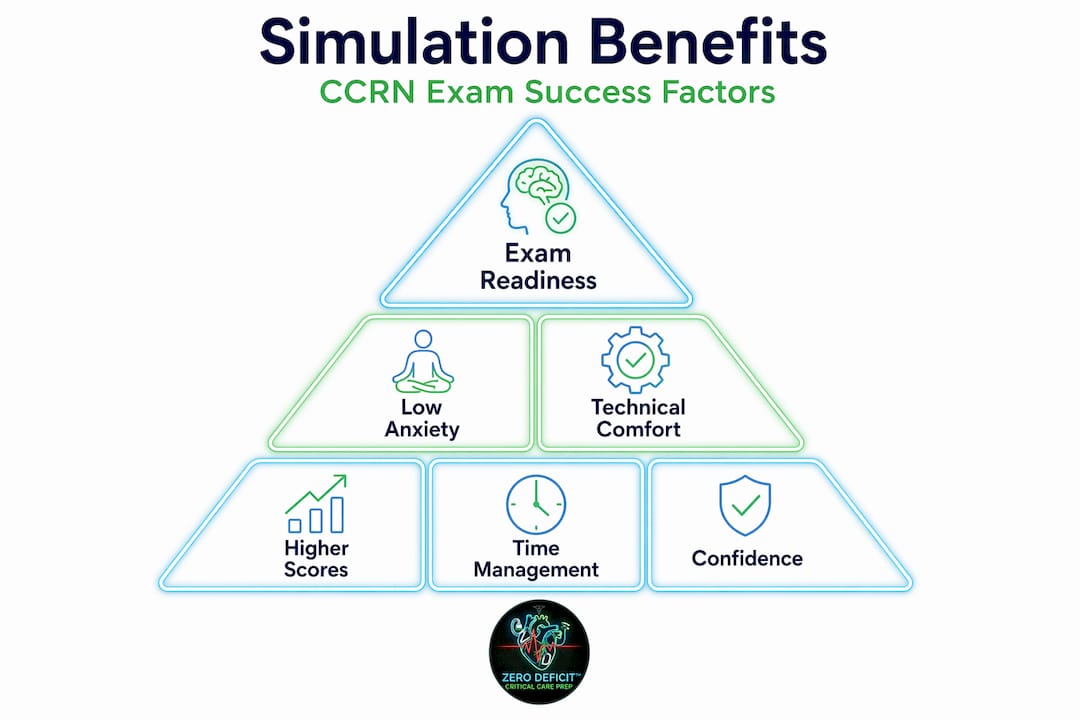
Time management under pressure. The CCRN gives you 3 hours for 150 questions, which works out to roughly 72 seconds per question. That is tighter than it sounds, especially when a question presents a full hemodynamic scenario with a ventilator setting and asks you to prioritize your intervention. Regular timed simulation builds the internal clock you need.
-
A safe space to make mistakes. Simulation creates a safe environment where learners experience errors without real consequences, which directly reduces future error rates. In a simulator, getting a sepsis question wrong teaches you something. On exam day, it costs you a point. The learning environment matters.
-
Improved digital proficiency. Exam day performance often suffers from unfamiliarity with digital tools rather than lack of content knowledge. Simulator practice makes navigation automatic, which shifts your full cognitive load back to the question itself.
-
Reduction of test anxiety. Repeated practice transforms anxiety into confidence by making the formal exam feel like a rehearsed experience you have been through before. The testing center stops feeling like unfamiliar territory. It starts feeling like another simulation run.
The effectiveness of exam simulators is not theoretical. The exam readiness strategies that produce the highest pass rates consistently include simulation as a core component, not an optional add-on.
What happens when you skip simulation practice
Here is what the research and the failure patterns actually show. Nurses who focus exclusively on content review without simulation practice hit a predictable wall on exam day. The knowledge is there. The performance is not.
Some of the most common and avoidable failure points include:
- Interface confusion wastes critical minutes. If you have never practiced navigating the exam platform, you will spend the first 10 to 15 minutes of the actual exam just orienting yourself. That time is gone permanently.
- Cognitive overload without paced practice. Reading about vasopressor titration in a study guide is low cognitive load. Answering five consecutive ICU scenario questions in 6 minutes under a running timer is a different experience entirely. Simulators condition your brain to maintain clarity under that kind of load.
- Timing failure is an automatic failure in some formats. For CAT-based exams, answering fewer than the minimum scored questions within the time limit results in automatic failure regardless of accuracy. No partial credit. No exceptions.
- False confidence from question banks alone. Answering 700 practice questions at your own pace, with no timer and no interface pressure, does not replicate exam conditions. It builds content familiarity. That is useful but incomplete.
“Underpreparing for task-based and timed simulations is the primary cause of avoidable failure on certification exams.” This point from CPA exam simulation research maps directly onto nursing certification prep. The format demands practice as much as the content does.
The solution is not to abandon question bank practice. It is to pair it with regular, timed, full-length simulation runs that mirror actual exam conditions. That combination is what builds true exam readiness.
How to integrate simulators into your CCRN study plan
This is where most nurses underperform. They plan to “do some practice tests at the end” and then run out of time or use them incorrectly. Here is a structure that actually works:
-
Start simulation practice at the midpoint of your study plan, not the end. Starting simulation from the study midpoint and practicing under timed conditions builds applied skills progressively. Waiting until the final week is too late to course-correct your pacing or identify weak domains.
-
Always practice under timed conditions. Untimed practice creates a false sense of readiness. Set your timer from the first simulation session and never turn it off.
-
Review your performance data after every session. Tracking multiple simulated exam attempts for stable performance, rather than relying on a single high score, reveals your actual readiness. Look at domain-level accuracy trends across sessions, not just your total score.
-
Balance simulation with content study. Simulators show you where you are weak. Your CCRN study guides fix those weaknesses. The two work together. Do not let simulation crowd out the content review that feeds it.
-
Run at least three to four full-length simulated exams before test day. Repeated exam environment exposure improves familiarity, pacing, and reduces stress, which leads directly to higher scores.
Pro Tip: After each simulation session, sort your missed questions by body system. If you miss three or more questions in cardiovascular hemodynamics, that is not bad luck. That is a signal to go back to your study guide and close the gap before your next simulation run.
The table below shows how to think about balancing simulation versus content study across a typical 8-week CCRN prep period:
| Study phase | Primary focus | Simulation frequency |
|---|---|---|
| Weeks 1 to 3 | Content review by body system | Short timed quizzes (20 to 25 questions) |
| Weeks 4 to 5 | Mixed content and question practice | Half-length simulations (75 questions, timed) |
| Weeks 6 to 7 | Simulation-heavy, targeted content review | Full-length simulated exams (150 questions) |
| Week 8 | Light review only, no new material | One final full-length simulation for confidence |
My honest take on why simulation is non-negotiable
I have worked with nurses who knew their content cold. Shock physiology, ARDS management, ICP waveforms, the whole blueprint. And some of them still struggled on exam day. What I have learned is that there is a category of readiness that content knowledge alone cannot produce.
Simulation builds something different. It builds the ability to stay sharp under conditions that are designed to be uncomfortable. When you sit in a testing center with 150 questions, a countdown timer, and no access to your notes or a colleague, you are not just retrieving information. You are performing under pressure. That is a trainable skill, and the only way to train it is to practice in conditions that resemble the actual exam.
The insight that most nurses miss is that technical comfort with the exam environment can outperform raw knowledge on test day. A nurse who has run five full-length simulations and knows exactly how to pace herself, when to skip and flag, and how the interface works under stress will outperform a nurse with marginally stronger content who has never practiced under those conditions.
The AI-powered tools available now make this even more accessible. Adaptive practice that adjusts to your individual weak areas means every simulation session is doing more work than a static question set ever could.
There is also an emotional component that does not get discussed enough. Anxiety costs you real performance. When the test environment is unfamiliar, your brain treats it as a threat. When it feels like something you have done before, your brain stays regulated and focused. Simulation is how you train that response.
— Zero
Start practicing with Zero Deficit CCRN Prep
If you are serious about passing the CCRN on your first attempt, you need more than content review. You need a platform built around realistic practice.
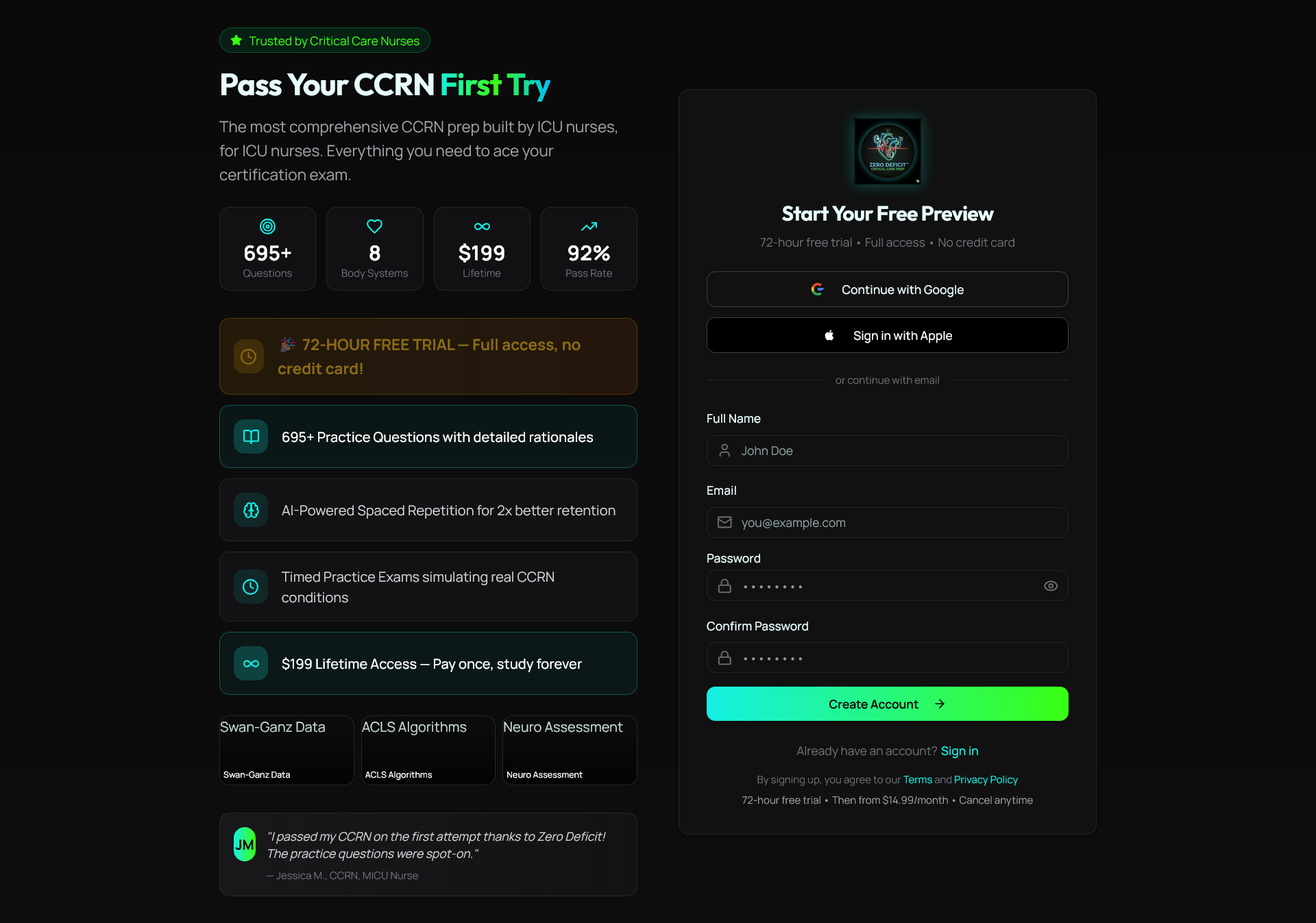
Zerodeficitccrnprep.com offers over 695 CCRN practice questions organized by body system, full CCRN practice tests designed to reflect the actual AACN exam format, and question breakdown methods that teach you how to dissect complex clinical scenarios under pressure. The platform tracks your performance across sessions so you always know where to focus next. Start studying free at Zero Deficit CCRN Prep today. No credit card required. See exactly what your prep is missing, and fix it before exam day.
FAQ
What exactly is an exam simulator for the CCRN?
An exam simulator is a digital practice tool that replicates the format, timing, and interface of the actual CCRN exam. It allows you to practice answering timed questions under conditions that closely mirror the Pearson VUE testing environment.
How many practice exams should I take before the CCRN?
Research shows that taking four or more practice exams significantly reduces test anxiety and improves performance. Aim for at least three to four full-length simulated exams in the weeks before your scheduled test date.
Can simulator practice reduce my CCRN exam anxiety?
Yes. Repeated exposure to the exam environment lowers anxiety by making the formal exam feel like a familiar experience. The more you practice in realistic conditions, the more regulated your stress response becomes on the actual test day.
Why isn’t a question bank enough on its own?
Question banks build content knowledge and clinical reasoning, but they rarely replicate real exam conditions including the timer, the interface, and the cognitive load of sustained performance. Simulators close that gap by adding the pressure and pacing that question banks alone cannot provide.
When should I start using an exam simulator in my CCRN prep?
Start timed simulation practice at the midpoint of your study plan, not the final week. Starting at the midpoint allows you to build applied skills progressively and gives you time to identify and close weak areas before exam day.
Recommended
Take a Neurological practice quiz
Test your knowledge of stroke, ICP, seizures, and neuro assessment.
Get Your Free 20-Question CCRN Diagnostic
20 high-yield CCRN-style questions across every body system, with detailed rationales — emailed to you instantly.
No spam. One email + a couple of helpful follow-ups. Unsubscribe anytime.
Ready to pass your CCRN?
Join 12,000+ nurses using Zero Deficit — 695+ practice questions with rationales, AI-powered weak-area drilling, and spaced-repetition flashcards.
Start Free Trial →