Why Is Confidence Important in Exams: A Nurse's Guide
TL;DR:
- Confidence in exams is a measurable, trainable skill that influences nearly 30% of academic performance variance and enhances focus, recall, and decision accuracy. Building confidence requires structured, consistent preparation over weeks through active recall, practice tests, and stress management techniques like breathing exercises; sleep is vital to solidify learning and reduce anxiety. Confidence stems from evidence-based effort, not feelings, and mastering it helps critical care nurses perform under pressure, leading to higher CCRN success rates.
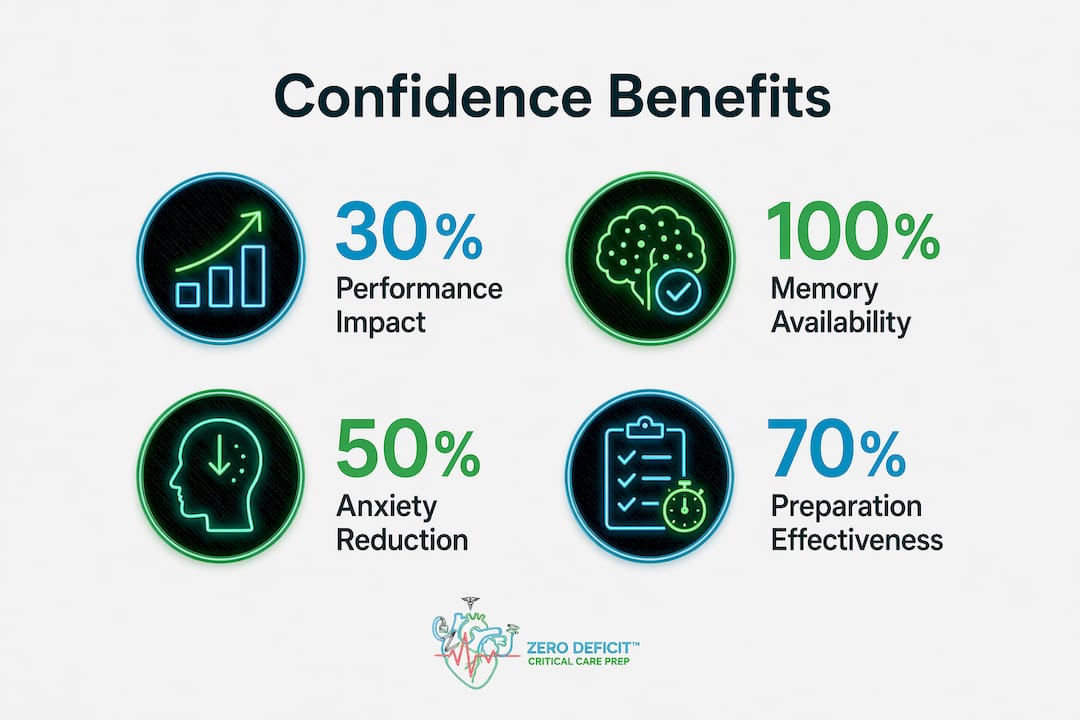
Confidence in exams is defined as your belief in your ability to perform well under pressure, and it directly determines how effectively you access, apply, and demonstrate knowledge when it counts. For ICU nurses preparing for the CCRN certification, this is not a soft skill. Academic confidence accounts for nearly 30% of performance variance, according to research from the 2026 Journal of Educational Psychology. That means your mindset walking into the exam room carries almost as much weight as the content you studied. Confidence improves focus, reduces the cognitive interference caused by anxiety, and enables faster, more accurate recall. The good news: confidence is trainable, and the methods that build it are specific and repeatable.
Why is confidence important in exams: what the research shows
The importance of confidence in exams goes well beyond feeling good before you sit down. Confidence functions as a cognitive buffer. When you believe you are prepared, your prefrontal cortex stays engaged, your working memory operates at capacity, and you make fewer impulsive guesses. When confidence is low, the fight-or-flight response floods the body with cortisol, narrowing attention and blocking retrieval pathways.
A March 2026 study measuring self-confidence and academic stress in secondary school students found a self-confidence scale reliability of 0.949, with a clear positive correlation between confidence levels and grades. Confident students resisted academic stress more effectively than their less confident peers. For CCRN candidates, this translates directly: the exam tests clinical reasoning under time pressure, and stress resistance is not optional.
“Confidence is a trainable skill built on repeatable systems that replace guesswork with calm control.” — Prep Expert
The data below summarizes what confidence does to exam performance across key dimensions:
| Performance dimension | Effect of high confidence |
|---|---|
| Working memory capacity | Stays fully available; less cognitive load consumed by worry |
| Stress resilience | Confident students buffer academic stress more effectively |
| Recall speed | Retrieval pathways remain accessible under timed conditions |
| Decision accuracy | Reduces impulsive guessing and second-guessing on questions |
| Performance variance | Confidence accounts for approximately 30% of academic outcome |

The reliability of confidence as a performance predictor is not anecdotal. It is measurable, consistent, and independent of raw knowledge level. Two candidates with identical content knowledge will not score identically if one walks in confident and the other walks in panicked.
How confidence and exam anxiety interact
Exam anxiety and confidence are not opposites. They exist on the same spectrum, and understanding that relationship is what separates candidates who manage test day well from those who fall apart on questions they actually know.
Anxiety activates the sympathetic nervous system. Heart rate rises, breathing shallows, and the amygdala begins competing with the prefrontal cortex for cognitive resources. The result is impaired recall, slower processing, and a tendency to abandon sound clinical reasoning in favor of gut reactions. For a CCRN question on hemodynamic management or ventilator weaning, that cognitive interference is costly.
Confidence does not eliminate anxiety. Eliminating all exam stress is unrealistic. The goal is to maintain stress at an optimal arousal level where it sharpens focus rather than impairs it. Confidence is the mechanism that keeps you in that zone. When you know your preparation is solid, moderate stress becomes a performance enhancer rather than a barrier.
Students with a growth mindset view effort as controllable and treat errors as data rather than evidence of failure. This shift reduces anxiety by removing the catastrophic interpretation of uncertainty. On the CCRN, you will encounter questions where two answers look equally correct. A confident mindset lets you apply the Synergy Model or prioritize by ABCs without spiraling. A panicked mindset leads to changing correct answers.
- Recognize the anxiety trigger: Uncertainty about preparation is the primary driver of test anxiety, not the exam itself.
- Replace avoidance with action: Every practice question you complete replaces a knowledge gap with a confirmed strength.
- Use self-affirmation before high-stakes moments: Self-affirmation exercises reduce performance-impairing anxiety by reconnecting you with your core values and competence.
- Reframe stress as readiness: A racing heart before the exam means your body is primed. Label it as preparation, not panic.
Pro Tip: Write down three things you know cold before you start the exam. A quick brain dump of confirmed knowledge, like normal CVP ranges or ARDS Berlin criteria, activates retrieval pathways and signals to your brain that you are prepared.
How to build confidence before your exam
Building self-confidence for exams requires a structured approach that starts weeks before test day, not the night before. Confidence results from repeated effort and structure, not positive thinking alone. Here is how to build it systematically.
-
Start structured prep 6 to 12 weeks out. Expert recommendations for standardized exams consistently point to 6 to 12 weeks of advance preparation as the window that builds earned confidence. For the CCRN, this means covering all eight body systems with enough repetition to move from recognition to application.
-
Use spaced repetition and active recall. Passive re-reading does not build confidence because it does not simulate retrieval. Spaced repetition tools force you to retrieve information at increasing intervals, which is exactly what the CCRN demands. Active recall through practice questions trains your brain to locate and apply knowledge under pressure.
-
Take practice tests under real exam conditions. Practice testing under timed, realistic conditions builds retrieval fluency and significantly reduces test anxiety. Sit at a desk, set a timer, and work through a full block without pausing. The advantages of practice tests for CCRN candidates extend beyond content review. They train you to trust your reasoning process when the clock is running.
-
Protect your sleep. Cramming overnight amplifies fatigue and anxiety while actively impairing the memory consolidation that happens during deep sleep. The night before the CCRN, your job is to rest, not review.
-
Build a pre-exam physical routine. Eat a protein-based meal, hydrate, and arrive early enough to avoid rushing. Physical stability reduces baseline anxiety before you read a single question.
-
Use the 4-7-8 breathing technique. Inhale for 4 counts, hold for 7, exhale for 8. This technique stabilizes focus in under 60 seconds by activating the parasympathetic nervous system. Use it between question blocks or whenever you feel your concentration narrowing.
Pro Tip: Review your personal analytics after every practice session. Seeing your scores improve across cardiovascular, pulmonary, and neuro sections is one of the most direct confidence builders available. Data beats doubt every time.
Comparing confidence-building strategies: what actually works
Not every confidence-building method works equally well for every exam type or learning style. The table below compares the most common approaches by effectiveness, time investment, and fit for high-stakes certification exams like the CCRN.
| Strategy | Effectiveness for CCRN-style exams | Best use case |
|---|---|---|
| Spaced repetition | High. Builds durable retrieval across all eight body systems | Daily review sessions, 6 to 12 weeks out |
| Cramming | Low. Increases anxiety and impairs consolidation | Not recommended for any certification exam |
| Mock exams (timed, quiet) | High. Builds retrieval fluency and reduces test-day novelty | Weekly full-length practice blocks |
| Mock exams (mild distraction) | Moderate to high. Trains cognitive focus resilience | Occasional sessions to simulate real conditions |
| Physical calming techniques | High for acute anxiety. Immediate effect on arousal level | Pre-exam morning and between question blocks |
| Positive self-talk alone | Low without preparation backing it. Hollow without evidence | Supplement to structured prep, not replacement |
| Peer or mentor review | High when structured. Catches blind spots and builds accountability | Weekly debrief sessions with a study partner |
| Solo prep with analytics | High when disciplined. Progress data builds earned confidence | Primary study mode with platform tracking |
Simulating exam conditions, including timing and mild distractions, trains cognitive focus resilience and makes the actual exam feel manageable rather than foreign. The role of mock exams in test success is well-documented across professional certification programs: repeated exposure to exam-format questions reduces the novelty response that triggers anxiety on test day.
The most effective overall approach combines spaced repetition for content mastery, timed practice tests for retrieval fluency, and physical calming techniques for acute anxiety management. Solo prep with a platform that tracks your progress by body system gives you the data to replace doubt with evidence. Learning how educators boost CCRN certification success consistently points back to this same combination: structure, repetition, and feedback loops.
Key takeaways
Confidence in exams is a measurable, trainable skill that accounts for approximately 30% of academic performance variance and is built through structured preparation, not positive thinking alone.
| Point | Details |
|---|---|
| Confidence drives performance | Academic confidence accounts for nearly 30% of exam performance variance, independent of raw knowledge. |
| Anxiety management is the goal | Eliminating stress is unrealistic; confidence keeps arousal at the optimal level for performance. |
| Earned confidence beats wishful thinking | Repeated practice under exam conditions builds the retrieval fluency that replaces panic with execution. |
| Sleep protects your preparation | Cramming the night before impairs memory consolidation and amplifies anxiety on test day. |
| Physical techniques work fast | The 4-7-8 breathing method stabilizes focus in under 60 seconds and costs nothing to use. |
What I’ve learned about confidence after years of CCRN prep
Here is the honest truth from working with critical care nurses through CCRN prep: the candidates who pass on their first attempt are rarely the ones who know the most. They are the ones who trust what they know. That distinction matters more than any single study technique.
I have seen nurses with deep ICU experience freeze on ARDS management questions because they second-guessed themselves into the wrong answer. I have also seen newer nurses with less bedside time score in the top percentile because they built a repeatable prep system and stuck to it. Confidence is the variable that explains the gap.
The mistake most candidates make is treating confidence as a feeling they need to wait for. It is not. Confidence is built through consistent effort and a method that removes uncertainty one question at a time. When you have worked through 600-plus practice questions with detailed rationales, reviewed every body system with spaced repetition, and tracked your improvement with real data, you do not need to feel confident. You have evidence that you are ready.
Start your structured prep now, regardless of how you feel today. The confidence will follow the work.
— Zero
Build your CCRN confidence with Zero Deficit™
Knowing why confidence matters in exams is step one. Building it through structured, evidence-based preparation is what actually moves your score.
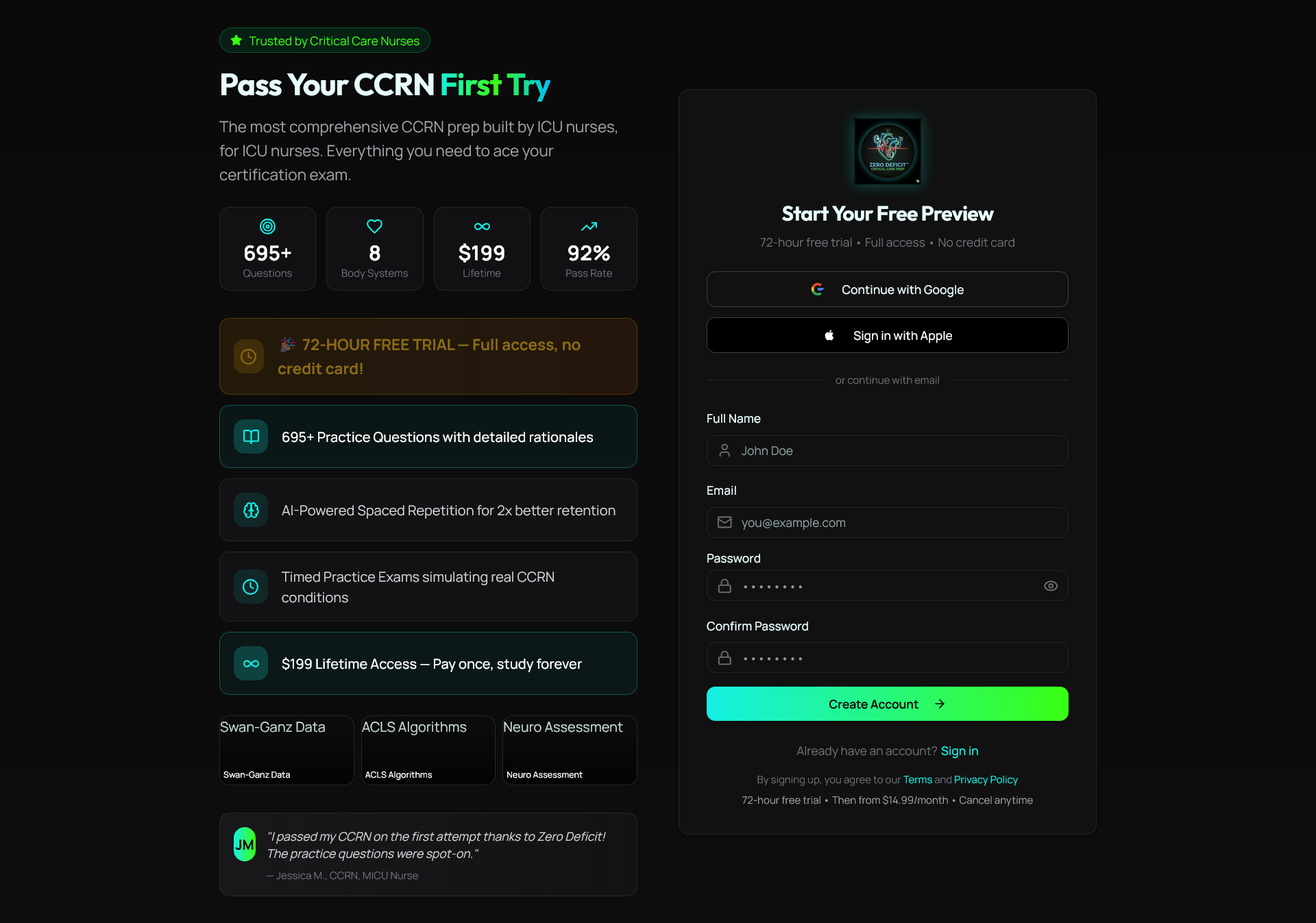
Zerodeficitccrnprep.com gives you over 695 CCRN practice questions organized by body system, detailed rationales that explain the clinical reasoning behind every answer, and study analytics that show exactly where your confidence gaps are. The question breakdown methods on the platform teach you to apply a consistent decision framework under timed conditions, which is the same skill that separates first-time passers from retakers. You can also access CCRN practice tests across all eight body systems to simulate real exam conditions and build retrieval fluency before test day. Start studying free at Zero Deficit CCRN Prep today. No credit card required.
FAQ
Why is confidence important in exams?
Confidence is important in exams because it keeps working memory fully available and prevents anxiety from blocking retrieval pathways. Research shows academic confidence accounts for nearly 30% of performance variance, independent of content knowledge.
How does exam anxiety affect performance?
Exam anxiety activates the fight-or-flight response, which floods the body with cortisol and narrows cognitive focus. This impairs recall, slows processing speed, and increases the likelihood of abandoning sound reasoning for impulsive guesses.
Can you build confidence before a high-stakes exam?
Yes. Confidence is built through structured preparation including spaced repetition, timed practice tests, and consistent review over 6 to 12 weeks. Earned confidence from repeated practice outperforms any amount of positive self-talk without preparation backing it.
What is the fastest way to reduce anxiety right before an exam?
The 4-7-8 breathing technique stabilizes focus in under 60 seconds by activating the parasympathetic nervous system. A quick brain dump of confirmed knowledge before starting the exam also activates retrieval pathways and reduces the cognitive interference caused by anxiety.
Does sleep really affect exam confidence?
Sleep is the primary mechanism for memory consolidation. Cramming overnight impairs the consolidation of everything you studied and amplifies fatigue-driven anxiety on test day. Protecting your sleep the night before the CCRN is one of the highest-return preparation decisions you can make.
Recommended
- The Role of Feedback in Nurse Study and CCRN Prep | Zero Deficit CCRN Prep
- Why assessment matters: Boost CCRN exam success | Zero Deficit CCRN Prep
- Pass the CCRN Exam: Proven Guide for Critical Care Nurses | Zero Deficit CCRN Prep
- How educators boost CCRN certification success for nurses | Zero Deficit CCRN Prep
Take a Neurological practice quiz
Test your knowledge of stroke, ICP, seizures, and neuro assessment.
Ready to pass your CCRN?
Join 12,000+ nurses using Zero Deficit — 695+ practice questions with rationales, AI-powered weak-area drilling, and spaced-repetition flashcards.
Start Free Trial →