Body system study guides: your key to CCRN success
TL;DR:
- Body system study guides organize CCRN content by major physiological systems, enhancing focus and clinical reasoning. Prioritized study of high-weight systems like cardiovascular and respiratory improves exam readiness through strategic review, practice, and mastery. Using diagnostic and active learning techniques with these guides maximizes retention and confidence for test day success.
The CCRN exam covers eight major body systems, dozens of disease processes, and hundreds of clinical scenarios, and most nurses hit a wall early in their prep when they realize that reading generic nursing textbooks isn’t enough. You need a focused, strategic approach that mirrors the exam itself. Body system study guides do exactly that. They cut through the noise, organize critical content into digestible sections, and align directly with the way the CCRN is actually structured. This article walks you through what these guides are, why they work, how to choose the best ones, and how to use them for maximum retention and confidence on exam day.
Table of Contents
- What are body system study guides?
- How body system study guides map to the CCRN exam
- Choosing the right body system study guides for your prep
- How to maximize your results with body system study guides
- Why most nurses underutilize body system study guides—and how you can do better
- Get started with Zero Deficit™ body system study guides
- Frequently asked questions
Key Takeaways
| Point | Details |
|---|---|
| System-based organization | Body system study guides break down CCRN material into manageable parts aligned with the exam blueprint. |
| Strategic exam focus | Using exam-weighted guides helps prioritize study time where it’s needed most for the test. |
| Resource selection matters | Choose current, high-yield system guides for the most effective CCRN preparation. |
| Active application | Integrate guides with practice tests and routine review for maximum retention and readiness. |
What are body system study guides?
Body system study guides are structured review resources that organize CCRN exam content by each major physiological system rather than by disease category or nursing specialty. Instead of reading about heart failure in one chapter and dysrhythmias in another, you work through the cardiovascular system as a complete unit. This matters because it builds the kind of systems thinking that the CCRN exam rewards.
Body system study guides are specifically organized around the eight major systems emphasized in the CCRN exam blueprint: cardiovascular, respiratory, neurological, gastrointestinal, endocrine, hematology, renal, and multisystem. Each guide zeroes in on pathophysiology, clinical presentation, nursing priorities, and pharmacology relevant to that specific system. You are not jumping between unrelated topics. You are building a complete picture of one system at a time.
The difference between system-based and topic-based guides is significant. Topic-based guides might group together all ICU medications or all monitoring techniques, which can leave gaps in your understanding of why certain interventions apply to specific systems. System-based guides maintain that clinical connection throughout, helping you think the way a critical care nurse thinks at the bedside.
Here is a quick look at how system-based guides compare to generic topic-based resources:
| Feature | Body system guides | Generic topic guides |
|---|---|---|
| Exam alignment | Direct match to CCRN blueprint | Partial match |
| Clinical context | Organized by system | Mixed across topics |
| Study efficiency | High, focused repetition | Variable |
| Pathophysiology depth | System-specific | Often surface-level |
| Practice question integration | System-specific questions | General questions |
Key benefits of using body system study guides include:
- Focused review that eliminates content overload
- Repetition within context, reinforcing how each concept connects to a system
- Systems thinking, which mirrors clinical reasoning on the exam
- Efficient use of study time, especially for nurses with limited prep windows
- Improved retention through organized, logical content sequencing
“Nurses who switch to system-based review consistently report greater clarity and higher confidence when they recognize exactly how much content they’ve truly mastered, system by system.”
This shift in structure alone changes how you experience exam prep. You stop feeling buried under random facts and start feeling like you are building real, durable knowledge.
How body system study guides map to the CCRN exam
Understanding the structure is only half the battle. It is also crucial to see how these guides map directly to what you will see on test day. The CCRN exam is not evenly distributed across all eight systems. Some systems carry significantly more weight, and your study time should reflect that reality.

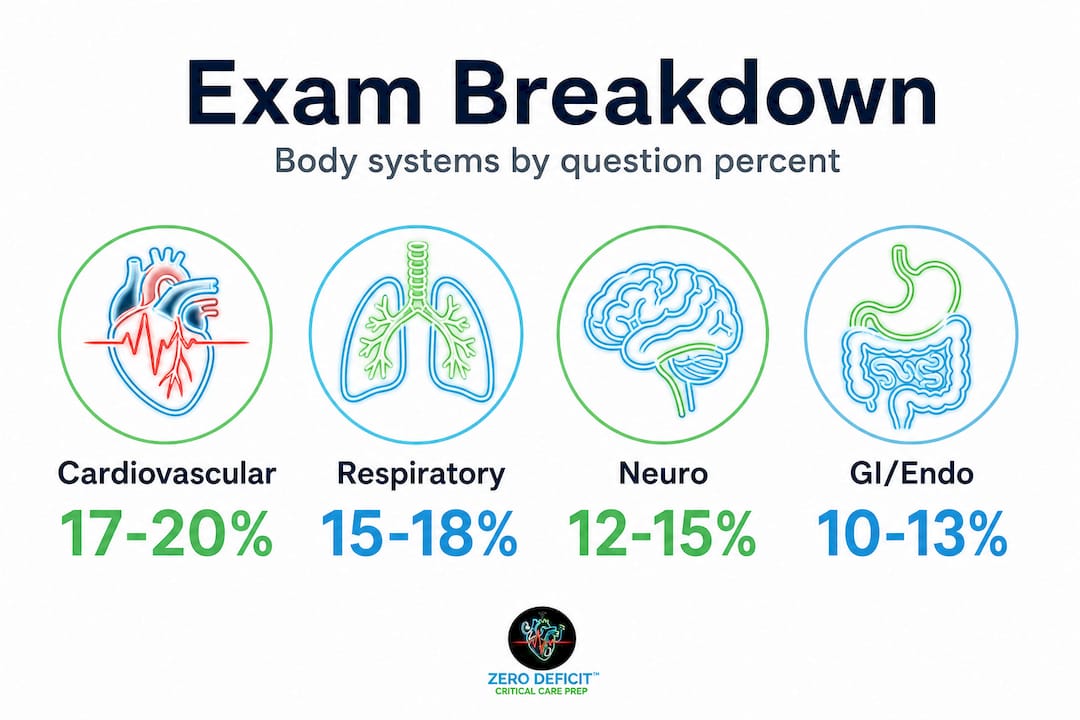
Here is an approximate breakdown of how questions are distributed across systems on the CCRN adult exam:
| Body system | Approximate % of exam questions |
|---|---|
| Cardiovascular | 17-20% |
| Respiratory | 15-18% |
| Neurological | 12-14% |
| Multisystem | 10-12% |
| Renal | 6-8% |
| Gastrointestinal | 6-8% |
| Hematology | 5-7% |
| Endocrine | 5-7% |
As you can see, cardiovascular and respiratory questions make up roughly one third of the exam combined. That does not mean you ignore the others, but it does mean your prep strategy needs to reflect those weights. Each system’s weight on the CCRN exam corresponds directly to how deep you should go in your prep, and system-based guides make it straightforward to allocate that time correctly.
Here is how using system-based guides ensures you study proportionally:
- Identify the highest-weight systems first and schedule them early in your review cycle.
- Use each system guide to assess your baseline knowledge before diving into content.
- Allocate more weekly review time to cardiovascular and respiratory, matching their exam weight.
- Rotate through lower-weight systems like hematology and endocrine without neglecting them entirely.
- Return to your weakest system after completing the full rotation for a second pass.
For example, the respiratory system guide covers mechanical ventilation, oxygenation failure, ARDS, and pulmonary embolism in a sequence that mirrors how exam questions are weighted within that system. Similarly, the hematology system guide targets coagulopathies, transfusion reactions, and DIC, which are high-yield topics despite the system’s smaller overall exam percentage.
Cardiovascular and respiratory questions alone account for approximately 32 to 38 percent of the total CCRN exam. Prioritizing these two systems in your first weeks of prep gives you the biggest return on your study investment.
Pro Tip: Before you open a single guide, map out a 12-week CCRN study plan and assign systems to specific weeks based on their exam weight. This prevents you from spending equal time on systems that carry unequal stakes.
Choosing the right body system study guides for your prep
Once you see the mapping, the next step is picking resources that match your style and maximize your results. Not all study guides are created equal, and choosing the wrong ones can cost you valuable time and confidence.
Quality guides offer targeted practice questions, succinct explanations, and often integrate with larger study plans, which is the combination that separates high-yield resources from generic review books. When evaluating any body system study guide, look for these essential features:
- Exam alignment: The guide should explicitly reference the CCRN blueprint and organize content to match it.
- System-specific practice questions: You need questions tied to each system, not a random mix at the end of a chapter.
- High-yield summaries: Condensed review sections that highlight the most testable content save time during final review.
- Pathophysiology integration: A guide that explains why a condition develops within a system is more valuable than one that just lists symptoms.
- Integration with a study schedule: The best guides tell you how to use them within a broader prep plan, not just what to read.
- Current edition: The CCRN blueprint is updated periodically, and an outdated guide may include content that no longer reflects current exam priorities.
When deciding between single-system guides and all-system bundles, think about where you are in your prep. If you are eight or more weeks out, an all-system bundle gives you a complete roadmap and ensures you do not skip any domain. If you are four weeks out and already have a strong foundation in most systems, targeted single-system guides let you drill your weakest areas without repeating content you have already mastered.
For instance, if neurological concepts are your weak spot, pulling a focused neurology system study guide lets you spend three to five days intensively reviewing ICP management, stroke, and seizure protocols without the distraction of other system content.
Pro Tip: Always check for updated 2026 editions when selecting guides. Exam content can shift with blueprint updates, and using current materials keeps your prep aligned with what will actually appear on test day. Outdated resources may reinforce concepts that are no longer heavily tested or miss newer clinical standards.
One major pitfall is over-relying on generic flashcard decks or broad nursing review books. These resources are helpful for memorizing isolated facts, but they rarely teach you how to reason through a clinical scenario at the system level, which is exactly what the CCRN exam demands. A study schedule structure built around system guides gives your prep the framework it needs.
How to maximize your results with body system study guides
Picking high-quality guides is powerful, but using them effectively is what turns effort into exam success. Many nurses invest in excellent resources and still underperform because their study habits are passive rather than active.
Here is a numbered framework for building a results-driven study routine using body system guides:
- Set a weekly review rotation. Commit to one to two systems per week, depending on their exam weight and your current confidence level. Do not move on until you can explain the system’s key conditions, interventions, and pharmacology without looking at your notes.
- Start each system with a diagnostic quiz. Before reading, take a short practice quiz on that system. This identifies your real gaps and focuses your reading on content that actually needs attention.
- Read actively and annotate. Write brief summaries after each section. If you can not explain a concept in two or three sentences, you do not know it well enough yet.
- Use system-specific practice questions immediately after reviewing content. The practice question bank is particularly effective here because it ties questions directly to system domains and provides detailed rationales.
- Review every incorrect answer before moving forward. Understanding why you got something wrong teaches more than reviewing what you got right.
- Integrate visual tools. Resources like the arrhythmia flowchart reinforce cardiovascular content and make complex rhythm interpretation stick faster than text alone.
- Complete a final pass on your weakest system in the last two weeks before the exam.
Combining system-based review with practice quizzes and strategic review boosts retention significantly. The reason is simple: you are not just reading, you are testing, analyzing, and rebuilding your understanding after every session.
Common mistakes to avoid:
- Not linking practice questions to the system you just reviewed, which breaks the feedback loop
- Skipping the rationale explanations when you get a question right, missing a chance to deepen your understanding
- Ignoring systems where you feel weak, because avoidance is the fastest path to a knowledge gap on test day
- Treating the guide as something to finish rather than something to master, which leads to passive reading without real retention
- Using the same study method for every system, when some systems (like cardiovascular) demand more application practice while others (like endocrine) reward heavy memorization
For additional strategies on structuring your review sessions, question breakdown tips offer practical methods for dissecting CCRN-style questions and identifying the reasoning pattern the exam rewards.
Pro Tip: Treat each system guide as a mini system bootcamp. Give it your full attention for its assigned week. Go in with a diagnostic mindset, study with intensity, and exit with measurable confidence. That focused repetition is what separates nurses who pass the first time from those who need a second attempt.
Why most nurses underutilize body system study guides—and how you can do better
We have covered the how-to, but here is what most guides won’t tell you about getting top scores with this approach.
The most common pattern we see is this: a nurse purchases a full set of body system guides, works through each one from page one to the end, completes a handful of practice questions, and considers the system “done.” That is passive consumption, not active mastery. And passive consumption does not translate to exam performance.
Real mastery is diagnostic. It means you open a guide knowing your weak points, you read with those gaps in mind, and you test yourself ruthlessly before declaring any system complete. The nurses who dramatically improve their scores are not the ones who read the most pages. They are the ones who identified their specific deficits and drilled with precision.
Here is the uncomfortable truth: most nurses avoid their weakest systems because reviewing them feels discouraging. If you struggle with renal content or find hematology confusing, your instinct is to spend more time on cardiovascular where you feel competent. That is exactly backwards. Your weakest system is where the exam will catch you.
The best performers use a cycle: review, test, analyze errors, review again. They iterate. They do not move forward until the numbers improve. A real-world study plan supports exactly this kind of iterative approach, building in time to circle back rather than treating exam prep as a linear march through content.
Our take is this: completion is not the goal. Mastery is. If you finish every guide but cannot accurately answer questions on your weakest two systems, you have not prepared. You have just read. Start using these guides diagnostically, and you will see a different kind of result.
Get started with Zero Deficit™ body system study guides
If you are ready to tackle your weakest areas and prep with purpose, here is the path forward.
Zero Deficit™ offers CCRN study guide bundles covering all eight body systems tested on the CCRN exam, built to align with the current exam blueprint. Whether you want a complete system-by-system bundle or a targeted single-system deep dive, the resources are structured to give you exactly what you need at each stage of prep.
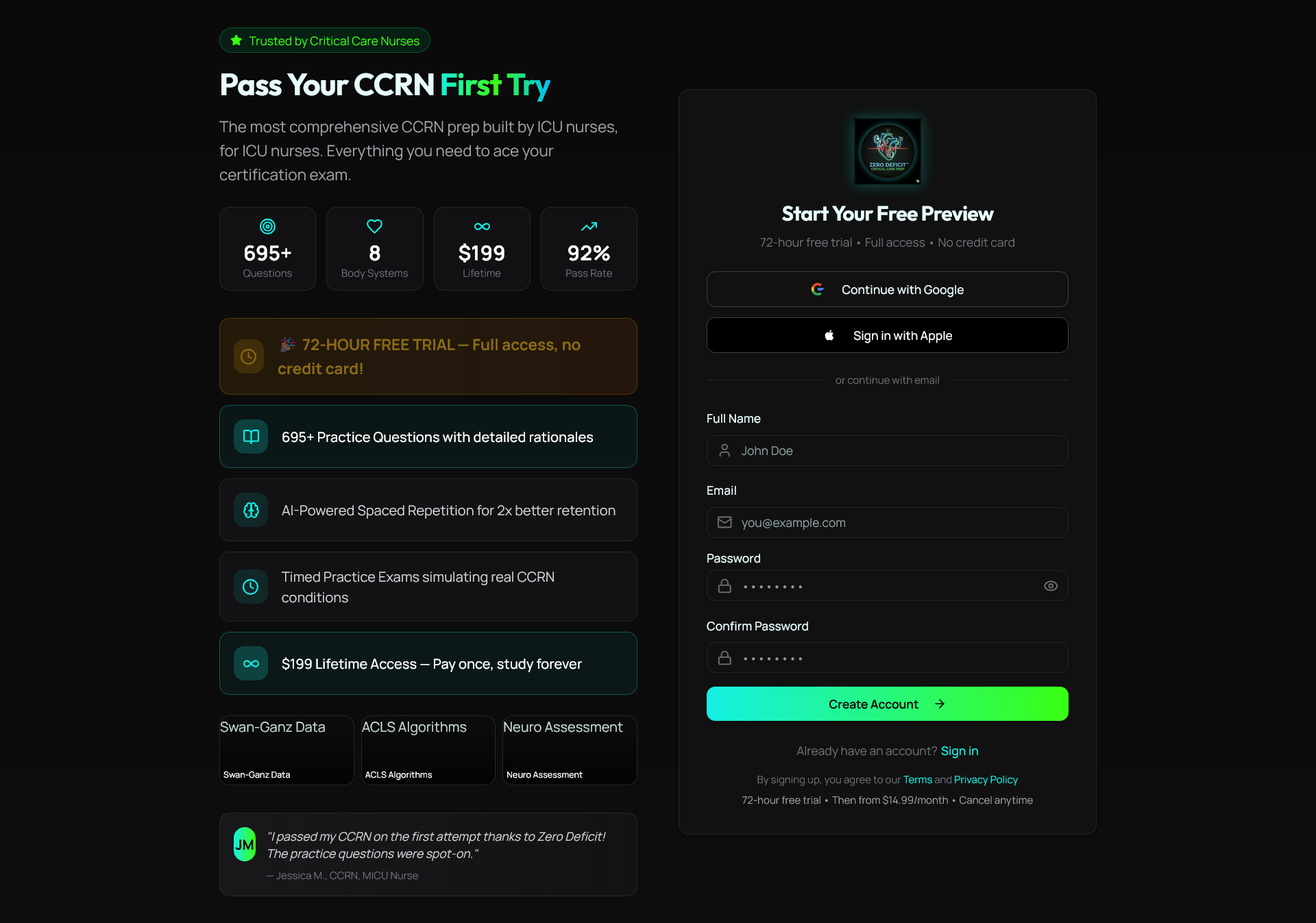
Pair your system guides with a detailed 12-week CCRN plan that maps your review by week, ensures proportional coverage, and builds in time for repetition and reassessment. Zero Deficit™ also offers a free version with no credit card required, so you can evaluate the quality of the materials before making any commitment. With over 695 practice questions, AI-powered review tools, and progress tracking built in, you have everything you need to prep with confidence and pass on your first attempt.
Frequently asked questions
Do I need to study all eight body systems equally for the CCRN exam?
No, focus more on systems that have a higher percentage of exam questions, using guides to prioritize your time. System weightings guide proportional study focus, so cardiovascular and respiratory deserve the most attention.
What makes a good body system study guide for CCRN?
A quality guide is exam-aligned, includes practice questions, and integrates review strategies for each system. Quality guides offer targeted practice and succinct explanations that connect pathophysiology to clinical reasoning.
How early should I start using body system study guides for exam prep?
Begin at least two to three months out to allow for systematic review, repetition, and assessment. Starting earlier gives you time to complete multiple passes through your weakest systems before exam day.
Should I supplement body system study guides with other resources?
Yes, blend guides with practice questions and diagnostic tools for best results. Combining system-based review with quizzes boosts retention and gives you the feedback loop needed to close knowledge gaps before test day.
Recommended
Take a Respiratory practice quiz
Master ARDS, ventilation, ABGs, oxygenation, and pulmonary emergencies.
Get Your Free 20-Question CCRN Diagnostic
20 high-yield CCRN-style questions across every body system, with detailed rationales — emailed to you instantly.
No spam. One email + a couple of helpful follow-ups. Unsubscribe anytime.
Ready to pass your CCRN?
Join 12,000+ nurses using Zero Deficit — 695+ practice questions with rationales, AI-powered weak-area drilling, and spaced-repetition flashcards.
Start Free Trial →