CCRN Case Study Practice: A 6-Week Plan for ICU RNs
Focus your CCRN prep on AACN-aligned, case-based practice questions paired with timed full-length simulations. That combination trains the exact skill the exam measures: clinical reasoning under time pressure, not fact recall. If you only review flashcards or reread a content outline, you’re prepping for a different test than the one you’ll sit for.
Here’s what to do in the next hour:
- Pull a free sample set and work it cold, no notes, no lookups.
- Run one timed 25-question block covering mixed systems, not a single-topic quiz.
- Read every rationale, including the ones for questions you got right.
Then build the habit around it:
- Schedule three 30-minute practice sessions this week.
- Log every missed question by system and error type.
- Book a full-length timed simulation for week five of your plan.
Start with a trial run through Zero Deficit’s practice questions. You’ll see how the rationales break down clinical reasoning step by step, not just flag right or wrong, so you know within one session whether the format matches how you actually learn.
Key Takeaways
Passing the CCRN depends on case-based practice with detailed rationales, timed full-length simulations, and a structured six-week schedule that shifts from focused review to mixed-domain performance testing.
| Point | Details |
|---|---|
| Start with a sample | Take a free trial question set cold to see your true baseline before studying. |
| Prioritize rationale depth | Choose materials that explain why wrong answers fail, not just which choice is correct. |
| Hit your volume target | Work toward a substantial number of practice questions with full rationale review. |
| Interleave before the exam | Shift to mixed-domain timed sets in weeks four and five, not single-system blocks. |
| Try Zero Deficit™ first | Its 695+ AACN-aligned questions and full-length sims match every item on the checklist above. |
Table of Contents
- What Does the Adult CCRN Exam Actually Test?
- Why Case-Based Practice Builds the Reasoning the CCRN Tests
- What to Look for in CCRN Case Study Practice Materials
- How to Use Case Studies Effectively: A 6-Week Plan
- Why Zero Deficit™ Fits This Plan
- A Nurse-to-Nurse Note From Zero
- Get Started With Zero Deficit CCRN Prep
- Sources
- FAQ
What Does the Adult CCRN Exam Actually Test?
The Adult CCRN blueprint splits roughly into clinical judgment and professional caring practices, with clinical judgment carrying by far the heavier weight. The AACN’s own exam framework organizes content by body system and explicitly emphasizes interpreting patient data and selecting priority interventions over memorized facts.
You’ll see questions distributed across:
- Cardiovascular (hemodynamics, shock states, ACS, vasoactive drips)
- Pulmonary (ARDS, ventilator management, ABG interpretation)
- Neurologic (ICP management, acute stroke)
- Sepsis and multisystem organ dysfunction
- Endocrine emergencies
- Renal and CRRT
- Hematology and immunology
- Gastrointestinal
- Integumentary and musculoskeletal
Notice what’s missing from that list: pure definitions. The exam wants you to look at a patient scenario, a set of labs, and a ventilator readout, then decide what to do next. That’s a reasoning skill, and reasoning skills don’t build from reading alone. They build from repeated exposure to realistic decision points, which is exactly what case-based practice questions simulate.
Why Case-Based Practice Builds the Reasoning the CCRN Tests
Passive review feels productive. It isn’t, at least not for this exam. Educational research on active recall consistently shows that retrieval practice and scenario simulation outperform rereading for building applied clinical judgment. You don’t get better at interpreting a hemodynamic profile by reading about hemodynamics. You get better by being handed one, cold, and forced to decide.
Detailed rationales matter just as much as the questions themselves. A rationale that only tells you “the answer is C” teaches you nothing repeatable. A rationale that walks through why B looked tempting but the trend in the patient’s lactate ruled it out trains the exact pattern-recognition and elimination process you’ll use on exam day. That’s the difference between memorizing an answer key and building a mental model you can apply to a scenario you’ve never seen. Our breakdown of how exam rationales drive certification success goes deeper on this if you want to see why rationale quality should be your top filter when picking a question bank.
Working questions that combine pharmacology with hemodynamic and clinical data is also the fastest route to the kind of automatic, pattern-based thinking the timed exam rewards, according to guidance from PracticeTestGeeks, which flags pharmacology and hemodynamics as the two domains where candidates most often stumble.
Pro Tip: After every shift, pick one patient you cared for and turn it into a two-question quiz: “What was the priority intervention, and what data point drove that decision?” Write both down. You just built a free practice case from your own clinical day.

Reviewers who track CCRN prep outcomes recommend diagnostic baseline testing followed by daily question sets and full-length timed practice as the core activities that convert bedside experience into exam-ready judgment. Reading alone doesn’t do that conversion. Testing does.
What to Look for in CCRN Case Study Practice Materials
Not every question bank labeled “CCRN prep” is built the same way. Before you commit money or study hours, run any resource through this checklist.
| Criterion | What to check |
|---|---|
| Blueprint alignment | Questions map to AACN’s system-by-system structure, not a generic ICU trivia list |
| Case quality | Multisystem scenarios with labs, hemodynamics, and vitals revealed in stages, not dumped all at once |
| Rationale depth | Explains why the correct answer is right and why each distractor fails clinically |
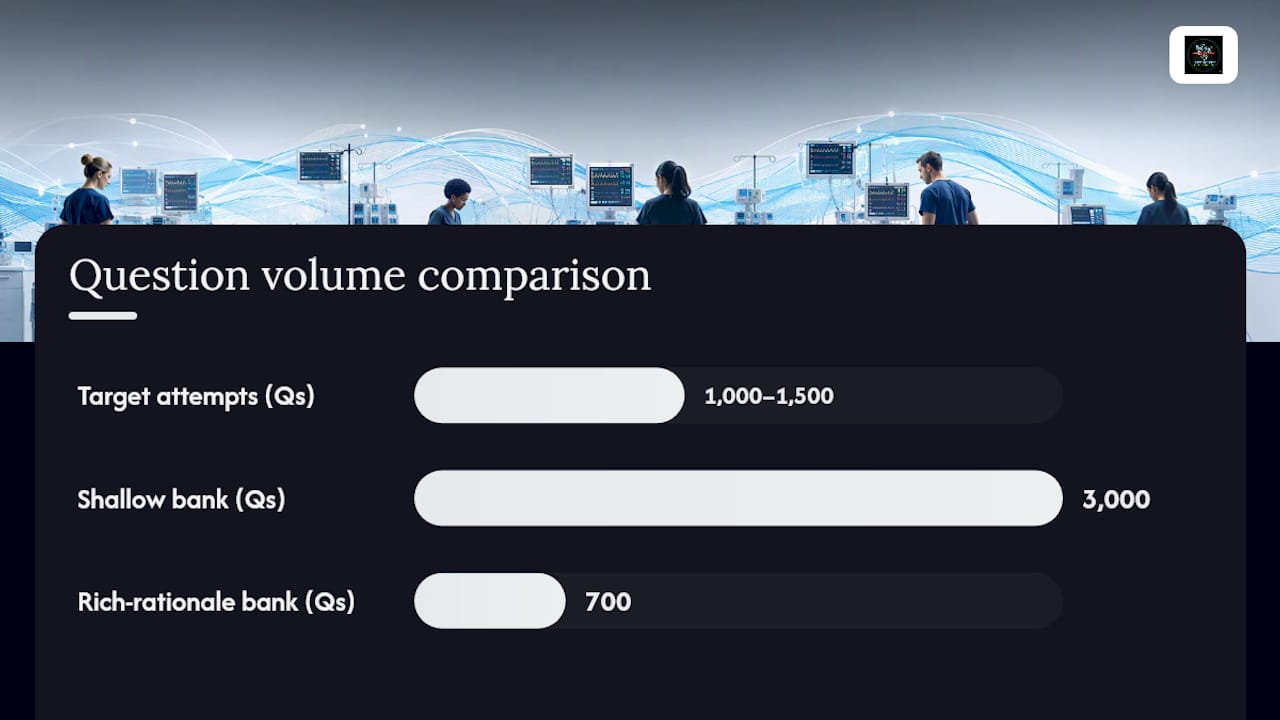
| Question volume | Enough items to reach 1,000 to 1,500 total attempts, plus full-length timed simulations |
| Learning tech | Spaced repetition, progress analytics, and remediation tied to your weak systems |
| Trial and pricing | A free sample or trial period, transparent tiers, no surprise lock-in |
A few of these deserve a closer look. Case quality is the one most banks fake. A “case-based” question that’s really just a single vital sign with four answer choices isn’t a case; it’s a regular question wearing a costume. A real case, like the multi-day sepsis scenario documented in nursing case study literature, builds across admission findings, sequential labs, ventilator changes, and multidisciplinary planning. That structure lets one scenario generate several exam-style questions, each testing a different decision point along the patient’s course.

Volume matters too, but only paired with rationale quality. A bank of 3,000 shallow questions teaches you less than 700 questions with rationales that explain the reasoning behind every option.
How to Use Case Studies Effectively: A 6-Week Plan
Random practice beats no practice, but a structured six-week runway beats random practice by a wide margin.
- Week 1: Baseline. Take one untimed diagnostic set across all systems. Don’t study first. You need to see your actual weak spots, not your assumed ones.
- Weeks 2 to 3: Focused system blocks. Spend two to three days per system (cardiovascular, pulmonary, neuro, sepsis/MODS, endocrine, renal/CRRT) working case questions and reading every rationale, right or wrong.
- Week 4: Interleaving. Stop studying single systems. Run mixed-domain timed sets that force you to switch context question to question, the same way the real exam will.
- Week 5: Volume push. This is where you close in on the a substantial number of practice questions that reviewers associate with stronger outcomes, shifting your ratio toward timed, mixed-domain sets, as commonly recommended.
- Week 6: Full simulation. Run at least one full-length, timed practice exam under real conditions. No pausing, no notes.
Daily, keep the routine simple: one timed block, full rationale review afterward, and a short log of every miss. Categorize each error as a knowledge gap, a reasoning error, or a careless mistake, then reattempt missed items about 48 hours later to confirm the fix stuck. Our guide to reviewing CCRN rationales walks through this exact log-and-recheck method in more detail.
Pro Tip: When you’re working an ABG or hemodynamic profile under a timer, resist the urge to calculate everything from scratch. Pattern-match first: does this look like compensated respiratory acidosis, or decompensated? Confirm with the numbers second. That order is faster and it’s how you’ll actually think during the real exam.
For extra review reps outside your main question bank, the Nursing School Pro study center offers system-specific refreshers that pair well with case practice, especially if you need to shore up baseline assessment skills before tackling higher-order scenarios.
Why Zero Deficit™ Fits This Plan
Zero Deficit™ was built around the exact workflow described above: system-aligned case practice, dense rationales, and a path from acquisition to timed performance.
- Over 695 practice questions organized by AACN blueprint system
- Detailed rationales written to explain clinical reasoning, not just flag the correct choice
- Full-length timed simulations for your week-six performance push
- Progress analytics that show which systems need another pass
- Spaced-repetition review built into the study flow
- Study guides created by ICU nurse experts, aligned to the same blueprint structure
Zero Deficit’s 695+ CCRN practice questions include a trial, so you can run the same baseline-and-review process described in week one of the plan above before committing to a subscription. Many candidates who complete the full question bank and rationale review report passing on their first attempt, a signal worth weighing alongside the feature checklist itself.
A Nurse-to-Nurse Note From Zero
I’ve watched too many strong ICU nurses over-prepare on content and under-prepare on test-taking reflexes. You already know sepsis pathophysiology cold from your unit. What trips people up isn’t knowledge, it’s speed under pressure and the discipline to eliminate wrong answers systematically instead of second-guessing a gut call. The single habit that separated my strongest candidates from the rest: they reviewed every missed rationale within 48 hours, out loud, as if explaining it to a new grad. Saying the reasoning aloud forces you to catch the gap between “I sort of remember this” and “I actually understand why.”
Get Started With Zero Deficit CCRN Prep
You’ve read the plan. Building it yourself from scattered PDFs and forum threads costs you weeks you don’t have. Zero Deficit gives you the whole six-week structure in one place: system-organized case questions, rationales written by ICU nurses, and full-length simulations ready to run in week six without you having to assemble any of it.
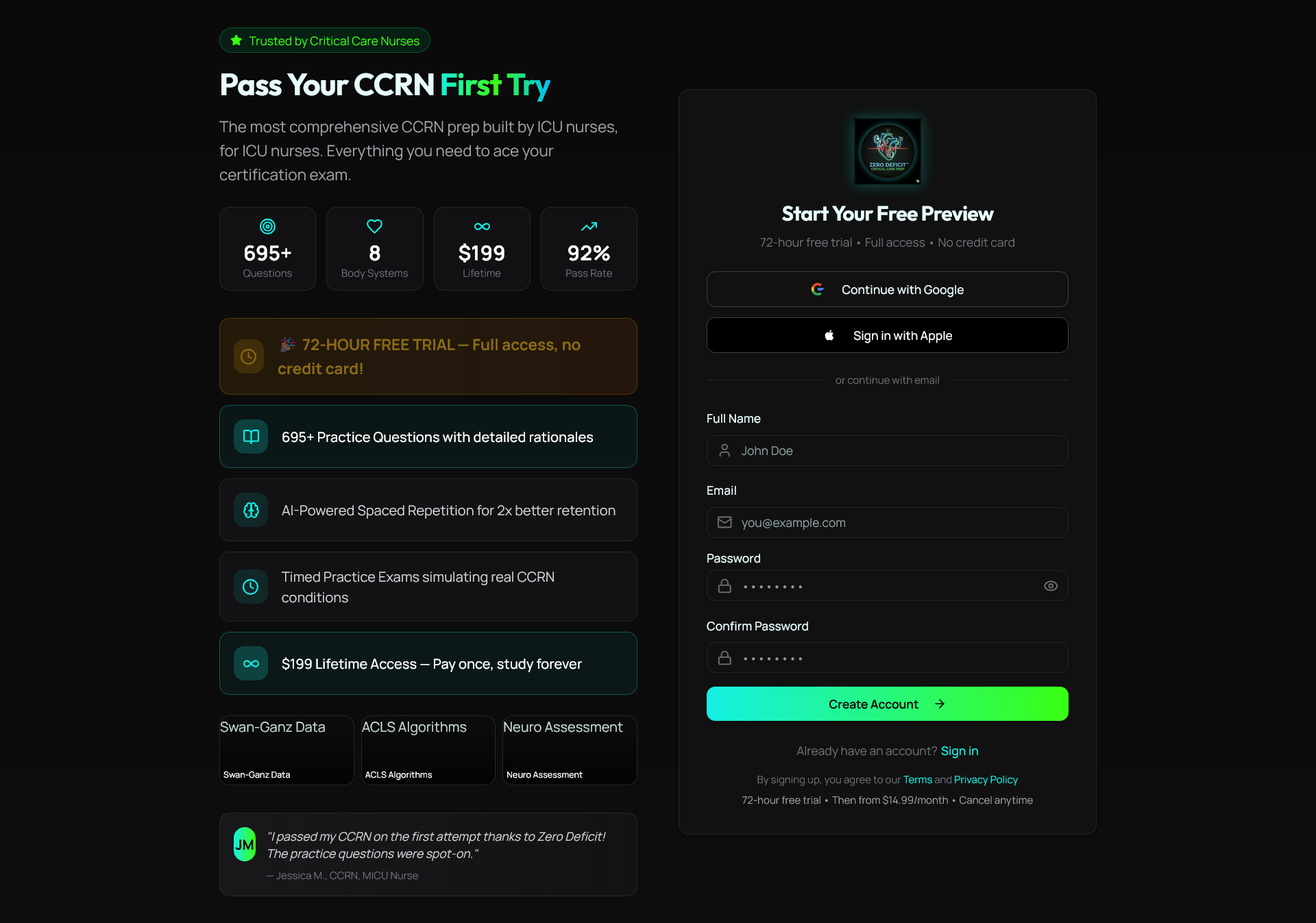
What makes this fit your situation specifically is the rationale depth. You’re not buying a stack of flashcards; you’re buying an explanation for every distractor, which is the piece most question banks skip and the piece that actually builds exam-day reasoning. Start with the free trial on the practice questions page, work one timed set, and read every rationale before you decide whether to upgrade. If you want to see the system breakdown first, the practice tests by body system page shows exactly how coverage maps to the AACN blueprint. Either way, your next step is the same: try one real set today and judge the rationale quality for yourself.
Sources
- CCRN Certification: The Complete Study Guide for ICU Nurses | The ICU Nurse
- CCRN Test Questions: Free practice & answers (PracticeTestGeeks)
- Best ways to revise — active recall (Birmingham City University)
- Case study: Genevieve Cragoe — Nursing case studies (Pressbooks)
FAQ
What Is CCRN Case Study Practice?
It means working realistic, multisystem patient scenarios as practice questions, with detailed rationales, instead of memorizing isolated facts. This trains the clinical reasoning the AACN blueprint actually tests.
How Many Practice Questions Should I Complete Before the CCRN?
Reviewers recommend a substantial number of practice questions with full rationale review, shifting to mixed-domain timed sets in your final weeks.
Does Zero Deficit™ Include Full-Length Timed Simulations?
Yes. Zero Deficit’s question bank includes full-length timed simulations alongside its 695+ system-organized practice questions and detailed rationales.
How Long Should I Study Before Taking the CCRN?
A six-week plan works well if you can commit daily time: two weeks on baseline and system blocks, two weeks on interleaved timed practice, and two weeks pushing volume and running full simulations.
What’s the Best Way to Review a Missed Practice Question?
Categorize the miss as a knowledge gap, a reasoning error, or a careless mistake, then reattempt it about 48 hours later to confirm the correction held.
Recommended
Take a Respiratory practice quiz
Master ARDS, ventilation, ABGs, oxygenation, and pulmonary emergencies.
Get Your Free 20-Question CCRN Diagnostic
20 high-yield CCRN-style questions across every body system, with detailed rationales — emailed to you instantly.
No spam. One email + a couple of helpful follow-ups. Unsubscribe anytime.
Ready to pass your CCRN?
Join 12,000+ nurses using Zero Deficit — 695+ practice questions with rationales, AI-powered weak-area drilling, and spaced-repetition flashcards.
Start Free Trial →