CCRN Scoring Explained for ICU Nurses: Why 83 of 125 Matters
The Adult CCRN passing standard is a raw cut score of 83 correct scored items, effective November 12, 2025. The exam has 150 total items, but only 125 count toward your score. The other 25 are unscored pretest items you cannot identify, so every question on the screen deserves your full clinical reasoning, not a guess at which ones “matter.”
TL;DR:
- The passing standard is 83 correct answers out of 125 scored items, but this number can shift slightly based on exam difficulty and form equating.
- All 150 questions are on the exam, with 25 unscored pretest items that are indistinguishable from scored questions, requiring consistent clinical reasoning throughout.
- The cut score is criterion-referenced, measuring competency rather than ranking against other candidates, and can vary with exam revisions or difficulty adjustments.
- Focus your study on achieving a total correct count, rather than calculating a percentage, and improve your weakest domains while maintaining strength across all areas.
- Use timed, full-blueprint practice tests to simulate test day pacing and develop strategies to answer every question within the time limit.
Table of Contents
- CCRN Scoring Explained: What the Passing Standard Really Means
- How the CCRN Exam Is Built: Scored vs. Unscored Items
- How AACN Sets the CCRN Cut Score
- Reading Your CCRN Score Report: Totals vs. Domain Breakdowns
- Test-Day Scoring Strategy: Pacing and Answering Every Item
- If You Don’t Pass the CCRN: Retake Rules and Next Steps
- Why the Score Report Should Drive Your Study Plan, Not Just Your Confidence
- Study Smarter With Zero Deficit™ Practice Resources
- Sources
- FAQ
CCRN Scoring Explained: What the Passing Standard Really Means
The current Adult CCRN cut score is 83 out of 125 scored items, effective as of November 12, 2025. That number is tempting to memorize, but treating it as a fixed percentage is the single most common misunderstanding candidates carry into test day.
Here’s why that matters:
- The cut score is a raw item count, not a percentage carved in stone.
- AACN can adjust the required number of correct items when the exam is revised or when forms are equated for difficulty.
- A future exam version could require 82 or 85 correct items depending on how the item pool changes, even if the content blueprint stays the same.
The standard-setting logic behind this number is criterion-referenced, meaning it measures whether you demonstrate the competency of a safe, effective critical care nurse. It isn’t graded on a curve against other candidates in your testing window. Two people testing months apart, on different forms, can face slightly different raw thresholds while both being held to the same competency bar.
How the CCRN Exam Is Built: Scored vs. Unscored Items
Understanding the architecture of the exam clarifies why every question deserves your attention.
- Total test time: 3 hours to complete the exam.
- Total items: 150 multiple-choice questions.
- Scored items: 125 items count toward your pass/fail result.
- Pretest items: 25 unscored items are mixed in to gather future exam data.
The pretest items look, feel, and behave exactly like scored ones. AACN doesn’t flag them, and you won’t spot a pattern that separates them from the 125 that count. That design is intentional: it keeps you answering every item with the same level of clinical rigor, rather than trying to game the test. The practical takeaway is simple. You cannot afford to coast through any block of questions assuming it might be “just pretest.” Answer everything as if it counts, because statistically, five out of every six items do.
How AACN Sets the CCRN Cut Score
The number 83 didn’t come from a committee guessing at a round figure. AACN uses a criterion-referenced modified Angoff process, a standard-setting method used widely across nursing and medical certification.
Here’s roughly how it works:
- A panel of practicing critical care subject-matter experts reviews each exam item individually.
- Each expert estimates the percentage of “minimally competent” CCRN-level nurses who would answer that item correctly.
- Those estimates are averaged and combined across all scored items to produce a target cut score.
- AACN’s Score Evaluation Committee reviews the results, and psychometricians apply statistical equating whenever exam forms differ in difficulty.
That equating step explains why the cut score can shift slightly between exam versions even when the content blueprint is unchanged. A harder form gets a statistically adjusted lower raw threshold; an easier form gets a higher one. The goal is that the competency bar stays constant even though the raw number moves.
Pro Tip: Stop trying to calculate your “percentage needed” from memory. Focus your energy on absolute correct-answer count across mixed practice, since that’s the metric AACN actually measures.
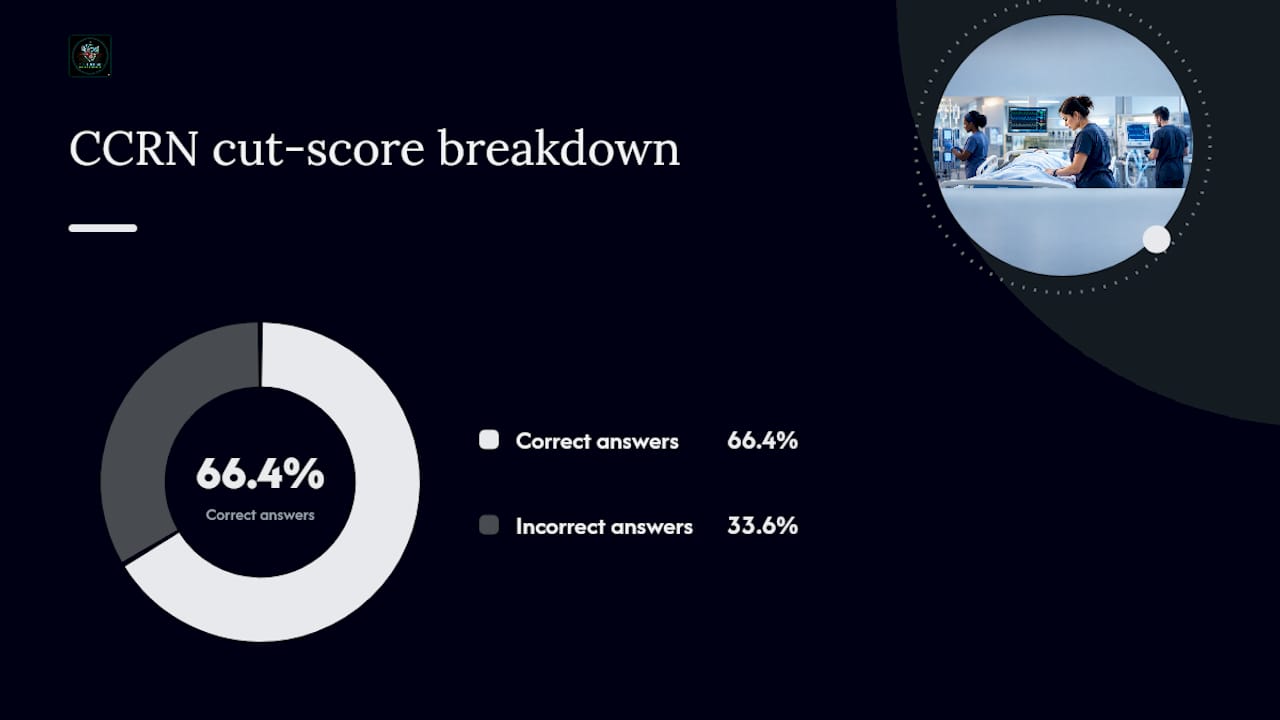
This is also why the standard is criterion-referenced rather than norm-referenced. You are not competing against the other nurses testing that quarter. You are being measured against a fixed definition of competent bedside practice, set independently of who else sits for the exam.
Reading Your CCRN Score Report: Totals vs. Domain Breakdowns

Your pass or fail result rests entirely on one number: total scored items correct out of 125. Everything else on your score report is diagnostic feedback, not a separate hurdle.
Domain breakdowns typically cover categories aligned with the CCRN blueprint:
- Cardiovascular (hemodynamics, shock states, ACS, vasoactive drips)
- Pulmonary (ARDS, ventilator management, ABG interpretation)
- Neurological (ICP monitoring, stroke management)
- Sepsis and multi-organ dysfunction
- Endocrine emergencies
- Renal and CRRT
- Professional caring practices, Synergy Model, and ethics
A weak percentage in one domain doesn’t fail you on its own. What fails you is not accumulating 83 correct answers across the full 125. That distinction changes how you should study after a strong or weak attempt. If your cardiovascular domain looks thin, don’t abandon the other six categories to drill it exclusively. Raising your total score usually means shoring up your weakest domain while maintaining strength everywhere else through mixed, full-blueprint practice.
Test-Day Scoring Strategy: Pacing and Answering Every Item
Your pacing math is straightforward: 150 items across 180 minutes gives you roughly 72 seconds per question. That’s tight, but manageable if you build discipline into your approach.
- Set an internal checkpoint. By item 75, you should be roughly at the 90 minute mark.
- There is no penalty for guessing, so never leave an item blank.
- Use an answer, mark, and move rule for tough items. Commit to your best clinical judgment, flag it, and return only if time allows.
- Maintain the same reasoning process on every item, since experimental questions are indistinguishable from scored ones.
Pro Tip: If you find yourself spending more than two minutes on a single question, that’s a signal to answer your best guess and move on. Sitting there rereading the stem rarely improves accuracy; it just steals seconds from items you could actually get right.
If You Don’t Pass the CCRN: Retake Rules and Next Steps
A failed attempt is a data point, not a verdict. AACN allows up to four attempts within a 12 month period, and a discounted retest fee is often available until you pass.
Your retake plan should follow your score report, not your gut feeling:
- Identify your lowest-performing domains from the diagnostic breakdown.
- Rebuild those domains with targeted CRRT or sepsis and MODS review rather than generic re-reading.
- Layer in timed, mixed-domain practice so you’re raising your overall correct count, not just one category.
- Run at least one full-length simulation before your next attempt date.
The CCRN retake policy rewards nurses who treat the second attempt as a targeted remediation project, not a repeat of the same study plan that didn’t work the first time.
Why the Score Report Should Drive Your Study Plan, Not Just Your Confidence
Passing the CCRN means meeting a fixed competency standard, nothing more mystical than that. Your score report is a roadmap. Use it to balance review across cardiac hemodynamics, vents and ABGs, neuro, sepsis and MODS, renal and CRRT, and the Synergy Model, instead of chasing one weak domain in isolation.
— Zero
Study Smarter With Zero Deficit™ Practice Resources
Zero Deficit™ is built around the exact scoring reality covered above: your total correct count decides pass or fail, so your prep needs to hit every domain, not just your comfort zone. Instead of generic flashcards, you get AI powered review tools that adapt to your weak areas, detailed rationales on every question so you understand the “why” behind each answer, and system-by-system study guides written by ICU nurses who’ve sat where you’re sitting.
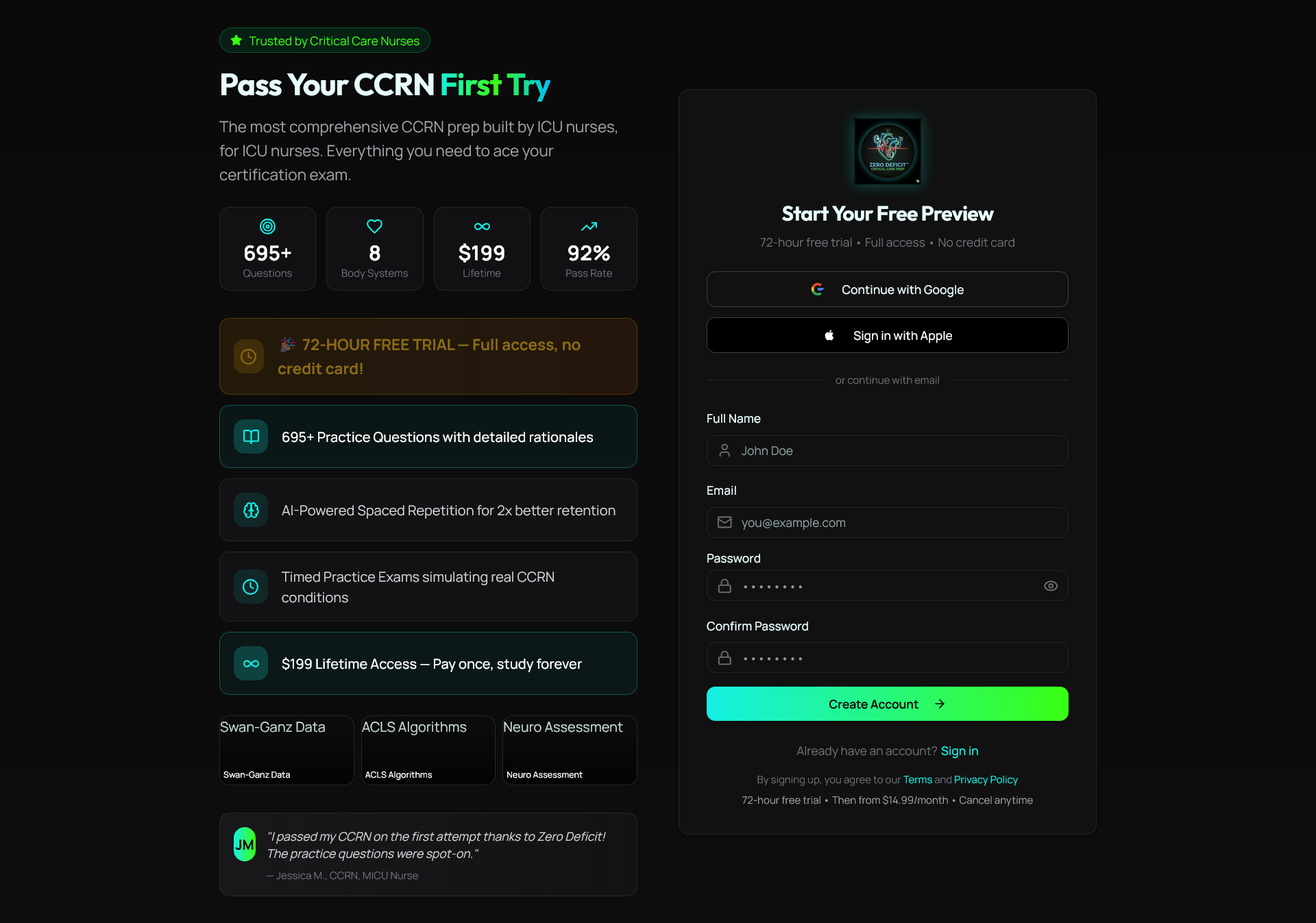
The platform’s 695+ practice questions map directly to the remediation strategy in this article: diagnostic rationales for domain gaps, spaced repetition to lock in retention, and timed practice simulations that mirror the actual 72 seconds per item pace you’ll face on test day. Whether you’re prepping for your first attempt or rebuilding after a near miss, start with a trial and see where your domain gaps actually are. Plans run from Premium Monthly at $14.99 per month to Yearly Access at $84.99 per year, with a Lifetime Mastery option also available on the subscription page.
FAQ
How are CCRN exams scored?
Your CCRN score is based on the number of correct answers among the 125 scored items out of 150 total questions. AACN uses a criterion-referenced modified Angoff process with subject-matter expert review to set the required cut score.
What is the passing score for the CCRN exam?
The current Adult CCRN passing standard is 83 correct scored items, effective November 12, 2025. That number reflects a raw competency threshold, not a fixed percentage, and can shift slightly when exam forms are revised or equated.
What is a good CCRN score?
Any result at or above the current cut score of 83 correct scored items counts as a pass. There is no separate “excellent” tier reported beyond pass or fail. Your domain breakdown gives diagnostic detail on relative strengths, but it does not change your pass or fail outcome.
How many questions do I need to get right on the CCRN exam to pass?
You need 83 correct answers out of the 125 scored items to pass the current Adult CCRN exam. The remaining 25 items on the 150 question exam are unscored pretest questions that look identical to scored ones, so treat every question as if it counts. Practicing with a full question bank like Zero Deficit’s practice questions helps you build the consistent accuracy needed to clear that threshold.
Recommended
Take a Respiratory practice quiz
Master ARDS, ventilation, ABGs, oxygenation, and pulmonary emergencies.
Get Your Free 20-Question CCRN Diagnostic
20 high-yield CCRN-style questions across every body system, with detailed rationales — emailed to you instantly.
No spam. One email + a couple of helpful follow-ups. Unsubscribe anytime.
Ready to pass your CCRN?
Join 12,000+ nurses using Zero Deficit — 695+ practice questions with rationales, AI-powered weak-area drilling, and spaced-repetition flashcards.
Start Free Trial →