Fix CCRN Difficulty in 8 Weeks: Question First Plan for ICU RNs
The CCRN is hard because it tests clinical judgment under time pressure, not because the content is obscure. It is with a crashing patient that prepared nurses lose points. The exam runs 150 items (125 scored) in three hours, and the CCRN exam handbook confirms passing comes down to a panel-set cut score, not a fixed percentage.
TL;DR:
- The CCRN exam emphasizes clinical judgment over rote knowledge, requiring practitioners to interpret complex scenarios and prioritize interventions under time constraints.
- The exam’s cut score is set by expert panels based on exam difficulty, meaning candidates need to meet a specific raw score that varies with each version, not a fixed percentage.
- The most heavily weighted domains are Endocrine, Hematology, Gastrointestinal, Renal, and Integumentary systems, which should be prioritized during study.
- A focused, question-driven study plan over eight weeks involving timed practice and error tracking is more effective than passive content review alone.
- Success depends on prior clinical ICU experience and practicing scenario-based questions, especially for newer nurses or retakers seeking to identify and close reasoning gaps.
Table of Contents
- Why the CCRN Feels Hard Even to Experienced ICU Nurses
- Exam Facts: Items, Timing, Scoring, and What “Passing” Really Means
- Hardest Domains Under the November 2025 AACN Blueprint
- An 8-Week, Question-First Study Plan That Matches How the Exam Actually Tests You
- Test-Day Tactics and What To Do If You Don’t Pass
- How Your Clinical Experience Level Changes the Way the CCRN Feels
- Comparing CCRN Difficulty to Other Nursing Certifications
- A Nurse-to-Nurse Take on What Actually Predicts a Pass
- Try Zero Deficit’s Practice Questions and Exam Simulations
- Sources
- FAQ
Why the CCRN Feels Hard Even to Experienced ICU Nurses
You already know your unit. You’ve titrated levophed, read a dozen ABGs before lunch, and talked a family through a withdrawal-of-care conversation. So why does the CCRN still feel like it’s speaking a different language sometimes? Because it isn’t testing what you know. It’s testing what you’d do with what you know, under constraints you don’t control.
AACN designs roughly 80% of the exam around clinical judgment, with the remaining share covering professional caring and ethical practice, according to the CCRN adult certification overview. That ratio is the whole story. A recall question asks you to identify a normal potassium range. A situational item gives you a patient with a potassium of 6.8, peaked T waves, and three plausible next steps, only one of which is right right now.
The exam draws on several distinct reasoning skills:
- Interpreting waveforms and hemodynamic numbers together, not in isolation
- Prioritizing among several correct-sounding interventions
- Recognizing when a “textbook” answer is wrong for this specific patient
- Synthesizing labs, vitals, and history into one clinical picture
This is exactly why passive review, rereading notes, highlighting review books, tends to plateau. It builds recognition, not judgment. Judgment only builds through repeated exposure to scenarios where you have to choose, get it wrong, and find out why.
Pro Tip: If you can explain out loud why the wrong answer choices are wrong, not just why the right one is right, you’re building the reasoning skill the exam actually tests.
Exam Facts: Items, Timing, Scoring, and What “Passing” Really Means
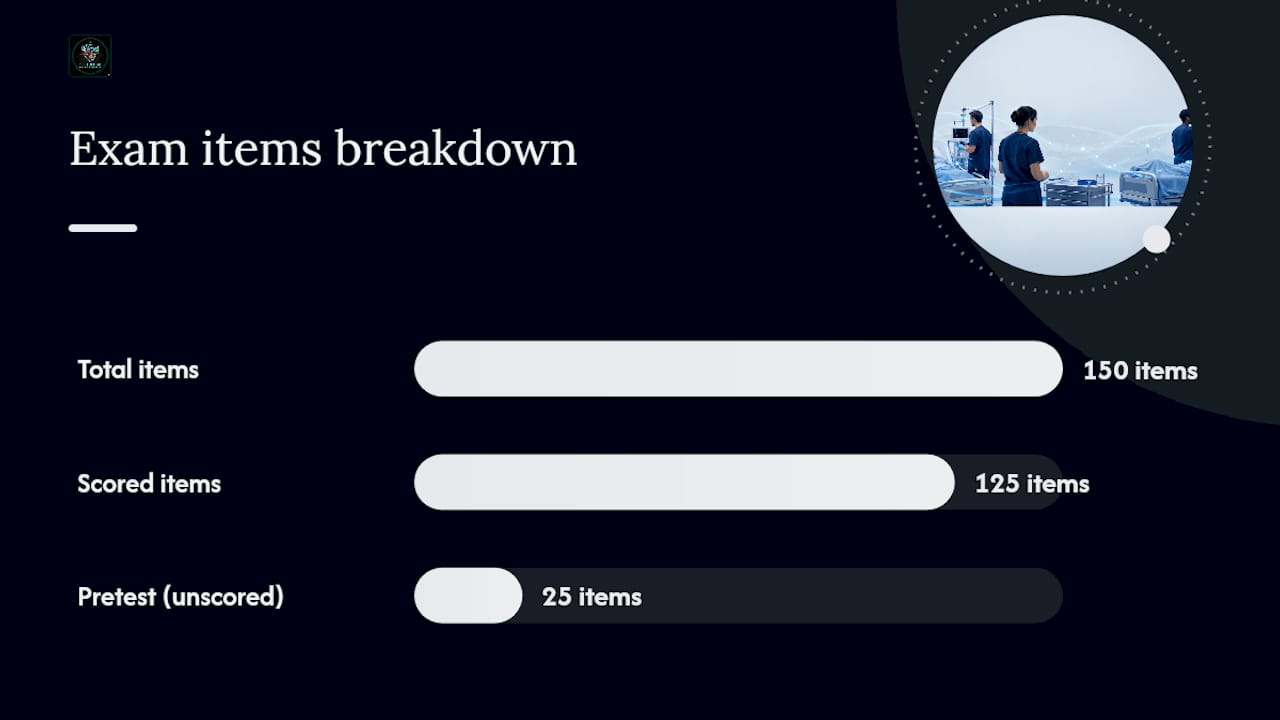
The structure is fixed and worth knowing cold. You sit for 150 multiple-choice items, 125 of which count toward your score, with the other 25 serving as unscored pretest items AACN uses to evaluate future exam content. You get three hours to finish, which averages out to a little over a minute per item, tighter once you factor in flagged items you return to.
| Exam element | Detail |
|---|---|
| Total items | 150 |
| Scored items | 125 |
| Pretest (unscored) items | 25 |
| Time limit | 3 hours |
| Passing standard | Cut score set by SME panel and psychometricians |
The cut score isn’t a published percentage like “you need 75% correct.” It’s a raw-number standard determined by subject-matter-expert panels working with psychometricians, calibrated against how difficult that specific version of the exam is, per the exam statistics and cut scores page. That’s a meaningful distinction: two candidates on different exam forms can pass with different raw scores because the forms weren’t identical in difficulty.
First-time pass rates get thrown around a lot in nursing forums, but AACN itself notes pass rates vary year to year and depend heavily on the candidate pool sitting for that cycle. Comparing CCRN pass rates directly to NCLEX pass rates is comparing two different populations solving two different problems.
By the numbers: the CCRN’s 125 scored items and three-hour window mean you’re managing pace and reasoning depth simultaneously, which is a different skill than either speed or knowledge alone.
Hardest Domains Under the November 2025 AACN Blueprint
AACN’s practice analysis reweighted the domain blocks effective November 12, 2025, and if you’re studying off an old breakdown, you’re prioritizing the wrong material. The CCRN practice analysis now weights domains roughly like this:
- Endocrine, Hematology, GI, Renal, and Integumentary combined: about 21%, now the single largest block
- Professional Caring and Ethical Practice (Synergy Model): about 20%
- Musculoskeletal, Neurological, and Behavioral/Psychosocial combined: about 18%
- Multisystem: about 16%
- Cardiovascular: about 13%
- Respiratory: about 12%
Cardiovascular and Respiratory dropped in weight, but don’t mistake that for “easier.” These two domains, hemodynamics, shock differentiation, ventilator and ABG interpretation, still demand the deepest physiologic reasoning on the exam, which is why they remain top remediation priorities even at lower percentages. A dense grouped category like Endocrine/Heme/GI/Renal/Integ is now where you can bank the most points fastest, so it deserves first pass in your schedule.
High-miss subtopics educators consistently flag include hemodynamic profile interpretation (distinguishing cardiogenic from distributive shock), ventilator mode and ABG troubleshooting, sepsis and MODS progression, and matching shock type to the correct first-line intervention.
An 8-Week, Question-First Study Plan That Matches How the Exam Actually Tests You
Content review alone won’t move your score. What moves it is timed, scenario-based practice paired with disciplined error tracking, an approach echoed across CCRN educator resources that emphasize question-bank-driven study plans over passive review. Here’s a template built around 10 to 15 hours a week, matched to the November 2025 weighting:
- Weeks 1 to 2: Bank points on the grouped Endocrine/Heme/GI/Renal/Integ domain and Professional Caring/Synergy Model content. These carry the heaviest combined weight, so early mastery pays off across the whole exam.
- Weeks 3 to 4: Shift into Musculoskeletal, Neuro, and Behavioral content, running mixed 50 to 60 question timed blocks that mirror real exam pacing.
- Weeks 5 to 6: Concentrate on Cardiovascular, Respiratory, and Multisystem, the high-reasoning zones. Expect this to be your slowest, most error-prone stretch, and budget extra time for it.
- Weeks 7 to 8: Run full 150-item timed simulations, at least two to three, and spend every off day working an error log instead of reviewing new content.
An error log matters more than most candidates think. Tag every missed question by concept and by the type of reasoning error, misread a lab value, chose a correct-but-not-priority intervention, missed a contraindication. Patterns show up fast, usually within your first 100 tracked misses. Spaced repetition on those tagged weak spots, rather than rereading everything, is what separates a study plan from an actual score gain, a distinction covered in more depth in Zero Deficit’s spaced repetition guide.
Pro Tip: Don’t wait until week 7 to take a timed full-length exam. Run one cold in week 2, even if you bomb it. That baseline tells you exactly where your reasoning breaks down before you’ve spent five weeks studying the wrong domain.
For a deeper breakdown of how to structure timed blocks and error logs day by day, Zero Deficit’s practice-question strategy guide walks through the mechanics.
Test-Day Tactics and What To Do If You Don’t Pass
Manage the clock from item one. Flag anything that takes more than 90 seconds and move on. Going back with fresh eyes after finishing the section is almost always more productive than grinding on one question.
- Do a full pass first, answering everything you’re confident on, then use remaining time for flagged items.
- Use box breathing or a 10-second pause before starting if you feel your heart rate spike mid-exam.
- If you don’t pass, request your AACN score report and identify your lowest-scoring domains by name, not by gut feeling.
- Build a focused 6 to 8 week remediation cycle targeting only those domains, with daily timed drills and one full simulation per week before you retest.
A retake isn’t a step backward. It’s a data-driven second attempt, and your score report tells you exactly where to spend the next six weeks.
How Your Clinical Experience Level Changes the Way the CCRN Feels
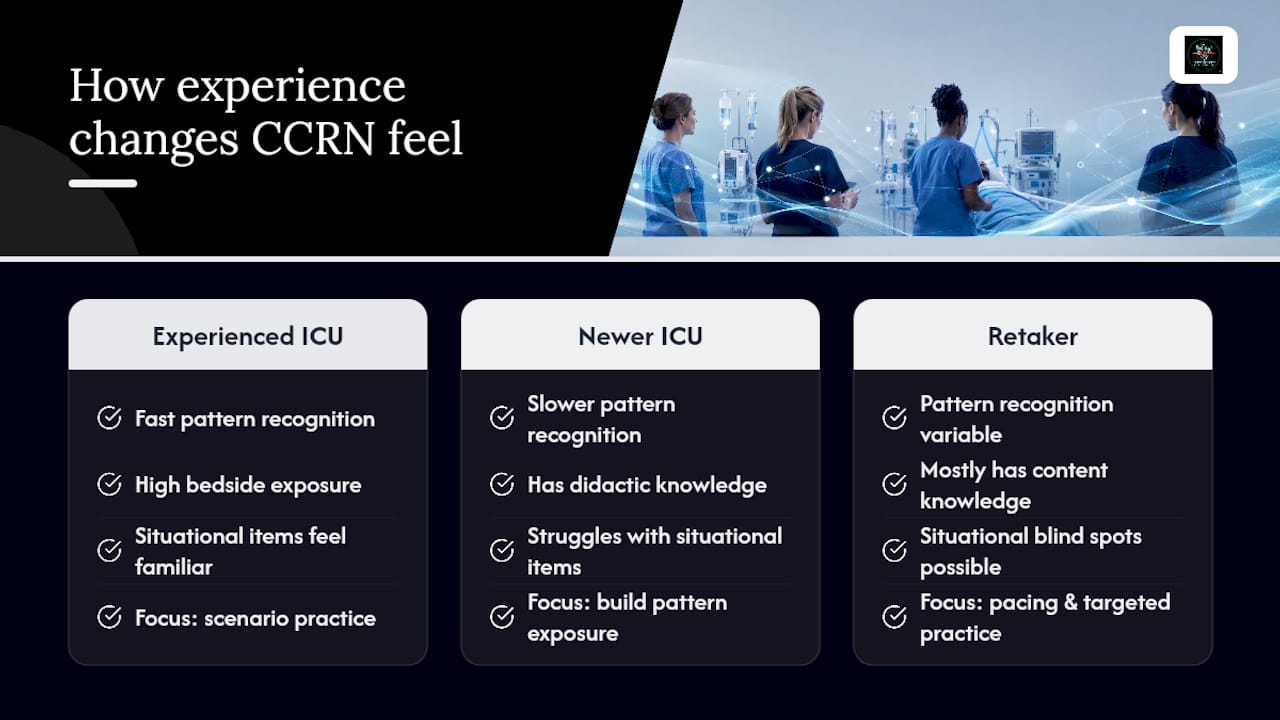
A nurse with five years in a cardiac ICU and a nurse six months out of orientation in a med-surg ICU can sit the same exam and have wildly different experiences of its difficulty, even scoring similarly in the end. Experience doesn’t just add knowledge. It changes how fast you recognize a pattern.
If you’ve managed forty septic patients, a CCRN vignette describing early sepsis with vague vitals reads almost like something you lived through last shift. Newer grads, or nurses from lower-acuity units, often have the didactic knowledge but haven’t yet built the pattern recognition that comes from repetition at the bedside. That gap shows up specifically on situational items, the ones requiring you to weigh several plausible actions against each other, less on straightforward recall.
This is why the CCRN’s eligibility requirement of prior critical-care clinical hours matters. It’s a specialty certification built for people who’ve already been in the room, unlike an entry-level exam such as the NCLEX, which assumes no prior nursing experience at all. If you’re a newer ICU nurse, that means your study plan needs to do double duty: teach content and manufacture the exposure your unit hasn’t given you yet, largely through scenario-based practice questions rather than textbook review.
Retakers face a different dynamic. You likely have the content knowledge already; what typically failed you the first time was pacing, second-guessing, or a specific reasoning blind spot in one or two domains. That’s a narrower, more fixable problem than starting from zero.
Comparing CCRN Difficulty to Other Nursing Certifications
Nurses researching “CCRN difficulty” often want to know how it stacks up against other specialty exams they’re weighing, particularly the CEN (Certified Emergency Nurse) or other AACN-family credentials.
The honest answer is that difficulty is less about raw content volume and more about how tightly the exam is built around situational reasoning versus recall. The CCRN leans heavily into multi-step physiologic reasoning, hemodynamics, ventilator management, shock differentiation, layered with ethics and prioritization under the Synergy Model. The CEN, by contrast, covers a broader but often shallower range of presentations across a wider age and acuity spectrum, reflecting the pace and breadth of emergency department work rather than sustained ICU-level physiologic monitoring.
Neither is objectively “harder” in a way that transfers cleanly across specialties, because they’re measuring different clinical skill sets built for different units. What does transfer is the study approach: any exam built primarily around clinical judgment, CCRN, CEN, or otherwise, responds better to scenario-based, timed question practice than to flashcard memorization. If you’ve prepped for one AACN-style exam before, the format and reasoning demands of the CCRN will feel familiar even if the content is new. If this is your first specialty certification, expect the situational item style itself to be part of what you’re learning, not just the pathophysiology behind it.
A Nurse-to-Nurse Take on What Actually Predicts a Pass
Here’s what I think most CCRN prep advice gets backward: it treats content knowledge as the bottleneck. For most ICU RNs with a year or more at the bedside, it isn’t. You know the pathophysiology. What’s missing is repeated, timed exposure to the specific way AACN phrases situational judgment, and a system for finding out exactly which reasoning pattern trips you up.
Zero Deficit CCRN Prep was built around that gap. The platform gives ICU RNs, from new grads to second-time retakers, over 695 practice questions with detailed rationales, AI-powered review tools that adapt to where you’re actually missing points, and system-based study guides mapped to the current AACN blueprint. If you’re a retaker, this matters even more: you don’t need to relearn cardiology from scratch, you need a tool that finds your specific blind spot fast and drills it until it’s gone. That’s the study plan outlined above, made executable instead of theoretical.
— Zero
Try Zero Deficit’s Practice Questions and Exam Simulations
If the 8-week plan above sounds right but you need the tool to run it, that’s exactly what Zero Deficit CCRN Prep builds for. You get over 695 practice questions with detailed rationales, system-based study guides aligned to the November 2025 AACN blueprint, an exam simulator for full timed runs, and spaced repetition that keeps resurfacing what you missed until it sticks.
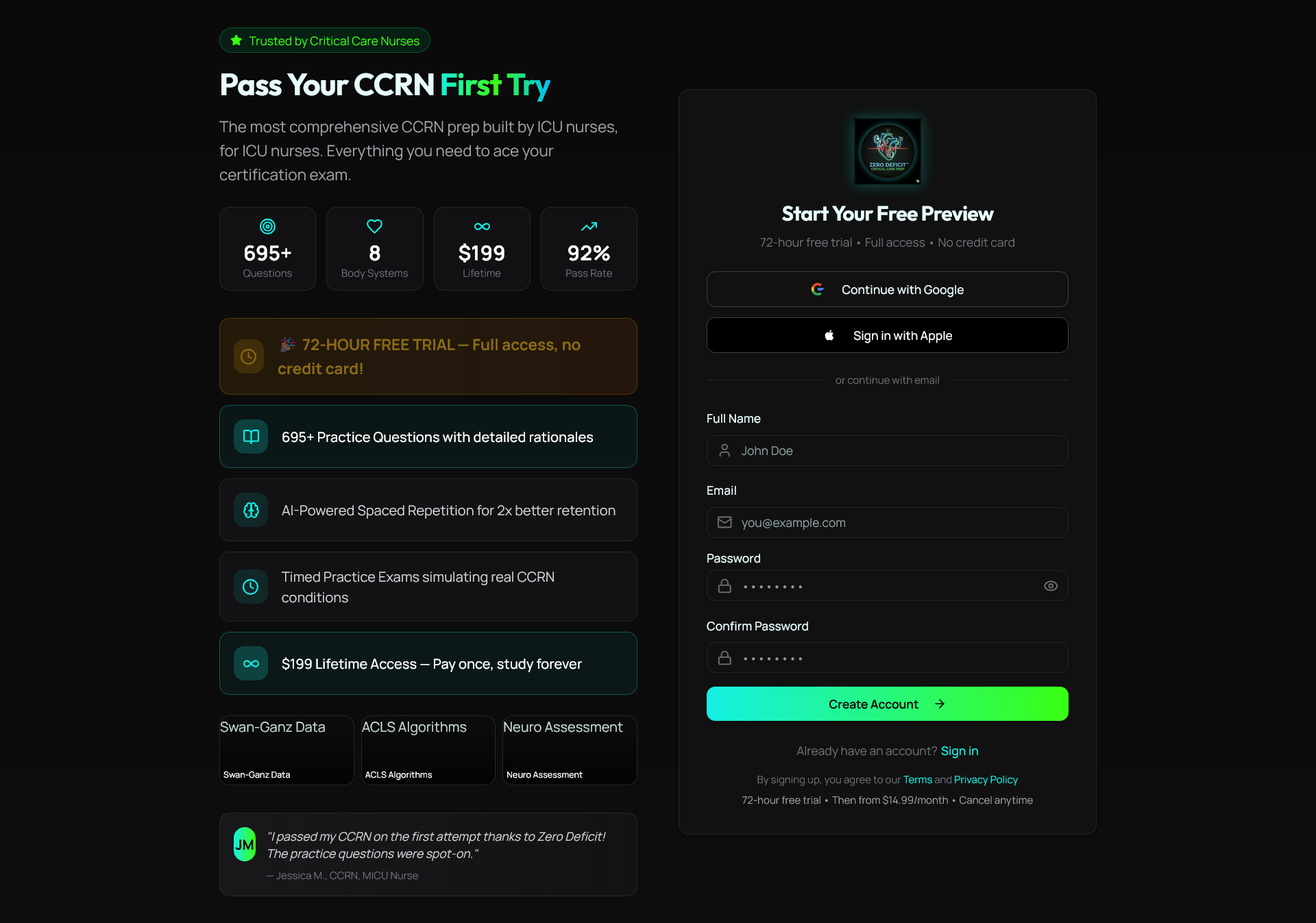
Each piece maps directly onto the plan you just read. The timed 50 to 60 question blocks from weeks 3 through 6 come from the practice bank. The error log and remediation playlists run through the platform’s rationale review and AI-powered targeting instead of a spreadsheet you build by hand. The full-length simulations from weeks 7 and 8 live in the exam simulator, built to mirror the real 150-item, three-hour format.
Start with the sample practice questions to see how the rationales work, then move into the full practice test bundles once you’re ready to simulate exam-day pressure across all eight body systems. Nurses preparing for scenario-based communication, like talking a family through a critical update, may also find it worth practicing clinical consultation language alongside their content review.
FAQ
How hard is it to be an ICU nurse compared to passing the CCRN?
ICU nursing demands constant real-time judgment with immediate consequences, while the CCRN compresses that same judgment into 150 timed, multiple-choice scenarios. Nurses who’ve spent a year or more at the bedside typically find the clinical reasoning familiar, even if the exam format itself takes practice.
How many people fail the CCRN on their first attempt?
AACN reports that first-time pass rates vary from year to year depending on the candidate pool, and doesn’t publish a single fixed percentage as a passing benchmark, according to its exam statistics page. What’s consistent is that candidates who rely on timed, question-based practice rather than passive review report better outcomes.
What is the hardest nursing certification to obtain?
There’s no single universal answer, since difficulty depends on how heavily an exam weights situational reasoning versus recall and how it aligns with a candidate’s own clinical background.
Is the CCRN harder than the CEN?
They test different skill sets rather than one being flatly harder. The CCRN concentrates on sustained ICU-level physiologic reasoning, like hemodynamics and ventilator management, while the CEN spans a broader range of emergency presentations across more age groups and acuity levels.
How many practice questions should I complete before sitting the CCRN?
There’s no official AACN minimum, but educators generally recommend working through several hundred scenario-based questions across multiple timed sessions before test day. Zero Deficit’s bank of over 695 practice questions with rationales is built to support that volume across all eight body systems.
Recommended
Take a Multisystem practice quiz
Master sepsis, shock, MODS, and multi-organ failure scenarios.
Get Your Free 20-Question CCRN Diagnostic
20 high-yield CCRN-style questions across every body system, with detailed rationales — emailed to you instantly.
No spam. One email + a couple of helpful follow-ups. Unsubscribe anytime.
Ready to pass your CCRN?
Join 12,000+ nurses using Zero Deficit — 695+ practice questions with rationales, AI-powered weak-area drilling, and spaced-repetition flashcards.
Start Free Trial →