U.S. ICU Nurses, Bigger CCRN Flashcard Decks Can Miss Blueprint Gaps

The best CCRN flashcards are a digital, spaced-repetition system that maps every card to the Adult CCRN blueprint and explains each answer in a concise rationale. Controlled experiments link spaced digital flashcards to better exam outcomes in health professions students. Below, we show what to look for and how to study with cards.
TL;DR:
- Audit decks against the current Adult CCRN blueprint, prioritizing weak systems; cards should include normal ranges, concise physiologic rationales, and current references.
- Space reviews by at least 2–3 days, retrieve each answer before flipping, and pair cards with patient vignettes to practice applying facts.
- Choose an integrated system for rotating shifts; use community Anki decks only if you can verify and edit uneven rationales and older guidance.
- Study daily, spend about 5–15 seconds per card, add two weekly question blocks of one hour, and turn missed answers into cards with rationales.
- A nursing student study found flashcard users nearly three times more likely to pass course exams, but it did not test CCRN outcomes.
Table of Contents
- Why do flashcards work for the CCRN exam?
- What should CCRN flashcards cover?
- What types of CCRN flashcard options are there?
- How should you use flashcards day to day?
- What would I pick for Adult CCRN prep?
- Zero Deficit™: flashcards and practice questions in one place
- FAQ
- Sources
Why do flashcards work for the CCRN exam?
Flashcards force retrieval. Instead of rereading a hemodynamics chapter, you pull the answer out of memory, and that effort is what builds durable recall. The review of retrieval practice in the health professions reports that frequent, spaced retrieval protects memory against stress and transfers knowledge into high-stakes testing, which is exactly the setting you will sit in.
Spacing matters as much as retrieval. Intervals of at least 2–3 days between sessions create “desirable difficulty,” and that produces stronger long-term retention than immediate, low-effort review. A card you can answer instantly an hour later tells you little. A card you nearly miss after three days is doing its job.
What this means for your CCRN prep:
- Review a card, then see it again after a gap, not back to back.
- Answer from memory before flipping, even when you think you know it.
- Pair cards with question vignettes, because exam items ask you to apply facts to a patient, not recite them.
- Treat the cards you almost miss as the most valuable ones.
A quasi-experimental study of nursing students found that flashcard users were nearly three times more likely to pass and more than twice as likely to earn the top grade, after controlling for confounders.
That study involved nursing students and course exams, not the CCRN, so read it as strong support for the method rather than a promise about your score.
What should CCRN flashcards cover?
Audit any deck against the Adult CCRN blueprint before you commit a single study hour. A deck with thousands of cards that skips your weak systems is worse than a smaller deck that hits them. Check AACN’s certification page for the current exam outline and requirements.
A solid deck covers these priority areas:
- Cardiovascular: hemodynamics, shock states, ACS, vasoactive drips
- Pulmonary: ARDS, ventilator management, ABG interpretation
- Neuro: ICP management, stroke
- Sepsis/MODS: recognition, bundles, organ dysfunction
- Endocrine emergencies: DKA, HHS, thyroid and adrenal crises
- Renal/CRRT: AKI, electrolytes, renal replacement therapy
- Synergy Model and ethics: patient characteristics, nurse competencies, moral distress
Then check card quality. Normal ranges should appear on the card itself: arterial pH 7.35–7.45, PaCO2 35–45 mmHg, HCO3 22–26 mEq/L, MAP of at least 65 mmHg as a common resuscitation target. Each answer needs a one or two sentence physiologic rationale, not just a bare fact. Where it applies, cards should point to AHA, SCCM or AACN guidance published in 2020 or later, so you are not memorizing outdated practice.
Pro Tip: Open ten random cards from the deck. If fewer than eight include a rationale and a current reference or range, move on.
What types of CCRN flashcard options are there?
You will find four realistic categories, and each fits a different schedule.
- Publisher and print decks: Curated content with editorial oversight, such as Barron’s CCRN review flashcards. They are easy to start, but they often lack spacing algorithms and performance tracking, so you schedule reviews yourself.
- Community Anki decks: Free and expansive. Quality varies, and rationales are inconsistent. Some cards reflect older guidelines, so you must check them.
- Standalone SRS apps: Built-in spacing, mobile review and tracking. Great for short sessions between shifts, though content depth depends on the provider.
- Integrated platforms: Flashcards, spaced repetition, a practice question bank and progress tracking in one place.
Here is how we would decide. If you work rotating shifts and want one workflow, choose an integrated SRS plus question bank. Choose community Anki decks only if you plan to vet and edit cards yourself, which costs real time. Choose a print deck if you learn best on paper and will build your own review calendar.
How should you use flashcards day to day?
Start months before your test date. Short daily sessions beat a last-minute cram because spacing only works if time passes between reviews. For more on scheduling, see our guide to CCRN spaced repetition.
- Set a regular spaced-repetition session, ideally at the same time each day.
- Aim for roughly 5–15 seconds per card, and split big concepts, like the stages of shock, into several microcards.
- Say or write your answer before you flip the card.
- Rate honestly. Marking a lucky guess as “easy” pushes the card out too far.
- Add two one-hour practice question blocks each week, aimed at your weakest systems.
- Send every missed question back into your deck as a new card with its rationale.
- Save stubborn cards with bookmarks so you can drill them before exam week.
A sample week: flashcards every day, questions on Tuesday and Saturday, and a Sunday check of the bookmarked cards. Missing a day is fine. Skipping a week lets cards pile up and makes the next return feel like a wall. For the broader plan around your cards, our guide on how to pass the CCRN exam lays out the full timeline.
Pro Tip: Do your card session right after a shift while the cases are fresh. A patient on norepinephrine makes the vasoactive cards stick better.

What would I pick for Adult CCRN prep?
With ICU hours and real life, I would not assemble three separate tools. One system that combines spaced repetition, a question bank and performance tracking saves the setup time you do not have. I would take a focused set of cards mapped to the blueprint, each with a clear rationale, over a much larger deck of uneven quality. And I would want cards written by clinicians who cite guidelines, because a wrong Lopressor threshold memorized in March is expensive to unlearn in June. Tracking matters too: seeing which systems keep slipping tells you where the next study hour goes.
— Zero
Zero Deficit™: flashcards and practice questions in one place
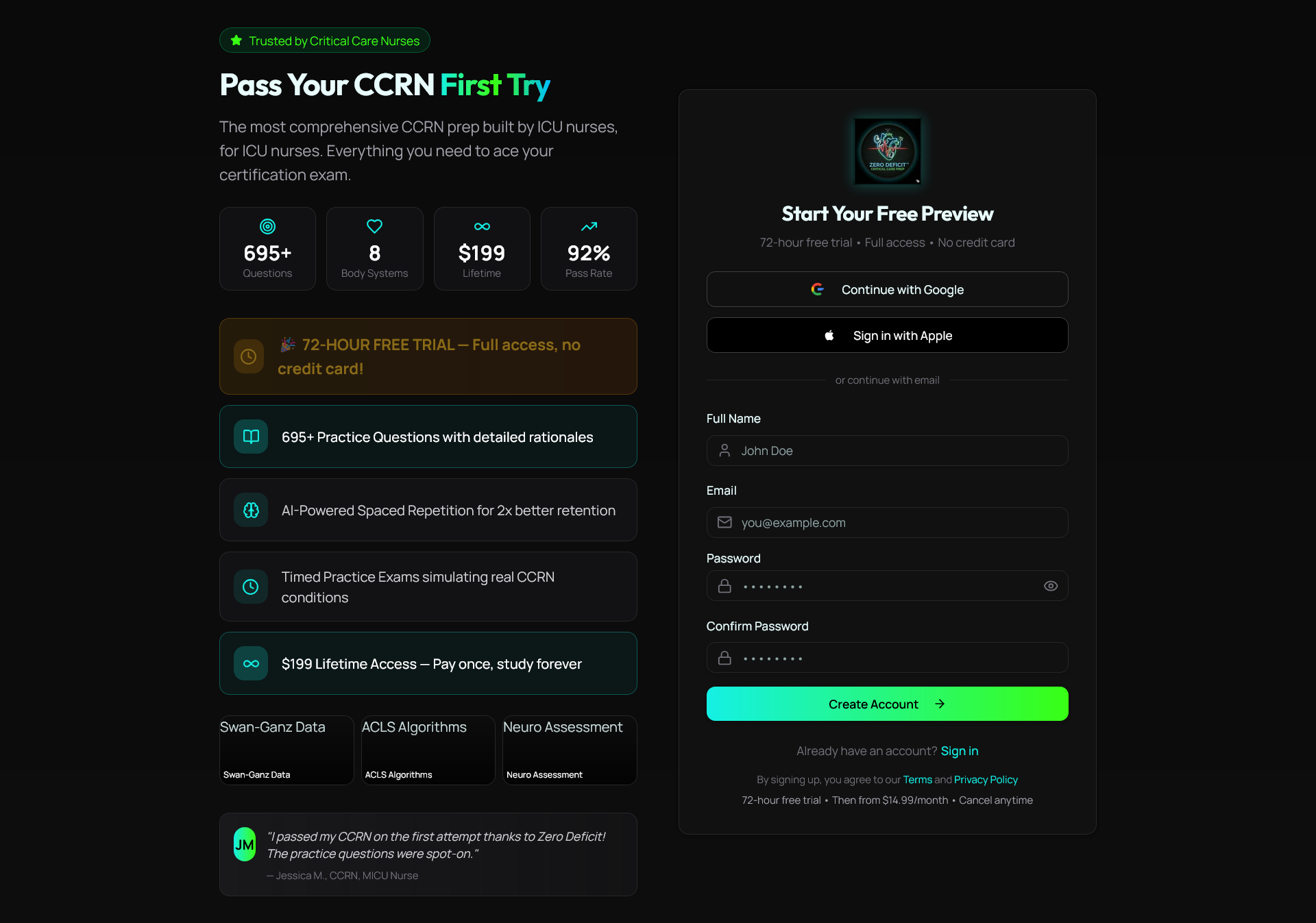
We built Zero Deficit™ so you do not have to piece together decks and question banks. Everything is in one place to support your review.
- 695+ practice questions with detailed rationales
- Flashcards with spaced repetition
- AI-powered review tools for personalized study
- Progress tracking by system and topic
Browse the CCRN practice questions or see our subscription options and start building your review routine today.
FAQ
How many questions do you need to pass the CCRN?
AACN scores the exam on a scaled basis, so there is no simple-fixed count of correct answers to aim for. Check AACN’s certification page for current scoring and exam details, and use practice question performance by system to judge readiness.
Are there flashcards for medical students that also work for nurses?
Medical student decks lean toward diagnosis and pathophysiology, while the CCRN tests bedside judgment and nursing care. They can help with background physiology, but cards built for the Adult CCRN blueprint serve you better.
Are there NCLEX RN flashcards, and do they help for the CCRN?
NCLEX-RN flashcards exist, but they test entry-level safety and prioritization. The CCRN goes much deeper into hemodynamics, ventilation and critical illness, so use CCRN-specific cards instead.
Is the CCRN or NCLEX harder?
They test different things. The NCLEX checks entry-level competence across nursing, and the CCRN tests specialized, applied knowledge of critically ill adults, which most ICU nurses find more demanding in depth.
Sources
- The Use of Retrieval Practice in the Health Professions: A State-of-the-Art Review - PMC
- Effective, Scalable, and Low Cost: The Use of Teacher‐Made Digital Flashcards Improves Student Learning
- Edresearch
Ready to put your cards to work? Start with Zero Deficit CCRN Prep practice questions and see where you stand today.
Recommended
Take a Respiratory practice quiz
Master ARDS, ventilation, ABGs, oxygenation, and pulmonary emergencies.
Get Your Free 20-Question CCRN Diagnostic
20 high-yield CCRN-style questions across every body system, with detailed rationales — emailed to you instantly.
No spam. One email + a couple of helpful follow-ups. Unsubscribe anytime.
Ready to pass your CCRN?
Join 12,000+ nurses using Zero Deficit — 695+ practice questions with rationales, AI-powered weak-area drilling, and spaced-repetition flashcards.
Start Free Trial →