Map 695+ Questions to the CCRN Exam Blueprint for US ICU RNs
The CCRN Adult test plan changed on Nov. Multisystem and neurological content weight went up. Cardiovascular and respiratory weight came down slightly. If your study plan still reflects the old percentages, you’re allocating hours to the wrong places.
TL;DR:
- The updated CCRN exam blueprint increases the emphasis on multisystem and neurological content, influencing how many hours should be allocated to these areas.
- Although cardiovascular and respiratory domains remain heavily tested, their relative weight has slightly decreased, requiring adjustments in study focus.
- Most current study materials remain relevant, but practice exams and review courses must be revised to match the new domain weightings, especially for multisystem and neurological topics.
- Practice questions should be filtered by body system and clinical judgment, reflecting the new blueprint’s focus on applied decision-making in complex ICU scenarios.
- Pacing and timed full-length simulations are essential to develop test-day strategies, particularly for prioritizing actions in multisystem and neurological cases, which now carry more scoring weight.
Table of Contents
- What the CCRN Exam Blueprint Update Actually Means for Your Prep
- CCRN Exam Format at a Glance
- The Official CCRN Blueprint Weights, Domain by Domain
- How AACN Actually Builds This Blueprint
- Turning the Blueprint Into a Study Schedule
- How Zero Deficit™ Maps Directly to the Updated Blueprint
- Reading Complex Item Formats Without Panicking
- Where Candidates Consistently Lose Points
- Why the Blueprint Should Drive Your Study Time, Not Your Comfort Zone
- Practice Questions Built Around the Updated Blueprint
- Sources
- FAQ
What the CCRN Exam Blueprint Update Actually Means for Your Prep
AACN doesn’t tweak test plans on a whim. The Adult CCRN Test Plan update effective Nov. 12, 2025 came out of a 2024 Study of Practice, a national practice analysis where a panel of bedside experts and educators reached full consensus on what today’s ICU nurses actually need to know. That’s not a marketing claim. It’s how AACN validates every certification exam it publishes.
Here’s what shifted and why it matters for your hours:
- Multisystem and neurological content increased in relative weight, reflecting how much ICU practice now spans sepsis, MODS, and complex neuro cases rather than single-organ problems.
- Cardiovascular and respiratory weight decreased slightly, though both remain heavily tested domains.
- Most existing prep material stays relevant. AACN itself notes that current study resources still apply, but practice exams and review courses are being revised to match the new domain weights.
If you’re studying from a guide published before late 2025, check it against the current Exam Handbook before you trust its percentages.
CCRN Exam Format at a Glance
Before you build a study calendar, know the mechanics you’re working within:
Each CCRN exam consists of a total number of multiple-choice items, with a majority scored and some unscored pretest questions, used to validate future exams. Candidates are given a set amount of time to complete the exam, allowing roughly a little over a minute per question, with some candidates budgeting additional time for review and flagging. 3. You can’t tell scored from unscored items during the test, so treat every question with the same focus. 4. Eligibility and accommodation details live in the CCRN Exam Handbook, including clinical hour requirements and testing policies you should confirm before you schedule.
Pacing matters more than most candidates admit. Burning six minutes on one tricky hemodynamics question means you’re rushing through five easier ones later.
The Official CCRN Blueprint Weights, Domain by Domain
The CCRN Exam Handbook breaks the exam into two top-level categories, and everything else nests underneath them.
| Category | Weight |
|---|---|
| Clinical Judgment | 80% |
| Professional Caring & Ethical Practice | 20% |
Within Clinical Judgment, AACN and independent analysis of the 2025 updates point to body-system weighting that looks roughly like this:
| Body system / domain | Approximate weight |
|---|---|
| Cardiovascular | Largest single clinical domain, slightly reduced from prior blueprint |
| Respiratory | Second-largest domain, slightly reduced |
| Multisystem (sepsis, MODS, shock states) | Increased |
| Neurological (ICP, stroke) | Increased |
| Endocrine, hematology, GI, renal, integumentary, musculoskeletal, behavioral (combined) | Moderate, distributed weight |
A few things worth flagging as you plan:
- Cardiovascular and respiratory still carry the most individual item weight of any single domain, even after the reduction.
- The multisystem bump reflects how often ICU patients present with combined sepsis, shock, and organ dysfunction rather than one isolated diagnosis.
- Renal and endocrine content, while smaller in percentage, shows up embedded inside multisystem and cardiovascular scenarios more than as standalone questions.
Confirm exact current percentages against your Exam Handbook PDF before finalizing your hour allocation, since AACN periodically republishes the document with minor refinements.
How AACN Actually Builds This Blueprint
You should trust these percentages because of how they’re produced, not just because AACN says so. AACN runs a Study of Practice at least every five years, pulling in a national panel of practicing critical care nurses and educators who work toward full consensus on what’s actually tested at the bedside today.
- A psychometrician reviews every proposed change for statistical validity before anything moves forward.
- The AACN Certification Corporation board formally approves the final test plan.
- Every item on the exam gets framed through the AACN Synergy Model, which pairs patient and family characteristics (like vulnerability, complexity, and resource availability) with nurse competencies.
That Synergy Model detail changes how you should read exam items. This isn’t a pathophysiology quiz. A question about a patient in septic shock isn’t just asking “what’s the drip.” It’s asking whether you can apply clinical judgment given that specific patient’s stability, complexity, and family dynamics.
Pro Tip: When you review a missed practice question, ask “what patient characteristic drove the right answer” before you ask “what’s the correct dose.” That habit trains you for how CCRN items are actually built.
Turning the Blueprint Into a Study Schedule
Percentages are useless until you convert them into hours. Here’s a workable 8 to 12 week structure for a full-time ICU nurse studying 8 to 10 hours a week:
- Weeks 1 to 3: Cardiovascular and respiratory. These remain your two heaviest domains, so front-load hemodynamics, shock states, ACS management, vasopressor titration, ARDS, ventilator modes, and ABG interpretation.
- Weeks 4 to 6: Multisystem and neurological. Cover sepsis and MODS pathways, then ICP management and stroke protocols, matching the increased weight these domains now carry.
- Weeks 7 to 9: Endocrine emergencies, renal and CRRT, GI, and integumentary/musculoskeletal content in shorter, focused blocks.
- Weeks 10 to 12: Full-length timed simulations, missed-question review, and Professional Caring & Ethical Practice content woven throughout rather than saved for the end.
Question practice under timed conditions builds the pacing instinct you can’t get from flashcards alone. Run one full 150-item timed simulation every one to two weeks starting in week 8, and reserve daily practice blocks for untimed, topic-focused review where you can dig into rationales.
Pro Tip: Log every missed question by domain, not just topic. If cardiovascular misses cluster around vasoactive drips specifically, you’ve found a gap thirty generic practice questions won’t fix.
How Zero Deficit™ Maps Directly to the Updated Blueprint
Zero Deficit™ was built around this exact structure. The platform’s question breakdown methods organize over 695 practice questions by body system, so you can drill cardiovascular hemodynamics one week and pivot to multisystem sepsis scenarios the next, matching whatever the blueprint weighs heaviest that month.
- 695+ practice questions with detailed rationales tagged by domain and Clinical Judgment task, not just topic.
- System-based study guides covering all eight domains AACN tests, from cardiovascular drips to endocrine emergencies.
- AI-powered spaced review that resurfaces questions you’ve missed before they fade from memory.
- Exam simulations built to match the 150-item, 3-hour format so your pacing practice mirrors test day.
Progress tracking shows you coverage gaps by domain in real time, so you’re not guessing whether you’ve actually put in proportional hours where the blueprint demands them.
Reading Complex Item Formats Without Panicking
CCRN items rarely ask a simple recall question. Most Clinical Judgment items present a patient scenario, several data points (vitals, labs, hemodynamic values), and ask you to prioritize an action, not just identify a diagnosis.
A few formats trip up even strong clinicians:
Multiple-response items ask you to select every correct action, not just one. Missing a single correct choice or adding an incorrect one usually counts the item wrong entirely, so resist the urge to stop once you’ve found “an” answer. Keep scanning every option against the full clinical picture.
Scenario-based items front-load a paragraph of assessment data before the actual question. Read the question stem first if the item allows it, then go back through the vitals and labs looking specifically for what that question needs. Rereading a wall of data twice wastes time you don’t have.
“Best next action” items almost always have two defensible-sounding answers. The trap is choosing the clinically correct action that’s not the immediate priority. If a patient is hypotensive and hypoxic, fixing the airway usually outranks starting a pressor, even if the pressor is also warranted.

Lab-value items expect you to know normal ranges cold: sodium 135 to 145 mEq/L, potassium 3.5 to 5.0 mEq/L, lactate under 2 mmol/L, and arterial pH 7.35 to 7.45. If you’re pausing to recall normals mid-question, you’re losing pacing time you need for the judgment call itself.
Where Candidates Consistently Lose Points
A few patterns show up again and again in missed-question data across CCRN prep, and they line up closely with where the blueprint puts its heaviest weight.
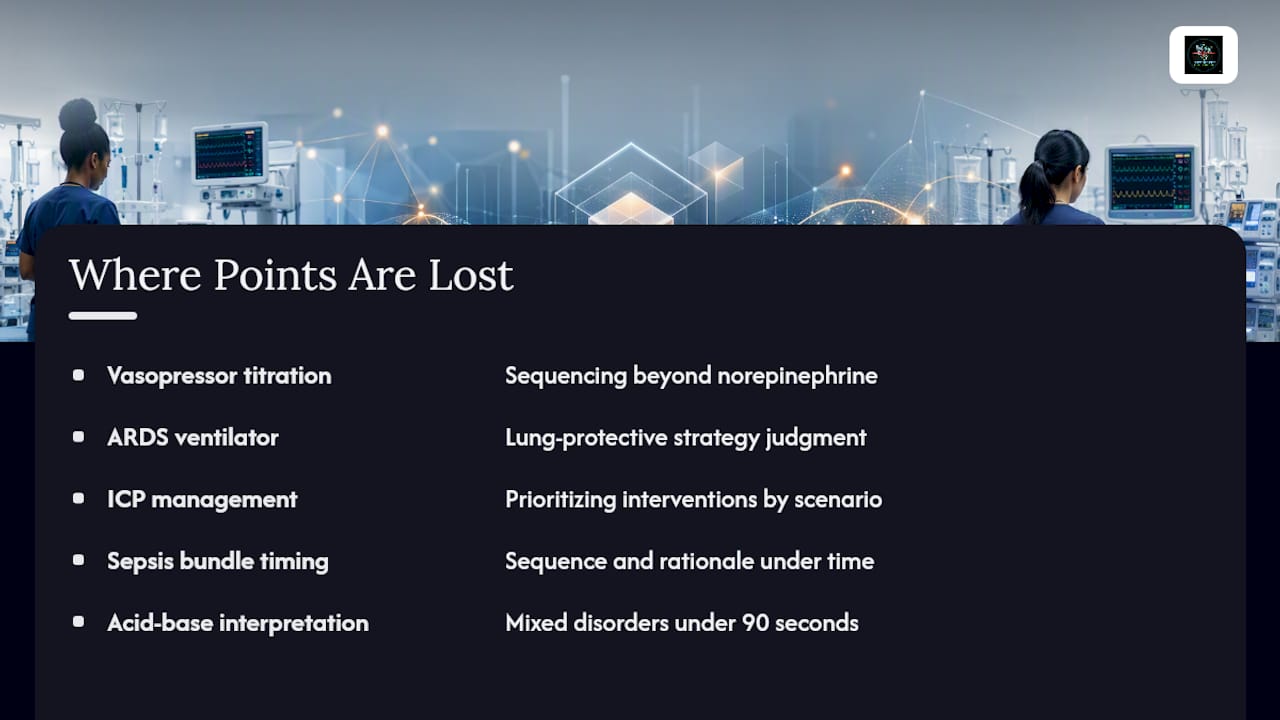
Vasopressor and vasoactive drip titration trips up candidates who know the drugs but not the sequencing. Knowing that norepinephrine is first-line in septic shock is table stakes. Knowing when to add vasopressin or pivot to epinephrine, and why, is where points get lost.
ARDS ventilator management questions often ask about lung-protective strategies (low tidal volume, plateau pressure limits) rather than basic vent modes. If your mental model stops at “SIMV versus pressure control,” you’ll miss the actual clinical judgment being tested.
ICP management items frequently combine multiple interventions (positioning, sedation, osmotic therapy, CPP targets) and ask which one takes priority given a specific scenario. Memorizing a flat list of ICP interventions without ranking logic is a common gap.
Sepsis bundle timing questions test whether you know the sequence and rationale, not just that broad-spectrum antibiotics and fluids matter. The multisystem weight increase in the updated blueprint makes this domain worth extra attention this cycle.
Acid-base interpretation under time pressure is where candidates who understand ABGs in theory fall apart in practice. If you can’t compensate mentally for a mixed disorder in under 90 seconds, that’s a drill-worthy gap, not a knowledge gap.
Why the Blueprint Should Drive Your Study Time, Not Your Comfort Zone
Most CCRN candidates study what they already know well, because it feels productive. That’s backwards. The blueprint tells you exactly where AACN is putting its scoring weight, and your study hours should mirror that distribution, not your personal comfort level with a given system.
The conventional advice to “just do practice questions until you feel ready” misses the actual lever: which practice questions, in what proportion. A nurse who drills 200 cardiovascular questions and 20 neuro questions is training for an exam that doesn’t exist anymore, given where the 2024 Study of Practice moved the weight. Multisystem and neurological content now pull more scoring power than they used to, and your question mix should reflect that shift directly.
What I’d prioritize first, if you’re rebuilding a study plan from scratch: pull the current Exam Handbook, map your available hours against the actual domain percentages, and pick a question bank that lets you filter and track by domain. Feeling busy with generic questions isn’t the same as closing the specific gaps the blueprint is actually testing.
— Zero
Practice Questions Built Around the Updated Blueprint
You don’t need more generic review material. You need to practice questions tagged to the exact domains the 2025 test plan weighs heaviest, with rationales that explain the clinical judgment behind each answer, not just the correct choice.
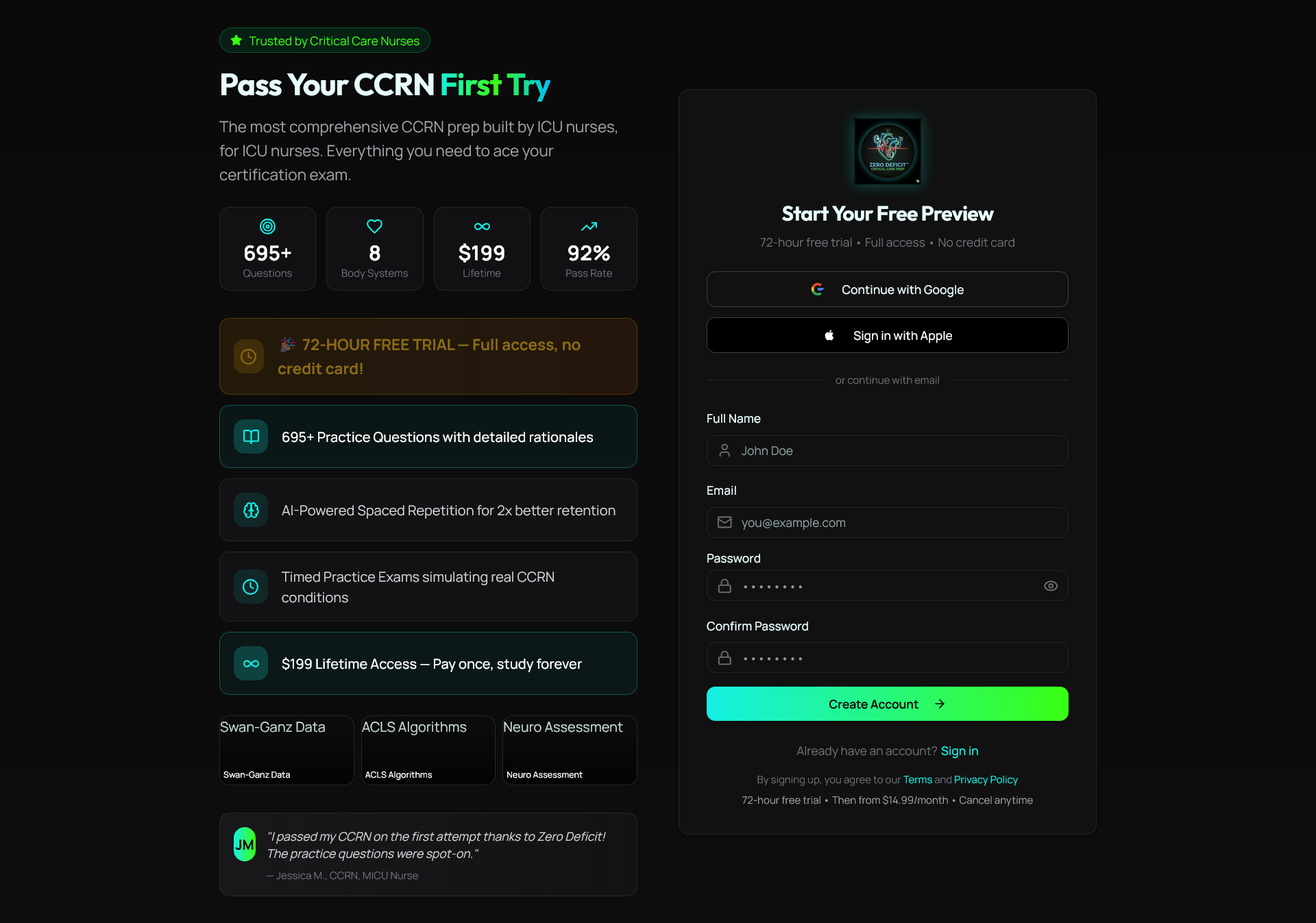
Zero Deficit™ gives you 695+ CCRN practice questions organized by body system, so you can drill multisystem and neurological content in the same proportion the blueprint now demands. Pair that with full-length timed practice tests that mirror the real 150-item, 3-hour format, and you’re rehearsing under the same conditions and pacing pressure you’ll face on test day. A free sample quiz lets you see the question style and rationale depth before you commit to a subscription. Start with a topic-focused block in your weakest domain, track your accuracy by system, then move into full simulations once your coverage evens out across the blueprint.
FAQ
Is there a new CCRN test plan available?
Yes. AACN launched updated CCRN test plans effective Nov. 12, 2025, based on the 2024 Study of Practice, with the Adult, Pediatric, and Neonatal test plans all revised.
What is the best study material for the CCRN exam?
Start with the official AACN Exam Handbook for the test plan and eligibility rules, then use a question bank like Zero Deficit™'s system-based practice questions to drill each domain in proportion to its blueprint weight.
How difficult is the CCRN exam?
The exam is challenging because 80% of items test applied Clinical Judgment through the Synergy Model rather than isolated recall, so success depends more on prioritizing actions in complex scenarios than memorizing facts.
How many questions are on the CCRN exam and how much time do I get?
Each CCRN exam consists of a total number of multiple-choice items, with a majority scored and some unscored pretest questions. Candidates are given a set amount of time to complete the exam, allowing roughly a little over a minute per question.
Recommended
Take a Multisystem practice quiz
Master sepsis, shock, MODS, and multi-organ failure scenarios.
Get Your Free 20-Question CCRN Diagnostic
20 high-yield CCRN-style questions across every body system, with detailed rationales — emailed to you instantly.
No spam. One email + a couple of helpful follow-ups. Unsubscribe anytime.
Ready to pass your CCRN?
Join 12,000+ nurses using Zero Deficit — 695+ practice questions with rationales, AI-powered weak-area drilling, and spaced-repetition flashcards.
Start Free Trial →