CCRN Knowledge Self-Assessment for ICU Nurses
TL;DR:
- A timed practice exam aligned with the AACN test plan is the most reliable way to assess CCRN readiness.
- Benchmarking by domain scores guides targeted study and helps determine when scheduling the exam is appropriate.
The fastest, most reliable way to judge your CCRN readiness is a timed baseline practice exam mapped to the AACN test plan, followed by a gap-based study plan targeting what you rarely see at the bedside. That one action tells you more than years of ICU experience alone.
Quick-start checklist — run this today:
- Take a full-length, timed practice exam (125 questions, 3-hour limit)
- Download and print the current AACN Certification Handbook/test plan
- Score your results by body system, not just overall percentage
- Flag every domain where you scored below 70% or rarely manage those patients
- Mark low-frequency topics (endocrine crises, CRRT, multisystem failure) for immediate review
TL;DR: You are ready to schedule your exam when you consistently score at or above the passing equivalent in high-weight domains and can explain your clinical reasoning, not just the right answer.
Table of Contents
- How your clinical experience maps to the AACN test plan
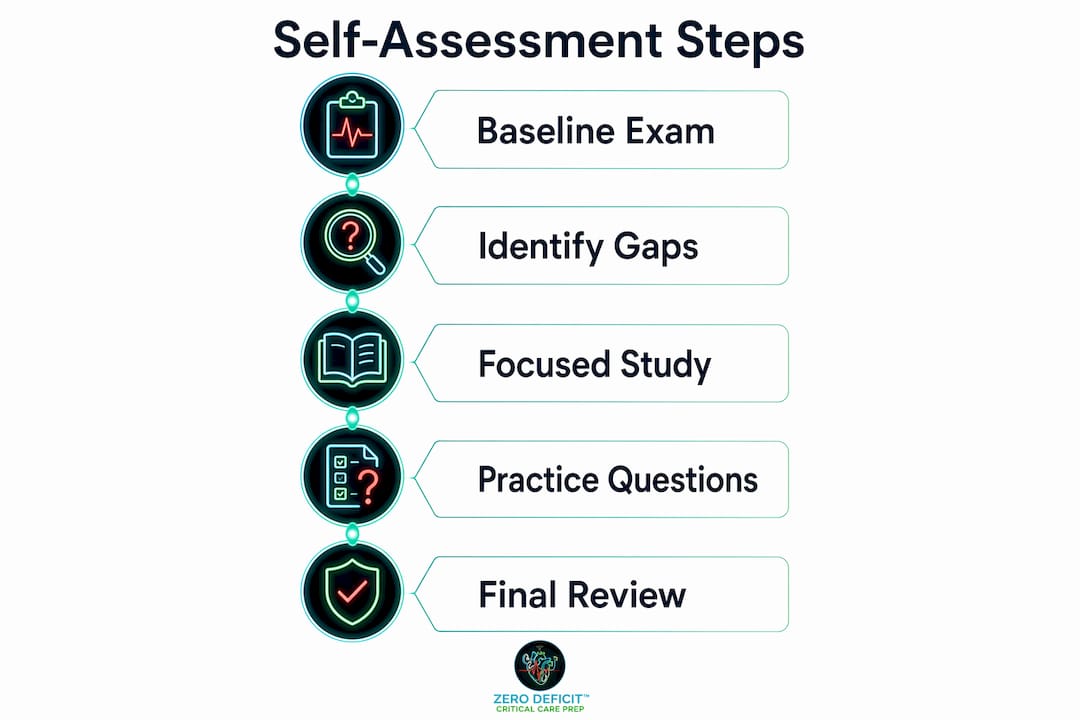
- Five steps to complete your self-assessment in one week
- Common knowledge gaps that catch experienced ICU nurses off guard
- How to choose practice exams that actually predict your readiness
- Readiness thresholds and what to do when you fall short
- Why this approach is grounded in evidence
- Zero Deficit™ CCRN Exam Prep gives you the tools to benchmark and close the gap
- Key Takeaways
- Useful sources and where to verify the exam blueprint
- FAQ
How your clinical experience maps to the AACN test plan
Objective benchmarking matters because your unit’s case mix is not the exam’s case mix. The AACN test plan, published in the Certification Handbook, weights each domain by frequency and criticality data from a national practice analysis. Use the table below as a working template: rate your own exposure, note the KSAs the exam emphasizes, and assign a study action.
| Domain / Body System | Your Unit Frequency | Key KSAs Tested | Immediate Action |
|---|---|---|---|
| Cardiovascular | High / Medium / Low | Hemodynamics, shock management, vasopressors, ACS | If low: targeted drips + hemodynamics review |
| Pulmonary | High / Medium / Low | ARDS, mechanical ventilation, ABG interpretation | If low: vent modes + ABG practice sets |
| Neurological | High / Medium / Low | ICP management, stroke, bedside neuro assessment | If low: ICP goals + neuro scenario cases |
| Renal / CRRT | High / Medium / Low | AKI, CRRT principles, electrolyte management | If low: CRRT module + renal practice questions |
| Endocrine | High / Medium / Low | DKA, HHS, thyroid storm, adrenal crisis | Almost always low: full module review |
| Multisystem / Sepsis | High / Medium / Low | Sepsis bundles, MODS, SCCM guidelines | If low: sepsis pathway + MODS case studies |
| Behavioral / Psychosocial | High / Medium / Low | Synergy Model, ethics, family communication | Review Synergy Model KSAs explicitly |
Retesters: pull your printed score report and use those domain percentages to fill in this table instead of estimating. The AACN Knowledge Assessment Tool offers randomized, ICU-specific questions that can sharpen this gap identification further.
Five steps to complete your self-assessment in one week
This workflow takes roughly 6–8 hours total and produces a written study plan you can act on immediately. Understanding test blueprint weighting before you start makes every step more efficient.
-
Take a timed baseline exam (3–4 hours including debrief). Simulate real conditions: 125 questions, no breaks, no references. Score by body system. This single data point is your honest starting line.
-
Parse the score report by domain. Flag every system where you scored below 70% or where your unit exposure is low. These are your remediation targets, not your overall average.
-
Map flagged topics to specific resources. Assign practice question sets, topic guides, or simulation scenarios to each weak domain. Set a weekly hour target per topic (example: 4 hours/week on cardiovascular if hemodynamics is your gap).
-
Re-benchmark after 2–3 weeks of targeted study. Take another full-length timed exam. Compare domain scores, not just totals. Iterate until high-weight areas consistently clear 80%.
-
Add scenario-based practice for clinical-judgment gaps. The AACN Synergy Model frames the exam around patient-centered decision-making, not task recall. Simulation and case-based questions close that gap.
Realistic timeline: A 6–8 week plan with 40–80 total study hours is standard for nurses with solid ICU experience. Paid prep resources typically range from $30–$150 depending on question bank size and subscription length. Spaced repetition scheduling within that window significantly improves retention of high-yield content.
Pro Tip: “I see this every shift” is the most dangerous bias in CCRN prep. Familiarity with a procedure does not equal exam-ready knowledge of the underlying physiology, target parameters, and clinical-judgment rationale the AACN tests.

Common knowledge gaps that catch experienced ICU nurses off guard
Published research confirms that tenure and prior certification do not guarantee comprehensive knowledge. A 2023 study in Critical Care Explorations found that even experienced critical care nurses show measurable gaps in bedside assessment and physiologic goal-setting — a pattern that applies directly to Adult CCRN preparation.
Neurological assessment and ICP management top the list. Many ICU nurses manage vented patients without routinely titrating to ICP targets. The exam expects you to know that the goal ICP is below a specific threshold and cerebral perfusion pressure (CPP) target falls within a recognized clinical range (MAP minus ICP). Normal MAP reference values are generally established within a standard clinical range.
Hemodynamics and shock drips are heavily weighted but often reduced to task-level familiarity. The exam tests why you titrate, not just how. Know your vasopressor mechanisms, typical normal cardiac index values, and established ranges for systemic vascular resistance.
Medication side effects and interactions — particularly for vasopressors, antiarrhythmics, and sedation agents — are a consistent gap. Knowing that amiodarone prolongs the QT interval or that propofol infusion syndrome is dose- and duration-dependent is exactly the kind of KSA the exam targets.
Endocrine emergencies (DKA, HHS, thyroid storm, adrenal crisis) are low-frequency in most units but appear reliably on the exam. Be aware of typical normal serum glucose levels, and diagnostic criteria for diabetic ketoacidosis include elevated glucose levels, low pH, and reduced bicarbonate, following clinical guidelines.
CRRT basics and renal management are another gap for nurses whose units use intermittent HD. Know the indications, filter types, and electrolyte monitoring priorities. Recognize typical clinical ranges for normal creatinine values.
Sepsis and MODS management per current SCCM Surviving Sepsis Campaign guidelines (2021 update) rounds out the high-yield list. Clinical guidelines recommend maintaining mean arterial pressure targets in septic shock and using lactate clearance as an indicator of resuscitation adequacy, according to current sepsis management protocols. Review high-yield CCRN topics to prioritize these areas efficiently.
How to choose practice exams that actually predict your readiness
Not all question banks are equal. A tool that predicts CCRN readiness must meet these criteria:
- Alignment to the AACN test plan: Questions weighted by domain, not randomly distributed across topics
- Realistic item style: Clinical vignettes requiring judgment, not recall of isolated facts
- Detailed rationales: Each answer explained with the why, including why distractors are wrong
- Timed exam simulation: Full 125-question, 3-hour mock with no pausing
- Content-weighted score reporting: Results broken down by body system so you know exactly where to remediate
- Progress tracking: Ability to compare scores across multiple attempts and see improvement by domain
- Question bank size: Larger banks (695+ questions) reduce item repetition and better simulate the randomized exam experience
Subscription-based practice banks are the right tool for re-benchmarking throughout your study plan. High-yield topic guides work best for focused remediation after you have identified gaps. Simulation workshops add value specifically for clinical-judgment gaps tied to the Synergy Model. Timed practice tests also build the pacing stamina the 3-hour exam demands.
Readiness thresholds and what to do when you fall short
Use these score benchmarks as decision rules, not guarantees:
Suggested thresholds: Baseline practice exam ≥80% in high-weight domains (cardiovascular, pulmonary, multisystem) and ≥passing-equivalent overall = proceed toward scheduling. Scores <70% in two or more weighted domains = targeted remediation before scheduling.
If your baseline is strong (≥80% overall):
- Confirm high-weight domain scores individually
- Schedule within 2–4 weeks
- Use remaining time for scenario-based clinical-judgment practice
If your baseline is moderate (70–79%):
- Run the 6–8 week plan with 40–80 study hours
- Re-benchmark at week 3 and week 6
- Prioritize domains below 75% with focused question sets
If your baseline is below 70% in multiple domains:
- Delay scheduling by 8–12 weeks
- Build a domain-by-domain remediation plan using the checklist table above
- Add simulation for clinical-judgment gaps before re-benchmarking
Retesters should treat their official score report as a pre-built gap analysis. The AACN practice exam provides subscription-based, randomized practice with rationales and scoring that supports this repeated benchmarking cycle.
Why this approach is grounded in evidence
The self-assessment method above is not intuition. It follows the structure AACN uses to build and validate the exam itself:
- The 2024 AACN National Practice Analysis surveyed 2,337 critical care nurses to identify the responsibilities and knowledge areas that define the CCRN test plan. Domain weightings reflect actual clinical practice frequency and criticality.
- The CCRN Exam Handbook documents the modified-Angoff standard-setting process, which is why blueprint-aligned practice exams are the most valid benchmarking tool available.
- The AACN Synergy Model frames every exam item around patient-centered clinical judgment, which is why scenario-based practice outperforms rote memorization for closing KSA gaps.
- Published education research confirms that experience alone does not close knowledge gaps in critical care, reinforcing the need for objective, structured self-assessment.
Zero Deficit™ CCRN Exam Prep gives you the tools to benchmark and close the gap
If you have worked through the steps above and want a platform that does the heavy lifting, Zerodeficitccrnprep delivers exactly what this process requires. The 695+ practice questions are mapped to the AACN blueprint by body system, written in realistic clinical-vignette style, and paired with detailed rationales that explain not just the right answer but the clinical reasoning behind it.
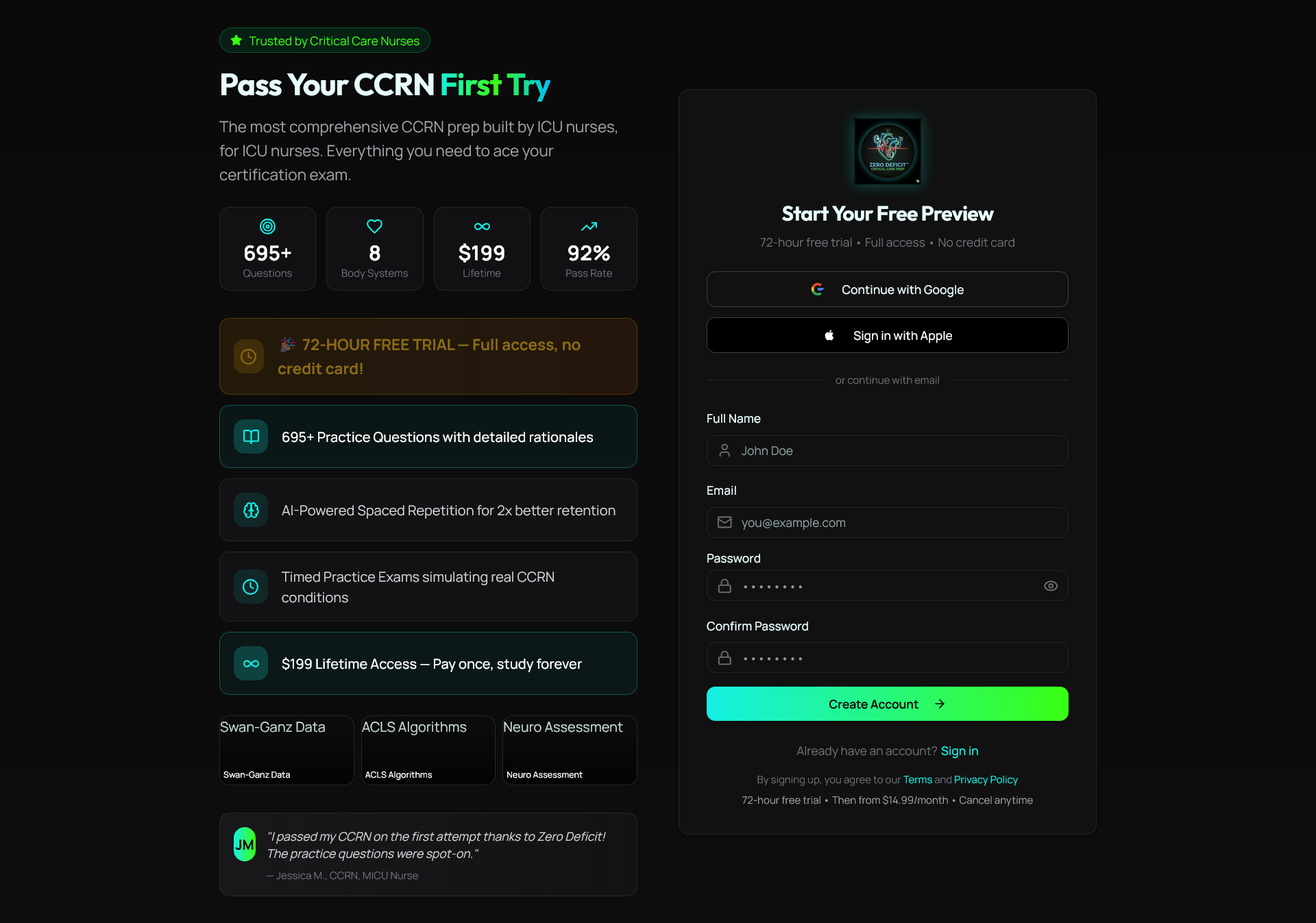
AI-powered review directs your study time to the KSAs where you are weakest, so you are not grinding through cardiovascular questions when your real gap is endocrine. Progress tracking lets you re-benchmark after each study block and watch your domain scores move. The system-based study guides cover all 8 body systems aligned to the test plan, and the timed practice tests simulate full exam conditions so pacing is never a surprise on test day.
Start with the practice question bank, run your baseline, and let the score report tell you exactly where to focus next.
Key Takeaways
A timed baseline practice exam mapped to the AACN test plan is the single most reliable CCRN knowledge self-assessment tool available to ICU nurses.
| Point | Details |
|---|---|
| Baseline exam first | Take a full 125-question timed exam before studying to establish your real starting score by domain. |
| Map gaps to the test plan | Use the AACN Certification Handbook weightings to prioritize domains below 70%, not just overall score. |
| Target 40–80 study hours | A 6–8 week plan with focused remediation and re-benchmarking at weeks 3 and 6 is the standard path. |
| Synergy Model matters | The exam tests clinical judgment in patient-centered scenarios, not task recall. Use scenario-based practice. |
| Zerodeficitccrnprep | 695+ blueprint-aligned practice questions with AI-powered remediation and progress tracking for re-benchmarking. |
The gap between bedside confidence and exam readiness is real — and measurable
Most nurses who struggle with the CCRN are not struggling because they are bad at critical care. They struggle because the exam tests clinical judgment across the full scope of adult critical care, including the endocrine emergencies, CRRT scenarios, and neuro physiology goals that many units rarely surface. Bedside confidence is built on repetition of your unit’s case mix. Exam readiness is built on objective evidence across all domains.
The nurses who pass on the first attempt are not necessarily the most experienced. They are the ones who ran an honest self-assessment early, identified the gaps their unit did not cover, and drilled those gaps with realistic, rationale-rich practice questions. That is a process, not a personality trait. You can run it starting today.
Useful sources and where to verify the exam blueprint
- AACN Certification Handbook (CCRN): Confirm current eligibility requirements (including the 1,040-hour practice pathway), domain weightings, and the modified-Angoff passing standard.
- AACN How to Prepare for the CCRN Exam: Official guidance on subscription practice exams, study strategies, and score report use.
- AACN Knowledge Assessment Tool: Randomized ICU/PCU-specific question sets for pre/post gap identification; useful for orientation and self-directed assessment.
- 2024 AACN National Practice Analysis: The survey of 2,337 critical care nurses that drives current test plan domain weightings.
- SCCM Surviving Sepsis Campaign (2021 guidelines): Verify current MAP targets (≥65 mmHg in septic shock), lactate thresholds, and bundle timing at sccm.org.
- AHA guidelines: Confirm current ACS management, antiarrhythmic protocols, and hemodynamic targets relevant to the cardiovascular domain at heart.org.
FAQ
What is a CCRN knowledge self-assessment?
A CCRN knowledge self-assessment is a structured process of comparing your current clinical knowledge against the AACN exam blueprint, typically using a timed practice exam, to identify which domains need targeted study before your test date.
How many practice questions should I complete before the CCRN exam?
There is no single required number, but working through a bank of 695 or more questions mapped to the AACN test plan gives you enough exposure to all weighted domains and reduces the chance of encountering unfamiliar item styles on exam day.
What score on a practice exam means I am ready to schedule the CCRN?
Consistently scoring at or above the passing equivalent overall, with domain scores at or above 80% in high-weight areas like cardiovascular and pulmonary, is a reasonable signal to schedule. Scores below 70% in two or more weighted domains indicate you need additional targeted remediation first.
How long should I study for the CCRN exam?
A 6–8 week study plan accumulating 40–80 total study hours is standard for ICU nurses with solid experience. Retakers or nurses with significant content gaps may need to extend that to 8–12 weeks.### Does ICU experience replace formal CCRN exam prep?
No. Research shows that experienced critical care nurses still demonstrate measurable knowledge gaps in areas like bedside neuro assessment, ICP goals, and endocrine emergencies. Objective self-assessment and blueprint-aligned practice questions remain necessary regardless of years at the bedside.
Recommended
- Role of Nurses in the ICU: A Complete Clinical Guide | Zero Deficit CCRN Prep
- CCRN Skin Assessment Review: ICU Nurse Exam Guide | Zero Deficit CCRN Prep
- Why assessment matters: Boost CCRN exam success | Zero Deficit CCRN Prep
- The Role of Ethics in Critical Care: 2026 ICU Guide | Zero Deficit CCRN Prep
Take a Multisystem practice quiz
Master sepsis, shock, MODS, and multi-organ failure scenarios.
Get Your Free 20-Question CCRN Diagnostic
20 high-yield CCRN-style questions across every body system, with detailed rationales — emailed to you instantly.
No spam. One email + a couple of helpful follow-ups. Unsubscribe anytime.
Ready to pass your CCRN?
Join 12,000+ nurses using Zero Deficit — 695+ practice questions with rationales, AI-powered weak-area drilling, and spaced-repetition flashcards.
Start Free Trial →