CCRN Practice Question Strategies: A Nurse's Guide
TL;DR:
- Effective CCRN practice requires spaced retrieval, thorough answer review, and deliberate focus on weak areas to enhance clinical reasoning. Avoid common mistakes like skipping detailed reviews or practicing only strengths; instead, analyze errors and target content gaps with scenario-based questions from CCRN-specific resources. Structured, intentional study habits build deeper retention and higher exam success, replicating real clinical decision-making.
A guide to practice question strategies is defined as a structured, evidence-based system for selecting, timing, answering, and reviewing exam questions to maximize long-term retention and clinical reasoning. For critical care nurses preparing for the AACN Adult CCRN exam, passive re-reading of study guides is not enough. Retrieval practice improves retention by 40 to 50% compared to re-reading alone. That single fact should change how you spend every study hour between now and your exam date.
Your guide to practice question strategies: scheduling and spacing
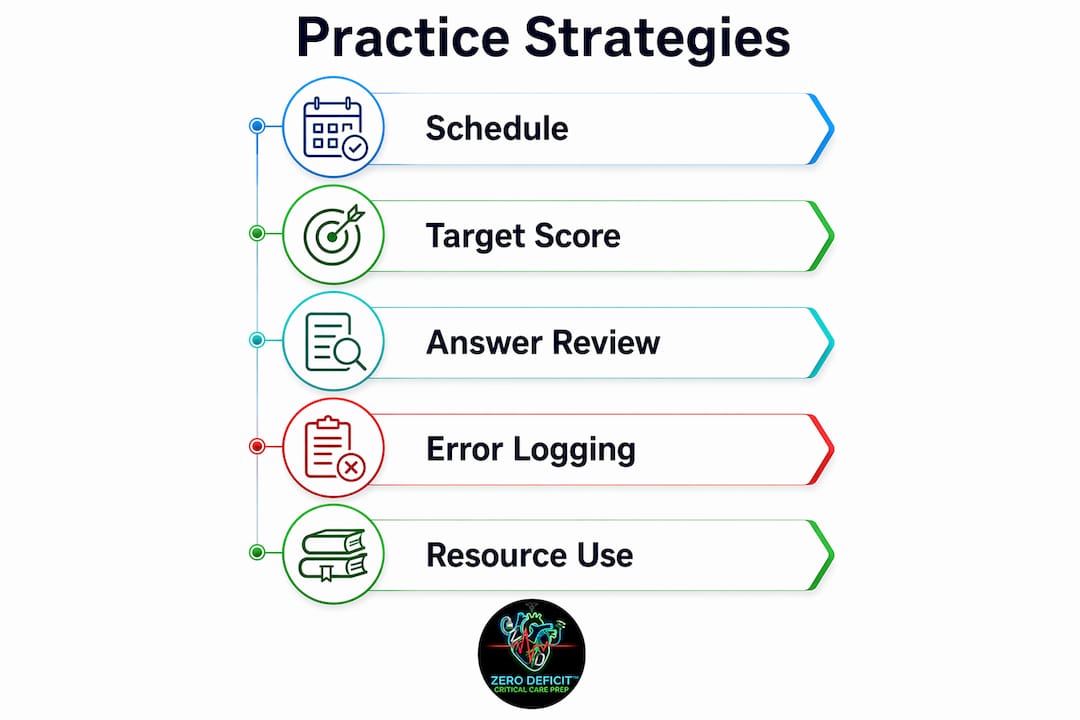
The most overlooked variable in CCRN prep is when you practice, not just how much you practice. Testing yourself after a 24 to 48 hour delay forces deeper memory processing than immediate self-quizzing, which relies on short-term recall that fades within days. Space your question blocks at least one day after your initial content review for each body system.
Here is a practical weekly structure that works:
- Days 1 to 2: Study a content block (e.g., cardiovascular hemodynamics, shock states). Read your notes, review AACN Synergy Model applications, and map out normal hemodynamic values (CVP 2 to 8 mmHg, PCWP 6 to 12 mmHg, CO 4 to 8 L/min).
- Day 3: Complete a timed question block on that content only. Do not check answers mid-block.
- Day 4: Full review session. Analyze every answer, correct and incorrect.
- Days 5 to 7: Interleaved practice mixing cardiovascular with a previously studied system (e.g., pulmonary or renal). Interleaved practice improves exam performance more than blocked practice because it trains your brain to discriminate between similar clinical presentations.
Your target success rate on any question block should fall between 60% and 85%. Scoring above 90% consistently means the material is too easy and you are not building new retrieval pathways. Scoring below 60% signals you need more content review before adding more questions.
Pro Tip: Set a weekly question quota of 50 to 75 questions spread across three to four sessions rather than cramming 100 questions in one sitting. Volume without spacing produces minimal retention gains.

How to choose and create high-quality practice questions
Not all practice questions are equal. The best questions for CCRN prep require you to apply knowledge to a clinical scenario, not just recall a definition. A question asking “What is the normal SVR?” tests memory. A question asking “Your patient with septic shock has an SVR of 400 dynes/sec/cm⁻⁵ and a MAP of 58 mmHg. Which vasopressor is the priority intervention?” tests clinical reasoning. That distinction matters enormously for the CCRN exam.
Follow this sequence when selecting or building your question bank:
- Prioritize scenario-based questions. Every question should include a patient presentation, a set of clinical data, and a decision point. The AACN CCRN exam is built on the Synergy Model, which means questions test your ability to match nurse competencies to patient needs, not just recall facts.
- Mix question formats. Use multiple choice as your primary format to mirror the exam, but supplement with short-answer self-quizzing when reviewing ABG interpretation, drip titration, or ventilator settings. Writing out your reasoning forces concept integration.
- Write your own questions. Self-generating practice questions produces stronger memory than answering externally written questions because you must identify what the examiner would test and why. After studying ARDS, write three questions from the perspective of the AACN blueprint before you ever open a question bank.
- Target desirable difficulty. Questions should feel hard but achievable. If you can answer a question in five seconds, it is not building the retrieval strength you need for a 150-question, timed exam.
- Use CCRN-specific question banks. Generic NCLEX banks do not reflect the critical care depth the AACN exam requires. Use resources built specifically around the CCRN blueprint, including cardiovascular, pulmonary, neuro, sepsis/MODS, endocrine emergencies, and renal/CRRT content.
Pro Tip: After writing a self-generated question, answer it 48 hours later without looking at your notes. If you cannot answer your own question, that is a direct signal of a knowledge gap worth addressing.
How to review practice question answers effectively
Review is where most nurses lose the most ground. Finishing a 25-question block and checking your score is not a review. Review time should be two to three times longer than the time spent answering. If you spent 30 minutes on a question block, budget 60 to 90 minutes for review.
Here is what a real review looks like:
- Categorize every wrong answer. Was it a knowledge gap (you did not know the content), an application error (you knew the content but misapplied it to the scenario), or a careless mistake (you misread the question)? Each error type requires a different fix. Knowledge gaps go back to your study guide. Application errors need more scenario-based practice. Careless mistakes need a test-taking strategy adjustment.
- Read every distractor explanation. Distractor explanations reveal alternative clinical scenarios and common exam traps. A distractor for a norepinephrine question might describe a scenario where vasopressin is correct instead. Reading it gives you an extra clinical scenario without answering an additional question.
- Flag questions you guessed correctly. Correct answers based on guessing or elimination without solid reasoning must be flagged and reviewed as thoroughly as wrong answers. A lucky correct answer is a hidden knowledge gap.
- Annotate your study materials. After each review session, add notes directly to your study guides or flashcards. Progressive annotation builds a personalized review tool over time. If your notes look the same after three weeks of studying, your review is too shallow.
“The struggle to retrieve an answer, even when you fail, strengthens the memory trace more than checking the answer immediately. Sit with the discomfort before you flip to the rationale.”
Use Anki for spaced repetition flashcards on high-yield content like hemodynamic values, ventilator parameters, and SCCM Sepsis-3 criteria. Pair flashcard review with question bank practice rather than replacing one with the other.
Common pitfalls that undermine your practice question strategy
Knowing the right strategy is only half the work. Avoiding the wrong habits is equally important. These are the five most common mistakes that reduce practice effectiveness for CCRN candidates:
- Skipping detailed review. Checking your score and moving on is the single most common mistake. Your score tells you nothing about why you got questions wrong. The rationale is where the learning happens.
- Starting questions before content familiarity. Jumping into a 50-question cardiovascular block before you have reviewed hemodynamics, shock states, and ACS management produces frustration without retention. Questions reinforce content. They do not replace it.
- Checking answers immediately after each question. Immediate answer checking bypasses the retrieval struggle that builds durable memory. Complete the full block before reviewing any answers.
- Practicing only your strong areas. Nurses who consistently score well on pulmonary questions often spend more time there because it feels productive. The CCRN exam will test your weakest areas just as hard. Track your performance by body system and deliberately target the lowest-scoring categories.
- Cramming practice tests. Completing 200 questions in a single weekend session does not replicate the spaced, distributed practice that produces lasting retention. Retaking practice exams after targeted study and tracking improvement over time is far more effective than volume alone.
Tools and resources that support your CCRN question practice
The right tools reduce friction and increase the quality of your practice sessions. Here is a direct comparison of the resources most relevant to CCRN prep:
| Resource | Best use | CCRN-specific? |
|---|---|---|
| Zerodeficitccrnprep 695+ practice questions | Full CCRN blueprint coverage with detailed rationales | Yes |
| Zerodeficitccrnprep body system practice tests | Targeted system-by-system timed quizzes | Yes |
| Anki | Spaced repetition flashcards for high-yield facts | Requires custom decks |
| Notesmakr | AI-generated question creation from your own notes | No (general use) |
| UWorld | High-quality scenario-based questions with detailed explanations | Partial (not CCRN-specific) |
For CCRN prep specifically, the most effective combination is a CCRN-aligned question bank paired with system-based study guides and a spaced repetition tool for high-yield facts. Timed practice exams under real conditions, meaning closed-book with no distractions, build the exam stamina you need for 150 questions in three hours.
Pro Tip: Use your error log as a weekly study guide. Every question you got wrong or guessed correctly becomes a priority item for your next review session. After four weeks, your error log is a personalized blueprint of your exact knowledge gaps.
Track your performance by AACN blueprint category: cardiovascular (approximately 17 to 26% of the exam), pulmonary (approximately 15 to 23%), and multisystem (approximately 24 to 34%). Adjust your question volume in each category based on your actual performance data, not your perceived confidence.
Key takeaways
Effective CCRN practice question strategy requires spaced retrieval, deep answer review, and deliberate targeting of weak areas. Passive question completion without structured review produces minimal retention gains.
| Point | Details |
|---|---|
| Space your practice sessions | Test yourself 24 to 48 hours after content review to engage deeper memory processing. |
| Target the 60 to 85% success zone | Scores above 90% signal material is too easy; below 60% means more content review is needed first. |
| Review takes longer than answering | Budget two to three times the answering time for review, including every distractor explanation. |
| Categorize every wrong answer | Separate knowledge gaps, application errors, and careless mistakes to apply the right fix. |
| Use CCRN-specific question banks | Generic NCLEX banks do not reflect the clinical depth and blueprint weighting the AACN exam requires. |
Why most nurses are practicing questions the wrong way
I have seen this pattern repeatedly: a nurse completes 50 questions, checks the score, feels good about 72%, and moves on. That 72% represents 14 questions with wrong reasoning, unknown distractors, and guessed correct answers that were never examined. The score became the goal instead of the learning.
The nurses who pass the CCRN on their first attempt are not the ones who answered the most questions. They are the ones who reviewed the most thoroughly. They sat with the discomfort of not knowing an answer before checking the rationale. They wrote notes in the margins. They retook question blocks two weeks later to confirm retention, not just completion.
There is also a clinical dimension here that goes beyond the exam. The same critical thinking you build by analyzing a wrong answer on a septic shock question is the same thinking you use at 0300 when your patient’s MAP drops to 55 mmHg and you have to decide between fluid, vasopressors, or calling the attending. Practice questions are not just exam prep. They are clinical reasoning reps.
My honest recommendation: cut your daily question volume in half and double your review time. You will score higher in four weeks than you would have with twice the questions and half the reflection. The advantages of practice testing are real, but only when the practice is deliberate.
— Zero
Build your CCRN prep with Zerodeficitccrnprep
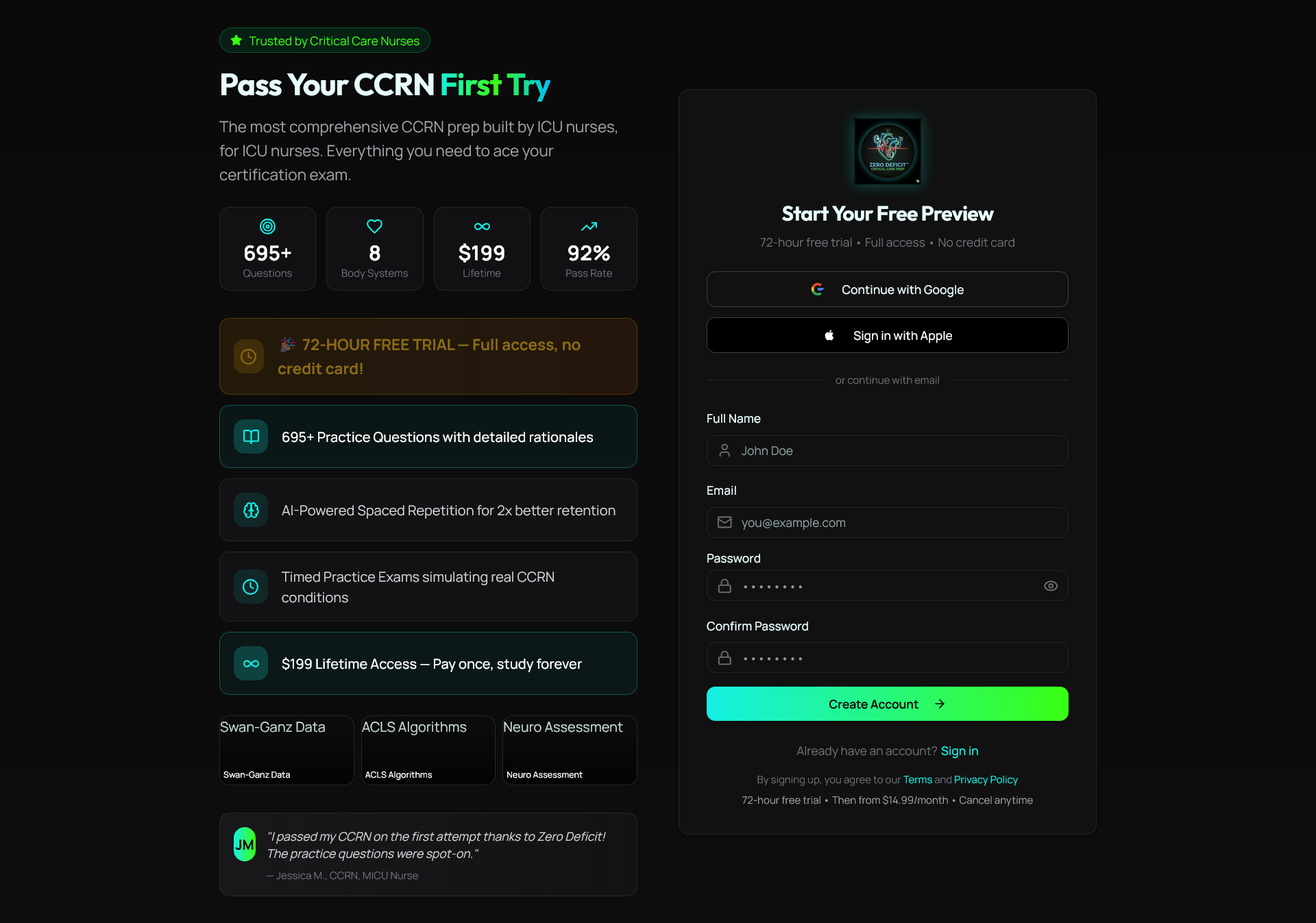
Zerodeficitccrnprep is built specifically for critical care nurses who want to pass the CCRN on the first attempt. The platform offers over 695 practice questions aligned to the AACN blueprint, covering all eight body systems with detailed rationales that explain not just the correct answer but why each distractor is wrong. The question breakdown methods walk you through a step-by-step approach to dissecting complex clinical scenarios, building the critical thinking skills the exam demands. Timed quizzes mirror real exam conditions so you build stamina alongside knowledge. Start your free version at Zerodeficitccrnprep.com and see exactly what your prep has been missing.
FAQ
What is the best strategy for CCRN practice questions?
Space your practice sessions 24 to 48 hours after content review, target a 60 to 85% success rate, and spend two to three times longer reviewing answers than answering questions. Categorize every wrong answer by error type to apply the right corrective strategy.
How many practice questions should I do per day for the CCRN?
Fifty to seventy-five questions spread across three to four weekly sessions is more effective than cramming large volumes in a single day. Quality of review matters more than raw question count.
Should I review questions I answered correctly?
Yes. Questions answered by guessing or process of elimination should be flagged and reviewed as thoroughly as wrong answers, because a correct guess is a hidden knowledge gap that will surface on exam day.
How do I use practice questions to improve critical thinking?
Choose scenario-based questions that require applying clinical data to a decision point, write your own questions after studying each body system, and analyze distractor explanations to expose alternative clinical presentations you have not yet considered.
Which question bank is best for CCRN prep?
Use a CCRN-specific question bank aligned to the AACN blueprint rather than a general NCLEX bank. Zerodeficitccrnprep offers 695+ CCRN-aligned questions with detailed rationales built around the exact content weighting of the Adult CCRN exam.
Recommended
- CCRN Practice Tests & Quizzes 2026 — All 8 Body Systems | Zero Deficit™
- Advantages of practice tests for CCRN exam success | Zero Deficit CCRN Prep
- Pass the CCRN Exam: Proven Guide for Critical Care Nurses | Zero Deficit CCRN Prep
- CCRN Exam Question Breakdown Methods: Master the Exam with Step-by-Step Guides | Zero Deficit™
Take a Multisystem practice quiz
Master sepsis, shock, MODS, and multi-organ failure scenarios.
Get Your Free 20-Question CCRN Diagnostic
20 high-yield CCRN-style questions across every body system, with detailed rationales — emailed to you instantly.
No spam. One email + a couple of helpful follow-ups. Unsubscribe anytime.
Ready to pass your CCRN?
Join 12,000+ nurses using Zero Deficit — 695+ practice questions with rationales, AI-powered weak-area drilling, and spaced-repetition flashcards.
Start Free Trial →