CCRN Strategies That Actually Work: 2026 Guide
TL;DR:
- Effective CCRN preparation involves a structured 10-14 week study plan focusing on high-yield topics and full-length practice exams. Mastering elimination techniques, pacing checkpoints, and developing clinical reasoning significantly improve the chances of passing on the first attempt. Consistent practice, strategic review, and understanding the exam blueprint are essential for success.
CCRN strategies are defined as targeted, evidence-based study and test-taking approaches designed to help critical care nurses master the AACN Adult CCRN exam content and pass on the first attempt. The most effective CCRN exam preparation combines a structured 10–14 week study schedule, full-length timed practice exams, blueprint-aligned content prioritization, and deliberate test-day tactics like answer elimination and pacing checkpoints. These are not generic study tips. They are the specific methods that separate nurses who pass from nurses who retake.
1. build a structured CCRN study schedule first
A 10–14 week study plan maximizes retention and pass rates. Cramming under three weeks frequently leads to failure, while studying longer than four months causes content fade. The window matters.

Commit to 8–12 hours per week. Divide that time between content review and active practice questions. Front-load your schedule with high-yield topics: cardiovascular, pulmonary, and multisystem disorders. These three areas represent 46% of exam content according to the AACN blueprint. Spending the first four weeks here gives you the highest return on study time.
Use spaced repetition to rotate through topics. Revisit cardiovascular content in week seven even after covering it in week two. Spaced review locks in retention far better than a single pass.
| Week Range | Focus Area | Weekly Hours | Practice Questions |
|---|---|---|---|
| Weeks 1–4 | Cardiovascular, Pulmonary | 10–12 hrs | 50–75 questions |
| Weeks 5–8 | Multisystem, Neuro, Renal | 8–10 hrs | 75–100 questions |
| Weeks 9–11 | Endocrine, Synergy Model, Ethics | 8–10 hrs | 75–100 questions |
| Weeks 12–14 | Full-length exams, weak area review | 10–12 hrs | 2 full 150-question exams |
Pro Tip: Track your progress weekly using a simple spreadsheet or a platform like Zerodeficitccrnprep that includes built-in study analytics. Seeing your score trends by body system tells you exactly where to redirect your time.
2. use full-length practice exams as your readiness benchmark
Full-length practice exams are the single most reliable predictor of CCRN exam readiness. Candidates who score 80% or higher on two consecutive timed 150-question practice exams have over a 90% chance of passing on the first attempt. That benchmark is not arbitrary. It reflects the margin needed to absorb exam-day pressure and still perform.
Take every practice exam under real conditions. Set a timer. Sit at a desk. Do not pause. The simulation matters as much as the score.
After each exam, review every missed question and read the rationale in full. Passive reading of content does not build the clinical reasoning the CCRN tests. Active review of why you got a question wrong does. Completing 500–1,000 practice questions across all exam topics, paired with detailed rationale review, is the standard for mastery-level preparation.
“The CCRN exam’s three-step clinical reasoning format requires practical application, not rote memorization. Every question presents a patient description, a priority action inquiry, and four plausible answers.”
Pro Tip: After your first full-length exam, sort your missed questions by body system. That list becomes your personalized study guide for the next two weeks. Learn more about practice test advantages to understand why this method outperforms passive review.
3. master the elimination strategy on every question
Eliminating two obviously wrong answers immediately raises your odds of selecting the correct answer from 25% to 50%. That single shift in approach reduces decision-making time and cognitive load across 175 questions. Over a three-hour exam, that adds up.
The method is straightforward. Read the question stem carefully. Identify what the question is actually asking. Then cross off the two answers that are clearly incorrect before comparing the remaining two. This prevents you from second-guessing yourself against four options simultaneously.
Candidates who combine elimination with rigid pacing consistently outperform those who rely on knowledge alone. Strategy and knowledge work together. Neither replaces the other.
4. prioritize high-yield clinical content areas
The AACN CCRN exam blueprint tells you exactly where to focus. Cardiovascular, pulmonary, and multisystem disorders together account for approximately 46% of exam questions. Mastering these three areas before anything else is the most efficient path to a passing score.
Within cardiovascular, prioritize hemodynamic waveform interpretation, shock states, vasoactive medication comparisons, and ACS management. Hemodynamic waveforms and vasoactive drips are among the most frequently tested topics on the entire exam. Mastering them also simplifies your understanding of sepsis, MODS, and renal failure because the physiology overlaps.
Within pulmonary, focus on ARDS management, mechanical ventilation modes, and arterial blood gas interpretation. Know your normal values cold: PaO2 80–100 mmHg, PaCO2 35–45 mmHg, pH 7.35–7.45, HCO3 22–26 mEq/L. The exam will test your ability to interpret and act on these values in a clinical scenario.
| Content Area | Exam Weight | Key Topics |
|---|---|---|
| Cardiovascular | ~25% | Hemodynamics, shock, ACS, vasoactive drips |
| Pulmonary | ~17% | ARDS, vents, ABGs, oxygenation |
| Multisystem | ~4% | Sepsis, MODS, trauma |
| Neuro | ~12% | ICP, stroke, sedation |
| Renal | ~6% | AKI, CRRT, electrolytes |
| Endocrine | ~5% | DKA, HHS, adrenal crisis |
| Synergy Model | ~20% | Nurse competencies, patient characteristics |
The Synergy Model deserves dedicated study time. It represents 20% of exam questions and covers eight nurse competencies and eight patient characteristics. Nurses who treat this section as an afterthought often lose significant points. Review the AACN’s Synergy Model framework directly and understand how each competency applies to real patient scenarios. For a deeper breakdown of top CCRN study topics, the Zerodeficitccrnprep blog covers each body system in detail.
5. apply pacing checkpoints during the exam
Pacing is a skill you practice before exam day, not something you figure out in the testing center. The CCRN gives you 180 minutes for 175 questions. That works out to approximately 62 seconds per question. You need a mental map before you sit down.
Use two checkpoints: reach question 58 by 60 minutes and question 117 by 120 minutes. These benchmarks leave a buffer at the end to return to flagged questions. If you hit minute 60 and you are only on question 45, you need to accelerate immediately.
Flag questions that genuinely stump you and move on. Do not spiral on a single question. Decision spirals, where you cycle through the same four answers repeatedly, are a major source of time loss and cognitive fatigue on high-stakes exams. Returning to a flagged question with fresh eyes often produces a clearer answer.
- Check your pace at question 58 (60-minute mark)
- Check your pace at question 117 (120-minute mark)
- Flag and move on when stuck; never spend more than 90 seconds on one question
- Reserve the final 15 minutes for flagged question review only
- Do not revisit questions you answered confidently
Pro Tip: Practice pacing during every full-length mock exam. Set a phone timer for 60 minutes and check your question number. If you are behind, you will train yourself to accelerate before it becomes a habit on the real exam. Review the exam day checklist from Zerodeficitccrnprep to make sure nothing catches you off guard.
6. protect your first instinct on test day
Changing answers without new evidence in the question stem reduces scores rather than improves them. This is one of the most consistent findings in test-taking research, and it applies directly to the CCRN. Your first instinct is usually grounded in the clinical knowledge you have built. Second-guessing it based on anxiety is not a strategy.
The exception is clear and specific. If you reread a question and notice a word you missed, a lab value you misread, or a clinical detail that changes the picture, change your answer. That is new evidence. Vague discomfort is not.
The night before the exam, prioritize sleep over last-minute review. Cognitive performance on a timed, high-stakes exam drops measurably with less than seven hours of sleep. Eat a real meal the morning of the exam. Bring water. Arrive early enough to settle in before your start time.
7. develop clinical reasoning, not just memorization
The CCRN does not test whether you can recall a fact. It tests whether you can apply clinical knowledge to a patient scenario and select the best priority action. That distinction changes how you should study. Reflective journaling after shifts moves nurses from task-oriented thinking to outcome-driven reasoning, which directly improves CCRN performance.
After a shift, write down one clinical decision you made and ask yourself why you made it. What was the priority? What would have changed your action? This practice builds the same reasoning pattern the exam tests. It also connects your study material to real patient care, which strengthens retention.
Critical thinking development through reflective practice and mentorship directly correlates with improved CCRN exam performance. Find a colleague who has passed the CCRN and talk through clinical scenarios together. Collaborative reasoning is one of the most underused study methods in critical care nursing.
Key takeaways
The most effective CCRN strategies combine a 10–14 week structured schedule, blueprint-aligned content mastery, full-length timed practice exams, and deliberate test-day techniques including elimination and pacing checkpoints.
| Point | Details |
|---|---|
| Study window matters | A 10–14 week plan maximizes retention; under three weeks or over four months both reduce pass rates. |
| Practice exam benchmark | Score 80% or higher on two consecutive full-length exams before sitting for the real test. |
| Content prioritization | Cardiovascular, pulmonary, and multisystem topics cover 46% of the exam; master these first. |
| Elimination strategy | Crossing off two wrong answers raises your odds from 25% to 50% on every question. |
| Pacing checkpoints | Reach question 58 by minute 60 and question 117 by minute 120 to protect your review buffer. |
What i have learned after years of CCRN prep work
I have worked with hundreds of ICU nurses preparing for the CCRN, and the pattern is consistent. The nurses who struggle are not the ones who lack knowledge. They are the ones who study without a system. They read passively, skip full-length practice exams, and walk into the testing center without a pacing plan. Knowledge without strategy does not pass this exam.
The shift that changes everything is moving from memorization to clinical reasoning. When you stop trying to remember facts and start asking “what would I do for this patient and why,” your practice scores climb. Reflective journaling after shifts accelerated that shift for more nurses than any flashcard deck ever did.
I also want to be direct about the Synergy Model. Most nurses underestimate it. Twenty percent of the exam is a significant portion, and the questions are not difficult once you understand the framework. Spend real time on it. Do not treat it as a bonus section.
Finally, trust your preparation. If you have followed a structured plan, completed your practice questions, and hit the 80% benchmark on two full-length exams, you are ready. Anxiety on exam day is normal. Decision spirals are not inevitable. You have the clinical experience and the preparation. Walk in and use both.
— Zero
Start your CCRN prep with the right resources
Zerodeficitccrnprep is built specifically for ICU nurses who want to pass the CCRN on the first attempt. The platform offers study guides for all 8 body systems, organized by the AACN exam blueprint so you always know what to study next. Every guide connects clinical concepts to exam-style reasoning, not just definitions.
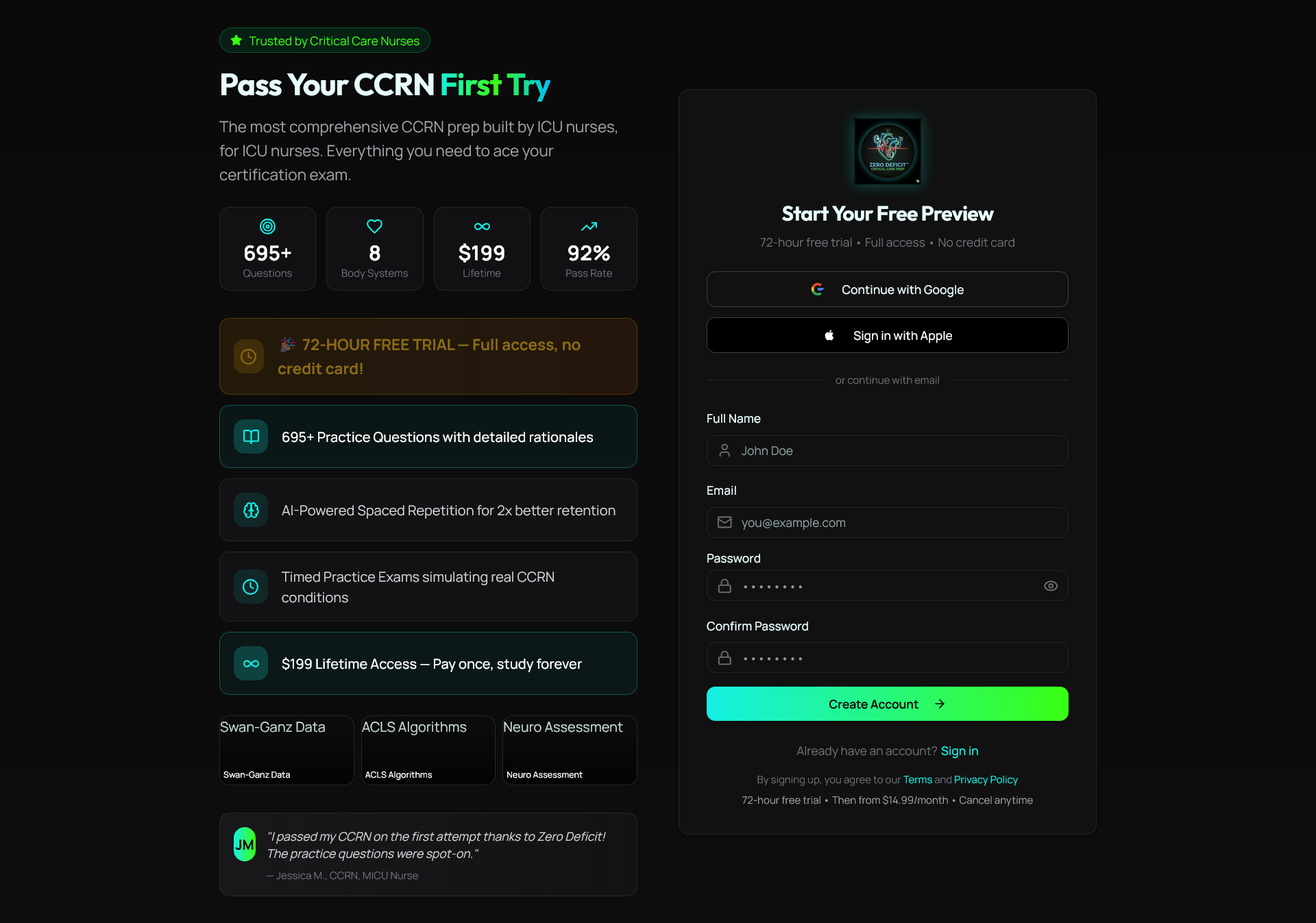
The CCRN practice question bank includes over 695 questions with detailed rationales, progress tracking, and analytics that show your performance by body system. You can start with a free version without entering a credit card. If the quality does not match what you need, you have lost nothing. If it does, you will have the most targeted prep resource available for the Adult CCRN exam.
FAQ
How long should i study for the CCRN exam?
A 10–14 week study plan is the most effective window. Studying under three weeks leads to failure, while studying over four months causes content fade.
What score do i need on practice exams to be ready?
Score 80% or higher on two consecutive full-length, timed 150-question practice exams. Candidates who hit this benchmark have over a 90% first-time pass rate.
Which CCRN topics should i study first?
Start with cardiovascular, pulmonary, and multisystem disorders. These three areas represent approximately 46% of the exam and provide foundational knowledge that applies across other body systems.
How many practice questions should i complete before the exam?
Complete 500–1,000 practice questions across all exam topics. Pair every session with full rationale review to build clinical reasoning, not just answer recognition.
Should i change my answers when reviewing flagged questions?
Only change an answer when you find new evidence in the question stem, such as a misread lab value or a missed clinical detail. Changing answers based on uncertainty alone reduces scores.
Recommended
- Step by Step Exam Review for the CCRN: 2026 Guide | Zero Deficit CCRN Prep
- CCRN High-Yield Topic Guides | Shock, Vasopressors, Sepsis | Zero Deficit™
- Pass the CCRN Exam: Proven Guide for Critical Care Nurses | Zero Deficit CCRN Prep
- CCRN Exam Question Breakdown Methods: Master the Exam with Step-by-Step Guides | Zero Deficit™
Take a Multisystem practice quiz
Master sepsis, shock, MODS, and multi-organ failure scenarios.
Get Your Free 20-Question CCRN Diagnostic
20 high-yield CCRN-style questions across every body system, with detailed rationales — emailed to you instantly.
No spam. One email + a couple of helpful follow-ups. Unsubscribe anytime.
Ready to pass your CCRN?
Join 12,000+ nurses using Zero Deficit — 695+ practice questions with rationales, AI-powered weak-area drilling, and spaced-repetition flashcards.
Start Free Trial →