CCRN Study Analytics Workflow: Your 2026 Pass Plan

TL;DR:
- A CCRN study analytics workflow transforms practice question performance into targeted remediation guided by the exam blueprint.
- It emphasizes detailed error logging, blueprint-weighted study prioritization, and spaced repetition to improve exam success efficiently.
A CCRN study analytics workflow is a systematic, data-driven method that converts practice question results into targeted remediation cycles aligned to the AACN Adult CCRN exam blueprint. Rather than logging hours and hoping for the best, this approach treats every missed question as a clinical data point. The Adult CCRN exam contains 150 scored questions split 80% clinical judgment and 20% professional caring and ethical practice, which means your study plan must reflect that same weighting. Tools like timed practice exams, structured error logs, and spaced repetition cycles are the core mechanics of this workflow. When you build your prep around these feedback loops, you stop studying broadly and start studying precisely.
What tools you need for a CCRN study analytics workflow
The right tools separate productive study sessions from busy work. You need four categories of resources to run an effective clinical study analytics system: a question bank, an error log, a tracking method, and a remediation schedule.

Question banks are your primary data source. The AACN recommends completing 1,000 to 2,000 practice questions under timed conditions across your full study period. That volume generates enough data to identify real patterns in your performance. Platforms like Zerodeficitccrnprep offer 695+ blueprint-aligned questions with detailed rationales and built-in progress tracking dashboards, which removes the manual burden of calculating domain-level accuracy yourself.
Error logs are the most underused tool in CCRN prep. Most nurses log a missed question as “cardiovascular” and move on. That level of analysis tells you almost nothing. A precise error log captures four columns: missed topic, missed cue, correct rule, and next drill plan. Capturing missed cues specifically rather than broad content labels is what increases remediation precision. A missed cue might be “patient on IABP with rising PCWP” rather than just “hemodynamics.”
Here is a comparison of error-log formats to help you choose the right one:
| Format | Best for | Limitation |
|---|---|---|
| Paper notebook | Retention through handwriting | Hard to sort by domain or cue type |
| Spreadsheet (Excel/Google Sheets) | Sorting, filtering, trend analysis | Requires setup time upfront |
| Anki flashcard deck | Spaced repetition integration | Less useful for multi-step clinical reasoning |
| Platform dashboard (e.g., Zerodeficitccrnprep) | Automatic tracking and domain weighting | Dependent on platform question coverage |
Pro Tip: Start your error log on day one, not after your first full-length exam. Even early practice sets reveal cue-recognition patterns worth tracking.
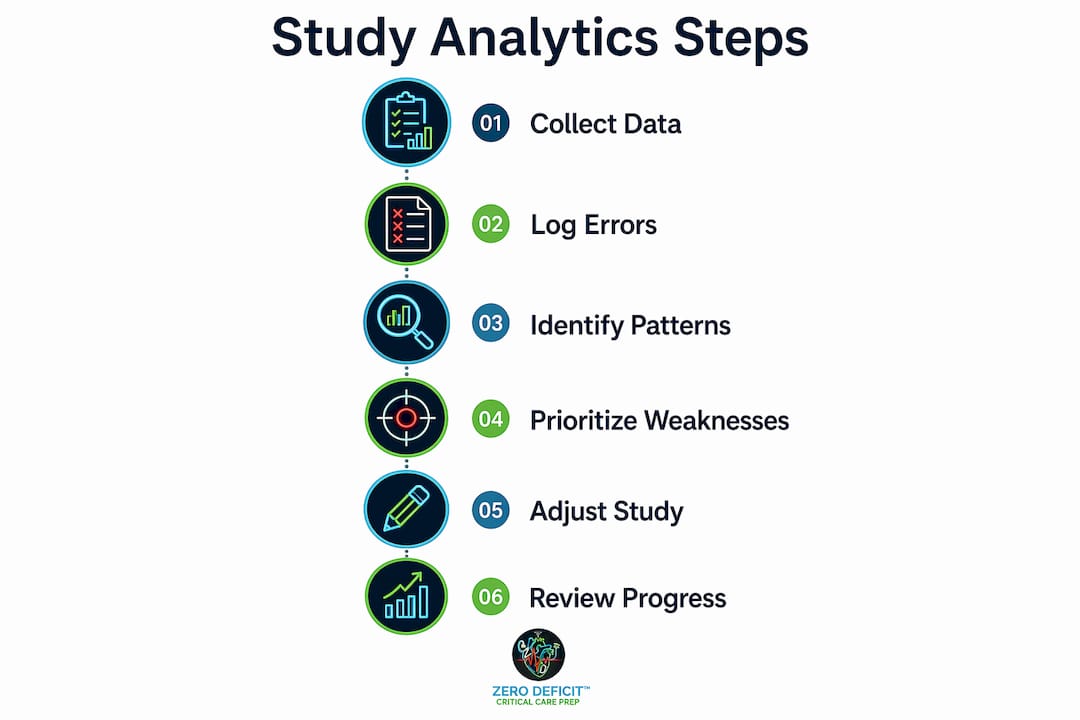
For tracking study time, a simple weekly log in Google Sheets or Notion works well. Record total hours, domains covered, and question accuracy by domain. This gives you the raw data you need to make weekly adjustments to your workflow.
How to execute your CCRN analytics workflow step by step
A well-run data analysis workflow for CCRN prep follows a repeating cycle: assess, log, prioritize, drill, and review. Here is how to build that cycle from week one.
-
Take a baseline full-length timed exam. Simulate real testing conditions: 150 questions, 3 hours, no interruptions. This is your starting data set. A baseline exam plus error-log setup identifies your weakest domains before you waste study time on areas you already know.
-
Build your error log immediately after. For every missed question, record the topic, the specific cue you missed, the correct clinical rule, and what you will drill next. Do not skip the “missed cue” column. This is the most precise unit of analysis in your entire workflow.
-
Prioritize by AACN blueprint weighting. Cardiovascular accounts for 17% of the exam, pulmonary for 15%, and multisystem for 18%. Spend proportional time in each domain. If your baseline shows 55% accuracy in pulmonary and 80% in renal, your weekly schedule should reflect that gap directly.
-
Run weekly domain-specific drill sessions. Cap each session at 25 to 50 questions and spend equal time reviewing rationales. Active recall and spaced repetition with small batch sessions produce better retention than bulk untimed practice.
-
Review your error log every 2 to 3 days. Pull your most recent missed cues and create micro-sets of 10 to 15 questions targeting exactly those triggers. This is where the workflow compounds. You are not re-reading content; you are drilling the specific decision points where you break down.
-
Include professional caring and ethical practice every week. This domain represents 20% of the exam and is consistently underrepresented in most study schedules. Build it into your weekly rotation from the start, not as an afterthought in week 10.
-
Practice pacing under timed conditions. The CCRN mixes 125 scored and 25 unscored questions indistinguishably. Because you cannot identify unscored items, your pacing and analytics must treat every question as scored. Aim for roughly 72 seconds per question and practice flagging and moving on without spiraling.
Pro Tip: Set a calendar block every Sunday to review your weekly error log trends. Fifteen minutes of pattern analysis saves hours of misdirected studying the following week.
Common mistakes in CCRN study analytics and how to avoid them
Most CCRN candidates who struggle with exam prep are not studying too little. They are studying without feedback loops. These are the most common workflow errors and how to correct them.
-
Logging misses by broad domain only. Writing “missed a neuro question” tells you nothing actionable. You need the specific cue: “missed early signs of transtentorial herniation in a post-craniotomy patient.” That level of specificity creates a drill target.
-
Skipping the professional caring and ethical practice domain. This section is worth 20% of your score and covers the AACN Synergy Model, advocacy, and end-of-life care. Nurses who focus exclusively on clinical content often lose 5 to 8 points in this domain alone.
-
Practicing untimed or in bulk. Untimed practice inflates your perceived accuracy. A score of 78% on an untimed 100-question set does not predict exam performance. Timed conditions change your decision-making under pressure, and that difference matters on test day.
-
Inconsistent study schedules. Spaced repetition only works when the spacing is consistent. Studying for 6 hours on Saturday and nothing for 4 days breaks the retention cycle. Shorter daily sessions outperform weekend cramming for CCRN content.
-
Introducing new content in the final two weeks. Late-stage new material competes with consolidation of what you already know. The final stretch is for mixed practice, rationale review, and cheat-sheet refinement, not new topic acquisition.
“The highest-yield analytics come from feedback loops focused on your weakest domains, not from counting total study hours.” — CCRN Study Guide
Pro Tip: If you catch yourself re-reading the same content chapter for the third time, stop. Pull your error log instead and drill the specific cues you have missed twice or more.
How to interpret your analytics and optimize the final weeks
The final three to four weeks of CCRN prep require a shift in how you use your data. You move from content acquisition to decision quality practice. These two phases require different study behaviors.
Start by pulling your error-log trends across the full study period. Look for cues that appear more than twice. These are your highest-priority targets. Create a one-page reference sheet for each recurring weak domain, listing the key clinical values, decision triggers, and correct rules. For example, a cardiovascular cheat sheet might include normal hemodynamic parameters (CVP 2 to 8 mmHg, PCWP 8 to 12 mmHg, CO 4 to 8 L/min) alongside the vasopressor decision tree for cardiogenic versus distributive shock.
Use this data table to guide your final-week session structure:
| Week | Focus | Session type |
|---|---|---|
| Week 9 to 10 | Weak domain drilling | 25 to 50 timed domain-specific questions |
| Week 11 | Mixed practice and rationale review | Full-length timed exam plus error-log review |
| Week 12 | Cheat-sheet refinement and pacing | Mixed sets, Synergy Model review, pacing drills |
Final-week preparation should shift toward mixed practice sets, rationale review, and concise reference creation. This is not the time to open a new body system chapter. Your brain needs retrieval practice, not new input.
Review the AACN Synergy Model in week 12 specifically. It underpins the professional caring domain and appears across multiple question types. Understanding the eight patient characteristics and eight nurse competencies gives you a framework for answering ethics and advocacy questions with clinical precision.
On the operational side, practice your flagging strategy during full-length exams. If a question takes more than 90 seconds, flag it and move forward. Your analytics will show whether you are losing time on specific question types, which is itself a data point worth logging.
Pro Tip: Review your CCRN rationale notes from the first half of your study period in week 11. Rationales you wrote early often contain the exact clinical reasoning you need to reinforce before test day.
Key takeaways
A CCRN study analytics workflow built around missed-cue logging, blueprint-weighted prioritization, and spaced repetition cycles produces the most targeted and efficient path to passing the Adult CCRN exam.
| Point | Details |
|---|---|
| Missed-cue logging | Record the specific clinical trigger you missed, not just the broad topic, to create precise drill targets. |
| Blueprint weighting | Allocate study time by AACN domain percentages, with cardiovascular, pulmonary, and multisystem as top priorities. |
| Spaced repetition cadence | Review your error log every 2 to 3 days and build micro-sets targeting repeated misses. |
| Ethics domain inclusion | Schedule professional caring and ethical practice questions weekly since this domain covers 20% of the exam. |
| Final-week shift | Move from new content to mixed practice, cheat-sheet review, and pacing drills in the last three weeks. |
What I have learned from watching nurses use analytics to pass
I have seen two types of CCRN candidates. The first tracks hours. The second tracks errors. The second group passes at a significantly higher rate, and the difference is not effort. It is feedback quality.
The nurses who struggle most are the ones who treat a missed question as a failure rather than a data point. When you miss a question about ARDS management, that is not a gap in your worth as a critical care nurse. It is a signal that one specific decision trigger needs reinforcement. That reframe changes everything about how you study.
For ICU nurses juggling 12-hour shifts and a family at home, the analytics workflow is actually a time-saver. You are not studying everything. You are studying what your data tells you to study. A 45-minute session built around your top five missed cues from the past week beats a 3-hour passive re-read of a cardiovascular chapter every time.
I also advocate keeping a handwritten error log even if you use a digital platform. Writing the missed cue and correct rule by hand forces you to process the information more deeply than clicking a button. Use both. Let the platform track your domain accuracy automatically, and let your notebook capture the clinical reasoning you need to internalize.
Your ICU experience is not separate from your analytics workflow. It is part of it. When you see a hemodynamically unstable patient on norepinephrine and recognize the clinical picture, that pattern recognition is the same skill the CCRN tests. The workflow just makes that skill explicit and measurable.
— Zero
Build your analytics workflow with Zerodeficitccrnprep
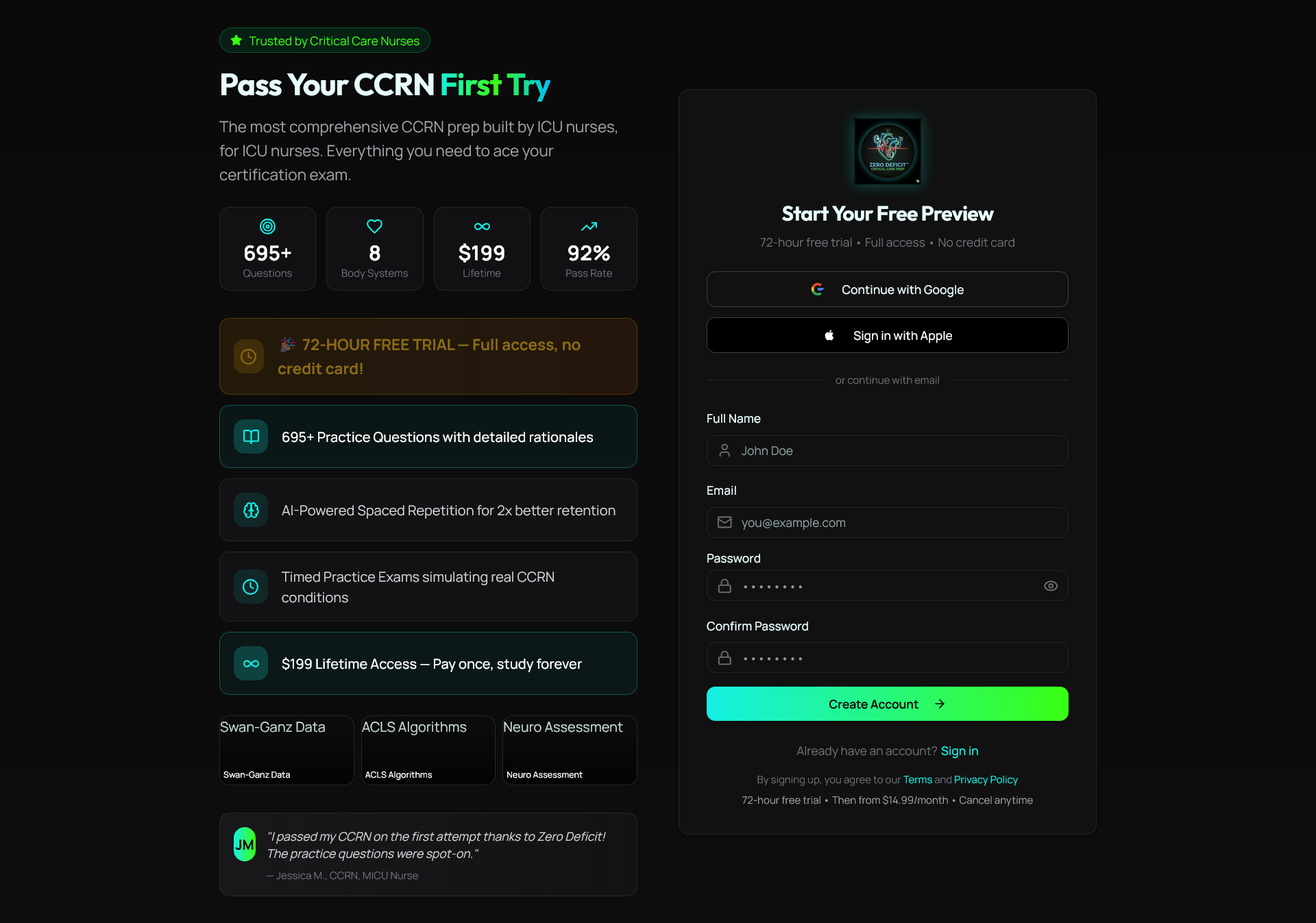
Zerodeficitccrnprep is built specifically for the kind of analytics-driven prep this article describes. The platform’s 695+ practice questions are organized by AACN blueprint domain, so your accuracy data maps directly to exam weighting. Built-in progress tracking shows you exactly where your performance is strongest and where you need more drill time. Detailed rationales support the error-logging process by giving you the correct clinical rule for every missed question. The blueprint-aligned study guides cover all eight body systems and integrate with the question bank so your remediation cycles stay focused and efficient. Start studying free at Zero Deficit CCRN Prep today, no credit card required and see how the platform fits your workflow.
FAQ
What is a CCRN study analytics workflow?
A CCRN study analytics workflow is a structured system that uses practice question performance data to guide targeted remediation. It combines baseline testing, error logging, domain-weighted prioritization, and spaced repetition to improve exam readiness.
How many practice questions should I complete before the CCRN exam?
CCRN candidates should complete 1,000 to 2,000 practice questions under timed conditions across a 10 to 12 week study period. Volume matters, but only when paired with detailed rationale review and error logging.
What should I include in a CCRN error log?
An effective error log captures four data points per missed question: the missed topic, the specific clinical cue you overlooked, the correct rule, and your next drill plan. Reviewing this log every 2 to 3 days maximizes remediation efficiency.
How do I prioritize domains in my CCRN study plan?
Align your study time to AACN blueprint percentages. Cardiovascular, pulmonary, and multisystem are the highest-weighted domains. Professional caring and ethical practice covers 20% of the exam and requires consistent weekly attention throughout your prep.
What should I focus on in the final two weeks before the CCRN exam?
The final two weeks should focus on mixed practice sets, rationale review, and refining your cheat sheets for weak domains. Avoid introducing new content. Instead, use your error-log trends to run targeted retrieval practice on your most persistent missed cues.
Recommended
- The Role of Study Analytics for Nurses in CCRN Prep | Zero Deficit CCRN Prep
- Step by Step Exam Review for the CCRN: 2026 Guide | Zero Deficit CCRN Prep
- Pass the CCRN Exam: Proven Guide for Critical Care Nurses | Zero Deficit CCRN Prep
- 2026 Trends in Critical Care Certification You Must Know | Zero Deficit CCRN Prep
Take a Multisystem practice quiz
Master sepsis, shock, MODS, and multi-organ failure scenarios.
Get Your Free 20-Question CCRN Diagnostic
20 high-yield CCRN-style questions across every body system, with detailed rationales — emailed to you instantly.
No spam. One email + a couple of helpful follow-ups. Unsubscribe anytime.
Ready to pass your CCRN?
Join 12,000+ nurses using Zero Deficit — 695+ practice questions with rationales, AI-powered weak-area drilling, and spaced-repetition flashcards.
Start Free Trial →