How educators boost CCRN certification success for nurses
More study hours do not automatically mean a higher CCRN pass rate. Many candidates spend months grinding through textbooks and random practice questions, only to walk into the exam feeling underprepared. What separates those who pass on their first attempt from those who don’t is rarely the total time spent studying. It’s the quality of instruction, the structure behind their prep, and the strategic support they receive along the way. This guide breaks down exactly how educators contribute to CCRN certification success and what evidence-based methods you should look for in any prep program.
Table of Contents
- How the CCRN exam is built and why your prep should match it
- The educator’s role: From subject-matter expert to strategic coach
- Case-based and skills coaching: The secret ingredient to deep retention
- Can seminars and attendance alone boost your CCRN scores?
- What most CCRN candidates and instructors miss (but shouldn’t)
- Take your CCRN prep further with proven educator-led resources
- Frequently asked questions
Key Takeaways
| Point | Details |
|---|---|
| Blueprint-driven prep matters | Educators base CCRN instruction on the exam’s validated test plan and Synergy Model, ensuring focused preparation. |
| Scenario learning boosts retention | Educator-designed case studies help anchor ICU knowledge and build real-world reasoning for the CCRN exam. |
| Coaching goes beyond lectures | Structured coaching and feedback drive improvements more than seminar attendance alone. |
| Assessment and feedback are critical | Frequent assessment and personalized feedback are essential for meaningful skill gains. |
How the CCRN exam is built and why your prep should match it
Before examining how educators support candidates, it’s essential to understand the exam’s foundation.
The CCRN exam is not a general nursing knowledge test. It is a precisely engineered assessment grounded in real clinical practice. According to the AACN exam handbook, the CCRN exam is built on a validated job analysis and a test plan developed by an expert panel, organized around the AACN Synergy Model for Patient Care. That model connects patient needs to nurse competencies in a way that directly reflects the realities of critical care nursing. You can read more about the critical care nurse role and how it shapes the exam’s design.
The test plan is updated on a regular cycle to reflect current ICU practice. This means prep that doesn’t track these updates leaves candidates studying outdated content. The following table breaks down the core structure of the CCRN exam:
| Content area | Approximate weighting | Focus |
|---|---|---|
| Clinical judgment | ~80% | Patient assessment, prioritization, clinical decision-making |
| Professional caring and ethical practice | ~20% | Collaboration, advocacy, caring practices, systems thinking |
| Cardiovascular | High yield within clinical judgment | Dysrhythmias, heart failure, hemodynamics |
| Pulmonary | High yield within clinical judgment | Ventilator management, ARDS, oxygenation |
| Neurology, renal, endocrine, hematology | Moderate yield | Condition-specific patient management |
“Educators who anchor their instruction to the official CCRN test plan aren’t just teaching content. They’re ensuring every minute of your prep is working directly toward your certification goal. Alignment isn’t optional. It’s the entire strategy.”
The reason this matters so much is that unfocused prep tends to spread effort across low-yield topics. Educators who understand the blueprint direct your attention where it counts most, reducing wasted effort and improving the precision of your preparation.
The educator’s role: From subject-matter expert to strategic coach
With that framework in mind, here’s how dedicated educators shape every stage of your preparation.
Great CCRN educators do far more than lecture on hemodynamic monitoring or ventilator settings. According to AACN’s Adult CCRN Certification Review, nurse educators are positioned as content experts who deliver scenario-based instruction, test-taking strategies, and modules aligned to specific CCRN content weighting. This multi-layer approach is what makes educator-led prep meaningfully different from solo reading.
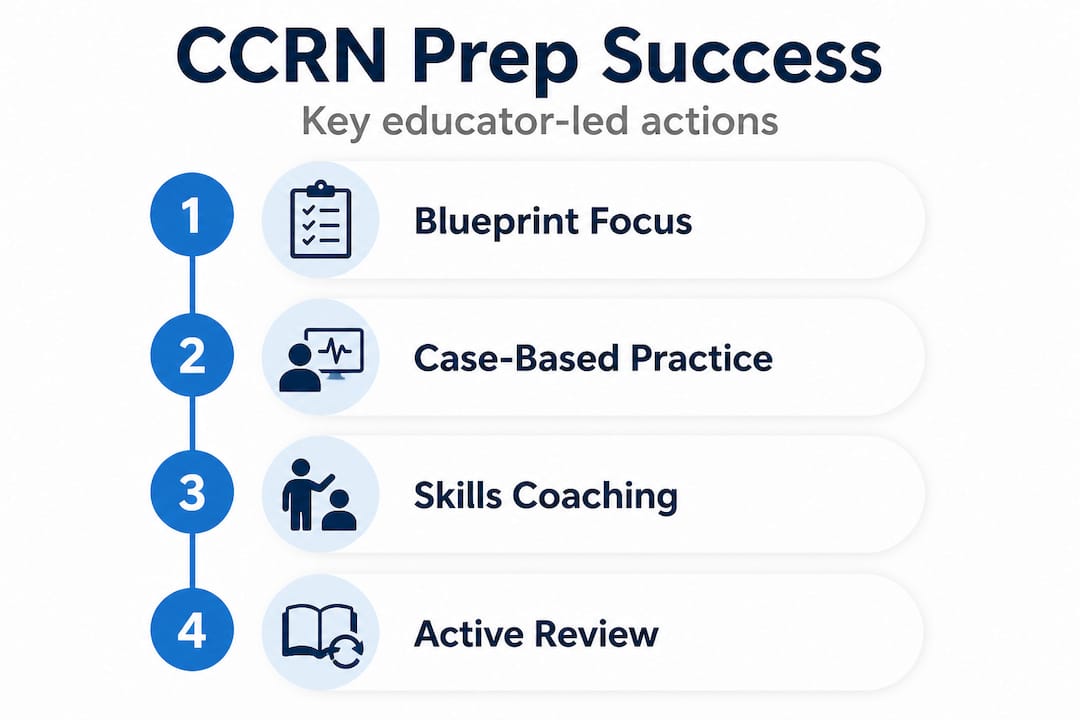
Here are the four core functions a skilled CCRN educator performs:
- Blueprint alignment. Educators map every lesson, case, and question back to the official test plan. This ensures you’re developing knowledge in exact proportion to how the exam actually tests it.
- Scenario and case-based learning. Rather than presenting information in isolation, educators create clinical stories that reflect real ICU situations. This forces you to apply CCRN nurse competencies under realistic conditions, which builds transferable understanding.
- Test strategy coaching. Understanding content and knowing how to answer CCRN questions are two different skills. Educators teach you how to interpret question stems, eliminate distractors, and manage time under pressure.
- Practice question review. Reviewing questions with an educator is completely different from reviewing them alone. An educator can explain why one answer is right and why the others are wrong at a deeper level, using clinical reasoning rather than surface-level logic. Strong step-by-step breakdown methods are a significant part of this process.
Pro Tip: Ask your instructor directly how each of their modules maps to the latest CCRN test plan. If they can’t point you to specific content weightings for each lesson, that’s a gap you need to fill.
This four-part role transforms raw ICU experience into exam-ready performance. The nurses who leverage all four consistently outperform those who rely on content review alone.
Case-based and skills coaching: The secret ingredient to deep retention
Now, let’s look at the educational methods that actually lead to long-term understanding.
Case-based learning is more than a teaching style. It’s a retention strategy. When you work through a clinical scenario, your brain encodes the information differently than it does during passive reading. You’re making decisions, connecting physiology to intervention, and experiencing consequences within the scenario. That active process creates stronger memory pathways, which means the knowledge is more accessible under exam pressure.

Structured coaching has measurable effects on both competence and clinical outcomes, reinforcing that individualized support is a key driver of performance improvement in nursing education interventions. AACN’s review course also pairs scenarios with practice questions, recognizing that neither element works as well in isolation.
Here’s how case-based learning compares to traditional lecture in the context of CCRN prep:
| Feature | Traditional lecture | Case-based modules |
|---|---|---|
| Information delivery | Passive, instructor-driven | Active, learner-driven |
| Retention rate | Lower without review | Higher with clinical application |
| Test readiness | Limited without application | Strong when paired with practice questions |
| Confidence building | Moderate | High, especially with feedback |
| Alignment to ICU reality | Indirect | Direct and deliberate |
The benefits of skills coaching extend well beyond the content level. Here’s what targeted 1:1 or small-group coaching brings to your prep:
- Personalized feedback on where your clinical reasoning breaks down
- Performance tracking that shows you precisely which content areas need more attention
- Confidence building through repeated successful application of knowledge
- Targeted remediation that addresses gaps before they become exam-day liabilities
- Accountability structures that keep your prep moving on schedule
This is also why effective exam review processes are so central to passing. Review without feedback is just passive repetition. Review with expert feedback methods turns every practice session into a targeted improvement cycle. Research on comprehensive exam prep parallels from other high-stakes assessments confirms that active, coached preparation consistently outperforms passive self-study.
Can seminars and attendance alone boost your CCRN scores?
But is educator-guided participation enough? Let’s dig into what the evidence and experts really say.
Seminar attendance is valuable, but it carries a limitation that many candidates overlook. A common assumption is that showing up to a CCRN review seminar equals preparation. The reality is more nuanced.
Research on this question shows a complicated picture. Studies examining clinical reasoning seminar attendance found that participants often achieved higher mean exam scores than non-attendees. However, the difference was not always statistically significant. That means you cannot count on seminar attendance alone to push you across the passing threshold.
Key finding: Seminar participants showed higher mean scores, but results did not consistently reach statistical significance, meaning attendance alone is not a reliable predictor of passing.
This does not make seminars useless. It makes them incomplete as a standalone strategy. Seminars work best when they are paired with ongoing assessment, personalized feedback, and individualized remediation pathways. A live session that teaches content without testing application leaves too many gaps.
What you actually need alongside seminar instruction:
- Regular practice under timed, exam-simulated conditions
- Feedback that ties your performance to specific content areas
- A remediation plan based on your actual performance data, not your own judgment of where you’re weak
- Ongoing contact with educators, not just a one-time event
Building your CCRN exam confidence depends on more than hearing great lectures. Confidence comes from repeatedly demonstrating competence in simulated conditions. That only happens when you combine seminar learning with deliberate practice question techniques and structured feedback.
Pro Tip: When evaluating a CCRN prep program, look past the seminar schedule. Ask whether the program includes ongoing feedback, performance analytics, and a clear process for addressing your specific weak areas. Programs that offer all three are the ones that reliably move the needle.
What most CCRN candidates and instructors miss (but shouldn’t)
This brings us to a crucial lesson largely overlooked in CCRN prep.
Here’s the uncomfortable truth: most CCRN candidates think they’re preparing effectively when they’re actually just staying busy. Attending a seminar, reading a study guide, and doing a few practice questions feels like progress. But progress is only real when it’s measured, and measurement requires feedback loops.
The same gap exists on the educator side. Many instructors deliver excellent content but function primarily as presenters rather than performance partners. They cover the material thoroughly and move on. What’s missing is the diagnostic function, the part where an educator analyzes your specific performance data and adjusts instruction to close the gaps they find.
Passive involvement in any learning program does not translate to higher CCRN pass rates. Active engagement does. That means completing practice questions with intent, reviewing rationales to understand your errors at a reasoning level, and returning to your educator with specific questions that emerge from that review.
The most effective educators in CCRN prep serve as both instructors and strategic partners. They don’t just teach. They track. They don’t just present. They diagnose. When an educator reviews your performance data and says, “You’re consistently missing hemodynamic questions that require you to interpret waveforms,” that’s actionable. That’s the kind of feedback that changes outcomes.
There is also a misconception that high ICU experience automatically translates to high CCRN scores. It doesn’t. The exam tests clinical judgment in a structured, standardized format that rewards systematic thinking and strategic test-taking. ICU experience gives you the raw material, but educator-guided prep is what shapes that experience into exam performance. Exploring real-world prep strategies that bridge clinical experience with exam strategy is one of the most valuable things any candidate can do.
“The candidates who pass aren’t just the most experienced nurses in the room. They’re the ones who engaged most actively with their prep, sought feedback, and adjusted their approach based on what their performance data actually showed.”
Take your CCRN prep further with proven educator-led resources
Ready to experience the difference strategic educator guidance makes in your CCRN journey?
Zero Deficit™ CCRN Exam Prep is built around exactly the principles covered in this article. Every resource is designed by educators who understand the CCRN blueprint inside and out, ensuring your study time is targeted, efficient, and mapped directly to what the exam actually tests.
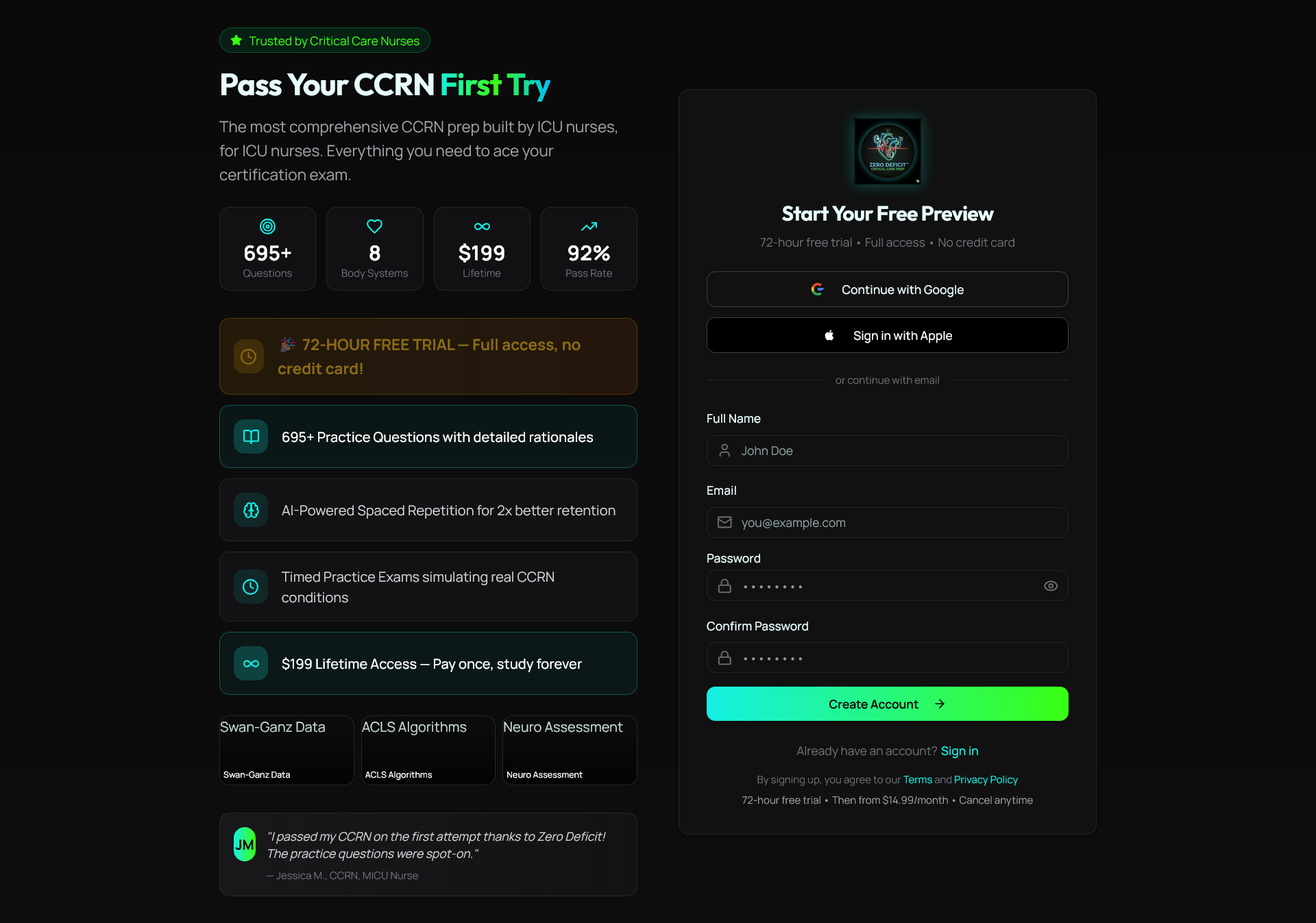
Explore the CCRN study guides organized by body system, each paired with practice questions and detailed rationales that mirror the reasoning style of the actual exam. With over 695 practice questions, AI-powered review tools, and study analytics that track your performance by content area, Zero Deficit™ gives you the feedback-driven prep experience that passive self-study simply can’t match. Start studying free at Zero Deficit CCRN Prep today, no credit card required, and see firsthand how educator-designed materials can sharpen your clinical reasoning and build the confidence you need to pass on your first attempt.
Frequently asked questions
What makes educator-led CCRN prep more effective than self-study?
Educator-led prep aligns instruction directly with the CCRN test blueprint, integrates real ICU scenarios, and incorporates test-taking strategies that improve clinical reasoning. AACN positions educators as subject-matter experts who use case studies and test strategy to deliver targeted instruction.
How do educators tailor their teaching to the CCRN exam?
Educators explicitly map their modules to the exam’s validated test plan, emphasizing clinical judgment which carries the heaviest content weighting. The CCRN test plan guides how content is weighted, so educators prioritize the highest-yield areas systematically.
Do seminar attendance or coaching sessions always improve CCRN scores?
Seminar attendance alone does not guarantee higher scores. Clinical reasoning seminar participants showed higher mean scores but results were not always statistically significant, reinforcing that ongoing feedback and individualized support are essential additions.
What is case-based learning and why is it used?
Case-based learning uses real clinical scenarios to build deeper understanding and replicate the reasoning demands of actual ICU patient care. AACN’s review course delivers scenario-based instruction integrated with test-taking strategies to maximize retention and application.
How can candidates maximize the impact of educator support?
Seek programs that offer practice questions, performance feedback, and individualized remediation rather than live lectures alone. Structured coaching and assessment are the components that drive measurable improvements in nurse competence and exam outcomes.
Recommended
Take a Renal practice quiz
Master AKI, dialysis, electrolytes, and fluid balance for the CCRN.
Get Your Free 20-Question CCRN Diagnostic
20 high-yield CCRN-style questions across every body system, with detailed rationales — emailed to you instantly.
No spam. One email + a couple of helpful follow-ups. Unsubscribe anytime.
Ready to pass your CCRN?
Join 12,000+ nurses using Zero Deficit — 695+ practice questions with rationales, AI-powered weak-area drilling, and spaced-repetition flashcards.
Start Free Trial →