How to review CCRN rationales: A critical care nurse's guide
TL;DR:
- Most critical care nurses spend little time understanding rationale explanations, risking exam success. Reviewing rationales effectively transforms mistakes into targeted learning and builds clinical reasoning aligned with AACN standards. Use domain-specific, active review strategies and measure progress to enhance competence for CCRN certification.
Most critical care nurses spend hours on practice questions, then skim the rationales and move on. That gap between answering a question and actually understanding its rationale is exactly where exam success gets lost. Knowing how to review CCRN rationales the right way transforms every missed question from a discouraging moment into a targeted learning opportunity. This guide gives you a practical, stepwise method grounded in how the AACN actually constructs and validates the exam, so you stop guessing and start building the clinical decision-making skills that earn a passing score.
Table of Contents
- Understand the foundation: What CCRN rationales really are
- Prepare your study toolkit: Gathering materials and setting goals for rationale review
- Execute active rationale review: Step-by-step method for deep learning
- Troubleshoot common pitfalls and mistakes when reviewing CCRN rationales
- Verify your progress: Measuring rationale review success and adjusting your plan
- A critical care nurse’s perspective: Why rationales are your clinical decision allies, not just exam clues
- Boost your CCRN prep with Zero Deficit CCRN Prep resources
- Frequently asked questions
Key Takeaways
| Point | Details |
|---|---|
| Understand rationale purpose | Rationales reflect clinical decisions validated by experts, not simple facts to memorize. |
| Use domain-based study | Identify and target weak content domains when reviewing rationales for efficient remediation. |
| Active rather than passive review | Engage deeply with rationales by analyzing errors and reattempting questions in weak areas. |
| Avoid common pitfalls | Do not ignore correct answer rationales or treat review as guesswork; maintain a systematic approach. |
| Measure progress regularly | Use practice test domain scores to track improvement and adjust study plans accordingly. |
Understand the foundation: What CCRN rationales really are
Before you can review rationales effectively, you need to understand what they are actually designed to do. Most nurses assume rationales are just answer explanations. They are more than that.
The AACN builds the CCRN exam through formal job and practice analyses conducted with expert panels of critical care nurses. Every question is reviewed for clinical relevance, accuracy, and fairness. The CCRN exam items are validated for relevance, accuracy, and fairness with evidence-based references, and the passing score is set by experts using a criterion-referenced standard called the modified Angoff method. This means the passing score is not based on how other candidates perform. It reflects the minimum knowledge and skill a competent critical care nurse should demonstrate.
Rationales, then, are not arbitrary explanations. They are compact justifications for clinical decisions that expert nurses would make in real scenarios. When you read a rationale, you are reading the reasoning a panel of experienced clinicians agreed on.
Here is what that means for your study approach:
- Rationales reflect clinical judgment, not trivia. Each one connects to a real decision point in patient care.
- They are validated against evidence. The supporting references are not textbook filler; they represent current best practice.
- They are domain-specific. Each rationale ties back to a content area in the exam blueprint, which is your roadmap for targeted study.
- They reward understanding, not memorization. The exam presents new vignettes, not recycled questions. If you only memorize the rationale, you will fail on the next variation.
Understanding why assessment matters for your CCRN success puts every rationale review session in the right context. You are not hunting for patterns. You are building clinical reasoning you can apply to questions you have never seen before.
Prepare your study toolkit: Gathering materials and setting goals for rationale review
With a clear understanding of rationale purpose, assemble your study tools and plan before you sit down for your first review session.

The most important document you need is the AACN CCRN test plan. The CCRN test plan is updated regularly to reflect current clinical practice domains with weighted content areas, which allows you to target your rationale review by domain rather than studying everything with equal intensity. If cardiovascular content makes up a larger portion of the exam, your rationale review should reflect that weight.
Pair the test plan with quality, evidence-based resources. Well-designed CCRN study guides organized by body system align your review directly with the exam blueprint domains. That alignment is critical. A study guide that does not follow the AACN framework can send your prep in the wrong direction.
Set measurable goals before each study session. Vague intentions like “review cardio today” produce vague results. Instead, use goals tied to your practice test performance.
| Goal type | Example |
|---|---|
| Domain accuracy target | Score above 75% in pulmonary questions by Week 3 |
| Rationale review volume | Review all missed rationales from a 50-question set within 24 hours |
| Remediation checkpoint | Reattempt cardiovascular domain after 48 hours of focused review |
| Time block structure | 90-minute focused session, 15-minute break, no phone during blocks |
Also use structured question breakdown methods to make your review consistent from session to session. Consistency matters more than intensity in the weeks before the exam.
Pro Tip: Study in 90-minute focused blocks rather than marathon sessions. Cognitive research consistently shows that spaced, time-limited review produces better retention than cramming, especially for clinical reasoning content.
Execute active rationale review: Step-by-step method for deep learning
Now let’s break down an effective, stepwise approach to reviewing rationales deeply. This is where most nurses either win or lose their prep.
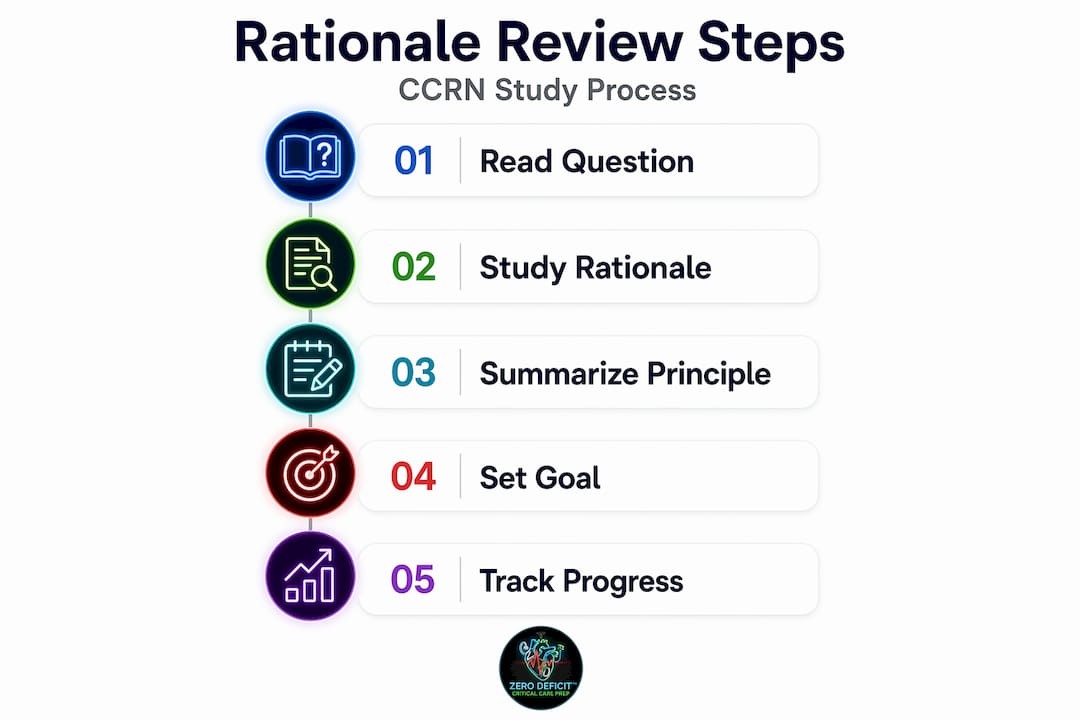
Domain-based remediation is the core principle here. After a timed question set, sort your misses by content area, then reattempt only those domains to aggressively close knowledge gaps. Here is the full method:
- Take a timed practice set under exam conditions. Aim for 25 to 50 questions. No notes. No pausing. Simulate the real exam experience so your review data is meaningful.
- Score immediately and record your domain breakdown. Do not wait until the next day. Note how many you missed in each content area, not just your total score.
- Read every rationale, including those for correct answers. This step surprises most nurses. If you got a question right for the wrong reason, you are building a false sense of confidence. Reading correct-answer rationales confirms your reasoning, not just your answer.
- For missed questions, write the clinical decision in your own words. Do not copy the rationale. Restate it. This active processing is what converts short-term recall into lasting understanding.
- Sort all missed rationales by AACN domain. Group them: cardiovascular, pulmonary, neurology, renal, and so on. Patterns will emerge. If you missed six pulmonary questions and one renal question, your next session is pulmonary-focused.
- Reattempt only your weak domain. Use exam question breakdown methods to go deeper on those specific question types. This is not about grinding more questions. It is about targeted exposure to the reasoning patterns you have not yet internalized.
- Review your retested rationales again 48 hours later. Spaced repetition is the mechanism that cements clinical reasoning. One review is not enough.
Pro Tip: Convert each missed rationale into a one-sentence “clinical decision rule” you can reuse. For example: “When a patient with ARDS shows worsening hypoxemia despite high FiO2, the priority intervention is positioning, not immediate FiO2 increase.” That sentence applies to dozens of future questions.
Here is a comparison of two common review approaches and their impact:
| Approach | What it looks like | Outcome |
|---|---|---|
| Passive review | Read rationale, say “I get it,” move on | Low retention, same misses repeat |
| Active domain review | Restate in own words, sort by domain, reattempt | Higher retention, targeted improvement |
Learning how educators boost CCRN certification success reinforces why active engagement with rationales outperforms passive reading every time.
Troubleshoot common pitfalls and mistakes when reviewing CCRN rationales
Even with a solid review method, be aware of common pitfalls to maximize your study efficiency. These errors are more common than most nurses admit, and they silently drain study time.
“Exam candidates should not treat rationale review as a ‘percentage guessing game’ but as targeted remediation to improve decision-making skills across domains.”
That warning from AACN guidance cuts to the heart of the most common mistake. Here are the pitfalls to watch for and how to avoid each one:
- Memorizing isolated rationales. If you memorize “answer C is correct because norepinephrine is first-line for septic shock,” you will fail the next question that changes one variable. Understand why norepinephrine is preferred, not just that it is.
- Skipping rationales for questions you got right. This creates knowledge gaps you do not even know you have. Always read every rationale.
- Letting emotional reactions derail your review. Missing a question you felt confident about is frustrating. That frustration can make you rush through the rationale without actually processing it. Pause. Reset. Then review.
- Ignoring domain weakness patterns. If you miss pulmonary questions repeatedly and keep labeling it “bad luck,” you are avoiding the real issue. Your domain data does not lie.
- Over-reviewing strong domains. Spending 45 minutes on cardiovascular because you enjoy it while glossing over renal rationales because they are harder is a comfort trap. Study what you need, not what feels good.
Pro Tip: After each review session, write a one-line summary of the single most important concept you clarified. That habit forces you to identify the real lesson in your misses rather than just logging them.
Understanding why focused assessment shapes CCRN outcomes can also help you stay disciplined when the temptation to overreview comfortable topics creeps in.
Verify your progress: Measuring rationale review success and adjusting your plan
Finally, learn how to verify your improvements and tailor your study for exam readiness.
Reviewing rationales without measuring your progress is like adjusting a medication dose without checking the patient’s response. You need data. AACN’s reporting includes number-correct scores by content domain, allowing you to identify and focus on your weakest areas before exam day.
Apply that same logic to your practice test analytics:
| Measurement action | How to use it |
|---|---|
| Baseline domain score (Week 1) | Establishes your starting point per content area |
| Weekly domain comparison | Shows improvement or stagnation in each area |
| Rationale review accuracy rate | Tracks how often retested questions are answered correctly |
| Stubborn miss list | Questions missed more than twice signal a deeper conceptual gap |
Your goal is not to hit a specific percentage score on practice tests. It is to confirm that your reasoning aligns with the “basic knowledge and skill” expectation AACN sets for competent critical care practice. The score is a proxy for reasoning quality.
Use these checkpoints to adjust your plan:
- If a domain shows no improvement after two weeks of targeted review, shift your resource, not just your effort. Try a different study guide section or question format.
- If your overall accuracy is rising but one domain remains flat, double your rationale review time in that area for the next week.
- If you are two weeks from your exam and still showing consistent gaps, prioritize clinical decision rule summaries over additional new question sets.
Tracking your CCRN progress with analytics tools gives you the objective data you need to make smart adjustments, rather than relying on how you feel after a session.
A critical care nurse’s perspective: Why rationales are your clinical decision allies, not just exam clues
Here is a fresh perspective on maximizing rationale review’s value beyond the exam itself.
Most nurses approach the CCRN as a gate to pass through, then forget. But the nurses who consistently report feeling more confident in the ICU after passing share one thing in common: they treated rationale review as clinical decision training, not exam prep. That distinction changes everything.
Rationales are compact clinical decision justifications useful across similar clinical scenarios, not one-off trivia to be discarded after test day. When you understand why permissive hypercapnia is acceptable in a specific ARDS scenario, that reasoning transfers to the next patient you manage in a real unit. The exam question is just the vehicle.
There is also a practical exam argument here. The CCRN presents novel clinical vignettes. No prep course can give you every question you will see. What prepares you for unfamiliar vignettes is not memorized answers, but internalized reasoning frameworks. A nurse who has genuinely processed 300 rationales will handle a new scenario more confidently than one who has answered 1,000 questions without ever understanding why.
The uncomfortable truth is that most nurses spend too much time answering questions and too little time reviewing the rationales behind them. An 80-question practice test reviewed in 10 minutes is wasted time. The same test reviewed domain by domain over 60 minutes is a powerful study session.
Think of each rationale as a framework you add to your clinical toolkit. Used right, that toolkit boosts your CCRN exam success and sharpens the judgment you bring to your patients every shift.
Boost your CCRN prep with Zero Deficit CCRN Prep resources
Ready to take your rationale review and exam prep to the next level? The strategies in this guide work best when paired with quality resources built specifically for the CCRN exam.
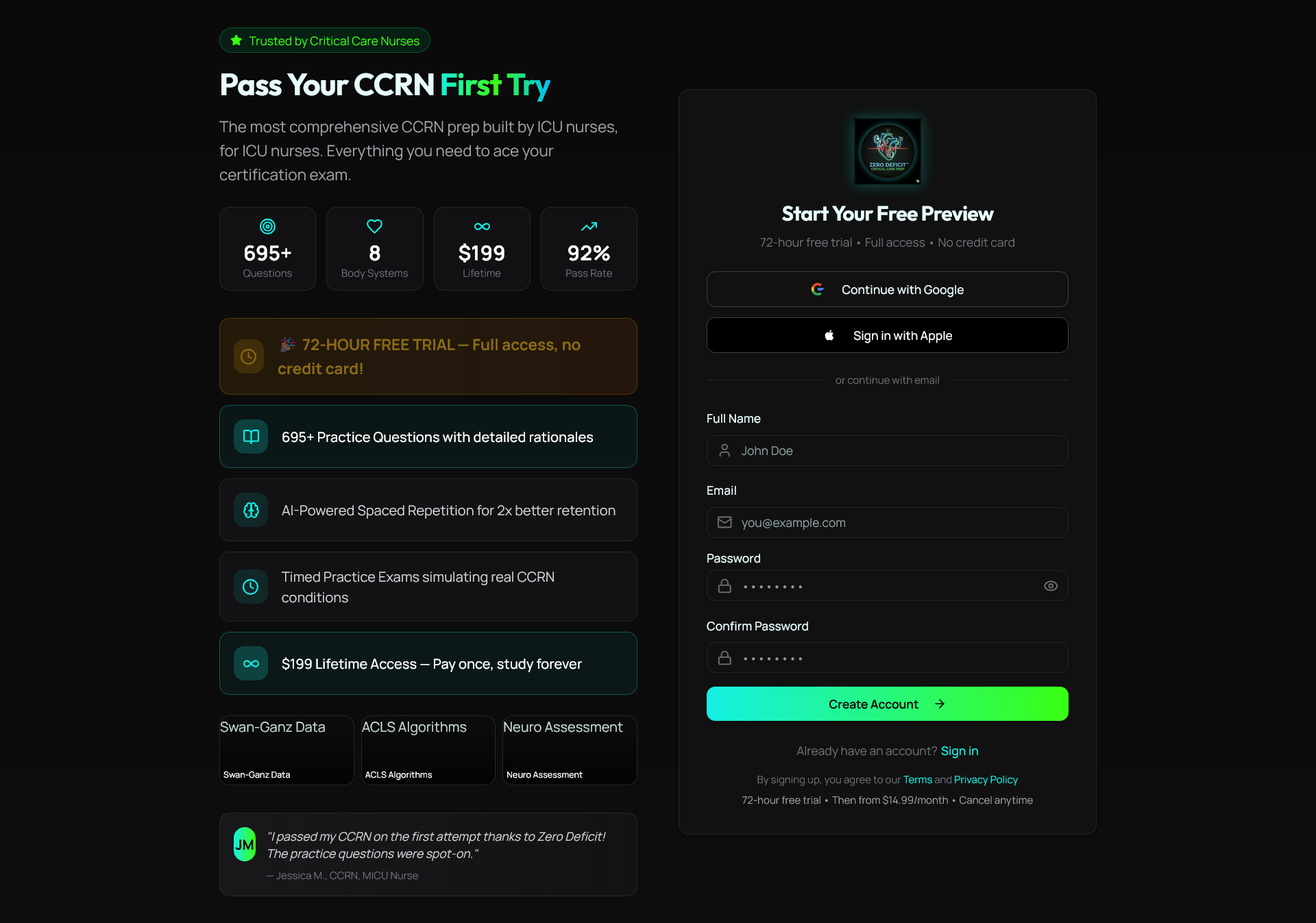
Zero Deficit™ CCRN Exam Prep gives you step-by-step question breakdown methods that mirror the active rationale review techniques outlined above. The platform offers over 695 CCRN practice questions with detailed, evidence-based rationales organized by domain so your review is always targeted, never scattered. Built-in progress tracking lets you see exactly where you are improving and where you still need to focus. No credit card required to start. Try it, test the quality, and build the confidence you need to pass on your first attempt.
Frequently asked questions
What is the purpose of CCRN rationales during exam preparation?
CCRN rationales explain the clinical reasoning behind correct answers, helping you understand the decision-making process rather than memorize isolated facts. The CCRN exam items have evidence-based rationales designed as clinical decision justifications you can apply across similar scenarios.
How should I use domain scores from CCRN practice tests in my rationale review?
Use domain scores to identify your weakest content areas and concentrate your rationale review there for more efficient, targeted study. AACN provides number-correct by content domain reporting specifically to guide this kind of remedial focus.
Why is memorizing rationales not an effective study strategy?
The CCRN presents new clinical vignettes on exam day, so memorized answers will not transfer to questions you have not seen before. Rationales are clinical decision justifications best used to build reasoning that applies across a wide range of scenarios.
How can I avoid common mistakes when reviewing CCRN rationales?
Always read rationales for both correct and incorrect answers, track your domain weakness patterns, and maintain a calm and systematic approach. Treat rationale review as targeted remediation, not a guessing game built around overall pass rates.
Recommended
- Why assessment matters: Boost CCRN exam success | Zero Deficit CCRN Prep
- How educators boost CCRN certification success for nurses | Zero Deficit CCRN Prep
- CCRN Exam Question Breakdown Methods: Master the Exam with Step-by-Step Guides | Zero Deficit™
- Top 4 Teachingsolutions.org Alternatives 2026 | Zero Deficit CCRN Prep
Take a Respiratory practice quiz
Master ARDS, ventilation, ABGs, oxygenation, and pulmonary emergencies.
Get Your Free 20-Question CCRN Diagnostic
20 high-yield CCRN-style questions across every body system, with detailed rationales — emailed to you instantly.
No spam. One email + a couple of helpful follow-ups. Unsubscribe anytime.
Ready to pass your CCRN?
Join 12,000+ nurses using Zero Deficit — 695+ practice questions with rationales, AI-powered weak-area drilling, and spaced-repetition flashcards.
Start Free Trial →