How to track CCRN progress: a critical care nurse's guide
TL;DR:
- Tracking CCRN progress accurately reveals areas needing improvement and ensures study efforts are effective. Consistently monitoring multiple practice exams and analyzing domain trends helps build confidence and optimizes exam readiness. Using updated test plans and reliable tools like Zero Deficit™ enhances study efficiency and guides targeted learning.
Many critical care nurses put in hundreds of study hours and still walk into the CCRN exam unsure whether they are ready. That uncertainty is not a confidence problem. It is a tracking problem. Knowing how to track CCRN progress changes everything: it shows you exactly where you stand, which domains need more work, and whether your preparation is actually moving in the right direction. This guide walks you through proven methods for monitoring CCRN progress, building a reliable CCRN progress checklist, and using your data to make every study session count.
Table of Contents
- Prepare your tracking toolkit: essentials for CCRN progress monitoring
- Step-by-step instructions to track your CCRN study progress
- Common pitfalls and troubleshooting when tracking CCRN progress
- How to use tracked data to boost your CCRN exam readiness
- Why progress tracking beats guessing: a nurse-to-nurse perspective
- Boost your CCRN prep with Zero Deficit practice questions and guides
- Frequently asked questions
Prepare your tracking toolkit: essentials for CCRN progress monitoring
Before you log a single score, you need the right tools in place. Tracking without a framework is just collecting numbers with no context.
Start with the current CACN (American Association of Critical-Care Nurses) test plan. AACN exam content was updated effective November 12, 2025, which means your tracking targets must reflect the new domain structure, not last year’s blueprint. If you are studying from old outlines, your metrics will point you in the wrong direction.
Here is what your tracking toolkit should include:
- A copy of the current CCRN test plan with domain weights clearly marked
- A progress log (spreadsheet or study app) to record scores, dates, and topics covered
- Timed full-length practice exams taken under real exam conditions
- Subject-specific quiz results broken down by body system and domain
- A weekly review calendar to schedule study sessions and data entry
A digital spreadsheet works well because it lets you build charts automatically as you enter scores. Many nurses prefer a simple Google Sheets file with tabs for each exam date, domain, and score. Whatever format you choose, consistency matters more than sophistication.
The table below shows a sample tracking structure you can adapt right now:
| Tracking element | What to record | How often |
|---|---|---|
| Full practice exam score | Total percentage, pass/fail threshold | Every 2 to 3 weeks |
| Domain score breakdown | Score per AACN domain category | After each practice exam |
| Topic-level quiz results | Score by body system or concept group | Weekly |
| Time per question | Average seconds per question | Every timed session |
| Weak area flags | Domains scoring below 70% | Ongoing |
For subject-level review, well-organized ccrn study guides give you the content structure to map against your scores. Pair them with your tracking log and you have a clear picture of where knowledge gaps live.
Pro Tip: Color-code your spreadsheet so that scores below 70% appear in red automatically. Visual cues make it faster to spot trouble areas without reading every number.
Step-by-step instructions to track your CCRN study progress
With your tracking tools ready, here is exactly how to implement a consistent progress monitoring routine.

The core mistake most nurses make is treating a single practice exam as a verdict. One score tells you almost nothing. Multiple timed practice exams are what reveal real trends and give you a reliable estimate of exam readiness. One bad day skews everything; a pattern across five exams tells the truth.
Follow this step-by-step process:
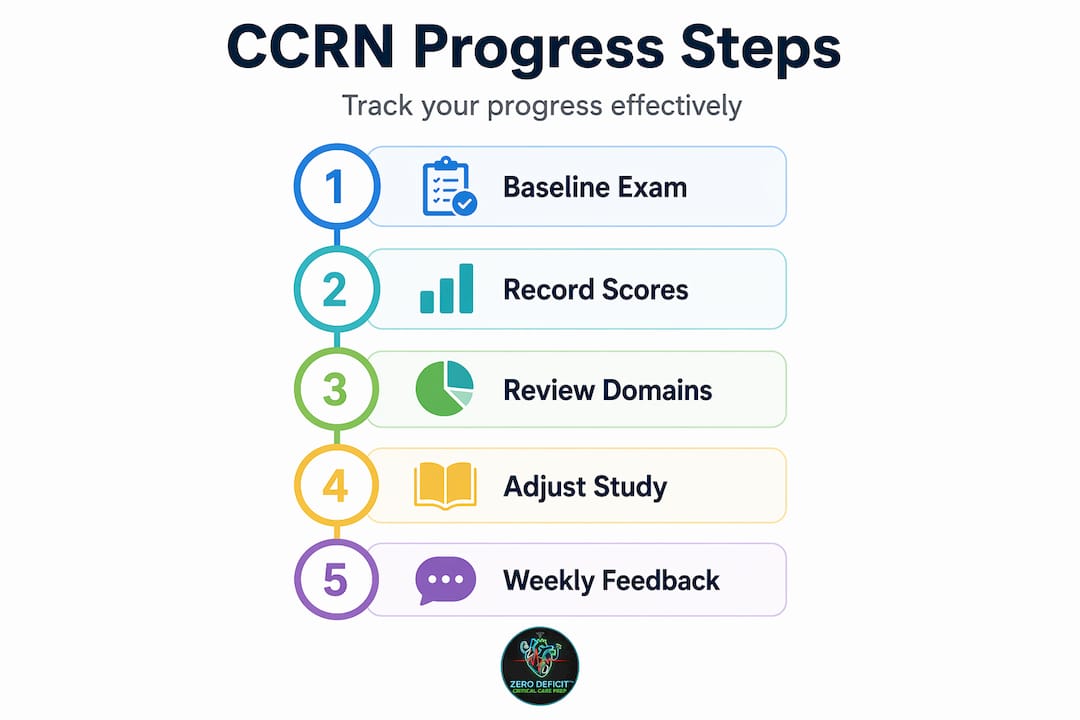
- Schedule your baseline exam first. Take a full-length timed practice exam in week one. Record your total score and every domain score. This is your starting point, not a judgment.
- Log all results immediately after each session. Do not wait until the next day. Enter scores while the exam is fresh so you can also note what felt difficult.
- Break scores down by domain. Do not just track your total percentage. Record how you performed in cardiovascular, pulmonary, neurology, renal, and every other tested area.
- Plot a trend line every two to three weeks. After your third practice exam, compare scores across all three dates. Are specific domains improving? Are others flat?
- Flag any domain consistently below 70%. That is your priority zone. Adjust your study schedule to add dedicated time in that area before your next exam.
- Use question-level data, not just totals. Learning question breakdown methods lets you analyze which question types trip you up, not just which topics.
Here is what a simple progress log entry looks like after a practice exam:
- Date: March 15, 2026
- Total score: 74%
- Cardiovascular: 81%
- Pulmonary: 69%
- Neurology: 72%
- Renal/endocrine: 65%
- Average time per question: 58 seconds
- Action item: Add two extra pulmonary and renal study sessions before next exam
Understanding why assessment matters goes deeper than just logging numbers. Regular assessment creates feedback loops that your brain uses to consolidate clinical knowledge more effectively than passive re-reading ever will.
Pro Tip: Take your first two practice exams without reviewing content in between. This gives you a cleaner baseline picture of your natural starting knowledge before study interventions kick in.
Common pitfalls and troubleshooting when tracking CCRN progress
Understanding common tracking errors helps ensure your data remains reliable and actionable.
The biggest trap is emotional tracking. You score 78% on a Tuesday and feel great. You score 71% on a Friday after a long shift and feel defeated. Neither number means much on its own. Trend analysis across multiple exams is the only reliable signal, not individual results that vary with fatigue, stress, or the specific question pool that day.
Watch for these frequent mistakes:
- Using outdated test plans as your tracking benchmark. Tracking based on outdated test plans reduces metric relevance, especially during update windows. Always verify you are working from the current blueprint.
- Ignoring low-scoring domains. A 58% in pulmonary does not mean you are bad at pulmonary. It means pulmonary is where your prep time should go. Treat it as a signal, not a verdict.
- Over-tracking to the point of burnout. Logging 15 data points per session sounds thorough, but it becomes a time drain that pulls focus away from actual studying. Track what you will actually use.
- Skipping updates after test plan changes. If you built your tracking targets around the pre-November 2025 domain weights, those benchmarks are no longer accurate for the current exam.
- Setting unrealistic weekly score targets. Progress is rarely linear. Expect plateaus. Expect one domain to improve while another temporarily dips. That is normal.
“The goal of tracking is not perfection. It is direction. Even a slow upward trend, maintained consistently, gets you to exam day ready.”
Linking your tracking data to real-world exam prep strategies helps you translate those numbers into actual study decisions, which is where tracking earns its value.
Pro Tip: Set a weekly 15-minute “data review” appointment in your calendar. Treat it like a clinical handoff. Brief, focused, and non-negotiable.
How to use tracked data to boost your CCRN exam readiness
Knowing how to act on your progress data is the key to making every study session count.
Raw scores without action are just numbers. What separates nurses who pass on their first attempt from those who do not is usually not total study hours. It is how well they used the data they collected. Aligning domain targets to the current test plan ensures your metrics stay relevant, not just busy.
Here is how to translate your tracked data into a smarter study plan:
- Rank your domains by performance. List every domain from lowest to highest score. Your study calendar should mirror that list, with the weakest areas getting the most scheduled time.
- Assign study resources to weak domains specifically. If neurology is your gap, go deep with a targeted neurology study guide. If pulmonary is lagging, a dedicated respiratory study guide gives you the focused content structure you need.
- Add timed mixed-review sessions every two weeks. Timed mixed practice simulates actual exam conditions and shows whether improvements in isolated domain study translate to full-exam performance.
- Use question breakdowns to identify error patterns. Consistent errors on application-level questions versus recall questions require different fixes. Question breakdown methods help you see that distinction clearly.
- Adjust session length and frequency based on trends. If a domain is improving steadily, maintain your current schedule. If it is flat after three weeks of targeted review, increase frequency or switch resources.
Here is a quick comparison of two common study approaches and how tracked data changes the outcome:
| Approach | Without tracking | With tracking |
|---|---|---|
| Domain review | Random or calendar-based | Driven by lowest-scoring domains |
| Practice exams | Taken occasionally for confidence | Scheduled every 2 to 3 weeks for trend data |
| Resource selection | General study materials | Targeted by gap areas identified in data |
| Study adjustments | Based on gut feeling | Based on score trends over time |
| Exam confidence | Uncertain | Grounded in demonstrated progress |
The difference is not just efficiency. It is the specific kind of confidence that comes from knowing your numbers, not just hoping for the best.
Why progress tracking beats guessing: a nurse-to-nurse perspective
Here is an uncomfortable truth most CCRN prep articles will not say out loud: studying hard without tracking is just sophisticated guessing. You feel productive. You cover content. But without data, you have no idea whether you are reinforcing strengths or ignoring the exact domains that will cost you a passing score.
The AACN test plans are built from periodic national studies of what critical care nurses actually do in practice. That means the exam is not abstract. It reflects real clinical priorities. When you track by domain, you are not just measuring test prep. You are measuring how well your knowledge maps to those clinical realities.
What we see consistently is that nurses who share their progress data with a peer or mentor pass at a higher rate than those studying in isolation. Not because the mentor has magic answers, but because accountability forces honest review of the numbers. It is harder to avoid a weak domain when you have to report it to someone else.
The shift that changes everything is treating your tracking log the way you treat a patient chart. You would not skip documenting a declining trend in a patient’s vitals. Apply that same standard to your own exam data. When neurology scores plateau for three weeks, that is your trend line telling you to change the intervention.
Using feedback methods in CCRN prep closes the loop between what you track and what you do next. Without that feedback loop, tracking is just record-keeping. With it, tracking becomes the engine that drives your preparation forward.
Boost your CCRN prep with Zero Deficit practice questions and guides
Ready to put these tracking strategies into practice? Zero Deficit™ CCRN Prep offers the tools to make it real.
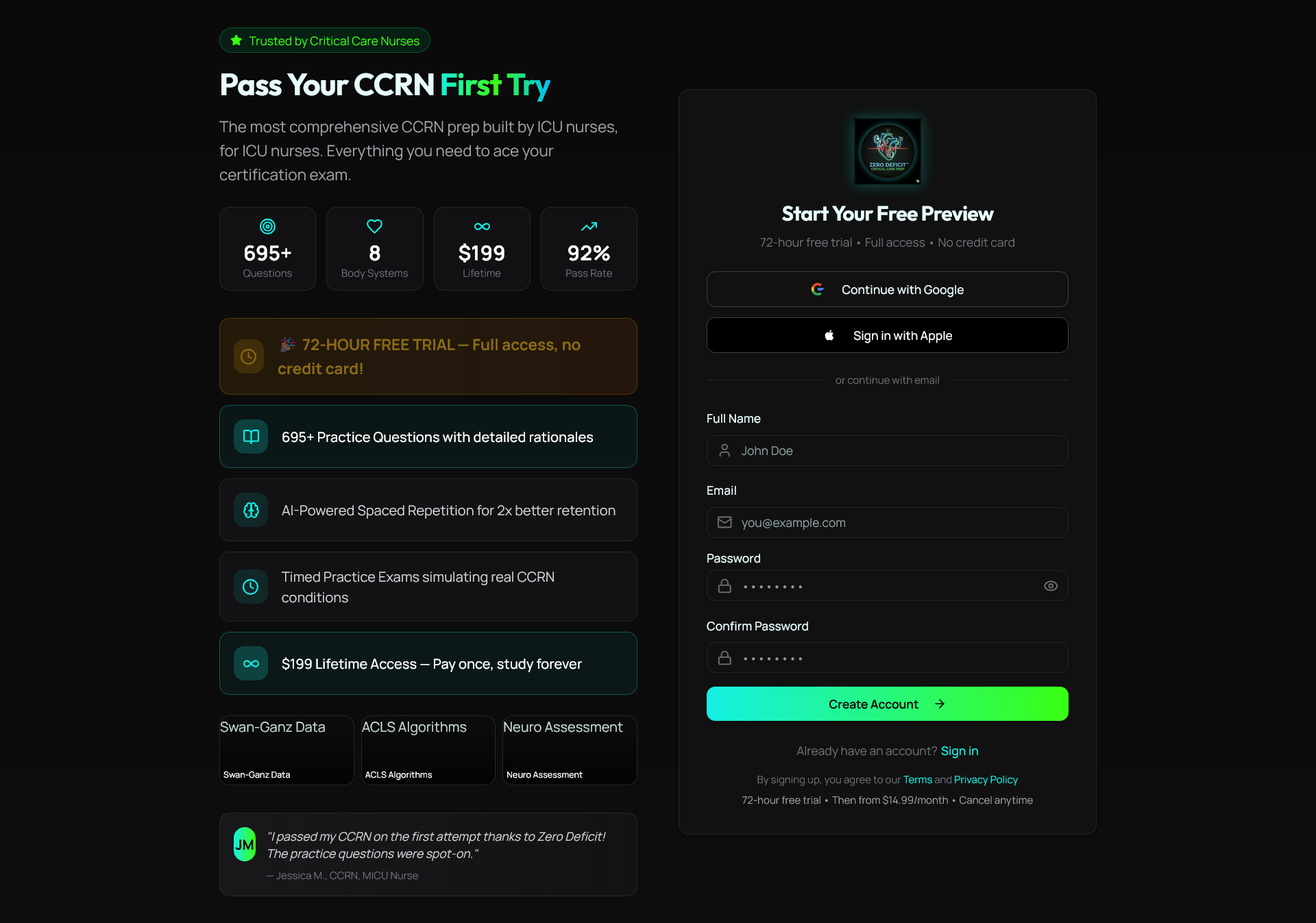
Zero Deficit™ gives you access to over 695 CCRN practice questions aligned to the current exam blueprint, so every question you answer feeds meaningful data into your progress picture. The platform includes built-in score tracking, achievement badges, and a leaderboard that make monitoring CCRN progress motivating rather than tedious. Pair that with step-by-step exam question breakdown methods to understand exactly why you missed a question, and comprehensive CCRN study guides 2026 covering every critical care domain. Best of all, you can start with a free version with no credit card required.
Frequently asked questions
Why is tracking CCRN exam progress important?
Tracking lets you identify strong and weak content areas over time, so your study time goes where it will have the most impact. Rather than relying on a single score, tracking trends across multiple exams gives you a reliable estimate of real readiness.
How often should I take practice exams to track progress effectively?
Take a full-length timed practice exam every two to three weeks and review domain-level results after each one. Multiple timed practice exams are what generate the trend data you need to spot patterns and adjust your study focus before exam day.
How do updated CCRN test plans affect progress tracking?
Updated test plans change which domains are weighted and how content is categorized, so your benchmarks must match the current blueprint. You should align domain targets to the plan effective November 12, 2025, to ensure your metrics still reflect what the exam actually tests.
What common mistakes should I avoid when tracking CCRN study progress?
The biggest mistakes are relying on single test results, ignoring low-scoring domains, and tracking based on outdated test plans. Keep your data consistent, update your benchmarks when the test plan changes, and use every weak domain score as a study direction, not a discouragement.
Can I use Zero Deficit™ CCRN Prep tools to track my study progress?
Yes. Zero Deficit™ offers practice questions, built-in score tracking, question breakdown methods, and domain-specific study guides all designed to support real-time progress monitoring aligned to the current exam content.
Recommended
Take a Neurological practice quiz
Test your knowledge of stroke, ICP, seizures, and neuro assessment.
Get Your Free 20-Question CCRN Diagnostic
20 high-yield CCRN-style questions across every body system, with detailed rationales — emailed to you instantly.
No spam. One email + a couple of helpful follow-ups. Unsubscribe anytime.
Ready to pass your CCRN?
Join 12,000+ nurses using Zero Deficit — 695+ practice questions with rationales, AI-powered weak-area drilling, and spaced-repetition flashcards.
Start Free Trial →