The Nursing Process: A Clinical ADPIE Guide for Nurses
The nursing process is a five-step, systematic, patient-centered clinical decision-making framework that guides every nursing action from first contact to discharge. The five steps, known by the acronym ADPIE, are:
- Assessment — collect and validate subjective and objective data
- Diagnosis — identify the patient’s actual or potential health problems
- Planning — set measurable, patient-centered outcomes and select interventions
- Implementation — execute interventions safely and document the response
- Evaluation — compare outcomes to goals and revise the plan as needed
ADPIE is not a checklist you run through once. It is a continuous clinical reasoning cycle. Every reassessment feeds back into diagnosis and planning, which is exactly why the ANA identifies it as the essential core of RN practice across every specialty. Your documentation of each step is also your primary legal record of clinical judgment.
Key Takeaways
The nursing process is a continuous five-step clinical reasoning cycle where each step directly informs the next, and documented ADPIE is your primary professional and legal record.
| Point | Details |
|---|---|
| ADPIE is a cycle, not a checklist | Evaluation triggers reassessment; the process repeats with every change in patient status. |
| PES format structures your diagnosis | Write: Problem related to Etiology as evidenced by Signs/Symptoms for every nursing diagnosis. |
| SMART goals make evaluation possible | Every goal needs a measurable criterion and a specific time frame or it cannot be evaluated. |
| Documentation is your legal record | Time-stamped, measurable entries linking assessment to intervention are the standard for audits. |
| Zerodeficitccrnprep reinforces ADPIE | 695+ practice questions with rationales tied to clinical reasoning help you apply ADPIE under exam conditions. |
Table of Contents
- ## 1. Assessment: how to gather, validate, and prioritize patient data
- ## 2. Diagnosis: writing PES-format nursing diagnoses with NANDA examples
- ## 3. Planning: writing SMART nursing goals and structuring the care plan
- ## 4. Implementation: executing interventions safely at the bedside
- ## 5. Evaluation: measuring outcomes and knowing when to revise the plan
- ## 6. Why documentation and communication make the nursing process legally binding
- ## 7. Copy-pasteable care-plan templates and two worked examples
- ## 8. Applying ADPIE in critical care: CCRN exam tips and study prompts
- What most nurses get wrong about the nursing process
- Your CCRN prep starts with nursing-process reasoning
- Sources
- FAQ
## 1. Assessment: how to gather, validate, and prioritize patient data
Assessment is a systematic and continuous process that establishes the foundation for every nursing diagnosis and care plan you write. Get this step wrong and everything downstream is built on bad data.
Subjective vs. objective data
- Subjective: what the patient or family reports — pain description, shortness of breath, anxiety, nausea, history
- Objective: what you measure or observe — vitals, SpO2, GCS, lab values, monitor waveforms, physical exam findings, EHR trends
Data sources to validate
- Patient interview and family report
- Medical record, prior nursing notes, MAR
- Bedside monitors (arterial line, CVP, capnography)
- Lab results: CBC, BMP, lactate, ABGs (normal PaO2 80–100 mmHg, PaCO2 35–45 mmHg, pH 7.35–7.45, HCO3 22–26 mEq/L)
- Consulting clinicians and pharmacy
When sources conflict — the patient denies pain but grimaces and guards — document both and use objective findings to drive your priority. OpenStax Fundamentals of Nursing identifies five assessment domains: physical, psychosocial, functional, nutritional, and pain. Cover all five in your initial assessment; focus subsequent assessments on the active problem.
Prioritization framework

Use ABCs (Airway, Breathing, Circulation) for acute physiologic threats. Maslow’s hierarchy works for holistic planning once the patient is stabilized.
Pro Tip: In high-acuity settings, run a focused assessment in the first 5 minutes of your shift: mental status, airway/breath sounds, hemodynamics, lines and drains, skin integrity. Save the full head-to-toe for the first hour. This triage approach catches the deteriorating patient before the chart does.
## 2. Diagnosis: writing PES-format nursing diagnoses with NANDA examples
A nursing diagnosis is a clinical judgment about a patient’s response to an actual or potential health problem — not the medical diagnosis. Your patient’s medical diagnosis may be ARDS; your nursing diagnosis addresses what that means for their airway clearance, gas exchange, and anxiety. OpenStax Clinical Nursing Skills frames the nursing process as a critical thinking model where assessment data drives these clinical judgments.
The PES format
PES stands for Problem, Etiology, Signs/Symptoms and structures your diagnosis into a defensible, actionable statement:
Problem related to Etiology as evidenced by Signs/Symptoms
Common NANDA-style nursing diagnoses (med-surg and critical care)
- Ineffective airway clearance related to excessive secretions as evidenced by coarse crackles and SpO2 88%
- Impaired gas exchange related to alveolar-capillary membrane changes as evidenced by PaO2 58 mmHg and PaCO2 52 mmHg
- Risk for infection related to invasive lines and immunosuppression
- Decreased cardiac output related to altered heart rate as evidenced by MAP 52 mmHg and cool extremities
- Acute pain related to surgical incision as evidenced by patient-reported pain 8/10 and guarding
- Anxiety related to ICU environment as evidenced by patient verbalization and HR 118 bpm
- Deficient fluid volume related to hemorrhage as evidenced by BP 88/52, HR 124, and urine output < 0.5 mL/kg/hr
- Impaired skin integrity related to immobility as evidenced by Stage II sacral pressure injury
Two worked PES examples
-
Med-surg: Patient post-op day 1 colectomy, reports pain 7/10, splinting respirations, SpO2 93% on room air.
-
Critical care: Septic patient, MAP 54 mmHg on norepinephrine 0.12 mcg/kg/min, lactate 4.2 mmol/L, urine output 18 mL/hr. Decreased cardiac output related to distributive shock as evidenced by MAP 54 mmHg, lactate 4.2 mmol/L, and urine output < 0.5 mL/kg/hr despite vasopressor support.
When a patient has multiple diagnoses, address immediate physiologic threats first. Airway and hemodynamic instability outrank skin integrity and knowledge deficit every time. For deeper practice on assessment and diagnosis skills, the CCRN exam tests your ability to prioritize exactly this way.
## 3. Planning: writing SMART nursing goals and structuring the care plan
Planning means setting measurable, patient-centered outcomes and selecting the interventions most likely to achieve them. A goal that reads “patient will feel better” is not plannable, not evaluable, and not defensible. BMJ Health Careers notes that goals should meet SMART criteria and be informed by evidence-based practice.
SMART criteria with critical-care examples
- Specific: “Patient will maintain SpO2 ≥ 94% on ≤ 4 L/min nasal cannula”
- Measurable: “MAP will be ≥ 65 mmHg within 2 hours of vasopressor titration”
- Attainable: goal is realistic given the patient’s current status and trajectory
- Realistic/Results-oriented: tied to a nursing intervention you can actually perform
- Timely: “within 4 hours,” “by end of shift,” “within 24 hours of admission”
Care plan structure
Every care plan follows the same four-column logic:
| Component | What it contains |
|---|---|
| Nursing diagnosis (PES) | Problem, etiology, signs/symptoms |
| Goal/outcome (SMART) | Measurable patient-centered outcome with a time frame |
| Nursing interventions | Independent, dependent, and collaborative actions |
| Evaluation criteria | How you will measure whether the goal was met |
Involve the patient and family when setting goals. A SMART goal the patient does not understand or agree with will not drive adherence. In the ICU, loop in respiratory therapy, pharmacy, and the intensivist when goals involve vent weaning, vasopressor titration, or renal replacement therapy. The interdisciplinary team owns the outcome together.
## 4. Implementation: executing interventions safely at the bedside
Implementation is where the plan meets the patient. You put planned interventions into action, monitor the response, and document both. Three types of interventions define your scope:
- Independent: nurse-initiated without a physician order — repositioning, oral care, fall precautions, patient education, pain reassessment
- Dependent: require a physician or provider order — medication administration, IV fluid boluses, ordered procedures
- Collaborative: team-based actions — ventilator weaning protocols with respiratory therapy, nutrition goals with dietetics, wound care with wound/ostomy nurses
Delegation checklist
Before delegating any task, confirm four things: the patient is stable enough for the task to be delegated, the staff member has verified competency, your state’s Nurse Practice Act permits delegation of that task, and communication is clear and documented (task, patient, expected outcome, when to report back).
Documentation that holds up
| Documentation element | Example phrasing |
|---|---|
| Intervention performed | “Repositioned to left lateral decubitus at 0230 per pressure injury prevention protocol” |
| Patient response | “Patient tolerated repositioning; SpO2 unchanged at 96%; skin intact, no new redness noted” |
| Follow-up action | “Reassessment scheduled at 0430; Braden score documented in EHR” |
For high-risk tasks — medication administration, central line care, code management — follow your facility’s policy and double-check against the five rights (right patient, drug, dose, route, time). In the ICU, vasoactive drips require weight-based dosing verification and continuous hemodynamic monitoring. A norepinephrine titration is not a set-it-and-forget-it order.
## 5. Evaluation: measuring outcomes and knowing when to revise the plan
Evaluation means comparing what actually happened to what your SMART goal said should happen, then deciding whether the plan worked, needs adjustment, or failed entirely. This step is where the cycle closes and often where it restarts.
Evaluation checklist
- Compare current vitals, labs, and clinical findings to the goal’s measurable criteria
- Assess pain scores, neuro status (GCS, pupil response), respiratory mechanics, and hemodynamic trends
- Review urine output, drain output, and wound status against documented baselines
- Ask the patient: “Is your pain better than it was two hours ago?”
Reassessment timelines
- Immediate: within 30–60 minutes of any intervention (medication, position change, fluid bolus, vent adjustment)
- Shift-based: full reassessment at the start of each shift and before handoff
- Trigger-based: any acute change in condition — new dysrhythmia, drop in MAP, altered mental status, SpO2 decline — demands immediate reassessment regardless of schedule
When to revise the plan
If the goal was not met, document the objective comparison: “Goal: MAP ≥ 65 mmHg within 2 hours. Actual: MAP 58 mmHg at 2-hour mark despite norepinephrine at 0.15 mcg/kg/min.” Then revise: update the diagnosis if new data emerged, adjust the goal if it was unrealistic, change the intervention if it was ineffective. Document your rationale. Evaluation documentation that compares measured outcomes to SMART goals is a primary audit point — vague entries like “patient doing better” do not satisfy that standard.
## 6. Why documentation and communication make the nursing process legally binding
The nursing process is your professional roadmap, and your documentation is the evidence that you followed it. The ANA is explicit: the process integrates clinical judgment, evidence-based practice, and therapeutic communication — and all of it must be recorded. In an adverse event or audit, your chart entry is the only record of your clinical reasoning.
Charting best practices
- Time-stamp every entry; never back-date
- Use measurable language: “BP 88/52 mmHg” not “hypotensive”
- Document patient response, not just the intervention performed
- Link your intervention to the nursing diagnosis it addresses
- Record follow-up actions and who was notified
SBAR for handoff and escalation
- Situation: “Mr. J, Room 12, post-op day 2, MAP dropped to 54 mmHg”
- Background: “History of CAD, on metoprolol, received 500 mL LR bolus at 0200 with no response”
- Assessment: “I suspect cardiogenic versus distributive shock; lactate pending”
- Recommendation: “Requesting bedside evaluation and consideration of vasopressor initiation”
SBAR keeps your communication structured, your handoffs complete, and your liability clear. For continuity across care settings, a well-structured home care plan follows the same ADPIE logic nurses use at the bedside.
## 7. Copy-pasteable care-plan templates and two worked examples
Use these templates as starting points. Adapt the PES statement and SMART goal to your patient’s actual data.
Care plan template
| Field | Your entry |
|---|---|
| Nursing diagnosis (PES) | [Problem] related to [Etiology] as evidenced by [Signs/Symptoms] |
| SMART goal | Patient will [measurable outcome] by [time frame] |
| Independent interventions | [Nurse-initiated actions] |
| Dependent interventions | [Ordered actions] |
| Collaborative interventions | [Team-based actions] |
| Evaluation criteria | [Objective measure] compared to [goal] at [time] |
Worked example 1: Med-surg (post-op pneumonia risk)
- PES: Ineffective airway clearance related to post-operative pain and immobility as evidenced by diminished breath sounds bilateral bases, SpO2 91%, and productive cough
- SMART goal: Patient will demonstrate SpO2 ≥ 95% on room air and clear breath sounds bilaterally by 1200 on post-op day 2
- Independent: Incentive spirometry q1h while awake; head of bed ≥ 30 degrees; encourage ambulation twice per shift
- Dependent: Administer prescribed analgesic 30 minutes before ambulation per MAR
- Collaborative: Respiratory therapy consult for nebulizer treatment; physical therapy for early mobilization
- Evaluation: SpO2 and auscultation reassessed at 1200; document objective comparison to goal
Worked example 2: Critical care (sepsis/vasopressor titration)
- PES: Decreased cardiac output related to distributive shock as evidenced by MAP 54 mmHg, lactate 4.8 mmol/L, urine output 14 mL/hr, and norepinephrine requirement 0.18 mcg/kg/min
- SMART goal: Patient will achieve MAP ≥ 65 mmHg and urine output ≥ 0.5 mL/kg/hr within 6 hours of resuscitation initiation per Surviving Sepsis Campaign guidelines
- Independent: Continuous hemodynamic monitoring; hourly urine output; reassess mental status q1h; document vasopressor titration with rationale
- Dependent: Titrate norepinephrine per protocol; administer 30 mL/kg crystalloid bolus as ordered; obtain repeat lactate in 2 hours
- Collaborative: Intensivist notification for MAP < 60 mmHg; pharmacy for antibiotic dosing; dietetics for early enteral nutrition
- Evaluation: MAP, lactate, and urine output reassessed at 6-hour mark; document objective comparison to SMART goal with vasopressor dose at time of measurement
For body-system organization across these high-yield critical care topics, the Zero Deficit body system guides map each system directly to ADPIE application.
## 8. Applying ADPIE in critical care: CCRN exam tips and study prompts
In critical care, the nursing process must be dynamic. You are not running ADPIE once per shift. You are reassessing continuously, pivoting the plan when hemodynamics shift, and documenting every decision in real time. That is exactly what CCRN-style questions test.
Focused assessments for high-acuity priorities
- Hemodynamics: MAP, CVP, ScvO2, lactate trends, vasopressor doses and titration rationale
- Ventilator checks: mode, FiO2, PEEP, tidal volume (6 mL/kg IBW for ARDS), plateau pressure (goal < 30 cmH2O), SpO2 and ABG correlation
- Sedation/pain/agitation: CPOT or NRS for pain, RASS for sedation depth, CAM-ICU for delirium — document all three every shift
- Organ-support monitoring: CRRT effluent, fluid balance, electrolytes (K+ 3.5–5.0 mEq/L, Mg2+ 1.7–2.2 mg/dL), ICP trends if applicable
How the CCRN exam tests ADPIE
CCRN questions rarely ask “what is the nursing process?” They present a clinical scenario and ask what you do next. That next action is almost always the correct ADPIE step applied to the data in the stem. A question showing a patient with new ST elevation, MAP 58 mmHg, and diaphoresis is testing whether you recognize the assessment findings, form the correct nursing diagnosis (decreased cardiac output), and select the priority intervention.
Study prompts to build speed
- Take a real patient scenario (or a practice question stem) and write a full PES statement in under 90 seconds
- Set a SMART goal for that diagnosis, including a specific time frame and measurable criterion
- List three independent, two dependent, and one collaborative intervention
- Write a one-sentence evaluation entry comparing a hypothetical outcome to the goal
- Repeat with a different body system each study session
Pro Tip: The fastest way to close the gap between classroom PES skills and bedside speed is timed charting drills. Set a 3-minute timer and write a complete PES-to-evaluation entry for a scenario from your last shift. Speed comes from repetition, not from reading more.
Using study analytics to track which ADPIE steps you miss most in practice questions tells you exactly where to focus your next drill session. Critical thinking in nursing is the underlying skill the exam measures through every ADPIE scenario.
What most nurses get wrong about the nursing process
The nursing process looks straightforward on paper. In practice, four mistakes show up repeatedly, and they cost nurses on audits and on the CCRN exam.
Mistake 1: Over-documenting irrelevant data. Charting every normal finding in exhaustive detail buries the abnormal ones. Document what changed, what is abnormal, and what you did about it. Normal findings get a brief notation; abnormal findings get a full entry with your response.
Mistake 2: Writing weak, unmeasurable outcomes. “Patient will have improved oxygenation” is not a goal. If you cannot evaluate it with a number or an observable finding, rewrite it.
Mistake 3: Not validating data sources. A family member reports the patient’s home medication list. The MAR says something different. You chart the family’s version without checking. That discrepancy can drive a wrong nursing diagnosis and a wrong intervention. Cross-reference every data source before you commit to a diagnosis.
Mistake 4: Delegating without confirming competency. Delegation is not just assigning a task. It is confirming the staff member understands the task, the patient’s current status, and exactly when to report back. Skipping that confirmation step puts the patient and your license at risk.
Fix all four by slowing down at the assessment and diagnosis steps. The rest of the process runs cleaner when your foundation is solid. Practice with the templates in this article, then test your reasoning with real scenario-based questions.
Your CCRN prep starts with nursing-process reasoning
Passing the CCRN means thinking in ADPIE under time pressure, across every body system. Zerodeficitccrnprep is built for exactly that. The platform’s 695+ CCRN practice questions are written by expert ICU nurses and tied to detailed rationales that walk you through the ADPIE reasoning behind every correct answer. You see not just what the right answer is, but why it is right and which step of the nursing process it tests.
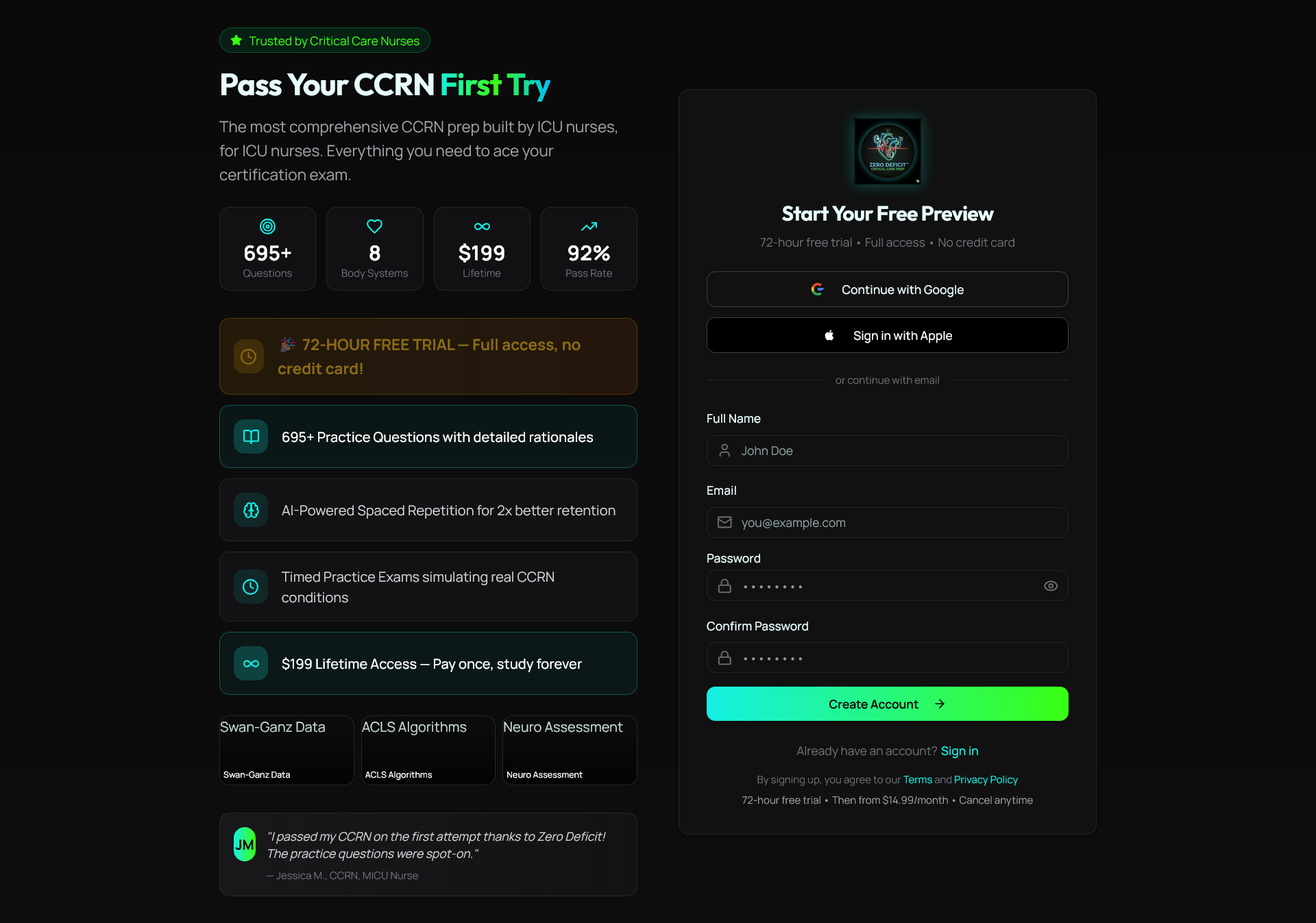
AI-powered review tools personalize your question sessions based on where your reasoning breaks down. Progress tracking shows you which ADPIE steps and body systems need the most work. The CCRN practice tests simulate timed exam conditions so the pressure of the real test feels familiar. Start your free trial at Zerodeficitccrnprep and work through your first set of ADPIE-focused scenarios today.
Sources
- Nursing Process - StatPearls - NCBI Bookshelf - NIH
- 12.1 The Nurse’s Role in Assessment - Fundamentals of Nursing | OpenStax
This article is general information, not a substitute for advice from a qualified doctor. Consult a qualified healthcare professional about your own circumstances before acting on anything here.
FAQ
What is the nursing process?
The nursing process is a five-step, systematic, patient-centered framework (Assessment, Diagnosis, Planning, Implementation, Evaluation) that guides clinical decision-making and documents nursing judgment. The ANA identifies it as the essential core of RN practice across all specialties.
What are the 5 steps of the nursing process in order?
The five steps are Assessment, Diagnosis, Planning, Implementation, and Evaluation, remembered by the acronym ADPIE. Each step feeds directly into the next, and evaluation often triggers a return to reassessment.
What is the nursing process definition in simple terms?
It is the structured method nurses use to identify a patient’s health problems, set measurable goals, act on them, and check whether the actions worked. Every step is documented to support clinical reasoning and accountability.
What are the 4 types of nursing process?
The nursing process itself has five steps, not four. Some older frameworks described four phases by combining diagnosis and planning, but the current standard recognized by the ANA and StatPearls is the five-step ADPIE model.
How does the nursing process apply to CCRN exam prep?
CCRN questions present clinical scenarios that test your ability to apply ADPIE reasoning, particularly prioritizing assessment findings, forming a nursing diagnosis, and selecting the correct intervention. Practicing with scenario-based questions tied to ADPIE rationales is the most direct preparation.
Recommended
- What Is Critical Thinking in Nursing? A Clinical Guide | Zero Deficit CCRN Prep
- Body System Organization in Nursing Guides: 2026 Edition | Zero Deficit Blog
- What Is a Comprehensive Review? A Guide for CCRN Prep | Zero Deficit CCRN Prep
- ICU Sedation, Analgesia & Delirium for CCRN | RASS, CAM-ICU & ABCDEF 2026
Take a Multisystem practice quiz
Master sepsis, shock, MODS, and multi-organ failure scenarios.
Get Your Free 20-Question CCRN Diagnostic
20 high-yield CCRN-style questions across every body system, with detailed rationales — emailed to you instantly.
No spam. One email + a couple of helpful follow-ups. Unsubscribe anytime.
Ready to pass your CCRN?
Join 12,000+ nurses using Zero Deficit — 695+ practice questions with rationales, AI-powered weak-area drilling, and spaced-repetition flashcards.
Start Free Trial →