Pass the CCRN Exam: Proven Guide for Critical Care Nurses
TL;DR:
- The CCRN exam is highly demanding, emphasizing clinical judgment and professional ethics within a 3-hour, scenario-based format. Effective preparation requires structured study, active practice, error tracking, and alignment with updated test plans launched in 2025. Success depends on mastering core content, decision-making skills, and professional principles through current resources and targeted strategies.
The CCRN exam is one of the most demanding certification tests in nursing, and the pressure to pass on your first attempt is real. The exam structure includes 150 multiple-choice items with 80% of scored questions assessing Clinical Judgment, meaning every weak spot in your preparation carries measurable risk. This guide walks you through the exact steps to prepare strategically, avoid the most common traps, and walk into test day with the confidence that comes from doing the right work in the right order.
Table of Contents
- Understand new CCRN exam requirements and format
- Set up your study plan: What works (and what to avoid)
- Master Clinical Judgment: The 80% test focus
- Don’t underestimate Professional Caring and Ethical Practice
- Choose the best study resources and know what’s outdated
- Why most CCRN study approaches fail—and what actually works
- Get expert CCRN support for your first-time pass
- Frequently asked questions
Key Takeaways
| Point | Details |
|---|---|
| Know the new test format | Understand the updated question distribution and scoring post-November 2025 to optimize your prep. |
| Build an error-focused study schedule | Baseline testing, repeated mixed practice, and targeted remediation outperform passive review. |
| Prioritize Clinical Judgment practice | Scenario-based questions and decision-making skills are 80% of what you’ll face on test day. |
| Don’t neglect Professional Caring | Weekly practice in ethical and professional-caring questions is essential for passing. |
| Use only current test-aligned resources | Avoid out-of-date materials by ensuring your guides and courses match the latest CCRN exam plan. |
Understand new CCRN exam requirements and format
Before you start studying, it’s vital to know what you’re facing and whether you’re eligible. Many candidates dive into content review without fully understanding the exam’s structure. That’s a mistake you can avoid.
The CCRN Exam Handbook specifies that the exam contains 150 total questions, with 125 scored items and 25 unscored pretest items scattered throughout. You won’t know which questions count and which don’t, so you must treat every question with the same focus. You have 3 hours to complete the exam, which works out to roughly 72 seconds per question.
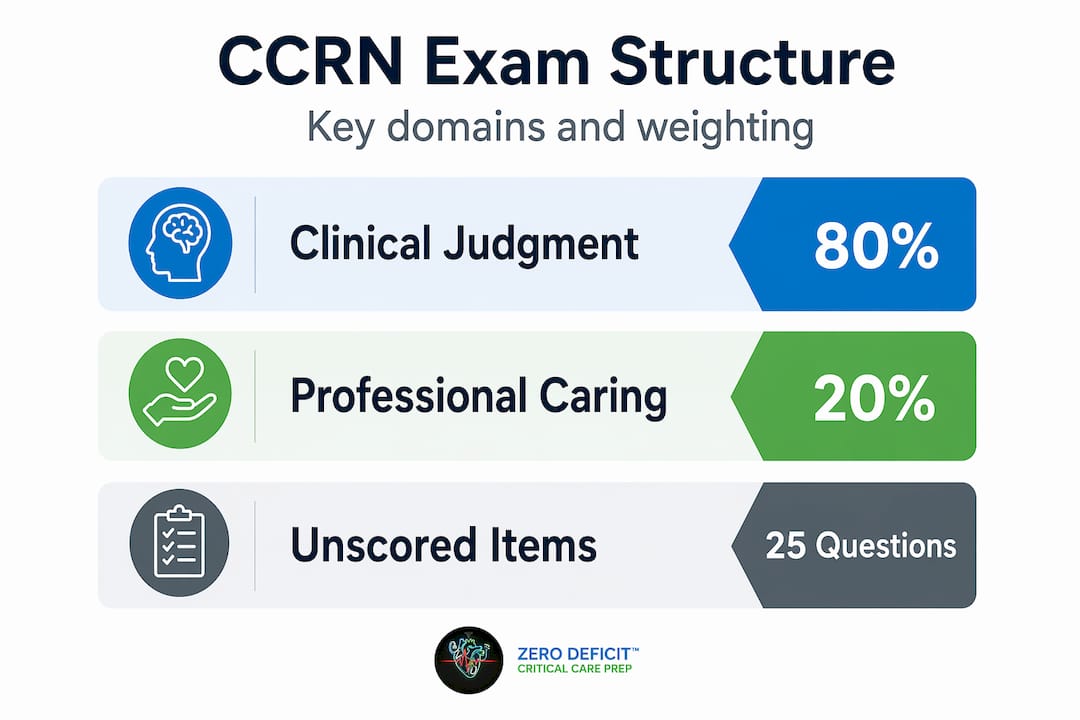
Here’s how the exam content breaks down:
| Domain | Percentage of scored exam |
|---|---|
| Clinical Judgment | 80% |
| Professional Caring and Ethical Practice | 20% |
The Clinical Judgment domain covers major body systems including cardiovascular, pulmonary, neurology, renal, endocrine, gastrointestinal, musculoskeletal, and multisystem topics. These are tested through scenario-based questions that require real decision-making, not just fact recall.
Key eligibility pathways for the CCRN (Adult):
- 2-year pathway: 1,750 hours of direct care of acutely or critically ill patients in the past 2 years, with 875 of those hours in the most recent year before application
- 5-year pathway: 2,000 hours of direct care over the past 5 years, with 144 hours in the most recent year
The AACN outlines these eligibility hour thresholds clearly, so verify yours before submitting your application. Applying before you’re eligible creates unnecessary delays.
Critical update: AACN launched updated CCRN exams effective November 12, 2025, following a 2024 practice analysis. Any exam taken on or after that date uses revised test plans and updated content distribution. If you’re testing in 2026, these changes affect you directly.
For a fuller breakdown of the exam’s scope and structure, the CCRN exam overview gives you a practical starting point before you set up your study schedule.
Set up your study plan: What works (and what to avoid)
Now that you know the requirements, it’s time to plan your study approach for maximum effectiveness. The difference between candidates who pass and those who don’t often comes down to structure, not effort.
The most effective approach is evidence-backed and active: start with a baseline diagnostic test, identify your weakest content areas, then build repeating practice blocks around those gaps. Passive reading and highlighting content textbooks is one of the least efficient ways to prepare for this exam.
Here’s what works versus what doesn’t:
| Study method | Effectiveness | Why |
|---|---|---|
| Timed mixed-question practice sessions | High | Simulates real test pacing and context-switching |
| Error log with targeted remediation | High | Forces you to confront and fix repeated weaknesses |
| Passive content reading only | Low | Doesn’t build clinical reasoning or test stamina |
| Reviewing only one topic at a time | Low | Creates false confidence, weak application under pressure |
| Structured 12-week plan with alternating domains | High | Builds consistent knowledge across all tested areas |
A strong weekly routine looks like this:
- Take a 20-question timed quiz in a mixed format covering multiple body systems.
- Review every incorrect answer in detail, including the rationale for why the right answer is correct and why the others are wrong.
- Log your errors by type: Was it a knowledge gap? A misread question? A prioritization mistake?
- Identify your bottom two topics and dedicate one focused study block to each before the next quiz cycle.
- Repeat the cycle every week, rotating through all major Clinical Judgment content areas.
- Include at least 5 Professional Caring and Ethical Practice questions in every weekly session.
Pro Tip: Don’t wait until week 8 or 10 to identify weak spots. Your first diagnostic baseline tells you exactly where to focus from day one. Candidates who skip this step often spend too much time reviewing content they already know.
The AACN’s own certification review course emphasizes structured practice and domain-specific targeting over broad content marathons, which lines up with what high-performing candidates report. Read about additional study success strategies that reinforce this approach.
Master Clinical Judgment: The 80% test focus
With your plan set, focus first on the highest-value topic, the 80% of the test that can make or break your CCRN pass. This is where most of your exam points come from, and it’s where your preparation needs to go deepest.
The CCRN Exam Handbook is direct: exam questions in this domain are built from the test plan’s job analysis, meaning they reflect what experienced critical care nurses actually do. You can’t memorize your way through these questions. You have to think through them.
How to build Clinical Judgment mastery:
- Practice scenario-based questions that require you to interpret rhythm strips, lab values, hemodynamic data, and clinical presentations, then decide on the best nursing action
- Prioritize body systems with the heaviest exam weighting such as cardiovascular and pulmonary, which represent the largest share of Clinical Judgment content
- Work through rationales for incorrect answers, not just correct ones. Understanding why a distractor is wrong builds sharper decision-making than confirming right answers alone
- Practice under timed conditions from week one. Your reasoning speed under pressure is a skill that must be trained, not assumed
- Use visual tools for complex topics. For example, the interactive shock flowchart helps you internalize hemodynamic relationships more effectively than static notes
“The CCRN is testing your ability to think like an expert critical care nurse, not your ability to recite a textbook.” The AACN’s review course is organized around a body-systems approach aligned with the current test plan, which directly models how you should structure your own review.
Pro Tip: When you get a Clinical Judgment question wrong, don’t just re-read the rationale and move on. Ask yourself: Was I missing clinical knowledge, or did I misread what the question was actually asking? These are two completely different problems that need two different fixes. Learn more about breaking down question patterns with the exam question breakdown methods resource.
Don’t underestimate Professional Caring and Ethical Practice
It’s easy to focus only on the clinical topics, but don’t overlook the professional caring and ethical segment. This part of the exam is consistently underestimated, and that underestimation costs real points.
Professional Caring and Ethical Practice represents 20% of your total score. That’s the equivalent of 25 scored questions. Missing most of them, because you barely studied this domain, is an avoidable mistake. Even nurses with years of ICU experience can fall short if their preparation ignores this content.
What this domain covers:
- Advocacy and moral agency
- Caring practices and compassionate care
- Collaboration and teamwork with the healthcare team
- Systems thinking and resource stewardship
- Clinical inquiry and evidence-based practice
- Facilitation of learning for patients, families, and staff
- Response to diversity
- Communication and conflict resolution
One study guide source specifically flags this section as frequently underestimated and recommends weekly inclusion of professional-practice questions. The Synergy Model, which is AACN’s framework underlying this domain, describes how nurse competencies align with patient characteristics to produce optimal outcomes. Understanding the Synergy Model conceptually helps you answer ethics and professional practice questions more accurately.
How to integrate this domain into your weekly prep:
- Include a minimum of 5 professional-practice questions in every study session, not just during the final review weeks
- Study the Synergy Model’s core nurse competencies and patient characteristics until you can apply them to scenarios, not just define them
- When you miss a professional-practice question, analyze whether you misunderstood the ethical principle or the situational priority
Pro Tip: Treat the Professional Caring domain exactly the way you treat cardiovascular content. Schedule it, practice it, and track your error rate in it. Explore dedicated practice questions for ethics and professional caring to build this specific skill.
Choose the best study resources and know what’s outdated
Once you know what and how to study, true effectiveness comes from using current, trusted materials. After the November 2025 update, the risk of studying with outdated resources is real and concrete.

The CCRN Exam Handbook remains the single most important document for your prep. It defines exactly what is testable, includes sample questions, and provides the weighting breakdown. Read it cover to cover before you finalize your study plan.
How to evaluate any resource before using it:
- Does it mention alignment with the test plan effective November 12, 2025, or later?
- Does it include scenario-based questions, not just content summaries?
- Does it provide detailed rationales for both correct and incorrect answer choices?
- Does it cover Professional Caring and Ethical Practice as a separate, substantial section?
- Is the publisher a recognized authority in critical care nursing education?
The November 2025 exam revision introduced updated content distribution and emphasis areas. Any review book, flashcard deck, or question bank published or last updated before mid-2025 may not reflect these changes accurately. This is especially important for candidates sitting for the exam in 2026.
| Resource type | What to look for | Red flag |
|---|---|---|
| Practice question banks | Scenario-based, updated test plan alignment | Isolated fact questions only |
| Review courses | Body-systems format plus professional practice | No ethics/Synergy Model content |
| Study guides | Detailed rationales, post-2025 revision | No publication or update date listed |
| AACN Exam Handbook | Primary authority, free download | Outdated version (pre-2025) |
Access updated CCRN study guides that reflect the current test plan, and check the CCRN prep tips blog for ongoing updates as new resources and strategies become available.
Why most CCRN study approaches fail—and what actually works
Putting all the steps together, here’s why some approaches repeatedly miss the mark, and what we’ve seen work firsthand for exam success.
The most common failure pattern is spending the majority of study time reading content and very little time practicing application. Reading gives you recognition memory. The CCRN tests retrieval and reasoning. Those are fundamentally different cognitive skills, and you can’t build one by practicing the other.
Here’s the uncomfortable truth: you could spend 200 hours reviewing content and still struggle on test day if you haven’t trained yourself to make rapid, accurate clinical decisions under timed pressure. The exam is not asking “do you know what septic shock is?” It’s asking “given this patient’s presentation at 0300, what is the most appropriate nursing action right now?”
The evidence-backed approach that actually builds exam-ready reasoning is explicit error tracking by type. When you get a question wrong, you need to know whether the problem was a knowledge gap, a misinterpretation of clinical data, or a prioritization error. Each of those requires a different fix. Generic review addresses none of them specifically.
Error logs don’t have to be complex. A simple spreadsheet with question number, topic, and error type is enough. What matters is that you return to the same error patterns with fresh mixed-question sets under timed conditions, simulating the context-switching of test day. This directly builds the cognitive flexibility the CCRN demands.
On the Professional Caring side, we’ve seen candidates who are exceptional bedside nurses still stumble because they assumed ethics questions were intuitive. They’re not. The Synergy Model creates a specific framework, and AACN writes questions within that framework. Without studying it deliberately, experienced nurses sometimes choose answers based on general clinical instinct rather than the tested professional framework. Explore the full range of exam breakdown methods to address this systematically.
The nurses who pass on their first attempt are not necessarily the ones who studied the most hours. They’re the ones who studied the right way, tracked what wasn’t working, and corrected course before test day.
Get expert CCRN support for your first-time pass
You’ve covered the strategy. Now it’s time to put it into action with tools built specifically for the CCRN.
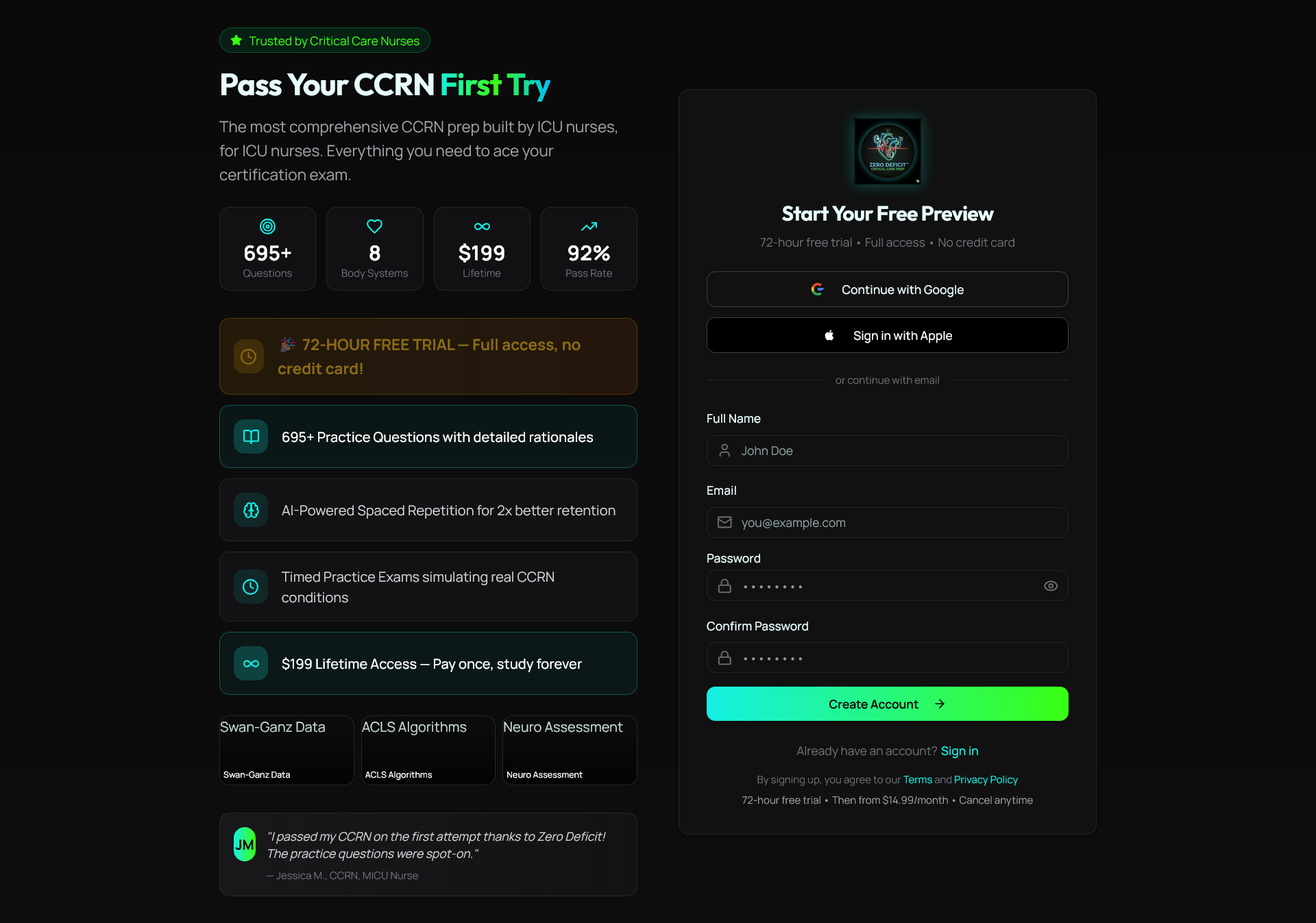
Zero Deficit™ CCRN Exam Prep offers everything you need to execute this plan, including 2026 CCRN study guides organized by body system and aligned with the updated test plan, step-by-step exam breakdowns that teach you how to reason through scenario-based questions, and a bank of over 695 CCRN practice questions with detailed rationales for every answer choice. The platform also includes AI-powered review tools, progress tracking, and study analytics so you’re never guessing about where to focus next. Best of all, you can start with a free version with no credit card required.
Frequently asked questions
What score do I need to pass the CCRN exam?
There is no single fixed passing score, but you must meet a criterion-referenced standard based on the 125 scored items. The passing threshold is set through a psychometric process, not a simple percentage.
How soon after Nov. 12, 2025 will the new CCRN test plan be used?
All exams taken on or after November 12, 2025 use the updated test plan and question distribution, so if you’re testing in 2026, the new content applies to you.
How do I verify if my study resources are up-to-date?
Look for explicit statements that prep materials align with the CCRN test plan effective after November 2025. If a resource doesn’t mention this update, treat it with caution.
Is the Professional Caring and Ethical Practice section really scored?
Yes, it counts for 20% of your exam score and is assessed with the same rigor as Clinical Judgment questions. Skipping it in your prep is a measurable risk.
How many direct care hours do I need to be CCRN-eligible?
You need at least 1,750 hours in the past 2 years or 2,000 hours over 5 years, as defined by the CCRN eligibility requirements, with specific minimums required in the most recent year before application.
Recommended
Take a Neurological practice quiz
Test your knowledge of stroke, ICP, seizures, and neuro assessment.
Ready to pass your CCRN?
Join 12,000+ nurses using Zero Deficit — 695+ practice questions with rationales, AI-powered weak-area drilling, and spaced-repetition flashcards.
Start Free Trial →