The Role of Pathophysiology in Nursing Practice
TL;DR:
- Pathophysiology is essential in nursing for understanding disease mechanisms behind patient signs and symptoms. It guides accurate assessment, prioritization, targeted interventions, and patient communication. Mastery of its components improves clinical decision-making and success on the CCRN exam.
What is the role of pathophysiology in nursing?
Pathophysiology is the foundational science behind every nursing assessment you perform, every intervention you prioritize, and every clinical decision you make at the bedside. It is the study of how disease disrupts normal body function, connecting the “why” behind a patient’s signs and symptoms to the care they actually need. Without it, you are reacting to data points. With it, you are reading a story the patient’s body is telling you.
Nursing professional standards, including those set by the American Association of Colleges of Nursing (AACN), require nurses to integrate pathophysiological principles into patient assessment and care planning. This is not an academic formality. When you understand that a patient’s rising lactate reflects impaired cellular oxygen utilization rather than just a lab abnormality, you act faster and more precisely.
The role of pathophysiology in nursing comes down to four core competencies:
- Accurate assessment: Connecting physical findings to underlying disease mechanisms
- Clinical prioritization: Recognizing which changes signal deterioration versus expected progression
- Targeted intervention: Selecting nursing actions that address the actual disease process
- Patient communication: Explaining what is happening in terms patients can understand and act on
How the four components of pathophysiology direct nursing care
Pathophysiology’s four interrelated components are etiology, pathogenesis, clinical manifestations, and treatment implications. Together, they form the clinical reasoning framework you use every shift.
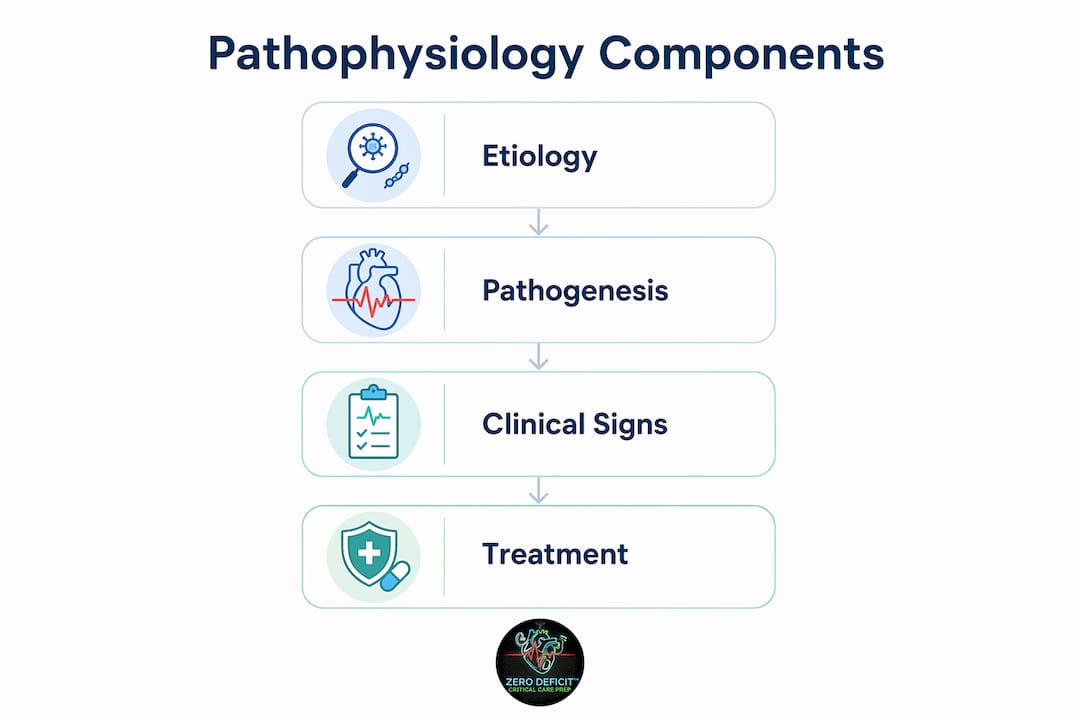
Etiology identifies the cause of a disease or injury. Knowing that a patient’s acute kidney injury stems from sepsis-induced hypoperfusion rather than nephrotoxic medication changes your entire approach to fluid management and medication dosing. Etiology also includes genetic predispositions, environmental exposures, and lifestyle factors that shape a patient’s risk profile.
Pathogenesis describes how a disease develops and progresses at the cellular and systemic level. For a patient with heart failure, pathogenesis explains why the renin-angiotensin-aldosterone system activates, why fluid accumulates in the lungs, and why the heart remodels over time. Understanding this sequence tells you what to watch for before the patient decompensates.
Clinical manifestations are the signs and symptoms that pathogenesis produces. They are your assessment data, but pathophysiology gives them meaning. Crackles in a heart failure patient are not just a lung finding; they represent fluid transudation driven by elevated left ventricular end-diastolic pressure. That connection is what separates a thorough assessment from a checklist.
Treatment implications close the loop. Once you understand etiology and pathogenesis, interventions make sense rather than feeling like protocol compliance. Diuretics for heart failure, vasopressors for distributive shock, lung-protective ventilation for ARDS: each targets a specific point in the disease mechanism.
Applying pathophysiology to nursing assessment and clinical decision-making
ICU nurses use pathophysiology to anticipate patient trajectories, prioritize diagnostic testing, and evaluate whether a therapy is working. That is a fundamentally different skill than symptom management alone.

Consider a practical scenario. Your patient is post-operative day two following abdominal surgery. Their heart rate climbs to 118, urine output drops to 20 mL/hour, and they become mildly confused. A nurse without pathophysiology grounding might document the vitals and wait. A nurse who understands the systemic inflammatory response to surgical stress, the compensatory mechanisms of early hypovolemic shock, and the renal response to decreased perfusion pressure will recognize this as a patient trending toward decompensation and act before the blood pressure drops.
Nurses with pathophysiology knowledge can identify disease phases and tailor interventions accordingly, which directly improves outcomes. Lyme disease, for example, is treated differently in stage one (localized infection) versus stage three (disseminated, neurological involvement). The same principle applies to sepsis: early goal-directed resuscitation targets the hypoperfusion phase, while later management addresses organ dysfunction.
Clinical decision-making also depends on critical thinking in nursing, and pathophysiology is what gives critical thinking its clinical teeth. You cannot reason through a differential without knowing what each disease process does to the body.
- Collect objective and subjective data through systematic assessment
- Map findings to known pathophysiological mechanisms
- Identify the most likely disease process and its current stage
- Anticipate the next likely complication based on disease progression
- Select interventions that target the underlying mechanism
- Reassess to determine whether the intervention shifted the trajectory
Pro Tip: Integrating pathophysiology with pharmacology sharpens medication safety. When you understand how organ dysfunction alters pharmacokinetics, you catch dosing errors before they reach the patient. A patient in acute liver failure metabolizes opioids differently than a healthy adult. That knowledge is not optional in the ICU.
Common diseases that illustrate pathophysiology concepts in nursing care
Sepsis, heart failure, and ARDS are among the most common conditions where pathophysiology directly guides nursing monitoring and care planning. The table below maps each disease to its core pathophysiological components and the nursing focus that follows.
| Disease | Etiology | Pathogenesis | Key Manifestations | Nursing Care Focus |
|---|---|---|---|---|
| Sepsis | Bacterial, viral, or fungal infection | Dysregulated immune response, vasodilation, microvascular injury | Fever or hypothermia, tachycardia, hypotension, elevated lactate | Fluid resuscitation, vasopressor titration, lactate clearance monitoring |
| Heart failure | Ischemia, hypertension, cardiomyopathy | Reduced cardiac output, neurohormonal activation, fluid retention | Dyspnea, crackles, peripheral edema, elevated BNP | Daily weights, fluid restriction, diuretic response, hemodynamic monitoring |
| ARDS | Sepsis, aspiration, trauma | Diffuse alveolar damage, increased permeability, refractory hypoxemia | PaO2/FiO2 ratio below —, bilateral infiltrates, low compliance | Lung-protective ventilation (tidal volume 6 mL/kg IBW), prone positioning, PEEP optimization |
| Type 2 Diabetes | Insulin resistance, beta-cell dysfunction | Chronic hyperglycemia, endothelial damage, neuropathy | Polyuria, polydipsia, elevated HbA1c, poor wound healing | Glucose monitoring, insulin management, foot assessment, patient education |
Understanding disease progression lets you anticipate complications rather than just respond to them. In ARDS, knowing that diffuse alveolar damage peaks in the first 72 hours tells you when to expect the worst compliance and the highest oxygen requirements. In sepsis, recognizing that lactate above 4 mmol/L signals severe cellular dysfunction tells you that fluid alone will not be enough.
Nurses who understand the role of nurses in the ICU recognize that pathophysiology is not background knowledge. It is the active lens through which every assessment, every lab value, and every clinical change gets interpreted.
Why pathophysiology mastery is non-negotiable for CCRN success
The AACN Adult CCRN exam tests your ability to apply pathophysiology under pressure, not just recall definitions. Every question about hemodynamic instability, ventilator management, or sepsis management assumes you understand the underlying disease mechanism. If you are guessing at rationales, you are guessing at answers.
Pathophysiology bridges bench science and bedside care, and that bridge is exactly what the CCRN exam tests. Questions on the exam are built around clinical scenarios where you must recognize a disease process, anticipate its trajectory, and select the most appropriate nursing response. That requires pathophysiology, not just protocol memorization.
Simulation-based training helps nurses apply pathophysiology under stress, improving prioritization and clinical performance in high-stakes scenarios. The same cognitive integration that simulation builds is what the CCRN exam demands.
Here is what deep pathophysiology mastery gives you for the exam and the bedside:
- Cardiovascular: You understand why cardiogenic shock produces a high PCWP and low cardiac output, so you know why dobutamine is the right choice before the question even finishes.
- Pulmonary: You know why ARDS causes refractory hypoxemia despite high FiO2, so lung-protective ventilation and prone positioning make mechanistic sense.
- Renal: You understand why acute tubular necrosis follows prolonged hypoperfusion, so you anticipate oliguria and electrolyte shifts before they become emergencies.
- Neuro: You know why increased intracranial pressure reduces cerebral perfusion pressure, so you understand why head positioning and osmotic therapy matter.
- Pharmacology: You understand how organ dysfunction alters drug metabolism, so you catch dangerous dosing assumptions before they reach the patient.
Pro Tip: Study pathophysiology by body system, then layer pharmacology on top. When you understand why a drug works based on the disease mechanism it targets, rationales become logical rather than memorized. Zerodeficitccrnprep’s pharmacology for critical care guide walks through this integration system by system.
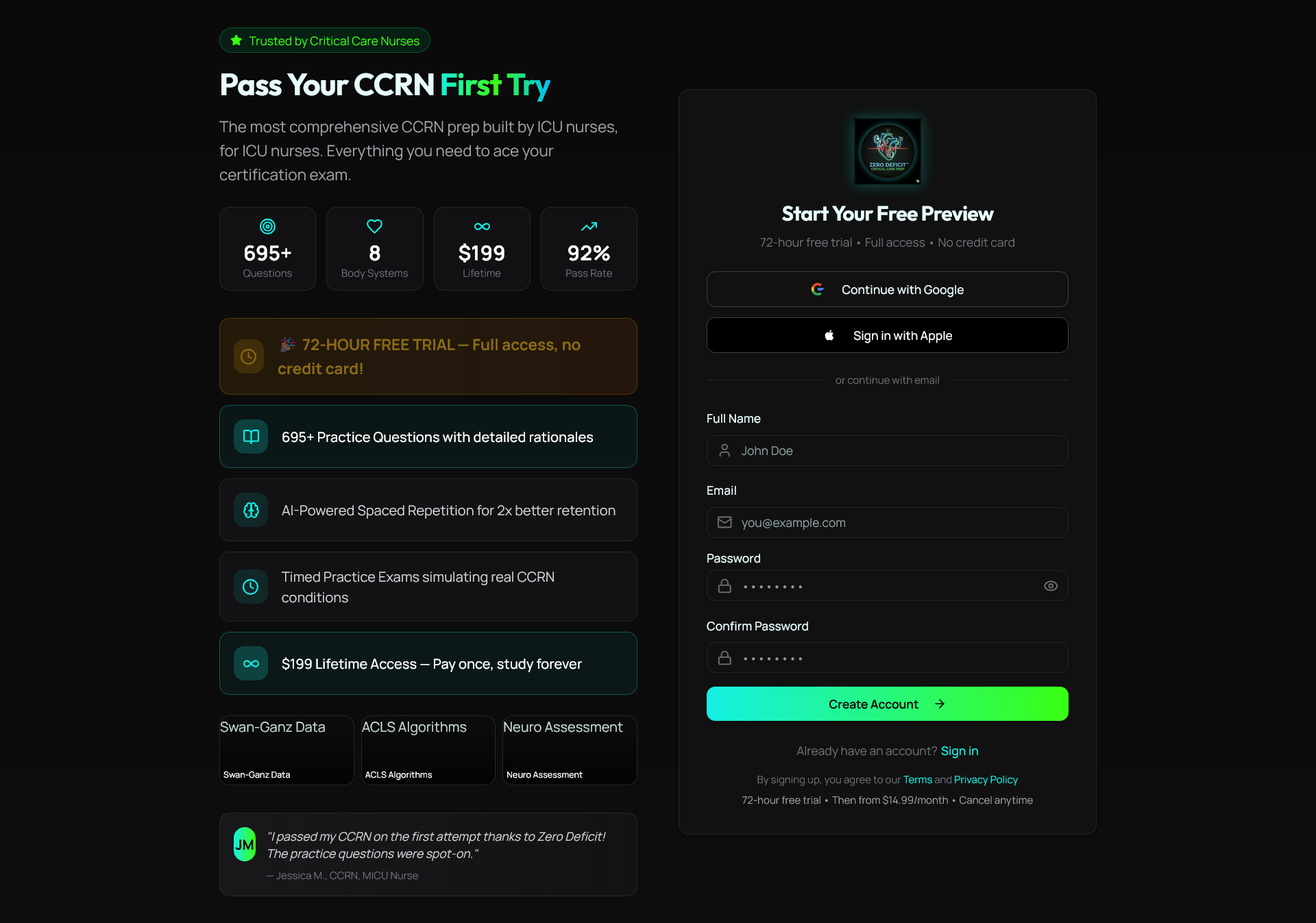
Zerodeficitccrnprep is built by expert ICU nurses who understand exactly how pathophysiology shows up on the CCRN exam. The CCRN study guides cover all eight body systems with pathophysiology integrated into every topic, and the 695+ practice questions include detailed rationales that explain the “why” behind every correct answer. That is how you build the kind of understanding that holds up under exam pressure. Custom practice questions also reinforce pathophysiology-based reasoning by forcing you to apply concepts rather than recall them.
Key Takeaways
Pathophysiology is the core science that connects disease mechanisms to every nursing assessment, intervention, and clinical decision you make, from the bedside to the CCRN exam.
| Point | Details |
|---|---|
| Four-component framework | Etiology, pathogenesis, clinical manifestations, and treatment implications guide every nursing care decision. |
| Assessment accuracy | Pathophysiology knowledge lets you map patient findings to disease mechanisms, not just document symptoms. |
| Disease-stage recognition | Identifying which phase a disease is in, such as early versus late sepsis, determines the correct intervention. |
| Pharmacology integration | Understanding organ dysfunction changes how drugs are metabolized, making pathophysiology essential for medication safety. |
| CCRN exam relevance | The AACN CCRN exam tests scenario-based pathophysiology application, not definition recall. |
FAQ
What is the role of pathophysiology in nursing care?
Pathophysiology gives nurses the framework to connect a patient’s signs and symptoms to the underlying disease process, enabling accurate assessment, appropriate intervention selection, and anticipation of complications before they escalate.
What are the four parts of pathophysiology?
The four interrelated components are etiology (cause of disease), pathogenesis (how the disease develops), clinical manifestations (signs and symptoms), and treatment implications (how interventions target the disease mechanism).
What is pathophysiology in nursing?
Pathophysiology in nursing is the applied study of how disease or injury disrupts normal body function, forming the scientific basis for clinical assessment, care planning, and patient education across all nursing specialties.
Why does pathophysiology matter for the CCRN exam?
The AACN Adult CCRN exam presents clinical scenarios that require you to recognize disease mechanisms and select appropriate nursing responses. Pathophysiology mastery is what allows you to reason through those scenarios rather than guess at answers.
Recommended
Take a Cardiovascular practice quiz
Test your mastery of hemodynamics, ACLS, MI, arrhythmias, and heart failure.
Get Your Free 20-Question CCRN Diagnostic
20 high-yield CCRN-style questions across every body system, with detailed rationales — emailed to you instantly.
No spam. One email + a couple of helpful follow-ups. Unsubscribe anytime.
Ready to pass your CCRN?
Join 12,000+ nurses using Zero Deficit — 695+ practice questions with rationales, AI-powered weak-area drilling, and spaced-repetition flashcards.
Start Free Trial →