Step by Step Exam Readiness Workflow for CCRN Prep
TL;DR:
- A structured, phase-based study system transforms scattered efforts into measurable daily progress for CCRN certification.
- Most nurses rely on passive review, which creates a false sense of preparedness without building real recall under pressure.
A step by step exam readiness workflow is a structured, phase-based system that converts scattered study efforts into measurable daily progress toward CCRN certification. Without a defined workflow, most nurses default to passive rereading, which creates a false sense of preparedness without building real recall under pressure. The AACN Adult CCRN exam tests clinical judgment across eight body systems, including cardiovascular, pulmonary, and neurological domains, so your preparation must match that complexity. A phased study plan for exams does exactly that. It breaks a daunting certification into weekly targets, daily output blocks, and trackable checkpoints you can actually trust.
What are the essential tools and prerequisites for exam readiness?
Effective preparation starts before you open a single textbook. You need the right materials organized and your baseline performance mapped before week one begins.
Gather these resources first:
- The current AACN CCRN exam blueprint (available at AACN.org)
- A dedicated study notebook or digital note app for error logging
- Your primary review source (study guides, lecture notes, or PDFs organized by body system)
- A calendar with your exam date marked and all work shifts blocked
- A confidence tracker: rate each topic 1–3 so you know where to start
Pro Tip: Set up your study environment before day one. A consistent physical space reduces the mental friction of starting each session and signals to your brain that it is time to focus.
Once your materials are in place, assess your baseline. Take a short diagnostic practice set covering cardiovascular, pulmonary, and sepsis content. Your score tells you which domains need the most time in weeks two and three.

| Tool | Purpose |
|---|---|
| AACN exam blueprint | Confirms content weight by domain |
| Error log notebook | Tracks missed concepts for targeted review |
| Confidence tracker | Prioritizes weak topics early |
| Study calendar | Prevents over-scheduling and burnout |
| Diagnostic practice set | Establishes baseline before week one |
A study plan reduces anxiety by converting vague intentions into daily tasks. That reduction in decision fatigue is not a soft benefit. It directly protects your study consistency over four weeks.
How to execute a phased 30-day study plan for CCRN exam readiness?
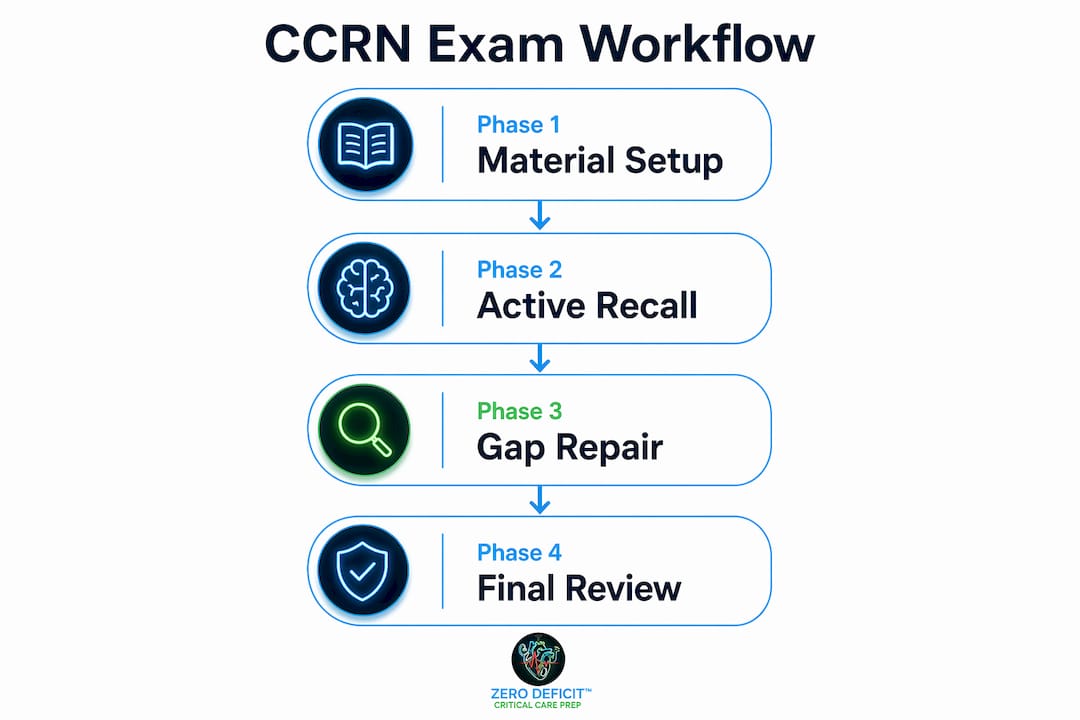
A four-phase 30-day system is the most effective structure for CCRN certification prep. Each phase builds on the last, so skipping ahead costs you retention.
-
Phase 1 (Week 1): Map the exam and gather materials. Pull the AACN blueprint and assign each content domain a study block. Cardiovascular carries the highest exam weight, so it gets the most time. Organize all source materials by system and create a master topic list.
-
Phase 2 (Week 2): Convert materials into active recall prompts. Stop copying notes. Instead, write questions from your notes and answer them from memory. For every concept, such as hemodynamic parameters in cardiogenic shock or ARDS Berlin criteria, generate at least three recall prompts. This is where passive input becomes active output.
-
Phase 3 (Week 3): Intensify recall and repair weak areas. Return to your error log from week two and prioritize those topics in your morning sessions, when mental acuity is highest. Run timed practice question sets of 25–50 questions per session. Track your accuracy by domain, not just your overall score.
-
Phase 4 (Week 4): Simulate exam conditions and refine timing. Complete full-length timed practice exams. Review every wrong answer with a written rationale, not just a mental note. Adjust your final days based on which domains still show gaps.
| Week | Focus | Daily Minimum |
|---|---|---|
| Week 1 | Blueprint mapping and material organization | 60 minutes |
| Week 2 | Active recall prompt creation | 75 minutes |
| Week 3 | Error repair and timed practice sets | 90 minutes |
| Week 4 | Full exam simulation and rationale review | 90 minutes |
Starting spaced repetition early, ideally 4–6 weeks out, lets you widen the intervals between review sessions as the exam approaches. That spacing is what moves content from short-term memory into durable recall. Zerodeficitccrnprep integrates this principle directly into its AI-powered study workflow, so you are not building the system from scratch.
What are best practices for daily study sessions and managing active recall?
The single biggest mistake nurses make during CCRN prep is spending most of their study time on passive input. Effective study requires 60–80% of session time in active output mode. That means answering questions, recalling concepts from memory, and explaining rationales out loud, not rereading highlighted notes.
Structure each session around these principles:
- Start with output, not input. Open with a 10-question practice set or a recall drill before reviewing any new content. This primes retrieval pathways and shows you exactly what you do not know.
- Use 25–50 minute focused blocks. Shorter blocks with clear goals outperform long, unfocused sessions. Two 40-minute output blocks beat one 90-minute passive read every time.
- Log every missed question immediately. Do not wait until the end of the week. Write the concept, the correct answer, and the clinical rationale in your error log while the reasoning is fresh.
- Prioritize high-weight topics in your first block. Cardiovascular, pulmonary, and sepsis content together represent the majority of CCRN exam questions. Tackle them when your focus is sharpest.
- Avoid passive rereading as a primary method. Rereading feels productive but creates false confidence without building the retrieval strength you need under timed exam conditions.
The shutdown protocol is one of the most underused tools in exam prep. Spend 10 minutes at the end of every session updating your error list and writing down exactly what you will do at the start of your next session. This eliminates the start-up friction that leads to procrastination.
Pro Tip: Write your next session’s first task on a sticky note and place it on your study materials before you close up. You will start the next session immediately instead of spending 15 minutes deciding where to begin.
How to prepare effectively in the last week before exam day?
The final seven days require a shift from building knowledge to confirming it. Your workflow for exam success in this phase is about triage, retrieval, and logistics, not learning new content.
-
Days 1–2: Triage high-value topics. Review your error log and confidence tracker. Identify the three to five domains with the most remaining gaps. Use a simple matrix: high exam weight plus low confidence equals your top priority. Cardiovascular hemodynamics, vasopressor management, and sepsis criteria typically top this list for most candidates.
-
Days 3–5: Active retrieval and error management. Run timed practice sets of 25–50 questions per session, focused on your priority domains. After each set, review every wrong answer and update your error log. Do not introduce new source material. You are retrieving and reinforcing, not adding.
-
Days 6–7: Final simulation and logistics verification. Complete one full-length timed practice exam on day six. On day seven, reduce study intensity significantly. Confirm your exam registration ID, test center location, and required identification. Verify all exam logistics at least one week before the exam to avoid disqualification.
Tapering your study intensity in the final 24–48 hours before the exam is not a sign of unpreparedness. It is a deliberate strategy. Cognitive performance on exam day improves when your brain has had adequate rest. The goal on the last day is confidence, not cramming.
The CCRN spaced repetition approach applies directly here. By day six, you should be reviewing concepts you first encountered in week two. That spacing is what makes retrieval automatic under pressure.
What common challenges should nurses avoid in their exam readiness workflow?
Most CCRN candidates do not fail because they studied the wrong content. They fail because their workflow had structural flaws that compounded over four weeks.
Watch for these specific pitfalls:
- Over-scheduling without buffers. Scheduling only 70% of available study time and reserving 30% as a buffer prevents plan collapse when a shift runs long or life intervenes. A plan with no slack fails at the first disruption.
- Defaulting to passive study. Rereading notes and watching review videos feels like studying. It is not retrieval practice. Passive input does not prepare you for the active recall demands of 150 CCRN questions under time pressure.
- Skipping exam simulation. Nurses who never practice under timed conditions consistently underperform on pacing. Run at least two full-length timed exams before test day.
- Ignoring logistics until the last minute. Confirming your test center, ID requirements, and check-in process belongs on your exam preparation checklist no later than day seven before the exam.
- Studying through burnout. Fatigue degrades retention and recall accuracy. Build rest days into your plan, not as rewards, but as required components of the workflow.
Pro Tip: If you miss a planned study session, do not try to double up the next day. Simply resume the plan. Doubling up leads to fatigue and lower-quality output, which costs more than the missed session.
What I have learned about building a workflow that actually holds
Most nurses I talk to approach CCRN prep the same way they approached nursing school: read everything, highlight everything, and hope it sticks. That method does not work for a 150-question exam built around clinical judgment and hemodynamic reasoning.
The shift that changes everything is treating your study plan as a clinical protocol, not a to-do list. A clinical protocol has phases, checkpoints, and decision points based on data. Your error log is your data. Your confidence tracker is your assessment. Your practice scores are your vitals. When you treat preparation that way, you stop guessing and start making evidence-based decisions about where to spend your time.
I have also seen nurses abandon solid plans because one bad practice score shook their confidence. A low score on week two is not a failure. It is diagnostic information. It tells you exactly where to focus in week three. That is the system working, not breaking.
The nurses who pass on their first attempt are rarely the ones who studied the most hours. They are the ones who studied with the most structure, tracked their gaps honestly, and trusted the process through the hard middle weeks.
— Zero
How Zerodeficitccrnprep supports your CCRN exam readiness workflow
Zerodeficitccrnprep was built by expert ICU nurses who understand exactly how the AACN Adult CCRN exam tests clinical reasoning. Every resource on the platform is aligned with the 2026 exam blueprint.
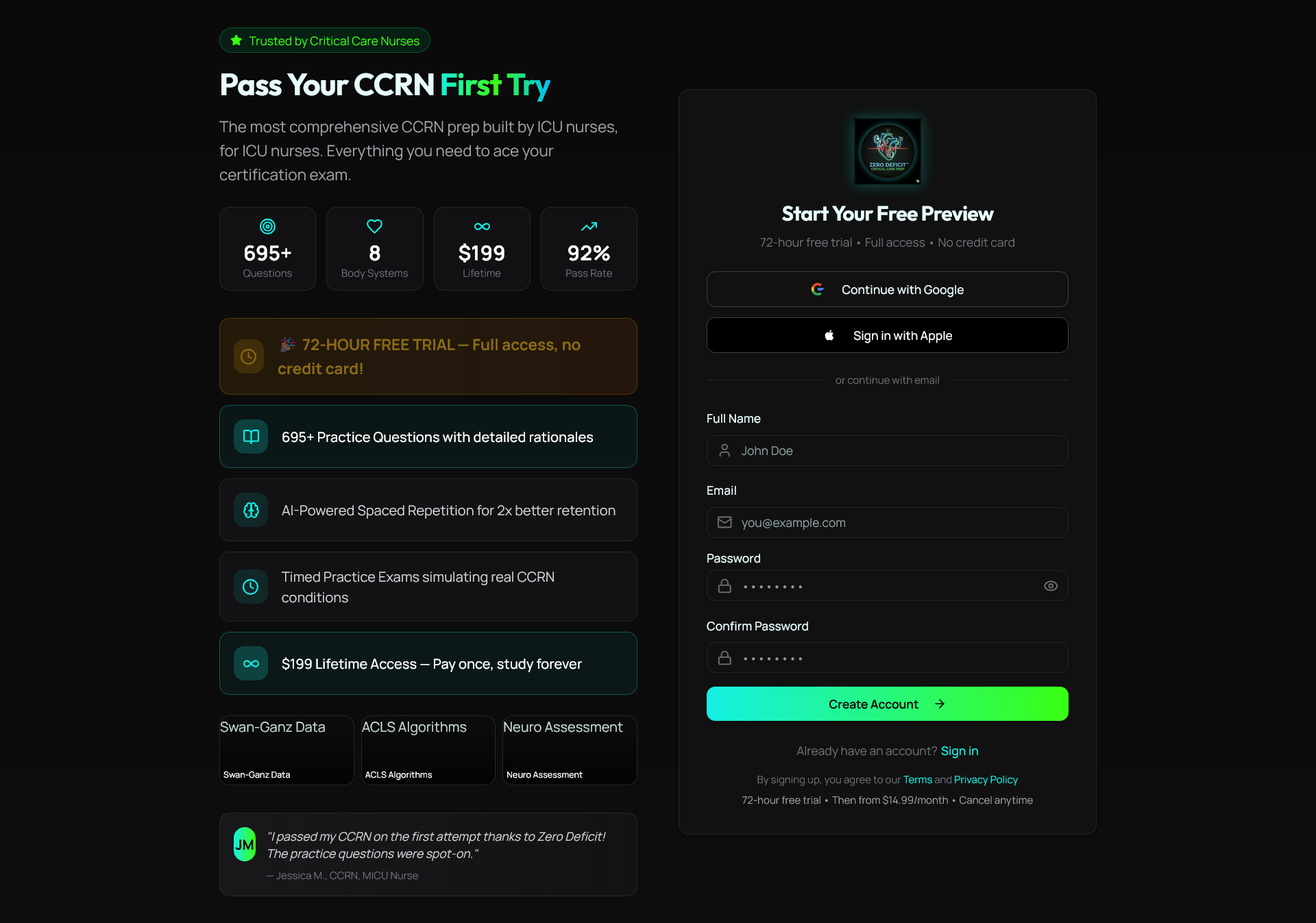
The CCRN study guides cover all eight body systems with the depth the exam demands, from hemodynamic monitoring and vasopressor management to ARDS ventilator strategies and sepsis criteria. The high-yield topic guides on shock, vasopressors, and sepsis give you focused prep for the domains that carry the most exam weight. With over 695 CCRN practice questions built with detailed rationales, you get the active output practice your workflow requires. Use Zerodeficitccrnprep to fill the gaps your error log identifies, week by week.
Key takeaways
A structured, phase-based exam readiness workflow built around active recall, error tracking, and spaced repetition is the most reliable path to passing the CCRN on your first attempt.
| Point | Details |
|---|---|
| Phase your 30-day plan | Divide prep into mapping, recall building, gap repair, and exam simulation weeks. |
| Prioritize active output | Spend 60–80% of each session on practice questions and recall, not rereading. |
| Use the shutdown protocol | Spend 10 minutes after each session updating your error log and planning the next. |
| Apply the 30% buffer rule | Schedule only 70% of available study time to protect the plan from life disruptions. |
| Verify logistics early | Confirm exam ID, test center, and blueprint compliance at least one week before test day. |
FAQ
What is a step by step exam readiness workflow for the CCRN?
A step by step exam readiness workflow is a phased preparation system that moves from exam mapping and material organization through active recall, gap repair, and full exam simulation. It replaces unstructured studying with daily, trackable tasks aligned to the AACN exam blueprint.
How many weeks should I study for the CCRN exam?
A 30-day, four-phase plan is the most effective structure for most candidates. Nurses with significant knowledge gaps in high-weight domains like cardiovascular or pulmonary may benefit from starting spaced repetition 4–6 weeks before the exam.
What is the most common mistake nurses make when preparing for the CCRN?
The most common mistake is spending the majority of study time on passive input such as rereading notes or watching videos. Effective preparation requires 60–80% of study time in active output mode, including practice questions and recall drills.
How do I handle the final week before the CCRN exam?
Triage your highest-priority gaps on days 1–2, run focused retrieval practice on days 3–5, and complete a full simulation on day six. Reduce intensity on day seven and confirm all exam logistics including your registration ID and test center location.
How does Zerodeficitccrnprep fit into a structured study workflow?
Zerodeficitccrnprep provides over 695 practice questions with detailed rationales, study guides for all eight CCRN body systems, and AI-powered review tools that align directly with each phase of a structured exam readiness workflow.
Recommended
- CCRN Spaced Repetition: Study Smarter for Certification | Zero Deficit CCRN Prep
- Nursing Certification Success Workflow for CCRN Prep | Zero Deficit CCRN Prep
- Checklist for Exam Day: CCRN and NCLEX Nurse Guide | Zero Deficit CCRN Prep
- How to track CCRN progress: a critical care nurse’s guide | Zero Deficit CCRN Prep
Take a Multisystem practice quiz
Master sepsis, shock, MODS, and multi-organ failure scenarios.
Get Your Free 20-Question CCRN Diagnostic
20 high-yield CCRN-style questions across every body system, with detailed rationales — emailed to you instantly.
No spam. One email + a couple of helpful follow-ups. Unsubscribe anytime.
Ready to pass your CCRN?
Join 12,000+ nurses using Zero Deficit — 695+ practice questions with rationales, AI-powered weak-area drilling, and spaced-repetition flashcards.
Start Free Trial →