
The Role of Exam Rationales in CCRN Certification Success
Published May 28, 2026 · Zero Deficit Team
Discover the vital role of exam rationales in CCRN certification success. Learn how they enhance your study strategy and boost your scores!
TL;DR:
- Exam rationales reveal examiner logic, exposing clinical reasoning gaps beyond simple answer confirmation.
- Thorough review of both correct and incorrect rationales enhances clinical judgment, reducing exam errors over time.
Most critical care nurses treat exam rationales as a quick read after checking their score. You glance at the explanation, nod if you got it right, and move on. That habit is one of the biggest reasons nurses hit score plateaus despite putting in real study hours. The role of exam rationales goes far beyond confirming correct answers. They reveal exactly how the examiner thinks, expose your clinical reasoning gaps, and teach you how to prioritize when multiple options look right. Used properly, rationales do more for your CCRN prep than almost any other single study tool.
Table of Contents
- Key Takeaways
- The role of exam rationales in clinical certification
- How rationale review improves your score
- Common pitfalls in rationale review and how to fix them
- Integrating rationales into your daily CCRN study routine
- Thinking like the examiner, not just the test-taker
- My honest take on why nurses underuse rationales
- Build your CCRN rationale skills with Zerodeficitccrnprep
- FAQ
Key Takeaways
| Point | Details |
|---|---|
| Rationales as reasoning teachers | Exam rationales reveal examiner logic, not just correct answers, making them more than a simple answer key. |
| Wrong answers deserve equal attention | Reviewing incorrect option rationales exposes cognitive traps and common prioritization errors you must avoid. |
| Active comparison beats passive reading | Comparing your thought process against expert rationales corrects flawed clinical reasoning before exam day. |
| Rationale review improves scores | Nurses who engage deeply with rationales shift from memorization to applied clinical judgment, reducing exam errors. |
| Start rationale review immediately | Reviewing rationales right after each practice block, not at the end of a session, maximizes retention. |
The role of exam rationales in clinical certification
An exam rationale is the structured explanation behind every answer choice on a certification question, correct and incorrect. It tells you not just what the right answer is, but why it is right given the clinical priorities in that scenario, and why every competing option falls short.
On the AACN Adult CCRN, you are not being tested on recall alone. You are being tested on clinical judgment: the ability to prioritize the safest next action when multiple reasonable options exist. Full-length practice exams built around this model contain 186 items, and every rationale in those exams is a window into how clinical evaluators score your reasoning. Skipping or skimming them wastes that window entirely.
Think of rationales as a second teacher, one who does not just mark your paper but explains the thought process you were supposed to use. Educational research shows that this approach, called Example-Based Teaching, directs your mental effort toward schema building rather than rote memorization. That matters enormously in critical care, where questions about hemodynamic instability, ventilator management, or septic shock require you to recognize patterns and act, not recall definitions.
Here is what a strong rationale actually contains:
- The clinical priority that determines the correct answer (patient safety, physiological stability, scope of practice)
- An explanation of why each distractor option is plausible but ultimately incorrect
- The underlying nursing judgment model or clinical principle guiding the decision
- The reasoning boundary, meaning how far the expected logic goes before judgment shifts
Pro Tip: When you read a rationale, write down the clinical priority it names. Over time, you will notice the CCRN returns to the same priorities repeatedly: airway before breathing, stability before comfort, assessment before intervention. Tracking these patterns builds a decision-making framework you can apply to any question.
How rationale review improves your score
There is a specific reason why nurses with strong ICU experience still struggle on the CCRN. Clinical experience builds confidence in real-world decision-making, but the exam tests a standardized version of clinical judgment. The two are related, but not identical.

Certification exams emphasize professional judgment where multiple competing priorities exist, and there is rarely a single textbook answer. Rationale review is the mechanism that teaches you to close that gap. Instead of memorizing that “dobutamine increases contractility,” you learn when dobutamine is the right choice over norepinephrine given a specific hemodynamic profile, and you understand why another vasoactive agent would be wrong in that scenario.
The table below shows the difference in outcomes between passive and active rationale review:
| Study approach | What you learn | Exam outcome |
|---|---|---|
| Skip rationale, check score | Whether you got it right | Score stays flat; same errors recur |
| Read correct-answer rationale only | Why the right answer is right | Modest improvement; distractor traps persist |
| Read all rationales, including wrong answers | Full examiner logic and clinical priorities | Consistent score gains; fewer prioritization errors |
| Active comparison of own reasoning vs. rationale | Where your judgment diverges from standardized models | Strongest improvement; builds durable clinical schemas |
“Even correct answers may stem from flawed logic. Rationales reveal evaluation expectations and distinguish a patterned, testable reasoning process from a lucky guess.” — Clinical judgment exam guidance
The exam rationale significance here is not abstract. Nurses who adopt this approach stop making the same prioritization errors on repeat attempts. They build durable clinical schemas that hold up under timed exam pressure, because the reasoning is internalized rather than memorized.
Common pitfalls in rationale review and how to fix them
The most common mistake is treating rationale review as a passive activity. You answer 30 questions, check your score, read the rationale for the ones you missed, and call it done. That approach leaves most of the learning on the table.
Here is what ineffective rationale use looks like in practice, and how to correct each habit:
-
Skipping rationales for correct answers. This feels efficient, but it is where most study gaps hide. Comparing your reasoning to expert rationales exposes whether you got the right answer for the right reason. A nurse who correctly identifies that a patient with a wedge pressure of 18 mmHg and a CI of 1.8 L/min/m² needs dobutamine should also be able to articulate why, not just recognize the answer.
-
Ignoring the wrong-answer rationales. Distractors on the CCRN are carefully constructed to reflect common clinical errors and cognitive biases. The wrong options are not random. They mirror the reasoning of a nurse who almost gets it right. Reviewing why those choices are incorrect teaches you exactly which thinking traps the exam is designed to catch.
-
Reading rationales after a full 186-question block when mental fatigue is high. Cognitive load is real. A rationale you read at question 150 of a timed practice exam registers far less than one you review after a focused 30-question block.
-
Not writing anything down. Passive reading without active processing does not stick. Write a one-sentence summary of what the rationale taught you. That act alone increases retention significantly.
-
Treating every rationale equally. Some rationales cover content you already own. Others reveal a reasoning gap you keep repeating. Prioritize the ones that challenged you most, not the ones that felt familiar.
Pro Tip: After every practice block, before reviewing rationales, write one sentence explaining why you chose your answer for each question you were uncertain about. Then compare that sentence to the rationale. The gap between the two is exactly where your study focus needs to go.
Integrating rationales into your daily CCRN study routine
Knowing the importance of exam rationales is one thing. Building a study routine that actually uses them is another. The structure of your sessions matters as much as the content.
Start each study block with a focused set of 20 to 30 practice questions rather than a full-length exam. After completing the block, immediately review every rationale before moving on to new content. This timing is deliberate. Your working memory still holds the reasoning you used, so comparing it against the expert rationale while the thought is fresh produces stronger correction of faulty logic.
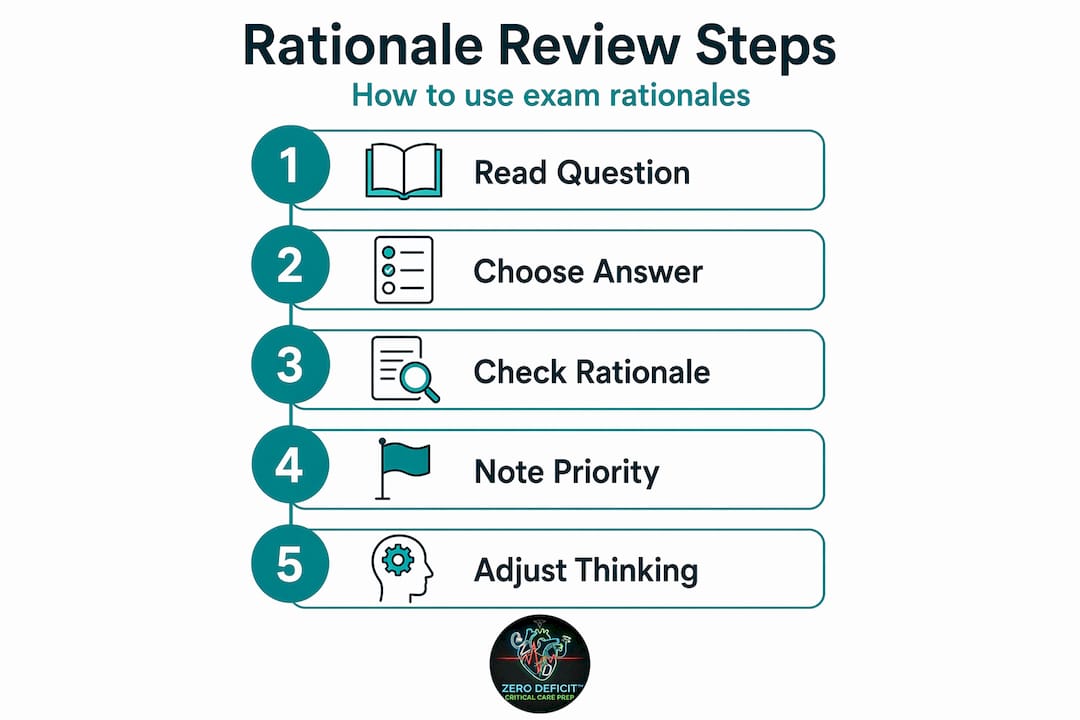
Here is how to structure rationale review for maximum impact:
- Flag uncertain questions while testing. Do not wait until review to identify where your reasoning felt shaky. A simple flag or asterisk during the block tells you where to focus your deepest rationale analysis.
- Build a running “priority pattern” log. Each time a rationale names a specific clinical priority (airway, hemodynamic stability, safety before comfort), add it to a running list. Patterns that appear repeatedly in your log are the exam’s highest-value decision points.
- Use rationales to build decision flowcharts. After reviewing a rationale for a hemodynamics question, sketch the decision pathway: low CI triggers assessment, then intervention selection based on filling pressures, then vasopressor or inotrope choice. This transfers the rationale’s logic into a reusable mental model.
- Revisit rationales from two weeks prior. Spaced review of past rationales consolidates the reasoning into long-term memory, which is where it needs to be on exam day.
Nurses who use this structure report that detailed rationale and feedback review produces measurably better learning outcomes than standard practice question approaches. The method works because you are not just accumulating questions. You are building a clinical judgment system.
Thinking like the examiner, not just the test-taker
There is a mindset shift that separates nurses who pass the CCRN on the first attempt from those who retake it. It is the shift from thinking like a test-taker to thinking like the person who wrote the test.
Students who adopt an examiner perspective improve clarity and alignment with exam scoring logic in a way that pure content review cannot produce. When you review a rationale through an examiner’s lens, you stop asking “What is the answer?” and start asking “What reasoning pattern is this question designed to test?”
“Exam questions test prioritization and judgment, not just recall. Rationales show how to choose the safest next action when competing priorities exist, and they expose the cognitive traps built into every distractor.” — Clinical certification exam guidance
This matters in the ICU as much as it matters on the exam. The CCRN is built around the AACN Synergy Model, which frames nursing judgment around matching nurse competencies to patient needs. When you study rationales through this frame, you are not just prepping for a test. You are training yourself to articulate clinical priorities with precision, communicate reasoning clearly during handoff and escalation, and defend your clinical decisions under pressure.
Rationale study that tightly links clinical evidence to decision priority without surface-level explanations is what builds this skill. Weak rationales that simply restate the correct answer without explaining the priority hierarchy mislead more than they teach. Strong rationales connect the clinical finding to the reasoning step to the action. That is the standard you should hold your study materials to.
For a deeper look at this approach, the CCRN rationale review guide at Zerodeficitccrnprep walks through how to apply this thinking systematically across body systems.
My honest take on why nurses underuse rationales
I have worked with enough ICU nurses preparing for the CCRN to see the same pattern repeatedly. Smart, experienced nurses who know their way around a ventilator or a Swan-Ganz catheter hit a wall on practice exams and blame their content knowledge. Nine times out of ten, content is not the real problem.
In my experience, the issue is reasoning alignment. The nurse knows the physiology. What they have not done is learn how the examiner expects that physiology to translate into a nursing decision under the specific constraints of a test question. Rationales are the tool that closes that gap, and most nurses never use them deeply enough to get the full benefit.
I have seen nurses jump from a 68% practice score to passing after spending two weeks doing nothing differently except reading every rationale, including the wrong-answer explanations, and comparing their reasoning out loud against the expert explanation. That is not a content overhaul. That is a reasoning recalibration.
The nurses who struggle most with rationale review are often the most clinically experienced. They trust their instincts, which have served them well at the bedside. The exam is not testing instinct. It is testing whether you can articulate the right priority in the right sequence with no patient in front of you. Rationales teach you exactly that. Start using them that way as early in your prep as possible.
— Zero
Build your CCRN rationale skills with Zerodeficitccrnprep
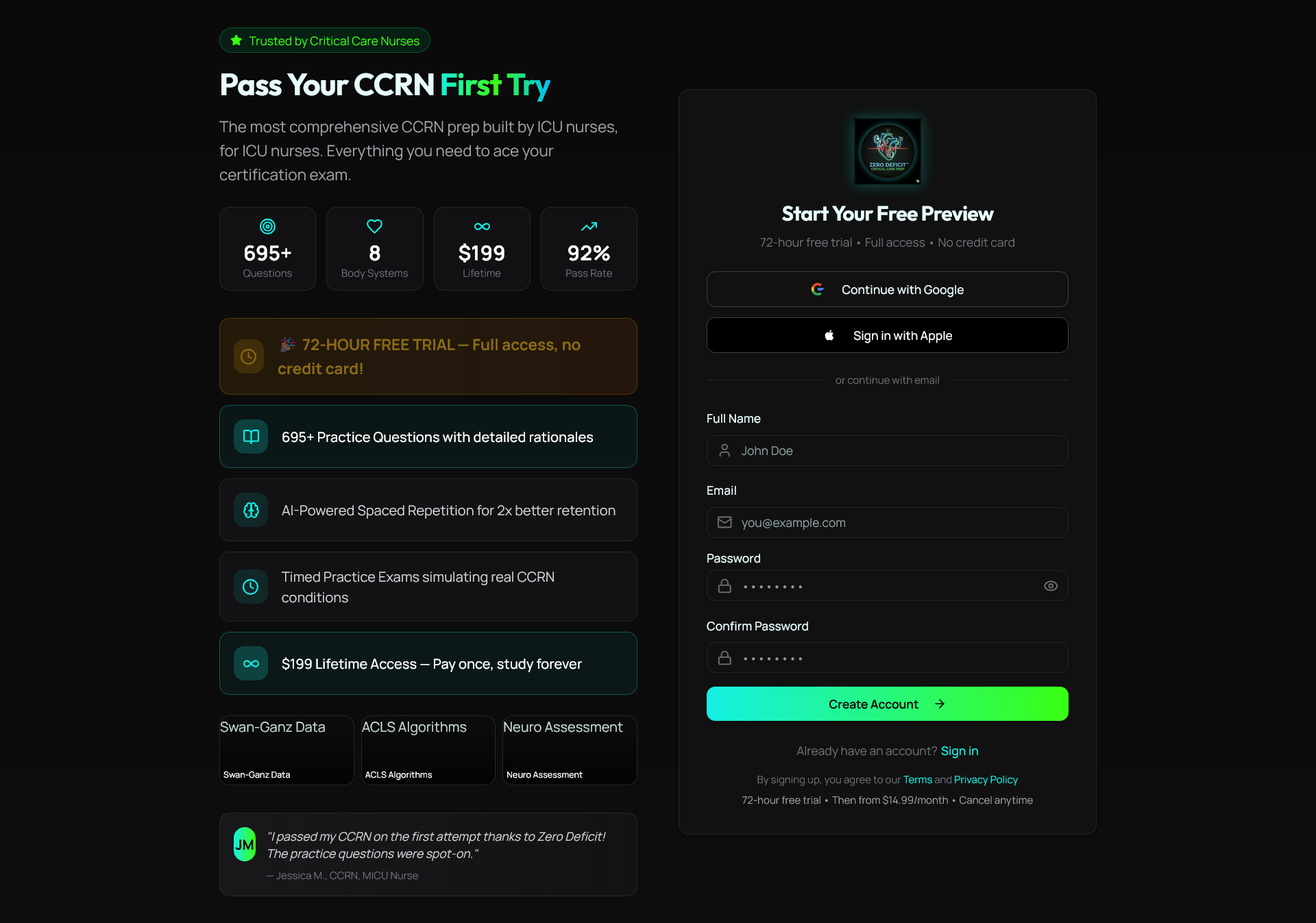
Zerodeficitccrnprep is built specifically for this kind of preparation. The platform offers 695+ CCRN practice questions with detailed, expert-written rationales that explain not just correct answers but the clinical priority logic behind every option. Study guides are organized by body system and framed around clinical judgment, so your rationale review connects directly to AACN exam blueprint content.
The question breakdown methods at Zerodeficitccrnprep teach you how to dissect any exam question using the same reasoning process the examiners use. Progress tracking and study analytics show you which reasoning gaps are recurring so you can target them before test day. No credit card required to start. Try it and see the difference that rationale-focused prep makes.
FAQ
What is the role of exam rationales in CCRN prep?
Exam rationales explain the clinical reasoning behind every answer choice, including incorrect ones, helping you align your judgment with examiner expectations rather than relying on memorization alone.
Why should you review rationales for wrong answers?
Incorrect options on the CCRN are built to reflect common clinical errors and cognitive biases. Reviewing their rationales teaches you exactly which reasoning traps the exam is designed to expose, so you stop falling into them.
How do exam rationales improve learning outcomes?
Rationales reduce cognitive load by directing study effort toward schema building rather than rote recall, which produces stronger retention and more accurate clinical decision-making under timed exam conditions.
When is the best time to review rationales during study?
Review rationales immediately after each practice block of 20 to 30 questions while your reasoning is still fresh. Waiting until the end of a long session or a full practice exam reduces the corrective impact significantly.
Can rationale review help experienced ICU nurses who keep failing the CCRN?
Yes. Experienced nurses often struggle with reasoning alignment, not content knowledge. Active rationale review corrects the gap between bedside instinct and the standardized clinical judgment model the CCRN tests.
Recommended
- How to review CCRN rationales: A critical care nurse’s guide | Zero Deficit CCRN Prep
- Top CCRN study topics to master for exam success | Zero Deficit CCRN Prep
- How educators boost CCRN certification success for nurses | Zero Deficit CCRN Prep
- Why assessment matters: Boost CCRN exam success | Zero Deficit CCRN Prep